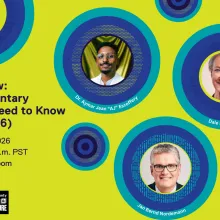
In this panel, we will address standards for using AI in nonfiction filmmaking, how to disclose it to partners and audiences, and what documentary filmmakers need to consider before choosing to use AI in their productions.
Educational Seminars
Our year-round series of seminars, panels and workshops focusing on the art, craft and business of documentary filmmaking. Become an IDA member to access previous seminars online.
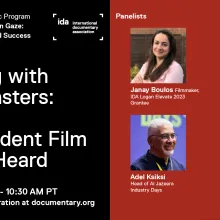
The panel discussion will delve into the differences between television/broadcast content and international festival documentaries and how funding works in these different spaces around the world. What does it mean to have broadcast partners versus festival partners? Does one offer more creative freedom than the other? How can we negotiate the drawbacks and best use the opportunities these different forms offer? The conversation will examine broadcasters' priorities and ways they evaluate content that might drive them to co-produce, buy, or broadcast certain films instead of others.
Immersive media vibrates embodiment. It allows the viewer to dissolve into dimensional narratives, making experiences and bodies pliable. The introduction of VR, AR, and interactive exhibitions into practice has given nonfiction media makers new tools to tell expanded narratives. In turn, these same tools, with their capacity to innovate, strengthen the need for accessible storytelling. The disabled community, in particular, calls for a radical restructuring of pre-existing frameworks, from inclusive asset libraries to cripped (accessible) workflows and haptics.
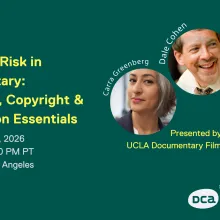
This multi-part program is designed to provide documentary filmmakers with practical legal tools to identify, assess, and reduce risk throughout the life of a project. The sessions will emphasize best practices that help filmmakers protect their work, secure their rights, strengthen their projects
Join Ranell Shubert, IDA Nonfiction Access Initiative (NAI) Funds Program Manager, and Keisha Knight, Director of Funds and Advocacy, to discuss the NAI program and launch of the NAI Nonfiction Media Makers with Disabilities Survey. Ranell and Keisha will present information about the survey, discuss how it was developed, and answer any questions.
Location: Hybrid, virtual on Zoom or in-person at IDA Office in Los Angeles In today’s rapidly evolving political and technological landscape, a legal doctrine as established as fair use, which remains as crucial to documentary filmmakers as the day it was introduced, is not safe from change. As a
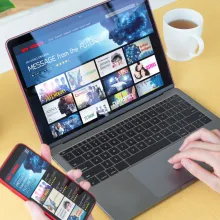
Join Emmy®-winning filmmaker Lindsey Dryden and filmmaker & writer Kyla Harris in a workshop on Disability Justice, disabled-led creativity, and accessibility in the film and TV industry.

Can film advance and energize Black Women’s Wellness? If so, how?
Does the language of mergers and corporate media consolidation leave you confused or unsure of how it may impact you and what you can do about it? To understand more, join this free community teach-in hosted by IDA, Future Film Coalition, and Art House Convergence.
A very small number of film festivals seem to hold an enormous amount of sway over a film’s sales and distribution prospects, as well as the filmmakers’ chances at creating a sustainable living through filmmaking. This perception drives many filmmakers to pin their hopes on just a handful of market-driven festivals that are most important in their region, whether it’s North America (where Sundance looms large), Europe (Cannes, which accepts very few documentaries), Asia (A-list festivals like Busan or Singapore) or elsewhere. In reality, there is a vast ecosystem of film festivals that can all contribute to the healthy life of a documentary film project, and distribution that doesn’t rely on the catalyst of perceived film festival success.