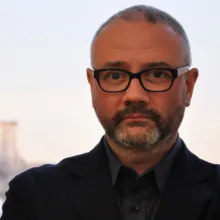
The International Documentary Association (IDA) is proud to announce the appointment of Simon Kilmurry to the position of Executive Director. Kilmurry will relocate from New York to Los Angeles to begin work on July 6, 2015. Kilmurry joins IDA following an illustrious 16-year tenure at POV, the long-running PBS showcase of independent documentaries, where he has served as Executive Producer since 2006. He also serves as Executive Director of American Documentary, POV’s non-profit parent organization. “It’s hard to imagine anyone better qualified to take the reins at IDA,” said Marjan Safinia
Latest Posts
The 18th annual Full Frame Documentary Film Festival, which ran April 9 through 12 in Durham, NC, was a four-day fest crammed with documentaries, nonfiction filmmakers, producers and interested locals. In addition to film screenings, the panel discussions, sponsored by A&E IndieFilms, also attracted large crowds. Held in the Durham Convention Center's Speakeasy, the venue played host to a number of panel conversations about controversial issues facing the documentary community. All panels, which were free and open to the public, allowed small audiences to listen to industry leaders like Motto
Independent Lens and POV to stay on Mondays at 10pm On the tail of a several-month, multi-city listening tour during which leaders from PBS, ITVS, POV and WNET held town hall-style meetings with members of the independent film community, PBS today announced their new strategy to increase visibility of independent film on PBS and its affiliates. The listening tour began in the Bay Area at the San Francisco Public Library thanks in part to the efforts of the IDA and partner organizations including Indie Caucus and Kartemquin Films. We are proud to have helped ignite the process of discussing how
Before viewing Brett Morgen's new documentary, Kurt Cobain: Montage of Heck, I had to jump through a few online security hurdles in order to watch the film. Fear of piracy is so rampant that I got to see my own watermarked name in the corner of the screen the entire time, making it a uniquely personal experience. As a guy who played in a band around that time, saw Nirvana play their first New York show to about a dozen people, and cried in a van while on tour when I heard about Kurt Cobain's death, I was a bit nervous to see Montage of Heck. I know Morgen's work, so I didn't think it would be
Avant-Doc: Intersections of Documentary and Avant-Garde Cinema by Scott MacDonald Published by Oxford University Press 2015 Don't let the "Avant-Garde" reference in the title of Scott MacDonald's latest book keep you away from reading this most accessible, revealing and often intimate exploration of the evolution and convergence of these two forms of cinema. As the author acknowledges in the introduction, "'Avant-garde film' and 'documentary' not only designate different film histories, they are different kinds of terms." He then goes on to prove through the next 419 pages and 21 interviews
I first saw Barry Alexander Brown and Glenn Silber's documentary The War at Home as a high school student in Minneapolis. Their portrayal of the anti-Vietnam War protest movement in Madison, Wisconsin, had a formative impact on my development personally and politically, and as a documentary filmmaker. The film shows young people discovering themselves through a collective commitment to stop the war, using tactics that intensify from peaceful demonstrations to violent confrontations with local police and national guardsmen, to a bombing of a university building that kills a student. Watching
Dear IDA Community, Transition of any kind is an opportunity for reflection. In the space between two defined states, we are afforded a chance to take stock—to honor what we leave behind, hold onto the pieces that we want to carry forward, and imagine ourselves through fresh eyes. With Michael Lumpkin’s move from executive director of IDA to his exciting new role as director of AFI Docs, the first part of 2015 has been a time of transition for us at IDA. Reconsidering the skills and talents a new executive director would need to take IDA to the next level in our evolution has been an exciting
Dear Readers, As we were going to press, the great Albert Maysles passed away at 88, culminating a rich and expansive life and even more so, a brilliant and inspiring career. With his comrades at Drew Associates, he blew the doors open to a new way of seeing and experiencing the documentary form. He took us there, and we got to know the people behind both the most famous figures of the day and the ordinary strangers, who would become indelible characters before Maysles’ masterful camera work. Maysles originally trained as a psychologist, and although he left that career path, the discipline
In 2014, Northwestern University announced the launch of a new Master of Fine Arts in Documentary Media, to be housed in the School of Communications and helmed by Debra Tolchinsky, a documentary filmmaker and artist whose breadth of experience in the arts is well suited to the program's emphasis on working across disciplines and embracing innovation. Now, in the middle of the inaugural cohort's first year, Tolchinsky acknowledges that launching a new program "is a bit like Whac-A-Mole—lots of things to design and figure out," but she is also already seeing the range of students drawn to the