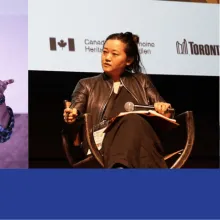
This year marks the fifth edition of Getting Real, IDA’s biennial conference, where documentary filmmakers and industry professionals will meet and dialogue in a hybrid gathering curated and programmed by Abby Sun, Conference Director and IDA’s Director of Artist Programs, as well as programmers Chris Boeckmann and Jonathan Ali. Through a digital platform, Getting Real ‘22 will enable a global audience to connect to the in-person Los Angeles gathering. The theme of this year’s conference, Flipping the Frame, reconsiders the traditional power dynamics in the documentary space. According to the
Latest Posts
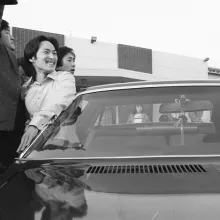
Essential Doc Reads is our curated selection of recent features and important news items about the documentary form and its processes, from around the internet, as well as from the Documentary magazine archive. We hope you enjoy! Hollywood productions of real people’s stories often miss the mark, but documentaries aim to balance this scale. Frank Shyong from the Los Angeles Times dives into the missteps of Hollywood’s portrayal of the story of Chol Soo Lee, a Korean-American wrongly convicted of murder, and how Eugne Yi and Julie Ha’s documentary Free Chol Soo Lee restores justice to Lee. Too
By GRACE LEE, Chris Pérez, Amir Shahkhalili AND Marcia Smith Dear IDA Community, We hope this note finds you well and enjoying the waning days of summer. It has been a busy few months but we wanted to give an update on some of the activities of the IDA board since our executive committee’s last newsletter. Like the organization itself, the IDA Board of Directors is in a transition period. The composition of the board has changed and board members are deepening their understanding of best practices in nonprofit governance. Co-chairs Grace Lee and Chris Perez, as well as ED Rick Pérez, have been
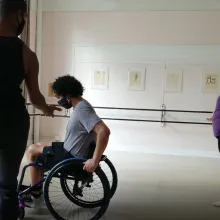
When I was a child, I remember my father having one of those giant Panasonic cameras for home movies. I am one of six kids; I was the quiet, twiggy one, not ever allowed to touch this camera. However, one time on a family vacation, I grabbed the camera and took it a bit down the beach from where my family was. I started filming some seagulls on a boat with decaying wood and peeling blue paint. I thought it was beautiful and interesting to observe, but when my dad found me, he took away the camera and told me not to waste the VHS cassette. Never did I imagine myself being behind a camera and
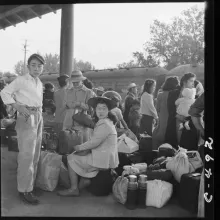
Essential Doc Reads is our curated selection of recent features and important news items about the documentary form and its processes, from around the internet, as well as from the Documentary magazine archive. We hope you enjoy! Sahar Driver and Sonya Childress, writing for Filmmaker Magazine, discuss the evolution of documentaries and their power to instigate real social change, citing filmmaker Chelsea Hernandez, one of IDA’s 2022 Logan Elevate grantees, of being successful in that. The documentary impact enterprise has always focused on the power of particular films to build understanding
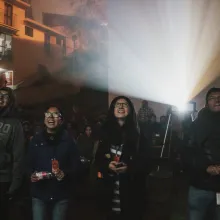
When opening her masterclass at Visions du Réel in Switzerland last April, filmmaker Kirsten Johnson named each member of the technical crew on set. “What I often find upsetting with cinema is that we forget to acknowledge all the people it takes to make these moments together.” Anyone who has worked in a film festival will also tell you that a festival’s “magic” is a lot of collective labor. It is the often invisibilized workforce that allows others to gather in celebration of cinema, and it is their labor that produces the cultural capital underlying every film festival. Twelve years ago
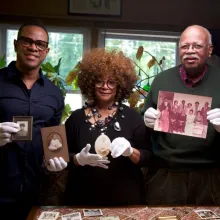
Back in 2019—before COVID-19, before the global reckoning on race and racial justice, before January 6, 2021 quickened and amplified the attack-in-progress on democracy—filmmaker Katerina Cizek and educator/author William Uricchio released Collective Wisdom, a field study report produced at Co-Creation Studio at MIT Open Documentary Lab. Cizek, the artistic director/co-founder/executive producer of Co-Creation Studio, and Uricchio, Professor of Comparative Media Studies at MIT and founder/principal investigator of MIT Open Documentary Lab and Co-Creation Studio, researched the field for

Screen Screen Time is your curated weekly guide to excellent documentaries and nonfiction programs that you can watch at home. There is no rulebook for documentaries, and the form’s beauty derives itself from the infinite creative decisions filmmakers make when trying to artfully capture a narrative. This week’s selection highlights new releases that dont just tell a story, but question and redefine the documentary form as they present poetic visuals that captivate us and draw us in. All of these films have a dreamy filter to them, as they capture the ethereal in reality, however rough that
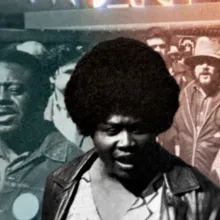
The 11th annual BlackStar Film Festival was back at the University of Pennsylvania’s Penn Live Arts at the Annenberg Center for the Performing Arts with a 76-film lineup representing 27 countries. The hybrid festival showcased many premieres including 16 world, eight North American, 12 East Coast, eight US and 25 Philadelphia premieres. The overall programming featured in-person and online screenings, live performances and events, and panels. BlackStar is known for honing in on Philadelphia’s legacy as a historically Black city and celebrating Black, Brown, and Indigenous filmmakers and
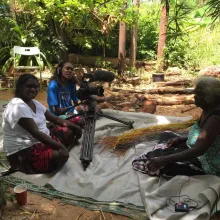
When Yolŋu filmmaker Ishmael Marika first found a 1970s recording of his grandfather speaking to his fathers as a small child, he was overwhelmed. He had never met his grandfather, but the recording couldn’t have come at a better time. Marika’s fathers 1 were heavily involved in leadership decisions for the community at the time, and the discussions had been tense. The fathers were starting to disagree, and tensions had sprung up that threatened to impact the community’s leadership unity. Marika burned a copy of the recording and walked it into the meeting and pressed play. His grandfather's