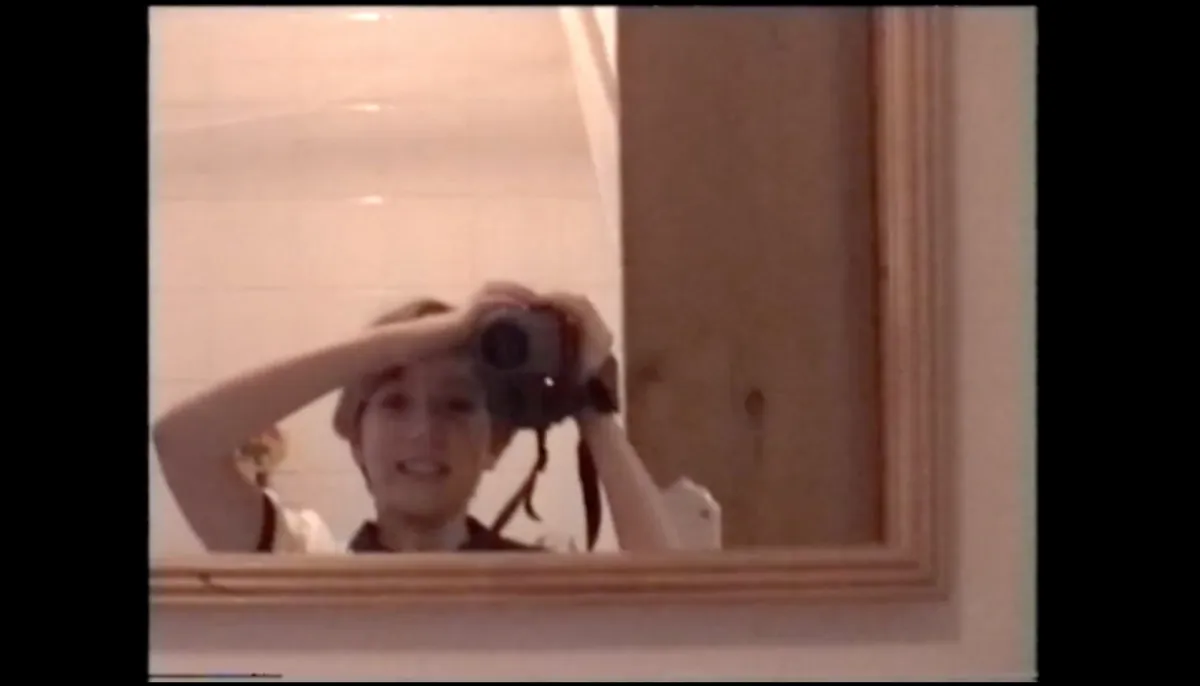


World-premiering at this year’s Camden International Film Festival, Grace Harper Brighouse’s Dependence is an astonishing feature debut from a British filmmaker who has been behind the camera since she was a child, documenting her close-knit family, whether they were celebrating a birthday or taking a car ride. Indeed, it’s through 30 years’ worth of her own home movies that Brighouse sifts, searching for clues in every frame. She’s on a Sisyphean mission to unravel the mystery that is her somewhat estranged father, a high-functioning addict whose substance abuse emotionally ravaged her entire family, the effects of which are still being felt as she picks up her camera and points it at him.
With echoes of Ross McElwee’s heart-wrenching Remake (with a role reversal of sorts, as Brighouse films from the child’s POV), Dependence is a cinematic attempt to decipher a loved one’s opioid addiction, and a testament to what it’s like to love a family member you can never save. And while there is no “Rosebud moment,” a revelation does occur: Extending love rather than demanding answers might just be a key to letting go and healing the soul.
Soon after Dependence rightly won the top Harrell Award at CIFF, Documentary reached out to the first-time feature filmmaker who’s also an accomplished director of shorts, including The Family Statement, which juxtaposes the private WhatsApp communications of the Sackler family with the voices of those devastated by the opioid epidemic (and was released on Field of Vision in 2023); and 2018’s Speak to Me, Brighouse’s first attempt to use the camera to reconnect with her father, which laid the groundwork for Dependence. Speaking candidly about her process, Brighouse talks about working with her editor to make sense of her home movie archive, eschewing voiceover as a way to forgo any presumption of authority, and why she hopes the film reaches audiences who may not seek out documentaries to begin with. The following interview has been edited for length and clarity.
DOCUMENTARY: I was quite struck by something you said in your director’s statement — that Dependence isn’t really a film about addiction, but about what it feels like to love someone inside it. You noted that this distinction matters to you more than almost anything else about the project. Could you talk a bit about this “narrative disruption within the addiction genre” that you were so bent on exploring? What does that look like, and how did you achieve it cinematically?
GRACE HARPER BRIGHOUSE: The addiction film genre has a grammar that audiences recognize immediately, which I really did not want to use. There’s usually a chronology: the before, the descent, the rock bottom, the reckoning. That chronology, however well-intentioned, ends up making the addicted person into a kind of case study, centering the substance rather than the human being.
I knew that, personally, that narrative didn’t serve me. Growing up with a high-functioning addicted father, I consumed every addiction narrative I could find, trying to understand what was happening in my home. None of them quite fit because high-functioning addiction doesn’t look like those films. It looks like ordinary life, with something underneath it that you can’t quite name.
My dad was so much more than what he was dependent on. He was funny, charming, maddening, and mysterious. I wanted to make a film about all of that, the full texture of who he was and what it was like to be his daughter, and let the addiction be present in the way it actually was in our lives: not as the plot, but as the weather, always there, shaping everything but not necessarily always visible.
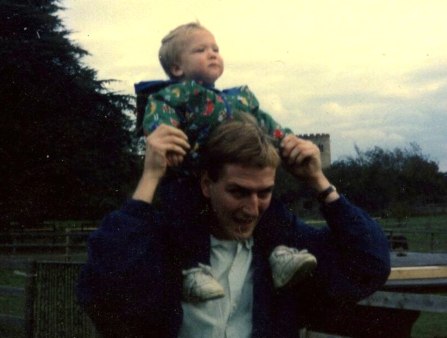
Richard holding a two year old Grace on his shoulders in 1989.
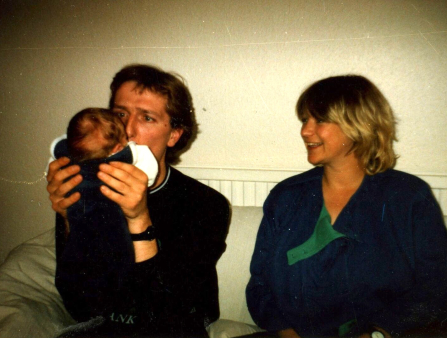
Richard and Beverley in 1987 holding up a newborn Grace.
D: I know you deliberately avoided using voiceover. Can you explain that choice?
GHB: I can’t speak for everyone in my family’s experience of my dad. This is my point of view, and I’m not pretending otherwise. I’m the one behind the camera, directing the audience through my lens. But what I could refuse to do was make my voice the authoritative one. Voiceover would have suggested that I understood him, that I’d processed it all, and was now explaining it to you. I couldn’t do that because I didn’t understand him, and I haven’t had a clean, closed, perfect processing experience. I was also very keen for this to be a film about an entire family, for other voices to have genuine space, not just as supporting evidence for my interpretation but as perspectives in their own right. The absence of voiceover was one way of honoring that.
The other thing I was adamant about was humor. This is something that’s really hard to include in a sincere way in an addiction narrative if it’s not your own family. I think our family is fairly consistently funny. In our house, the humor and the pain weren’t separate things. Disrupting the addiction genre of rock bottom to redemption really allowed for that humor, because you know from the beginning that death is going to be part of the story when redemption isn’t the main aim of the film.
D: I actually got to chat with your editor, Vera Simmonds, on the way back to the Portland airport from Camden, so I’m especially curious to hear about the process of piecing together 30 years’ worth of archive. She mentioned that this project has taken almost a decade to come to fruition.
GHB: Vera is extraordinary. This film simply doesn’t exist without her. The problem with 30 years of intimate domestic footage is that it’s not organized by story, theme, or narrative. It’s organized by time, and time is not a story.
You have beautiful moments sitting next to completely mundane ones, and devastating things buried between birthday parties. You have no idea, while you’re watching, whether what you're looking at is significant. Vera was the person who could hold all of it in her head and begin to feel where the weight was.
I met my producer, Alistair [Payne-James], in 2018, so it has been nearly a decade. But at no point were we continuously editing. We were actually only in the edit proper for 19 weeks, and we spread the edit over four years. This timeline meant that much of the mental work was done outside the edit suite. But to be totally honest, this was also how long it took me to be ready to make the film this way. The film I would have made five years ago would have been very different. In earlier versions, I was trying desperately to be funny so I could protect audiences from the pain. I was much less willing to sit with the ambiguity. The film I’ve made now is one I had to grow into.
Structurally, the challenge was moving between time periods and making sure that movement felt emotionally rather than chronologically motivated. It wasn’t, Here’s 1997; Here’s 2003, but more like, What does this moment in the present need, and which moment in the past answers it? That’s the kind of question Vera and I would sit with for days.
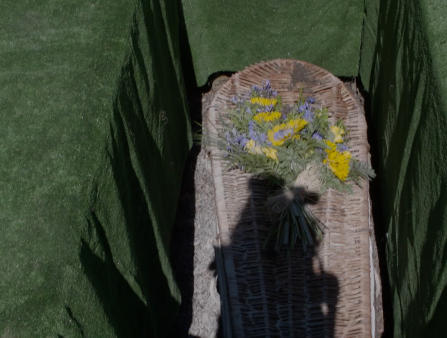
The shadow of Grace in 2018 on a freshly dug grave.
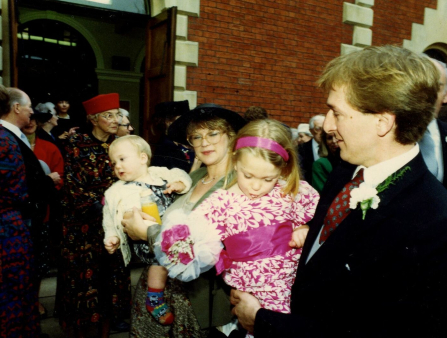
Richard, Beverley, Grace and Sam in 1989 at a wedding.
D: In a way, Dependence also felt to me like a coming-of-age story, one in which a child grows up to remove the rose-colored glasses and simply view their parent as just another flawed and mortal human being. So how did making the film change you, both personally and as a filmmaker?
GHB: In many ways, it’s a story of coming of age behind a camera. There is something very particular about the moment you stop seeing your parent as your parent, as this fixed and almost mythological figure in your life, and start seeing them as a person who was doing their best with what they had.
A lot of life happened while making this film. Everyone in our tiny but mighty team has become a parent over the course of it, and that changes the lens through which you view your own parents in ways I didn’t anticipate. It makes you more generous. You understand, in a way you couldn’t before, the weight of it. And it also clarifies things. It helped me see with more precision the places where addiction clouded some of my dad’s decisions. Both things happened simultaneously: more forgiveness and more understanding of what was lost.
As a filmmaker, I also had to overcome a long period of not trusting that the personal could be political. I’m a journalist who makes documentary work for Channel 4 News. My previous film was a short for Field of Vision called The Family Statement, which used unpublished messages sourced from the Sackler family’s private WhatsApp group that were buried in their bankruptcy disclosure documents. That film let me explore the broader capitalist context of OxyContin addiction—the systemic behavior that created the crisis. I think for a long time I felt that Dependence needed to do that too, that I had to weave in the bigger picture for people to care, to justify it as something more than just my family’s story.
In the end, I emerged with a much deeper conviction that specificity is the way in, not the obstacle. Nevertheless, it took me a long time to accept that intimacy was the strength, not a limitation to compensate for. One film can’t do everything, but what this film can do is put you inside the experience of loving someone in addiction, from the inside of a specific family, in a way that no systemic analysis can reach. Ultimately, the film is not trying to solve my dad; it’s trying to love him honestly. That realization took years, because intimacy is also really vulnerable. And vulnerability is much harder for me to sit with than argument.
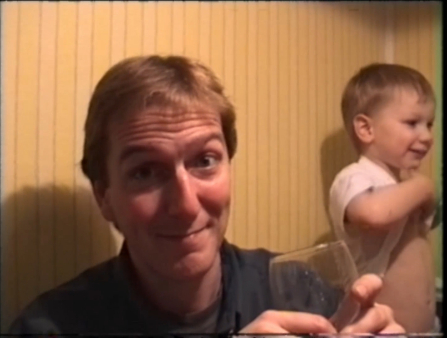
Richard in 1995 raising his eyebrows at the VHS camera directed at him by eight year old Grace.
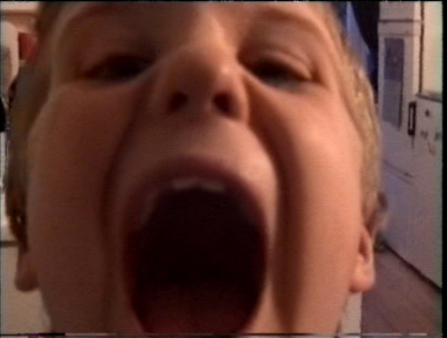
Six year old Sam, the director’s brother, opening his mouth into the VHS family camera in 1995.
D: Have all the living participants seen the final film, and did the family members you lost see early versions or rough cuts? What have been the various reactions?
GHB: The rough cut screening we had back in January for the members of my family who are in it was one of the most emotional moments of this whole experience. I knew that if they didn’t think it was honest or fair, I’d have to change the direction of the edit. We all felt very strongly that they had to see it before anyone else, and that they had to have the chance to raise their concerns about anything that felt genuinely harmful rather than just uncomfortable. We knew some of this material is uncomfortable, and we’re not apologizing for that, but we wanted them to know we’d heard them.
But they loved it and are all really proud of the film. I think because we all lived the complexity of loving my dad, and the pain of losing Sam, there is something unifying in seeing that complexity explored and not totally resolved. Sadly, my dad and my brother never got to see the film. Sam died way too early to see anything, though I showed him rushes when I was filming because I wanted to gossip about dad with him. (You can see my computer with Adobe Premiere open in a shot of the film!) And my dad wanted to wait to see the finished film.
D: What are your ultimate hopes for Dependence? Do you have an impact campaign planned?
GHB: I’ve always had a bit of a childish hope for this film, which is just that after watching it, you want to call someone whom you struggle to tell that you love, or just don’t say it enough to them; you feel that urge to call and tell them that you love them. I hope that the film speaks on that level to people who know complex, messy love.
As a team, our deepest hope is that someone who knows addiction, and not the dramatic visible kind of addiction, necessarily, but the quiet and persistent everyday kind, through loving someone in its orbit, watches this film and feels less alone. We hope they see their experience reflected on screen and feel that it’s worth talking about. Addiction doesn’t disqualify you from having had a loving family. Both can be true at the same time.
This isn’t an awareness film in the traditional sense. My hope is that the way it’s made means it will reach a really broad audience, including people who don’t think of themselves as documentary audiences at all. The people who need it most are probably not the ones seeking it out at film festivals. So how it lives beyond its festival life, how it reaches those people, is something I’ve been thinking about a great deal—and I’m open to any advice about it!