

When Montreal-based filmmaker Ashley Da-Lê Duong talks about her TIFF-premiering doc, Ba’s Book, she’s open about which lauded documentaries she sought to emulate.
“I was inspired by films like [Sarah Polley’s] Stories We Tell (2012), [Joshua Oppenheimer’s] The Act of Killing (2012), and [Kaouther Ben Hania’s] Four Daughters (2023).” (In fact, Ben Hania consulted on the script and edit of Ba’s Book.)
Her film utilizes reenactments to dramatize the memoir that her immigrant father (or Ba), Anh, published in 2024, titled Dear Da-Lê: A Father’s Memoir of the Vietnam War and the Iranian Revolution. Shot on location in Vietnam, the documentary staged and encouraged familial dialogues that one might more conventionally expect to occur on a chaise lounge—a far cry from the cagey communication style Duong grew up with in Calgary, Canada.
“Growing up, my dad was always a supportive person in my life,” Duong tells Documentary. “But we didn’t talk about anything real. It’s the same with my mom, who was also a refugee. I knew that it must have been hard to be in a war, but I didn’t know the details.”
Though she had previously met her Vietnamese relatives as a child in 2002, she traveled back after an extended absence—first in 2017, then again in 2019—believing that, if anything, she’d make a relatively straightforward project with talking-head interviews about their experiences during the Vietnam War in their rural village and her father’s decades-long absence. But she found that her relatives were hesitant to speak openly on any of these subjects. (“I didn’t want to press,” she remembers.) And so she returned to Canada, unsure if what she filmed from these family reunions would result in anything creative.
As her father worked on his memoir, Duong concurrently recalibrated her approach, and she ventured back to Vietnam in 2023 with a new idea. “I did a simple scene test with some of my cousins as younger versions of my aunts and uncles,” she says. “Everyone was super curious and had all of these suggestions, thoughts, and memories. It was a way to talk about something that we’ve never been able to talk about.”
This new footage is what enticed Ina Fichman, producer of nonfiction heavyweights like Monsoon (dir. Sturla Gunnarsson, 2014) and Fire of Love (dir. Sara Dosa, 2022)—and president of the board at IDA—to sign on to the project. “What excited me was the innovation and the risk taking,” she tells me on a joint call with Duong. “I’m always intrigued by filmmakers who find a new way of telling stories.”
To lightly challenge Fichman’s definition of “new,” Duong’s own specific references, citing some of the most lauded documentaries of the 21st century, situate Ba’s Book within an established hybridized strain of nonfiction filmmaking.
Reenactments in documentaries are not fiction, but a new entryway of telling one’s story.
—Ina Fichman
However, Duong’s film doesn’t quite feel at home among those previously mentioned titles. For one, it lacks the palpable political danger of Oppenheimer’s film, which saw perpetrators of the Indonesian mass killings of communists in the mid-’60s reenact their brutal crimes. Not only did Indonesian crew members choose to remain anonymous due to the murderous subjects’ continued power in the country, but Oppenheimer received continued death threats from their lackeys and has refrained from returning to Indonesia since. Something similar could be said about a comparison to Four Daughters, which had actors stand in for a single mother’s eldest two daughters who, after being radicalized, fled their home in Tunisia to join Daesh forces in Tunisia. Ben Hania allows their mother (who is also portrayed by an actress in certain scenes), as well as their two remaining sisters, to reconnect with and reckon with versions of their long-gone loved ones. There are kernels of each of these films in Ba’s Book—the horrors of bygone battlefields are dramatized, the family home is made a site for psychodrama—but Duong notably lacks the critical distance that these filmmakers afforded themselves.
And unlike Polley, whose film featured faux home movies to interrogate the fickle nature of memory, Duong doesn’t withhold her fabricated framework from the audience. Instead, she elucidates it from the get-go. During the opening scene, we see a younger version of Anh (played by Hanoi-born, Montreal-based actor Duy Nguyen of Park Chan-wook’s The Sympathizer [2024]) enter a meeting with a Canadian diplomat in Iran. We may not yet know how he ended up here, pleading for a visa so that he may escape the tumult of the 1979 revolution, but we do see the parameters of Duong’s set—boom mics, camera, the director herself—slide into the frame. There’s no rug-pull here.
Then, during our conversation, Fichman references another project, one that feels radically more in communion with not only the conceit of Duong’s film but the emotional outcome she sought to achieve for her participating family members and future audiences alike.
“At Getting Real two years ago, Cecilia Aldarondo was talking about her film You Were My First Boyfriend [2023],” Fichman remembers. “She actually said something that I found very meaningful, which was that reenactments in documentaries are not fiction, but a new entryway of telling one’s story. When I heard her say that, I thought, That is really what I’m interested in doing.”
Indeed, Duong feels more aptly situated here, amid a growing number of filmmakers who aim to unpack personal hang-ups, and through the filmmaking process achieve—or at most, move toward—emotional healing. Aldarondo’s film centers on her high school experiences—the bullies, best friend, and naturally the boyfriend that indelibly shaped her—and finds the filmmaker (then in her forties) playing a teenage version of herself. Through this specific approach, known as psychodrama, in which role-playing aids emotional processing, Aldarondo gains self-confidence ahead of her high school reunion.
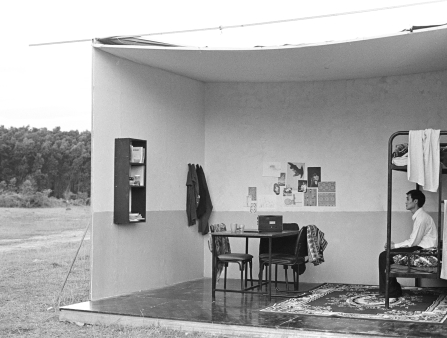
Actor Duy Nguyen shoots reenactments in Vietnam for Ba’s Book. Photo by Hieu To.
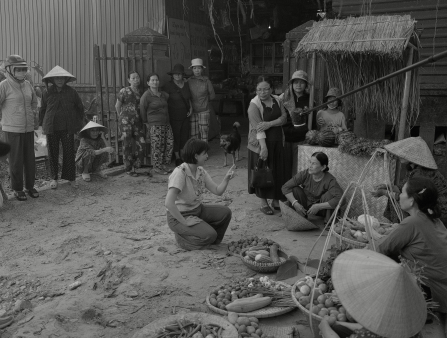
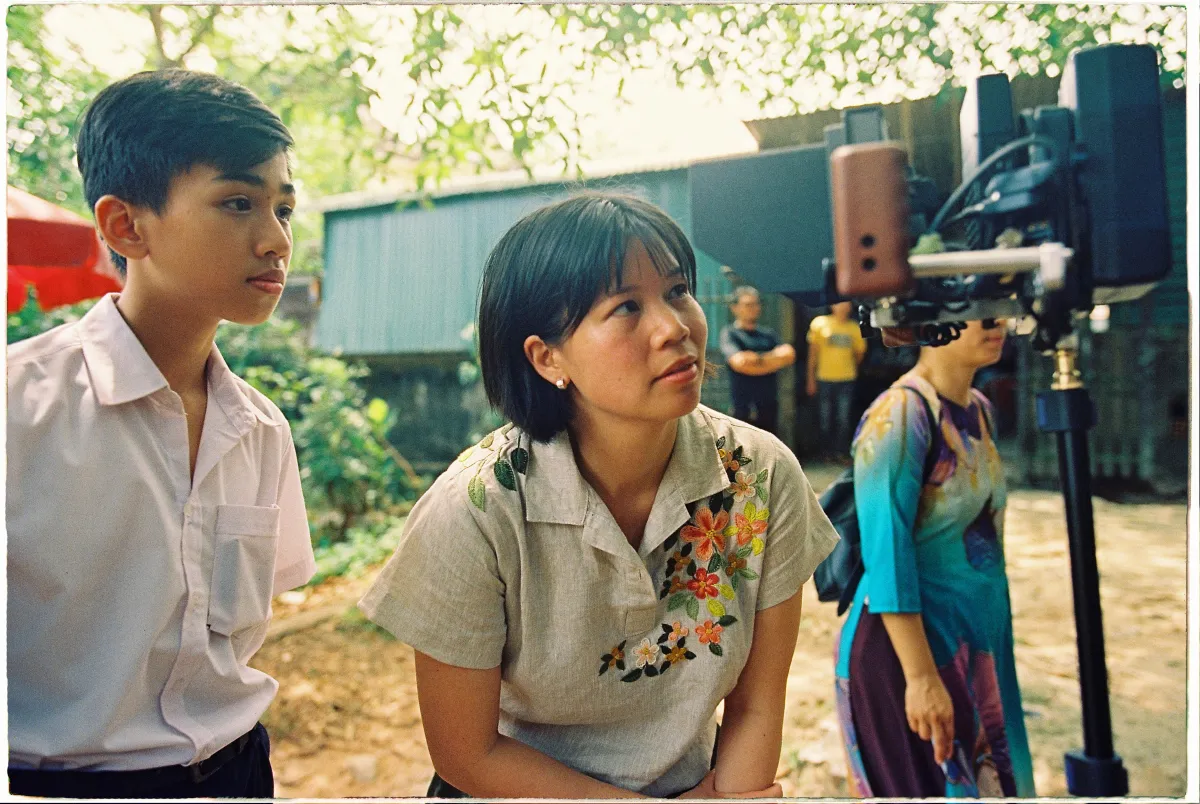
Ashley Da-Lê Duong directs reenactments based on her father’s upbringing in rural Vietnam. Photo by Tobias Haynes
Unlike The Act of Killing or Four Daughters, the use of reenactments in Duong’s film isn’t meant to be politically provocative, despite having them be set during the Vietnam War. Duong knew these dramatizations would allow her family to have conversations—either directly with each other or through their thespian avatars—that would be considered otherwise impossible due to cultural mores or psychological blocks. Through the guise of agreeing on period accuracy, Duong’s relatives were able to frankly discuss the horrors of what they collectively experienced during the war, as well as their lives after Anh’s departure. Just as the family hadn’t realized just how politically tumultuous the eldest son’s experience in Iran was, Anh hadn’t fully taken in the reality of his siblings’ forced evacuation from the family home. They’re only able to do so via proxy, through the tools Duong’s film production made available for them.
Yet Duong’s position as a daughter of immigrants, who largely don’t see Western mental health services as a viable resource (“I don’t think therapy is a solution,” Anh at one point tells Duong regarding his sister’s lingering resentment), puts her film directly in conversation with another distinct group of films. These projects, largely directed by women from specific ethnic diasporas, juxtapose the experiences of their older relatives, who are decidedly reluctant to reveal their soft underbellies, with their own dueling penchant for diaristic vulnerability—itself perhaps a product of some of them growing up in Western culture.
For example, there’s British filmmaker Chloe Abraham’s Taste of Mango (2023), which braids personal archive with confessional interviews between herself and her Sri Lankan mother, eventually revealing abuse in the latter’s past. In a similar vein, Karla Murthy’s The Gas Station Attendant (2025) eulogizes the Indian father she did not always have the easiest relationship with via the patriarch’s trove of home movies. Moroccan filmmaker Asmae El Moudir utilizes miniature clay figurines in The Mother of All Lies (2023) to re-create a fraught period in Casablanca that her grandmother refuses to discuss, and New Wave (2024) finds Elizabeth Ai using the backdrop of a popular music craze among Vietnamese immigrants in California to reconnect with family members—most notably her mother—and dramatize their crazier ’80s experiences. Through reenactments, home movies, and metatextual elements, these directors seek and bring about healing.
In terms of tangible emotional healing, Duong’s film was a much-needed conduit for Aunt Hanh, Anh’s younger sister, to air grievances about her gendered role in the family. Though reluctant to actually voice these thoughts to her older brother out of respect, she allowed Duong to show her father an emotional excerpt from a previous interview.
“When your dad was young, he only ate and studied,” she recalls. “Because I was a girl, my parents forced me to stay home and take care of my younger brothers.” She pauses, wiping away tears as her voice trembles. “I begged to go to class, if only for half the day, but it was not possible.”
Yet this vulnerability via screen allows Duong to coordinate a face-to-face conversation between her father and aunt, where the filmmaker essentially acts as an emotional mediator. (“I wanted to have an on-set therapist,” Duong clarifies, “but nobody seemed to want that. Like, Okay, I'm just bringing in my Western ideas.”) When she asks her father if he’d like to thank his sister on camera for everything she’s done, he clams up and asks Duong to thank her aunt for him. Instead of forcing him, she obliges. This exchange may not initially register as sufficiently dramatic for the film’s narrative purpose, but it sets up the emotional beats Duong leaves her audiences with during the film’s last scene.
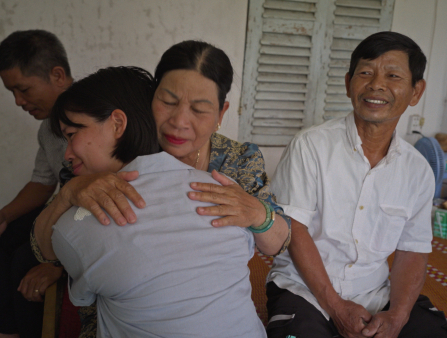
(L to R) Dương Văn Chương, Ashley Da-Lê Duong, Dương Thị Hạnh, and Dương Ngọc Hòa in Ba’s Book.
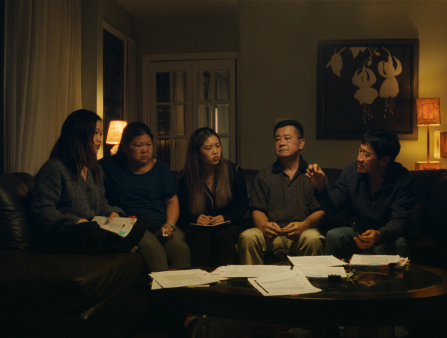
Carol Nguyen’s family discussing her Uncle Thach’s medical records in Still Night, Burning House. Courtesy of the National Film Board of Canada
“You have the chance to study, so study hard,” Hanh tells the grandniece who played a younger version of herself, echoing, no doubt, what she wished she’d heard as a little girl. “I hope you succeed in school and you go out and be equal to others.” The child nods her head and wishes her aunt good health, and Hanh pulls her in for an embrace. The moment is made possible precisely because of the distance the reenactments they’d all worked together to stage for Duong’s camera insists on: Hanh is able to see a version of her younger self from afar, allowing for a moment of emotional closure where you’re led to believe her own inner child may well be better cared for moving forward.
In Duong’s view, catharsis is the end point of Ba’s Book, if not altogether its reason to exist. This is why, as the film itself explains, Duong needed her father’s involvement if she was ever going to make the film at all (her mother, and curiously, her brother are decidedly absent from the proceedings). As we see at the outset, Anh had at first refused to travel back to Vietnam for the project, only agreeing after a final, exaggerated plea via Zoom finally convinced him. Since the film wrapped its sweaty five-week shoot in July of 2025, Duong says her father has “changed so much. To even think back to how he was so emotionally guarded at the beginning of the process is crazy.”
Perhaps more potently, Duong experienced a personal transformation as a result of the film. “I think that there’s clearly a before I made this film and an after,” she says. “I don’t even feel like the same person. It had a huge impact on me.”
“Ashley’s relationship with our professional and nonprofessional actors and her family allowed us to have something where everyone felt safe and comfortable,” Fichman says of the film’s set, which she visited two weeks before production kicked off and again during its final week. “I think that’s the key to this, and I actually think this form of hybridity will continue to flourish.”
Flourish it will: Echoing the themes of Ba’s Book is fellow Montreal-based filmmaker Carol Nguyen’s Still Night, Burning House, which centers on the filmmaker traveling to Vietnam with her family in order to grieve her uncle through a series of cultural ceremonies. Though both films have surprisingly similar premises, they screened at TIFF in the very same program.
As this specific strain of hybridized filmmaking proliferates, it’s crucial to consider precisely what resources filmmakers will be expected to provide on set. Through initiatives like Film in Mind, which aims to provide “consultation and therapeutic interventions for the filmmaking community” internationally, the ability to seek personal and production-wide mental health services feels ever more accessible. While Duong notes that her Vietnamese relatives balked at the idea of participating in traditional talk therapy, it’s interesting that the film, transparent as it attempts to be, never features the filmmaker candidly stating what she does to maintain her mental hygiene while on production and in her daily life.
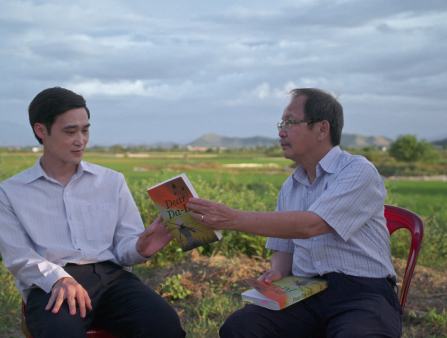
Actor Duy Nguyen (L) plays Duong’s father, Ahn (R), in Ba’s Book.
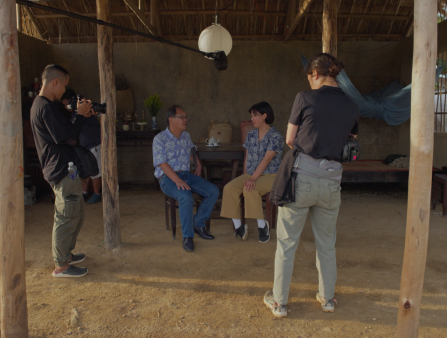
Ahn Duong and his daughter, filmmaker Ashley Da-Lê Duong, in Ba’s Book.
During our conversation, Duong reveals that her domestic partner was a vital presence during the shoot, as he provided comfort, companionship, and a familiarity with her family dynamic that grounded her. It’s even more intriguing to discover that Duong’s brother, a computer programmer in Silicon Valley, is practically estranged from the family. While Ba’s Book openly addresses her mother’s refusal to return to Vietnam, it barely mentions her brother outside of his limited presence during a brief montage of home movies. These are curious absences in a film so keen to reveal the mechanics of its making, especially considering how markedly vulnerable she expects her father and his siblings to be.
There is no way to say with certainty that all parties involved in Ba’s Book—or any of the subjects of the aforementioned documentaries—will successfully process the decades of distress inflicted upon them by national, foreign, and familial parties. No matter how intensely these directors sought to emulate therapeutic practices, from role play to exposure and art therapies, they are not mental health specialists, nor did they bring one aboard production. (There are some exceptions in this realm, such as Robert Greene, who worked closely with registered drama therapist Monica Phinney on Procession [2021]).
“We didn’t tell you about the illness, what we would now call PTSD,” Anh at one point reads aloud, in a passage addressing his daughter. “We would just keep living with the past and hiding how it has wounded us. But its effects don’t stop with us; it carries forward for generations.”
Ba’s Book—like Duong’s father’s memoir—is a conscious attempt to stop such trauma from being carried forward anymore. The film’s final image, of father and daughter talking candidly as the camera pans out to reveal the film crew and the set dressing amid a contemporary rural village, once more reveals the constructedness of such intimate interactions. Audiences may well wonder how much healing the camera actually prompted. But what’s clear is that the emotional opening up the film engendered has had some tangible consequences for those involved.
Both Duong and her father named their respective projects after each other, yet the perspective they center is utterly their own, brokering a newfound bond built on mutual recognition as opposed to preconceived expectations of how a father-daughter relationship should look.
“The book wasn’t for me, and the film wasn’t for him,” she concludes, “but maybe this is how we show up for each other.”
This piece was first published in Documentary’s Fall 2026 issue.