

Welcome to “Notes From the Real,” a series written by curator, educator, and current IDA Executive Director Dominic Asmall Willsdon. Looking at the reality-based practices documentary trades and allies itself with (the essay, testimony, visual anthropology, and more), the column will illuminate the work, value, and purpose of documentary as seen from the outside, from the edges, from the real.
Rencontres d’Arles and FIDMarseille are neighboring yet different festivals. They are programmed by separate institutions, with separate histories. One is a festival of photography, the other of film. But they take place an hour apart by train, and this July they overlapped by a week. I split my time between them, moving back and forth across that hour, and kept finding similar forms and purposes at both ends: documentary’s core concerns—memory, testimony, the surfacing of buried or forgotten records—showing up in work that wasn’t conventionally documentary, or wasn’t framed as such. That’s the encounter I hope “Notes From the Real” can be about: between documentary and the neighboring practices that take up its tasks, some of them under different names.
Both festivals were founded to support a practice that was, in some ways, subordinate to more dominant ones—photography against painting and sculpture, documentary against fiction feature filmmaking. Rencontres d’Arles began in 1970, when photography still had to argue for its status alongside painting, sculpture, and the so-called fine arts. FIDMarseille was founded in 1989 to make the case for documentary against fiction. In 2011, FIDMarseille dropped “documentaire” from its name, keeping the acronym while becoming the Festival International de Cinéma de Marseille, a change that raises the question of what a festival dedicated to documentary—to films that are evidently documentaries—does and does not do. Did FIDMarseille’s opening to fiction and artist films signal a softening of its original commitment, or rather confidence that work that is evidently documentary can thrive as part of a wider cinema of the real?
The notes that follow turn from what I wrote last time—on documentary and the educational turn in art, and Vladlena Sandu’s magical, personal recollections in Memory (2025)—toward documentary as a work of collective remembrance, and a painful case of that work: the memory of defeat, and of the defeated. Two works, one from each festival, take up that task without being the type of documentary that task conventionally belongs to. Sammy Baloji’s Landscape Lens: A Katangese Crossing (2026), at Rencontres, and Eloy Enciso’s Letters From an Inner Exile (Todo es cárcel, 2026), at FIDMarseille, share—without adopting its typical forms—a purpose with documentary: surfacing what’s been left out of the historical record.
Not just these two works, but the practices of both Baloji and Enciso begin, as each has said, in the awareness of an absence from what they were taught in school: of the colonial period in the Congo and the Franco era in Spain, respectively. In each case, their art functions as an informal supplement to an education that wasn’t doing justice to reality—which is, I would say, close to the heart of what documentary practice is. Remembering the defeated may not simply be a topic documentary happens to take up; documentary may in fact be the proper tool for it. Which raises the question of what that tool actually is, and who else belongs alongside documentarians in what Erika Balsom has called the “reality-based community”—and whether the boundaries between its residents are anything more than institutional: festivals and other exhibitors, schools, funders, awards, and publications, including this one.
Sammy Baloji has worked for two decades across documentary film and photography, moving between the spaces and systems proper to each—gallery and museum on one side, festival and cinema on the other. His is a blended practice sustained by a blended career. Baloji is, without doubt, a maker of documentaries, but without much presence in the field that calls itself documentary film.
His exhibition Landscape Lens: A Katangese Crossing is a single installation staging his multidisciplinary practice. In the vaulted nave of the Église des Trinitaires in Arles, photography, film, and archive are co-present. Choosing a single-channel film, unlike the multichannel Tales of the Copper Cross Garden: Episode I (2017), which I saw at Documenta 14, Baloji has a screen show RN1: Traversée Katangaise (2026), a 50-minute documentary that follows the Route Nationale 1 (RN1) road that runs through Katanga. That screen inhabits the same space as his photographs, hung against wallpaper enlarged from a 1977 Gécamines public-relations photograph of polished malachite. The mining company’s own promotional image of the region’s wealth now serves as the literal ground on which the exhibition’s photographs and documents are mounted. The blown-up photograph continues Baloji’s abiding interest in the material culture of colonial history; elsewhere, he has exhibited artillery shells used as flowerpots.
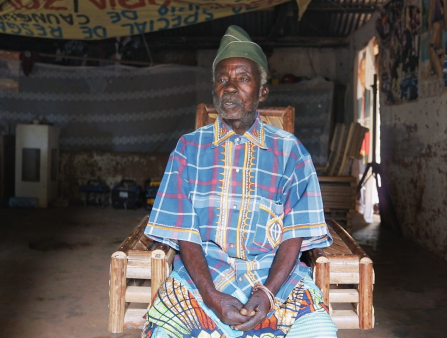
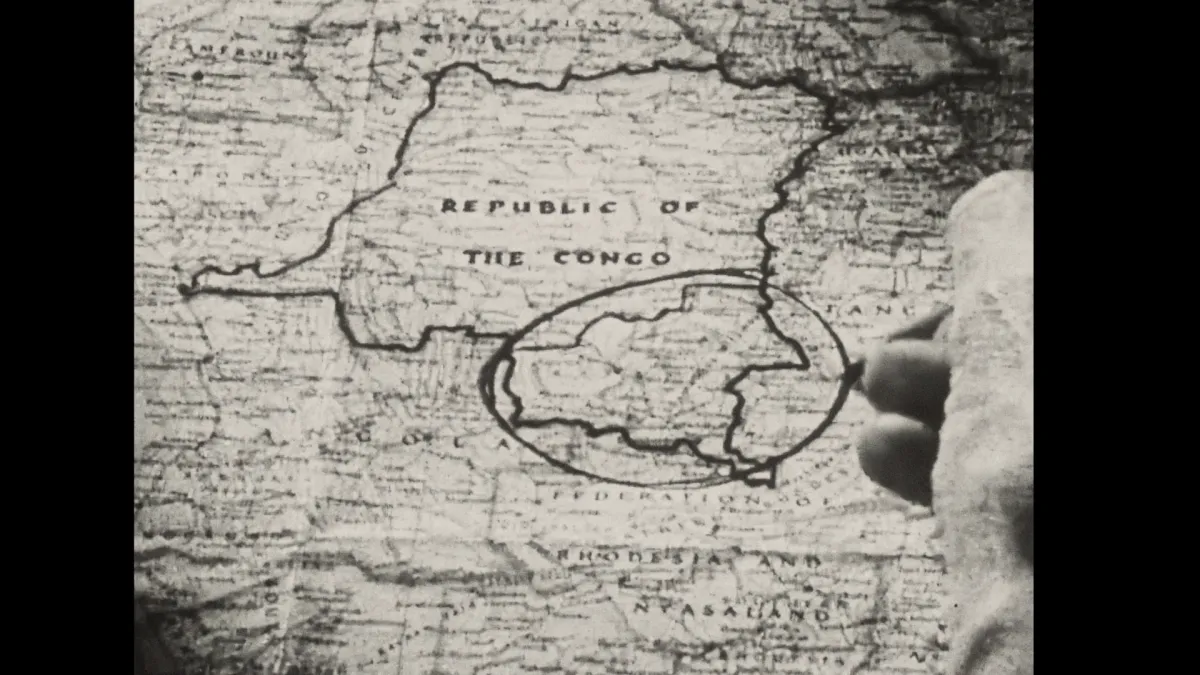
RN1: Traversée Katangaise. Courtesy of Rencontres d’Arles
I first came to Baloji’s work through Mémoire (2004–2007): originally a photographic series overlaying archival black-and-white images of Congolese mineworkers onto contemporary color photographs of the ruined Gécamines/Union Minière factories in Lubumbashi. He later adapted the project into a 14-minute film in which the choreographer Faustin Linyekula dances alone inside the ruins. Remembering, in Baloji’s case, might seem to imply reenactment, except that the acts performed were never performed before. This is, rather, what Diana Taylor calls “performance as repertoire,” in The Archive and the Repertoire (2003).
Landscape Lens traces its own historical throughline of loss and defeat. Katanga, the source of three-quarters of Congo’s mining production in 1960, was an asset Belgium refused to relinquish at independence, and Patrice Lumumba, likely to nationalize those resources, was treated as a threat to be removed. Katanga became independent because Belgium wanted to retain control of the minerals; its secession, backed by Belgium, lasted until UN pressure ended it, but the secession’s failure produced exile and division. Thousands of Katangese fled into Portuguese Angola, from where they invaded Katanga twice, in 1977 and 1978, briefly seizing Kolwezi, the region’s principal mining town, which became a symbol of the Congolese condition: wealth that invites intervention, a state repeatedly destabilized from within and without. Landscape Lens centers on the Hôtel Impala, a property in Kolwezi that belonged to Baloji’s great-uncle and was requisitioned amid these conflicts—a point of entry, through the artist’s own family’s history, into a public and collective one.
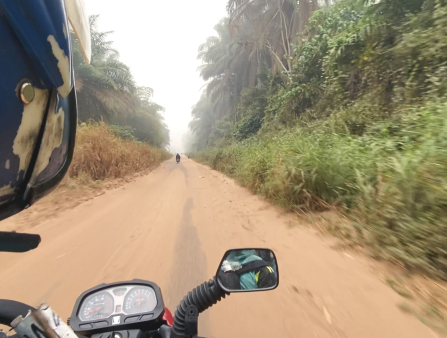
RN1: Traversée Katangaise is a blended road-trip film. Present-day footage of the route is intercut with archival material from Katanga’s wars of decolonization. Traversée, in the title, alludes to the way the film understands its own multivalence: It is at once a road movie (following a road that traverses Katanga), an account of the hard passage the Katangese experienced, and a study of the road as the thing that literally cuts through the extractive landscape the exhibition’s malachite wallpaper depicts.
RN1 continues something of the same performance-as-repertoire quality as Mémoire, but in a different way, and across three kinds of footage that overlap and interfere with each other. There is archival news material, largely centered on Moïse Tshombe (the leader of the secession) and other Katangese across the events of 1960 and their aftermath. There is the filmmaker’s own footage of their motorcycle journey along the RN1, its paved highway and dirt-track interior sections. More than a record of travel, it’s a quiet meditation on the mine- and battle-scarred landscape. And there are the interviews, static and interior, with single figures in domestic spaces: veterans of Katanga’s political and military conflicts, encountered, as one imagines, along the road, and nonfictional performers, one of whom does in fact dance. These interview sequences are the film’s moving image counterpart to the portrait photographs seen elsewhere in Landscape Lens. The veterans are the film’s defeated: defeated by regional and international forces over many years, and defeated, in a sense, from the outset, in Katanga’s submission—at the moment of decolonization—to Belgian interests, which is where RN1 begins. The film moves back and forth between the present-day open road and the closed rooms that hold the testimony of the past.
Landscape Lens makes things visible while also leaving them in pieces, in a state of disassembly.
What’s documentary here is everything the exhibition is built from—the maps, the administrative archive, the company photography, the footage of RN1—and none of it resolves into documentary as we’d normally see it. Landscape Lens makes things visible while also leaving them in pieces, in a state of disassembly: photographs, film, archival maps and letters, design elements, fragments we walk between and around, as if at an archaeological museum. Nothing here is incompatible with being a documentary; not only RN1 but also Landscape Lens could have been made as one. But the installation form creates extra room for the viewer to assemble the work themselves—an embodied version of the co-creation that any documentary asks of its audience, made explicit by the walking, the choosing, the doubling back. Landscape Lens is, by design, nonnarrative and in places obscure: a revealing and a concealing which, for Baloji, reproduces the colonial process itself—a process that worked, as he has described it, by strategically erasing or hiding information, producing an abstract relation to reality.
Whereas Baloji moves between the art and film worlds, in film after film Eloy Enciso’s work sits in cinema on the fiction/documentary line. Arraianos (2012), shot in a village straddling the Galician-Portuguese border, cast its residents as nonprofessional actors and deliberately kept documentary observation and fictional narrative as two distinct, uncombined languages. Endless Night (Longa noite, 2019) built its script not from an original screenplay but from a collage of postwar Spanish texts, including work by Max Aub and Luis Seoane alongside prisoners’ letters and memoirs. Enciso has described his interest as showing “how it happened” rather than focusing on “what happened,” the past used as a better mirror for understanding today’s reality than documentary reconstruction would offer.
Letters From an Inner Exile (its Spanish title translates as “Everything is a prison”) continues that method. The winner of the Grand Prix at this year’s FIDMarseille, the film was described by the festival as “a photographer’s journey between past and present, as she develops a project on the concentration camps of the Spanish dictatorship, gradually reveal[ing] a cartography of the memory of the defeated.” Its central figure, played by the dancer Elsa Pereira, acting for the first time, is a photographer traveling alone across Spain by train and car, visiting the sites of Franco’s concentration camps—of which there were more than two hundred, holding over a million prisoners between them—for the purpose of making a documentary. The film builds its narrative from letters between two fictional lovers, Carmen and Ángel, who are separated at the end of the war, voiced by nonprofessional actors she recruits along the way. Neither the letters nor the lovers exist, and yet none of their words were invented. They are a synthesis of many actual letters and documents from the time, fragments of correspondence from writers credited at the film’s end—an indirect, authored relation to the historical archive; an invented form built in service of real material, rather than real material simply inserted into invented form.
Letters takes up a task that documentary has often built itself upon: to surface what has been left out of the public record. The film undertakes that task for the defeated of the Spanish Civil War. But it does so as a fiction feature, about a fictional character carrying out, within the film, the very documentary project the film itself completes around her. This raises the question of “Why fiction?” and why the fiction needs to stage a documentary within itself. Enciso has said he wanted to avoid the over-repeated tropes of concentration camp films as well as the psychological conventions of mainstream fiction. He wanted instead to capture the character of social life under Franco, the spirit of an age, transmitted across generations as an underground current, rather than one person’s trajectory through it. The conceit of a fictional documentary project lets the film hold both registers at once: the intimate, in the photographer and her estranged family, and the structural, in the nationwide scale of the camp system, that a conventional documentary would have to account for rather than simply evoke. It’s not that documentary is displaced by fiction so much as folded inside it.
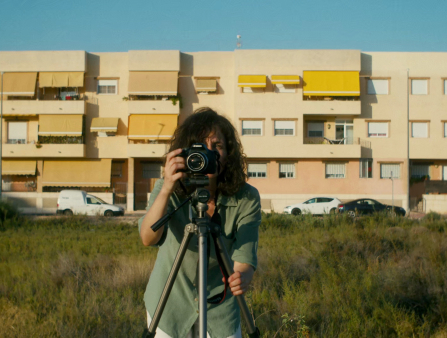
Letters From an Inner Exile. Courtesy of FIDMarseille
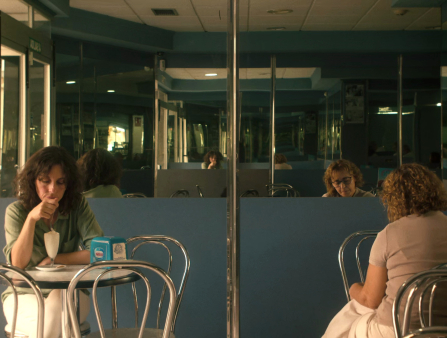
The letters and the photographer’s journey both move through named, specific ground: the port at Alicante, where the Republican evacuation collapsed in the spring of 1939; the concentration camp at Albatera; the monastery at San Miguel de los Reyes, converted into a prison; the women’s prison at Segovia; the bullring at Badajoz; the camp at Soneja. Around these places, the film builds its relationships less through plot than through circulation—letters and photographs, some found in the historical record and some made for the film, passed between the defeated and the generation that came after—so that the connection between 1939 and now is carried object to object rather than narrated as history. That connection has its own present-day counterpart within the film: The photographer is dealing, in the framing story, with the death of a relative and the ensuing negotiations over inheritance. Family, in both Enciso’s film and Baloji’s installation, stands in for the nation in miniature—a group of people obliged to relate to each other, to find ways for their divergent inheritances of a common history to coexist.
That phrase from FIDMarseille’s synopsis, “a cartography of the memory of the defeated,” describes Landscape Lens about as well as it describes Letters From an Inner Exile. Baloji’s installation is built around actual maps—colonial electoral boundaries, a hand-drawn record of guerrilla routes, mining production overlaid on a landscape—so that memory, again, is figured as terrain to be charted rather than a story to be told. Both works are road-journey structures at their core: an artist moving through a landscape to gather what a defeated history has left behind, that history distributed along a route rather than delivered as a fixed account. And both stage forgetting and inheritance across generations at once—Enciso’s photographer inheriting her family’s unresolved past has a counterpart in Baloji’s new portraits, in which his contemporary subjects are seated beneath the family photographs and devotional images they’ve had to inherit in turn. In both works, text and image move alongside each other rather than one describing or driving the other, which keeps at bay the spell that a settled, seamless account of reality can cast over a viewer. There are many kinds of hybridity in all this, not only in the object made, but in the practice that makes it, the venues that hold it, and the mixed economies—of grants, sales, commissions, audiences, careers—that sustain the people who make this kind of work at all.
Neither Baloji nor Enciso set out, I think, to argue that documentary should dissolve into everything adjacent to it. Both are documentarians in some part of their practice, and both know the difference between what’s evidently documentary and its neighbors well enough to choose which tools to use and which not to use. What their work leaves each of us with is a case, not a rule, and the question worth carrying out of Arles and Marseille is one to ask of any single work, rather than of documentary as a whole: Is this particular piece of remembrance better served by documentary knowing and respecting its own parameters, or by pursuing a more blended strategy? Neither Landscape Lens nor Letters nor any other single work will answer that question, but they can remind us that it has to be asked again, each time, of each work that takes up documentary’s purpose.
This piece was first published in Documentary’s Fall 2026 issue.