

Polish filmmaker Kamila Serwicka was a third-year cinematography student at the Lodz Film School when she returned home. There, armed with a camera, she witnessed the end of what had led her to leave her family when she was still a teenager. In a tiny village near Kielce, Serwicka had grown up with her younger sisters Natalia and Kinga, her mother Agnieszka, and her father Wojciech, who had subjected the family to years of domestic abuse—a pattern her grandmother Danuta had once endured in her own marriage.
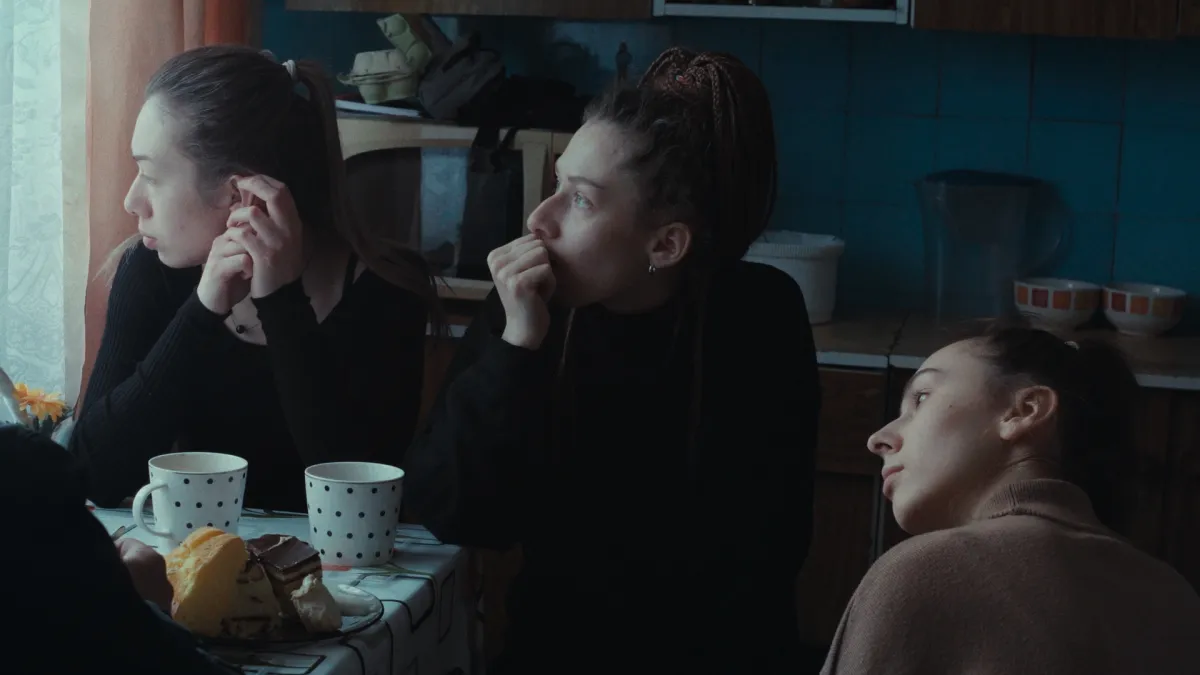
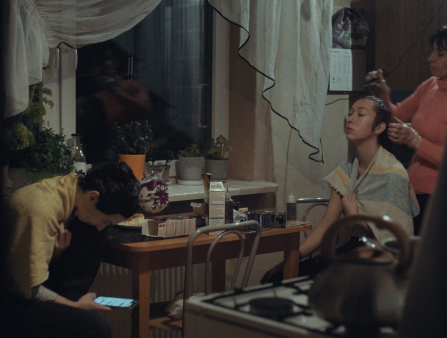
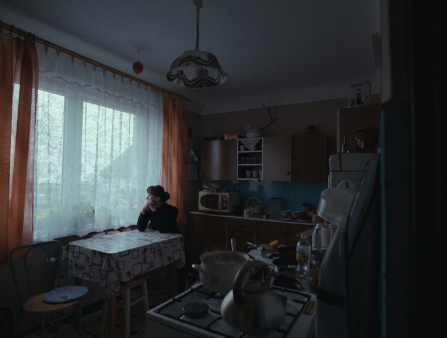
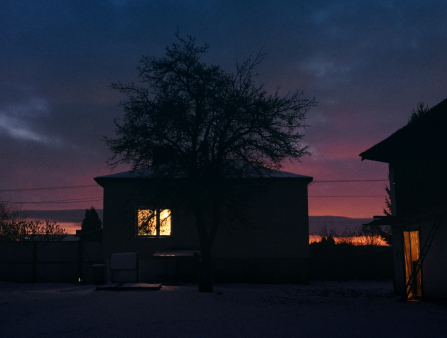
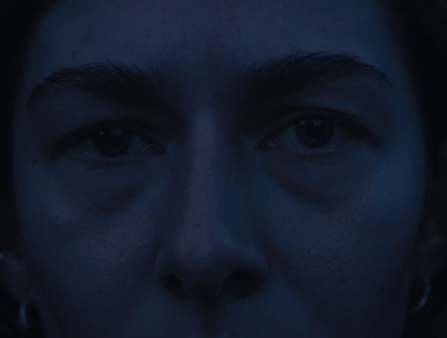
Serwicka opens Blossoming by turning her amateur camera on herself against the gloomy backdrop of the house, before stepping inside as an embodied witness. Within those walls, Wojciech looms large as a threatening figure. His drinking drains the household’s budget while he humiliates and terrorizes the women he lives with. Agnieszka works long shifts at the grocery store and takes on the tougher labor of raising and protecting her three daughters. Yet Serwicka keeps the violence beyond the frame. Through her grainy handheld camera, she instead lets the house express the fear hanging in its every corner—in the claustrophobia of its cramped corridors, in a glimpse of the snowstorm through frosted glass; in the nauseous squeal of the kettle. Serwicka catches each detail with the hypervigilance that oppression breeds.
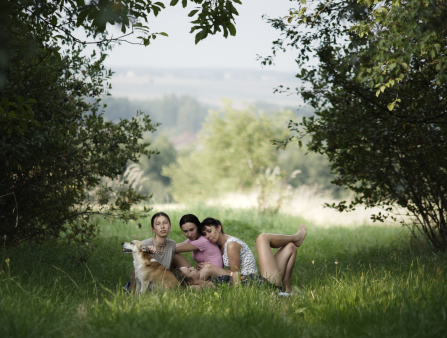
When, after yet another violent incident, the police take the father away, the film pivots to recovery and the strength of sisterhood, only then revealing the full metaphorical charge of its title. Therapy sessions, emotional conversations over dinner, and new plans for the future coincide with the arrival of spring, as the house, like the women, begins to bloom. Serwicka gradually changes her cinematography to convey how everything in the house grows brighter, clearer, and safer, until the film settles into a pensive calm. From this intensely intimate world, Blossoming expands into a study of inherited trauma across three generations of women, and ultimately reveals how blending observational and participatory filmmaking can not only bear witness to a complicated healing but become part of its very fabric.
I spoke with Serwicka ahead of the film’s screening at DOK Leipzig about turning anger into the strength to tell this story, distilling a dramatic arc from the energy of the house, and why she sees the film as part of a larger national mission. This interview has been edited for length and clarity.
DOCUMENTARY: The film opens on the clear premise of your return home—to tell a story of domestic abuse in your family. As a student at the time, how did your studies inform that decision?
KAMILA SERWICKA: I left home when I was 15, as the situation was very tense. I disagreed with my father; we had a lot of fights, and I decided to change my environment. From my tiny village, I moved to a tiny city called Kielce, where I enrolled in an art high school. Here I have to mention one person—Marcin Bondarowicz—because of him I took an art path as such. As a child, he taught me painting in a youth center in a nearby town. Besides being my mentor, he was a father figure through all that hard time. I am honored that he made a poster for Blossoming.
Entering art school, I discovered an entirely new world, where people don’t believe in the same God, don’t listen to the same music—everything was so big and new to me. I was ambitious to do something with my art drive, so I barely slept and worked as hard as I could. I was lucky to meet great people, like my best friend Anna Jasińska, who opened this magical world of film to me. Together we passed the exam for Lodz Film School. Studying cinematography helped me to develop a sensibility for the world and how I want to express myself—I was just nineteen at the beginning of my studies.
In the third year, I had an assignment for a documentary course: to make a short during COVID. Because of Wojciech Staroń, the head of the course, I really started to understand what documentary is, for me—more about getting to know people and searching for answers inside my head and heart. Around that time, I also started therapy, digging into the topic of my family, as I couldn’t bear it anymore. Therapy reveals many hidden things inside the head that are really hard to say out loud. Perhaps because of it, I was able to even think about filming in my family home—it was a way to process that influence and feelings.
Continuing therapy, I, in a way, returned to my past life with a small camera, and decided to look at my family through it. I first shot a small documentary about my sister preparing for her graduation exam. Because of escalating [COVID] restrictions, I felt trapped there, but it gave me the ability to see my entire family in the same place, as when I left home, but with a new perspective. Gradually, the camera became an observer of the beginning of change in my family, and I really wanted to take it on as my main focus.
D: You say “observer,” but it’s also very much an embodied type of witnessing. How did you integrate that subjectivity, achieving trust of your family within such a vulnerable position?
KS: Above all, I needed to make them feel comfortable, so I began by leaving my turned-off camera on the refrigerator or table, and they began to ask questions. As I carried a camera with me all the time, they started to treat it like an integrated part of my body. Sometimes I would record, sometimes not, or they would explicitly ask me not to film. I had to be really sensitive and super focused on the barriers they set.
I learned how hard it is to make a documentary about a family, because knowing your family does not release you from the work of getting to know them better. A relationship this deep asks for even more care in what you do, since the responsibility is enormous. There were times when I had to turn off the camera because I needed to be fully present in a particular moment for my family.
D: Did the camera also work as a form of protection, or as a catalyst for the central decision of the film?
KS: The central decision certainly wasn’t because of the camera. It was when my mother called me after one of my father’s devastating actions and told me that she wanted to change something. The police took him from our home, and because of it, in our home and in our heads, space cleared. My mother felt that she was no longer under his pressure, and that there was a chance to do something. I felt so proud of her then, and I just felt that I needed to record this process.
It was her decision that made me feel I needed to tell the bigger story about my family, called Blossoming. The camera was the observer but also a part of the family, and I did my best to make the viewer feel that this is my POV. That’s why I really focused on the handheld effect and kept the shots where I changed the focus or set up the frame.
D: It’s fascinating how you cinematically convey the sensorial texture of existing in the house, which takes on its own vivid dramatic arc. What were your methods for achieving this effect?
KS: Thank you for mentioning it, because it was such an important thing for building the film’s environment. It was essential to convey that feeling of claustrophobic pressure, so I put the whole world inside our house. The house also purposefully confines the action in this film to give a sense of that oppression when you live with a person who has a damaging influence on you and have no privacy in such a tiny space. I used long lenses to make it feel even more cramped, and if I wanted to film something outside the house, I would first do it through windows.
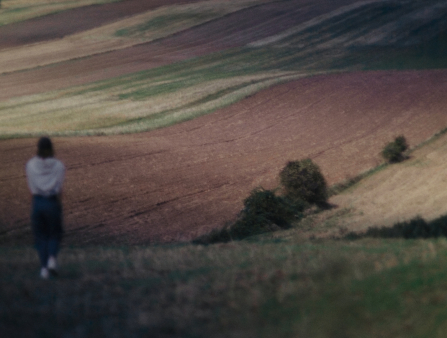
That aesthetic development happened through the change of equipment. Initially, I shot on a very old Canon 60D, and after my father left, I switched to a Sony Alpha SLL. To change both the camera and the lenses was so helpful in showing the house changing gradually, as we were.
At the beginning of the film, the image is grainy and high-contrast, and over time I reduced the grain for a sharper, cleaner look. Then we see more conversation appear between us, and we see that even outside things seem to be quieter, less frightening even. Everything starts to bloom, and the house becomes wider and brighter. All of it was central to achieve during the editing—to present the story in a clear order, with dramaturgy and a sense of passing time.
D: Speaking of editing, Blossoming feels so emotionally and eventfully expansive for its only 74-minute runtime. Assuming you shot a great deal of footage, how did you achieve that brevity during editing?
KS: Editing was really complex, because I shot this film for about five years by myself. It was really crazy because, on different levels, it’s a really intimate story and also too large to compress years into one hour. Editing somehow became a part of my cinematography: during the filming, I decided what I would or wouldn’t show. Especially the first, abusive part of the film, I focused on a process inside me, my mother, sisters, grandmother, and even a bit inside my father, but not on abuse and alcohol—we have almost none of it at all. We see only the tension between people, and that once my father appears in a frame, everyone gets tense and quiet.
My first editor was my good friend, Asia Szczęsnowicz, who over three years delivered an hour and a half of rough cut. The story was there, but the dramaturgy was missing. Editing a feature-length documentary for the first time was overwhelming for both of us. After a couple of years of the process, we decided to part ways and look for someone more experienced and with a fresh perspective. That’s how I found my new editors, Kuba Darewski and Julia Oleksy, who fell in love with the story and felt a certain familiarity with it. It is, I think, a strong thing about this film—people can see themselves in this story because this oppressive relationship within a family, or even in friendships, is genuinely global. If we were to sum up all the days we worked on the edit, it would be a total of 7 months without any breaks.
D: In another interview, you said that you would like this film to reach people on a wide scale; how do you see its activist effect?
KS: This film is a kind of mission for me. Coming from a dysfunctional family from a small village and economic hardship, I find it to be quite a privilege to attend a film school and gain tools that made it possible to tell this story. I have a really big responsibility not only for my family but also for all the people with similar stories. It is really important for me to fight for all the people who have similar experiences but can’t speak up for themselves because of the fear.
I wanted to make this film for these people who might have lost their hope for a better future. I wanted to let them know that they are not alone in their suffering and show them that you can succeed in a fight for your own and your family’s happiness. It’s gonna be very difficult, for sure, but that’s the fight worth fighting. Because who doesn’t want and deserve to have peace in life?