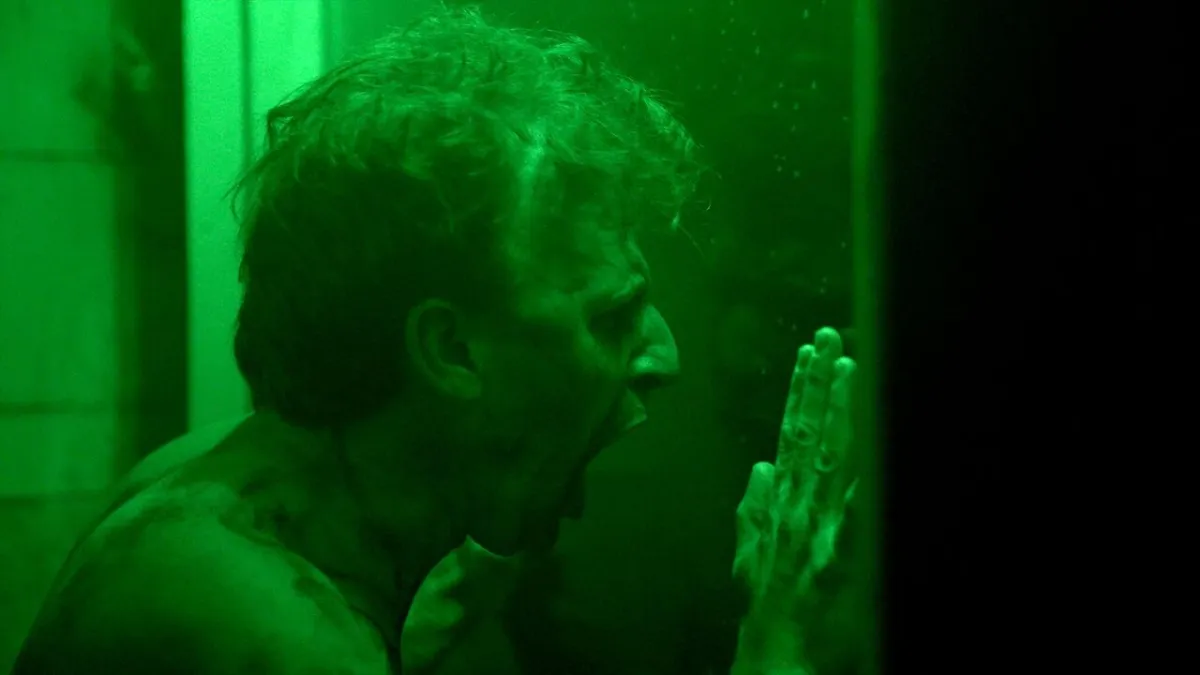


A “horror film about care” is how multi-disciplinary artist Nathan R. Stenberg has described his initial concept for the Tribeca-premiering The Haunting of Pennhurst, a simultaneously disturbing and empowering doc he’s crafted along with fellow interdisciplinary artist Katarina Poljak and filmmaker Mike Attie (2014’s In Country). The film is an archival and vérité look at the Pennhurst Asylum, a tourist destination in Spring City, Pennsylvania, famous for its visceral “haunted attractions” and likewise infamous for having once been home to the Pennhurst State School and Hospital, a facility that systematically tortured and experimented on its disabled residents for close to 80 years.
But what makes the multimillion-dollar enterprise truly stand out is that the majority of the “haunters” staging those spooky attractions are themselves disabled, including museum director and volunteer trainer/makeup artist Autumn Werner, who serves as the main guide in the doc. For this group of creatives, what was once a house of horrors has become a space to retake the narrative and to educate others so that the dark, ableist policies of the past are never instituted again. (Whether that message stays with visitors as they exit the gift shop or browse the Etsy store is less clear.)
Soon after The Haunting of Pennhurst’s debut in the Escape From Tribeca section, Documentary reached out to the diverse trio of directors to learn all about their unique collaboration, as well as filming in a place of preservation financed by fear. This interview has been edited for length and clarity.
DOCUMENTARY: How did you all decide to embark on this project? Had any of you worked together before?
NATHAN R. STENBERG: I came to Pennhurst through my doctoral research on care systems in the United States. I went there expecting to document exploitation. Here was a former institution, closed after years of abuse and neglect, now turned into a haunted attraction that sold tickets to unknowing patrons, commodifying myth and capitalizing on stereotypes for profit.
Then I met the haunters. I found people who came for more than the thrill of scaring customers and a paycheck. They had built a community on a site designed to isolate people, strip them of control over their lives, and sometimes even kill them. That shift in understanding—what this place is to different people—broke the film I thought I was making and demanded a different one. It became a horror film about care.
MIKE ATTIE: I first visited Pennhurst in October of 2020. The Asylum was fully operational then, despite COVID restrictions still impacting our day-to-day. Nathan and I had spoken on the phone, but I didn’t appreciate the scale of the site until seeing it in person. It’s truly overwhelming, like an abandoned college campus.
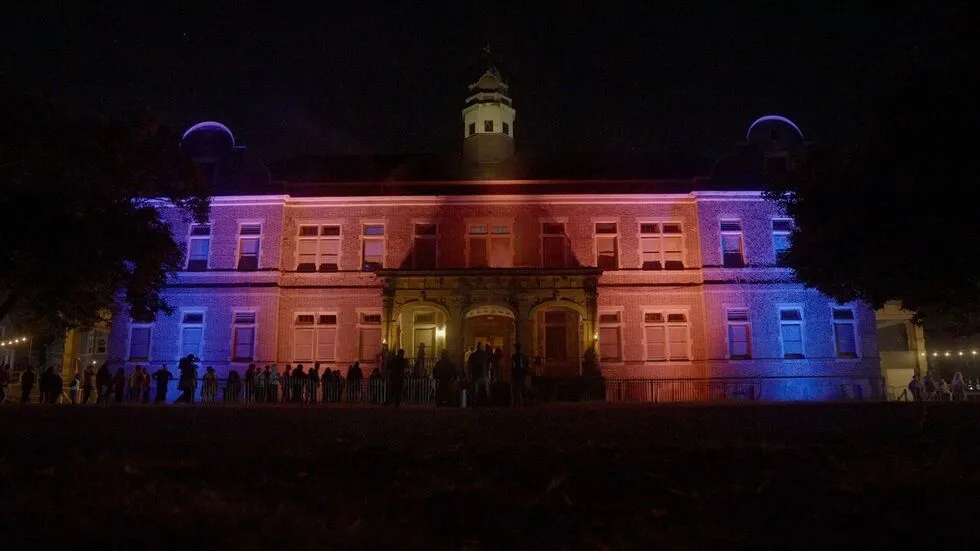
That night, I got to experience the haunted attraction and meet some of the performers. I still remember the chills I got when the entire cast and crew of the haunt lined up on the stairs of the old Admin building and took part in the pre-show “We Are Pennhurst” chant. At that moment, I knew it had to be a film.
KATARINA POLJAK: Mike was familiar with some of my earlier work, which leaned toward experimental horror and often involved collaborations with dancers and performers. He connected me to Nathan, and I joined the team in 2022.
At Pennhurst, I was struck by the way the haunters described a sense of empowerment through their performances. Haunting becomes a space where the grotesque can shift power dynamics. It allows the body and mind to momentarily transform how they are seen and understood, raising a central question: Who are we afraid of, and why? For spectators, the haunt becomes a test of bravery. For performers, it can be a site of release, an unruly space that pushes against expectations of what constitutes an “acceptable” body or mind.
As co-director, I bring a poetic and visually driven approach to the film, while also examining society’s enduring fascination with gore, spectacle, and the commodification of bodies and minds. The project felt like a natural extension of themes I’ve been exploring for years. It offered a powerful opportunity to interrogate how fear, performance, disability, and representation intersect.
D: How did you divide up directing duties? Was everyone involved in all aspects of the production?
MA: On location, the process was very straightforward. I was the cinematographer, Katarina did location sound, and Nathan acted as field producer. Our first season of shooting consisted primarily of vérité work with our participants, so it was quite fluid as we were just doing our best to keep up with the functions of the haunted attraction.
The following season, we were a bit more intentional with our production, deeply considering how we could give the site its own perspective and working more methodically to get specific images and sounds. This “season” of shooting was personally really enriching for me as I got to immerse myself in low-budget horror (1940s Val Lewton films) to develop an aesthetic and play with light and shadow.
NRS: Since on set our roles were clear, I was often tracking story, access, participants, and the larger historical context. But the film only worked because those roles were fluid. If someone saw something, heard something, or felt the scene changing, we followed it.
Post was where the collaboration became more complicated. Our editor, Sarah Garrahan, had to help us weave together the simultaneous narratives of the haunted attraction, the archive, survivors’ histories, and the site itself without letting one strand explain away the others. Our producer, Daniel [Chalfen], was also central to keeping the process moving and keeping us honest.
KP: While we each had defined roles, the visual language emerged through constant collaboration. We spent a lot of time talking about how to film Pennhurst not simply as a backdrop, but as a place where the past continues to watch the present. That idea influenced many of our creative decisions—from how we approached the architecture to how we followed haunters as they moved through spaces once occupied by inmates.
My background is in experimental film, installation, and performance, so I was particularly interested in creating images that hold multiple histories at once. I gravitated toward moments where the site felt suspended between realities: where performance, memory, spectacle, and trauma overlapped. We all shaped the visual approach by building a visual catalog driven by atmosphere, perspective, and confrontation.
Beyond production, I was deeply involved in both the archival and editorial processes. I spent time reviewing and pulling selects from our vérité footage and the archival materials.
The hardest part was resisting a clean emotional exit. There is no happy ending here. Pennhurst is a living monument, documenting horror, care, commodification, memory, and performance.
—Nathan R. Stenberg
D: The film deftly blends the contemporary vérité centered on the enthusiastic haunters with disturbing archival footage and audio accounts. Which made me wonder how you actually came up with this approach and balanced these dissonant threads in the edit.
MA: I had used an approach like this on my previous feature, In Country, which used vérité scenes from a contemporary Vietnam War reenactment, archival news footage from the Vietnam War, and personal recordings from our participants. Pennhurst was quite different, however, because of the specificity of the archive.
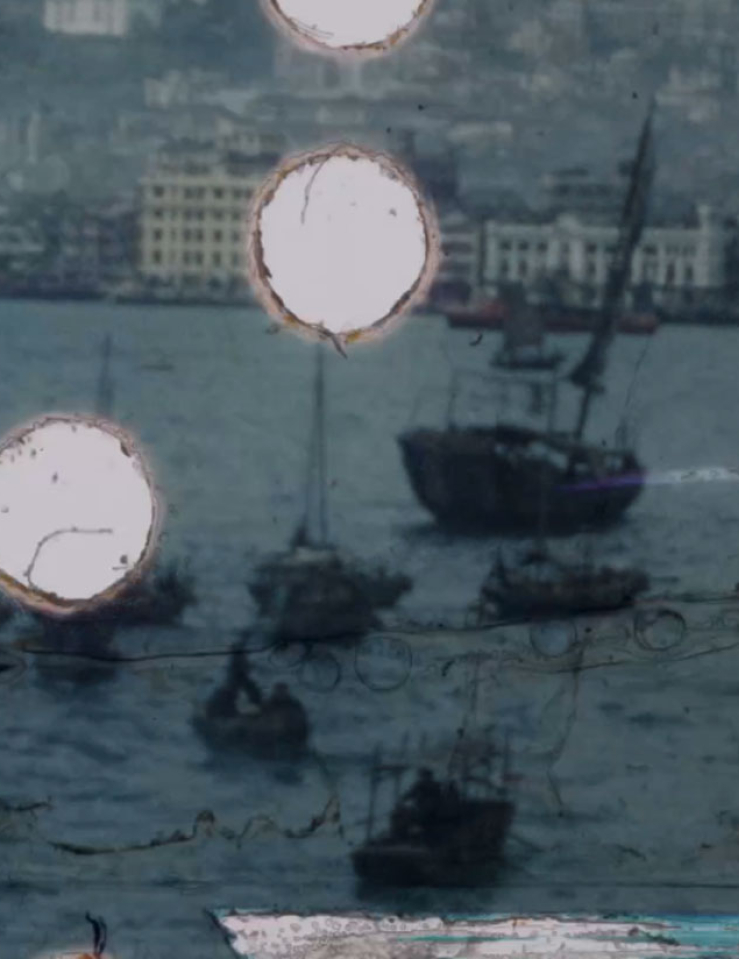
We had countless documents and news clippings about Pennhurst, both lauding its creation and reporting on the atrocities that took place there. There were also two key moving image pieces—Somebody Touched Me [1967], narrated by Henry Fonda, a beautifully shot and surprisingly haunting exposé documentary, and the multipart NBC news report Suffer the Little Children [1968], which brought widespread attention to the conditions at Pennhurst.
NRS: The edit had to hold two Pennhursts at once: the past and the present. Our editor, Sarah, was essential in finding that balance. The archival material is brutal, especially Suffer the Little Children, but we didn’t want to use it as shock footage. Yet we also wanted it to interrupt the present story, and make sure the audience was rooted in the history that built the myth and reality of what Pennhurst is today.care
The haunt also posed a practical problem. Haunted attractions are designed to lose people in space, darkness, timing, and surprise. Trying to capture that experience in film changes it—for the haunter, the patron, and the audience. To make up for that dissonance, the edit had to find other ways to make the haunt legible, through rhythm, sound, repetition, and the way haunters move through space.
The hardest part was resisting a clean emotional exit. There is no happy ending here. Pennhurst is a living monument, documenting horror, care, commodification, memory, and performance. If audiences leave unsure how to feel, that is the point. It is the most honest response the film can offer.
I think the film ultimately reflects all three of us. It has Mike’s attentiveness to lived experience, Nathan’s historical and ethical rigor, and my interest in visual metaphor, performance, and the ways people navigate systems that seek to define them.
—Katarina Poljak
D: Two of you are making your feature directorial debuts: Nathan, who is a disabled multi-disciplinary artist and scholar from Minnesota, and Philadelphia-based Katarina, an interdisciplinary artist whose work is shown in museums and galleries. While Mike, another Philadelphian, is an award-winning filmmaker. All of which makes me quite curious to hear how your seemingly diverse backgrounds informed the collaborative filmmaking process overall. How did you incorporate each of your individual POVs into a coherent whole?
NRS: My background taught me to think about structures, sound, people, and power at the same time. I was always asking how Pennhurst should feel, who controlled the story, and what the audience was being asked to sit with.
Music was central to how I saw Pennhurst. I listened to a lot of pipe organ symphonies while we were making the film. Organists think about sound as color, shaped through different pipes and registers. That influenced the film’s rhythm: when to let something swell, when to pull back, when to let silence do the work. Our composer, Dan Deacon, picked up on that and brought the organ into the score.
Mike brought documentary experience and a strong sense of structure. Katarina brought a visual art practice attuned to texture, atmosphere, and dissonance. I brought theater, disability studies, and a musician’s sense of composition. The film worked because we didn’t erase those differences. We let them press against each other, shaping a story that feels honest.
KP: The coherence emerged from a shared curiosity about contradiction. I think the film ultimately reflects all three of us. It has Mike’s attentiveness to lived experience, Nathan’s historical and ethical rigor, and my interest in visual metaphor, performance, and the ways people navigate systems that seek to define them.
D: Autumn stresses that visitors must be respectful since Pennhurst could indeed contain the spirits of those who were tortured on the site; but she also seems to have, if not made peace with the Ghost Hunters and Paracons and the non-disabled wealthy investors treading on sacred ground, at least come to terms with the crass commercialism as a means to achieving the higher goals of education and empowerment. Which made me wonder if you likewise wrestled with the fact that this preservation of crucial disability history is only made possible through the profits of dark tourism. Did you ever consider confronting the corporate capitalist elephant in the film, so to speak, more directly?
NRS: Yes, we wrestled with it constantly. The preservation of Pennhurst’s history is tied to dark tourism, and there’s no clean way to talk about that. Questions about ghost tours, private ownership, and profit are fair. They’re necessary. They also can’t be where the conversation stops.
The Commonwealth of Pennsylvania created Pennhurst, used it as a tool for extraction, and then abandoned it. It provided legal justification to take people from their families and communities. It extracted labor, privacy, autonomy, and humanity from the people confined there. Then Pennhurst was closed, left to rot for 20 years, and sold for one dollar, setting the conditions for its current afterlife. Now the site faces another potential extraction, with proposed plans to destroy what remains and build a data center.
The most damning part is that Pennhurst is the only operating museum of disability history and culture inside a former custodial institution in the United States. The only place documenting horror on the grounds of that horror. Its survival is precarious, and it exists alongside a haunted attraction because that model has kept the doors open. That should make people uncomfortable. Pennhurst’s history should not have to survive on fear. If this is what preservation looks like, it tells us exactly how little public value has been placed on disability history and disabled people.
KP: For me, that contradiction is at the heart of the film. At Pennhurst, I was interested not simply in the existence of dark tourism, but the ways people negotiate it. Throughout the film, we encounter individuals who are aware of the ethical tensions surrounding the site, yet continue to engage with it. They see possibilities for community, reclamation, remembrance, or survival. Those contradictions felt more revealing than a straightforward critique.
Rather than positioning corporate capitalism as a singular villain, I was interested in showing how systems of commodification permeate the entire landscape of Pennhurst. The institution historically treated disabled bodies and minds as objects to be managed, categorized, controlled, and profited from. Today, different forms of value are still being extracted from the site—through tourism, paranormal investigation, historical preservation, media production, and potentially future development. The forms have changed, but questions about who benefits, who is seen, and whose stories are told remain.
As filmmakers, we are also implicated in those dynamics. By making this film, we are inevitably contributing another layer of representation. Our goal is to invite audiences to sit with that discomfort, not to offer moral resolution. To ask ourselves why preserving this history required spectacle in the first place.