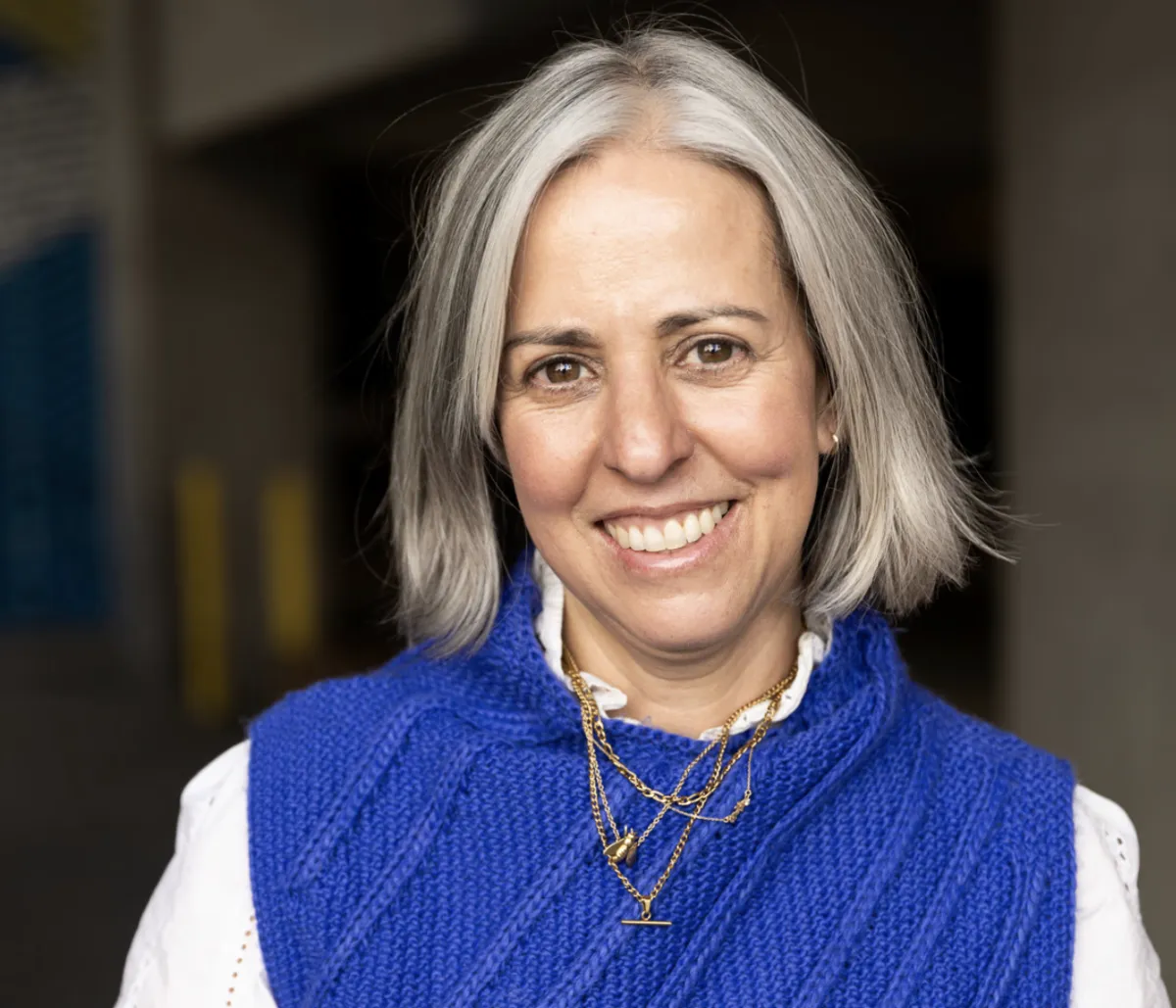
Jennifer Sofio Hall
Jennifer Sofio Hall is an Emmy award-winning producer and dynamic leader in the production industry, known for her dedication to innovation and growth. Under her leadership, MakeMake emerged as a leading force in advertising and entertainment, designing industry-changing titles for television and film, from Game of Thrones to The Last of Us, and collaborating with some of advertising’s best creative talent, winning dozens of awards, including Cannes Lions, BAFTAs, and Emmys.
About Industry Standard
Industry Standard is a catalyst for professional growth and workforce diversification. In an ecosystem that thrives on more voices, different stories, and new ideas, we foster connections between the creative community and the brilliant people they have yet to meet. Through specialized programs and services, we support emerging talent and build bridges to companies, studios, artists, and brands eager for fresh perspectives.
IDA: Could you share a bit about your background and the experiences that shaped who you are as a producer?
Jennifer Sofio Hall: I have had the chance to work across a lot of formats. Producing commercials. Post-producing for editorial, design, and visual effects. Each one runs differently, and each one taught me something the others could not.
That led to MakeMake, where I was Managing Director and oversaw the documentary division. That is where it clicked. I had a front-row seat to how much of a documentary is actually made in post.
There is no script. The story is found rather than executed, and it is found by editors, archival producers, sound teams, and post producers just as much as by the filmmaker leading it.
IDA: You’ve worked across scripted and unscripted, from a long commercial career and main title work with showrunners on series like Game of Thrones to documentaries like Freedom on Fire: Ukraine’s Fight for Freedom. How has moving between those worlds shaped your producing practice?
JSH: Every corner of this business works differently. The pace changes, and so does the way the storytelling actually gets built.
What carries across formats is the soft skills. Listening. Reading a room. Staying open to an idea that is not yours, especially when you already had one of your own.
Those are the lessons and learnings I try to bring to every project, no matter what I am working on. They never appear on a call sheet, and they decide whether people want to work with you again.
IDA: For members who aren’t yet familiar with Industry Standard, could you tell us about the organization, what it does, who it serves, and what problem you and Bedonna Smith set out to solve when you started it?
JSH: Industry Standard is a catalyst for cultivating a creative career. A talent support system, and not only for people starting out. It is for every level.
Talent support has always been at the core of how I produce. Get the artist what they need, get the conditions right, and the work gets better.
Industry Standard is an extension of that.
We help people identify and chart a career, name the obstacle in front of them, and get through it. COVID and the contraction that followed left a lot of creative people without the support they needed to thrive. I had many mentors over the course of my career. I want the people coming up now to have that too.
Experience Residencies is our cornerstone program, built specifically for documentary and supported by Netflix.
When the setting and the environment are right, talent does its best work. That is the entire premise.
IDA: Experience Residencies grew out of a pilot program you ran while still at MakeMake. What did that pilot teach you that told you it needed to become something bigger?
JSH: The pilot sat inside a production company. That is a limited reach for something designed to go deep into the industry.
Whatever network a resident walked out with was the network of one employer. Generous and bounded. If the point is relationships that outlast a single job, the program has to touch more than one company.
So residents are now placed one to a studio, across eight of them. The network they leave with is theirs, not their host’s.
IDA: Experience by Industry Standard places emerging documentary professionals inside working production companies for nine months. What was broken that made you build it, and how does the program answer it?
JSH: The industry has gotten reasonably good at first jobs. What almost nobody focuses on is the second one.
Someone finishes a good placement, the show wraps, and then there is silence. No network to call, nobody to ask whether the rate they were offered is insulting, no way to tell whether three months without work means the market is slow or means they failed. We call it the re-employment cliff. It stays invisible because the people who fall off it go quietly, and the market has made it worse. Fewer projects mean fewer openings, and when openings are scarce, the people already known get called first.
So the program exists to create access to a closed industry, and to pull people up rather than hold them steady from underneath.
This year, we placed eight people across Ark Media, RadicalMedia, Union Editorial, Library Films, Campfire Studios, Archival Ninjas, Vaudeville Post, and Mezzanine Media. Full-time and paid, with benefits, on the crew rather than shadowing. Each of them has a mentor inside the studio and a standing call with me every other week for nine months. That is long enough for the people working beside them to become personally invested. Department heads put in their own hours, so they have a stake in what happens next.
IDA: You’re about to wrap the 2026 cycle. What areas are the 2026 Residents working in?
JSH: All of the Residents have a background in nonfiction filmmaking. Three are in editorial, two in archival research and producing, two in post producing, and one in sound post.
The mix is deliberate. I’ve always appreciated that careers in post-production offer longevity and durability that are unique to creative fields. They often work in teams and are highly collaborative. When you look at the programs available to emerging filmmakers, they are often in above-the-line roles. Post-production has fewer ways in.
This year, Industry Standard residents have contributed to both independent and streamer documentary features and series at their host studios, for Netflix and HBO, and on titles headed to festivals in the coming year.
The 2026 cycle wraps in September.
IDA: You map the nine months of the Industry Standards experience as a sequence: observation, first contribution, friction, volume and pressure, ambiguity, then transition. Which phase do people get wrong?
JSH: The first one, almost every time.
Observation gets misread as passivity. As a weakness. So they rush to prove themselves before learning the rhythm of the team they just joined, and what comes out is early overconfidence, premature judgment, and anxiety wearing the costume of certainty. Watching is the work in month one. Nobody believes me until month four.
Then, early contribution, where reputation compounds quietly through responsiveness, preparedness, tone, and follow-through. They almost universally mistake visibility for value.
Then friction, where they have to earn authority without getting cocky. Standing first, then voice. Confidence is clarity plus humility. Jason Peckham, Archival Resident, arrived at Campfire assuming that with a team that size, his voice would be lost. The team engaged him in the work and made room for him to meaningfully contribute. He was not expecting that, and I think it rearranged something for him.
Then volume and pressure, which run underneath most of the residency’s experience. Residents are over-performers who over-commit out of fear and go quiet about it. Landon Bost, Editorial Resident, worked this out early. Sustaining this level of work over months takes real stamina, and he built it, along with something most people take years to learn. Pacing is part of the craft. Protecting your capacity is what keeps the work strong.
Then ambiguity, the phase I spend the most time on. An emerging person hears everything said about them as a verdict. An offhand remark on a Tuesday gets carried for a month, weighted the same as a considered note from their mentor. So we work on sorting. Whose feedback is about your development, and whose is about their afternoon.
Then transition, which is where all eight are standing right now. It is scary, and I cannot make it not scary.
IDA: What does somebody learn inside a company operating at volume that they can bring to an independent film production?
JSH: Systems, and what systems are actually for.
Documentaries almost always take longer than they are expected to. Schedules extend, funding gaps open, and people leave. An editor books what was meant to be twelve weeks; it becomes nine months, so they go, and somebody else picks it up. That is not a failure of the production. It is the normal condition of the form.
What a company operating at volume has solved is the handoff. Their systems exist so a project can change hands without two weeks of onboarding and without the next person having to decode how the last one thought. Bins are named the way everyone names bins. The clearance log lives where the clearance log lives. Nobody has to be in the room to explain it.
Meron Tebeje, Archival Resident, learned that by design. She started her residency at Archival Ninjas before moving to RadicalMedia partway through, so she had to pick up cold inside a second system. She can now walk into either kind of room and find the thread. Celi Mitidieri, Post-Producing Resident, spent the cycle in the pipeline on documentary features at Union Editorial, tracking cut versions and handoffs into color and sound.
That sounds like housekeeping, and it is actually a culture. Systems let people come and go while the work stays at the center, rather than the personalities. The project belongs to the project.
IDA: What have this year’s eight Residents told you about the year and their experience, in their own words?
JSH: Not the polished version. The honest material arrives at the midpoint, once they have stopped performing gratitude.
Zaki Farooqui, Editorial Resident, went and found the editorial leads at Union himself, because he wanted somewhere to ask the granular craft questions. Not a panel. A room small enough that he could admit what he did not know and dig in properly. Nobody assigned him that. He decided the year was his to use.
Rita Carmona, Sound Post Resident, arrived with two years of experience in sound, real skill, and a growing community of emerging filmmakers hiring her. Steady work. No door into anything larger. And by her own account, a great deal of imposter syndrome. A few weeks ago, she sat down with her studio, laid out every project she had touched this year, and told them what she wanted next.
That is the distance.
These can look like byproducts next to a credit on a Netflix show. They are the actual purpose. Craft gets you the first job. This is the layer that builds a career.
IDA: For our members interested in working with and learning more about the Industry Standard residents, what should they know going into that relationship?
JSH: That they will show up prepared, and that preparation is the whole thing.
They know how to be in a room. How to take feedback without collapsing or defending. How to say they are at capacity before the work starts to suffer. How to hand a project off cleanly and how to pick one up cold. None of that appears on a résumé, and all of it is what separates a contributor from a pair of hands.
Victor Dias Rodrigues, Editorial Resident, is the clearest case. He joined a Netflix series in its final weeks, which is the hardest moment to join anything, and the editor pulled him onto the next thing the day it wrapped. Senior people do that when somebody makes the work easier rather than heavier. Bridget Stevens came in as a Post-Producing Resident with a background in network long-form and has emerged from the cycle as an associate producer who can carry nonfiction from research all the way through delivery to a streamer.
What people underestimate is what comes back the other way. These eight will teach the filmmaker things. I have learned from each of them this year about the work and what it costs to build a career right now.
Their profiles and contact details are on our website here, and I am glad to make the introduction myself.
Eight a year is not a solution to an industry this size. It is proof that the thing can be done. We are reviewing applications for the 2027 cycle now, which starts in February, and I have no doubt this group turns up in it as peer mentors, pulling the next cohort deeper into the industry the way the cohort before them did.