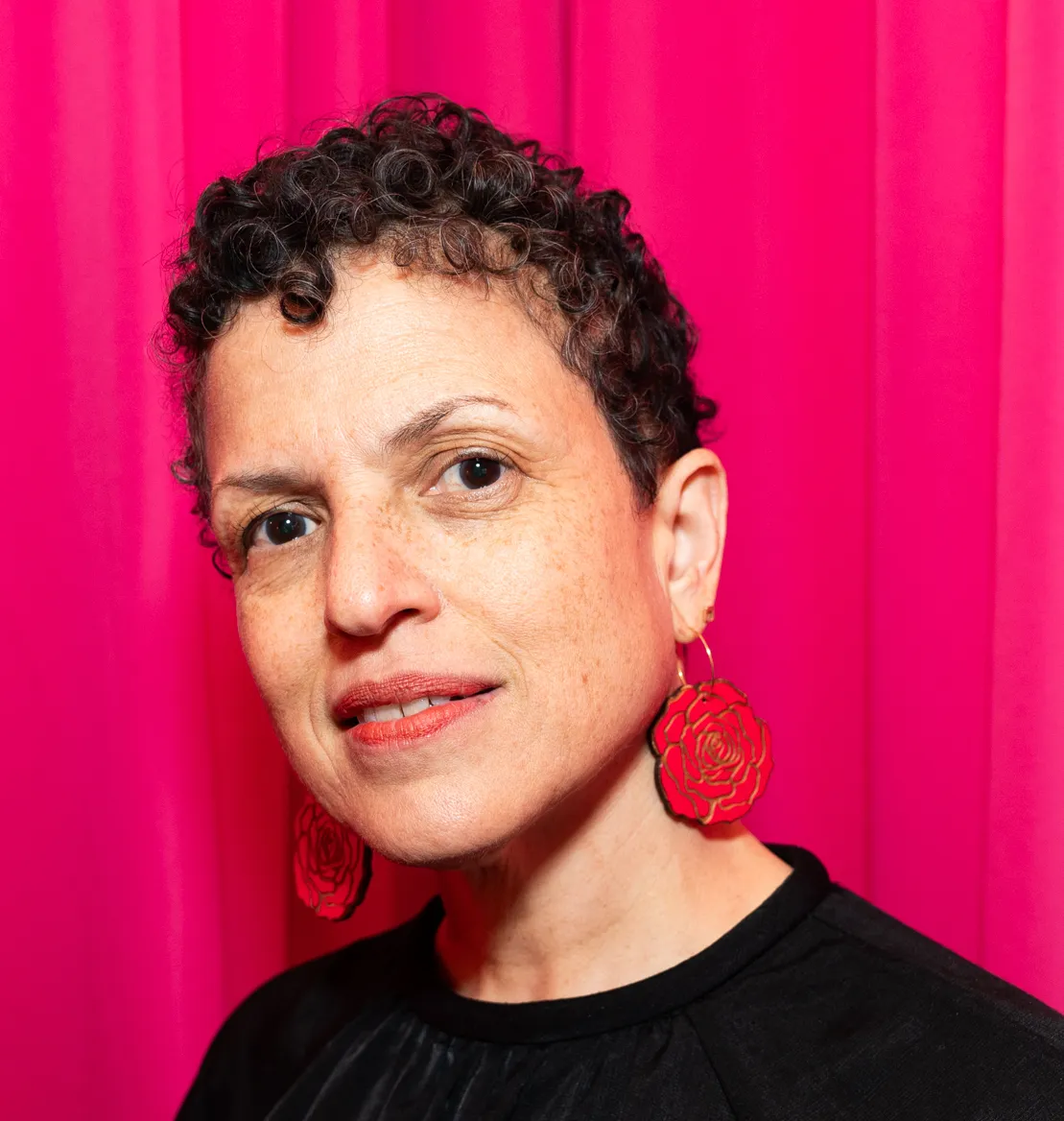
Michèle Stephenson
Emmy, Guggenheim, and Sundance Award–winning filmmaker, artist, and author, Michèle Stephenson, draws on her Haitian and Panamanian heritage to transform nonfiction storytelling. Through a Black Atlantic lens, she reimagines narratives of resistance and healing, weaving fiction, immersive, experimental, and hybrid forms that center a Black Radical tradition and the lived experiences of the Black diaspora. Her nonfiction films Going To Mars: The Nikki Giovanni Project and Black Girls Play: The Story of Hand Games were both Oscar-shortlisted, with Going To Mars winning the Sundance Grand Jury Prize and the prestigious Emmy Award for Outstanding Exceptional Merit in Documentary Filmmaking, and Black Girls Play winning the Edward R. Murrow for Excellence in Video. Her other body of work includes The Changing Same, a magical-realist VR installation that premiered at the Sundance Film Festival’s New Frontier Showcase and won Tribeca’s Grand Jury Prize for Best Immersive Narrative. Her NFB co-produced nonfiction film, Stateless, received a Canadian Screen Award nomination. Her newest work, True North, which premiered at TIFF and was recently released in theaters and on PBS’ Independent Lens, is a creative nonfiction feature that explores the history of the Black liberation movement in Canada. She is a Creative Capital Artist, a Black Film Project Fellow at the W.E.B. Du Bois Research Institute, Hutchins Center for African & African American Research at Harvard University, and a member of the Academy of Motion Picture Arts and Sciences.
IDA: Could you share a bit about your background and the experiences that shaped who you are as a storyteller?
Michèle Stephenson: Wow - that is a very expansive question. So many influences come to bear on my storytelling. From the politically radical influences of my dad that he was intent on passing down to me, his only child, and his out of the ordinary bed time storytelling, to my mom’s unconditional love for me.
Growing up as part of a Haitian and larger Caribbean diaspora in Canada and the United States had this deep effect on my lens that pushed me to turn towards the Caribbean, its history and relation to North America, and what it means to be part of a diaspora, a people in movement, that exists right in the belly of Empire. This influenced my choice of study and work in my previous careers and also the stories I chose to tell - understanding that art and storytelling are political weapons.
From an aesthetic perspective, the evolution has been enormous since my very first short film. Having never gone to film school, I always felt a sense of insecurity that led me to challenge myself with each film I made. So, at Rada Studio, we have evolved significantly in our aesthetic approaches. And I have come to understand that the aesthetics of cinema are equally political as the content of our films, and crucial to the search for defying Empire and racial capitalism. Archive plays a crucial role in this process and has become a deeply rich space for exploration, experimentation, interrogation, and challenging our creative practice.
IDA: Your work moves fluidly between different forms, from more traditional forms to immersive media and speculative storytelling. What role does formal experimentation play in your practice and work and the stories you tell?
MS: I believe form is political. The conventions we choose to use to tell our stories make a statement about what we value. So, for me, playing with form becomes a space to challenge norms we have internalized and normalized that don’t center or value the ways we engage with each other. Now, that doesn’t mean that at times I don’t lean on three-act structure conventions or character building at certain points. But it means I must question each intention to expand my world-building and honor forms and modes. It can be challenging but always exhilarating.
So, formal experimentation is an integral part of my practice. It has also become an organic process in which the material, the idea, and the footage inform the formal decisions I make. But also key to this movement with form are the collaborations that exist along the way. World-building and challenging forms require investment and trust in the collaborative process, where respect and space for creative iteration as a team become the bedrock of our work.
IDA: Congratulations on True North, premiering at TIFF last year. For members who may be new to the project, could you tell us a bit about the film?
MS: Set against the backdrop of 1960s Montreal and centering the testimonials of those who led a movement that changed the trajectory of the global Black liberation movement across the Western Hemisphere, TRUE NORTH unearths two pivotal but underrecognized events: the Congress of Black Writers and the Sir George Williams Affair, positioning the city as a crucial nexus in the global Black liberation movement. Through never-before-seen archival footage and intimate first-person testimonies, the film revisits a charged era of resistance in which Black students and activists challenged institutional racism, sparking reverberations across the globe. Canada would never be the same after these events. TRUE NORTH is a love letter to 1960s Montreal and a radical reimagining of its place in global Black history.
IDA: When did you begin working on True North, and what inspired you to look back at the student protest movement of the 60s, specifically in Montreal and Concordia University?
MS: Growing up in the Montreal area, I felt robbed of the history of the contributions of my community to Canadian society. True North emerged from a sense of anger and a deep urge to “set the record straight” from the voices of those who had been made invisible, to honor the work of my parents’ generation, and to center Black Atlantic solidarity and community by using exciting cinematic expressions that challenged conventional uses of archival material and first-person testimonials while centering a collective narrative that did not prioritize one individual voice. To honor that Black Atlantic solidarity, I had to play with the form to center a mode of expression that is fluid and full of movement and rhythm.
The seeds of the film were planted back in 2021 when I was hired to work on an episode of an 8-part series on the history of Black Canada titled BLACK LIFE UNTOLD STORIES for the CBC (Canadian Broadcasting Corporation). I was immediately drawn to the episode covering the late-60s Black Liberation movement. I knew little to nothing about the seminal events described in the film, yet I went to college with, and became friends with, one of the movement leaders’ daughters, and I also came to learn that my family members and my parents' friends were heavily involved in these events. We had never discussed these events within our community and had never learned about the Black liberation or the Canadian civil rights movement in school. I believe the ancestors were calling and directing me. The resulting 45-minute episode was titled Revolution Remix.
The series’ producer, Leslie Norville, and I were so overwhelmed by the richness and complexity of the archive we came across that we decided to embark on creating a feature-length film that would center the archive and the voices of the people who directly led and experienced the movement firsthand. There was just too much material left behind that deserved so much more. We felt it was our duty to explore these moments using a rich cinematic palette that honored the sacrifice that our elders made.
IDA: What has been the film’s reception, and does it resonate with the impact you hoped it would inspire?
MS: Oh, yes, very much. The film premiered at TIFF last year and has continued a robust rollout beyond the festival, with recent theatrical runs in Canada and beyond. The film has qualified for the Oscars and continues to draw not just strong audiences but provokes deep conversation after every screening. Overall, people seem consistently blown away by what they have learned, but also by the deeply immersive emotional way they have absorbed the story. It seems to stay with them beyond the immediate theatrical experience. You couldn’t ask for more as a filmmaker.
IDA: For members who want to watch True North and stay connected with your work, what's the best way to see the film and follow what you do next?
MS: The best way is to join our Rada Collaborative newsletter - go to radastudio.org and follow us on IG @radastudionyc and @michele_0608. We post our screening schedule on those socials as well.
While the film was made to be experienced in community in the theater, understanding the limitations that poses for many, it is also currently available on the Independent Lens YouTube Channel for everyone to access – which is awesome. No paywalls!
IDA: Looking ahead, what’s next for you? Are there any upcoming projects you’re able to share with us?
MS: Yes, I am super excited and deeply grateful to be able to continue doing the work and deepen my practice with our upcoming hybrid projects: The Ordinary Life of Paul Robeson (working title) is currently in the works with my continued creative collaboration with my partner Joe Brewster, and I am at the early research phase of a deeply personal hybrid film, Las Milagrosas (working title - aka My Grandmother and Oshun).