
Online Feature

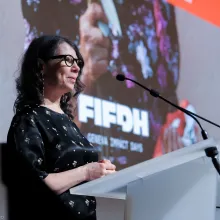
Close to the start of her hypnotic documentary The Memory of Butterflies, director Tatiana Fuentes Sadowski describes the moment that inspired the film. While looking through a selection of propaganda images taken by a company operating in the Amazon during the late 19th-century rubber boom, Sadowski came across a posed portrait of two young Indigenous men. In the image, the pair stands hand in hand dressed in Western clothes, stiff suits and ties, gazing at the camera with solemn, unreadable expressions: Omarino and Aredomi. Documentary spoke to Sadowski shortly after the film’s premiere at the Berlinale, where the documentary jury awarded the film a special mention, about the ethics of colonial archive, cinematic speculation, and sound as a threshold. This interview has been edited for length and clarity.
In Imago, the Chechnya-born filmmaker Déni Oumar Pitsaev journeys to a Chechen enclave in Georgia named Pankissi, where his mother has secured a plot of land for him to settle down. He spends time with his mother, with whom he’s close, and a hearty cousin and a friend, but he has barely seen his father since his parents divorced when he was nine months old. That’s on top of a childhood marked by his and his mother’s stays in Kazakhstan, Chechnya, and—when the Russians attacked Grozny in 1996—St. Petersburg, where she changed his Chechen name for his protection. After Imago won L’Œil d’Or, the best documentary prize of Cannes, Documentary interviewed Pitsaev about starring in a film about his life journey and the balance between pre-planning and responding in the moment.
Last year, national and international press widely reported on what The Globe and Mail described as “the most tumultuous year in the festival’s history,” complete with sweeping personnel changes, social and financial pressures, and the temporary closure of their flagship Ted Rogers Cinema. Though Hot Docs managed to pull through for its 32nd year with a new executive director (Diana Sanchez, formerly of TIFF) and a replenished staff (some of the programmers, including department head Heather Haynes, returned after their prior exodus), what frightened this hamstrung fixture of Toronto’s flailing film scene was dismally clear. Social issues don’t entirely permeate the programming, nor do their chosen films observe such issues in totality, but Hot Docs has always strived to stay in tune with urgent matters of the present, especially through films that align their audience’s point of view with what will one day be the right side of history.
Amid the past few decades of Holocaust-focused works, queer artist Kinga Michalska has found a unique approach to “the Holocaust memory documentary” in their native Poland. Their feature-length debut, Bedrock, is a psychological journey through the contemporary sites of former concentration camps and mass graves. It also poses the rhetorical question: What does “never again” really mean? Bedrock premiered in the Panorama section at the Berlinale, where Documentary spoke with Kinga Michalska.
Founded in 2008, Doc Alliance is a collaborative network of seven key European documentary festivals—CPH:DOX, Doclisboa, FIDMarseille, Ji.hlava, Vision du Réel, Dok Leipzig, Millennium Docs Against Gravity—dedicated to promoting arthouse non-fiction cinema and supporting emerging filmmakers. For over 15 years, the initiative has played a pivotal role in strengthening the continent’s documentary scene by fostering inter-festival collaboration and increasing exposure for independent work. Spearheading many of its recent efforts is Galya Stepanova, the network’s coordinator and one of the driving forces behind its growing industry profile. Ahead of this year’s Cannes Film Festival and its Marché du Film (May 13–24), Documentary magazine sat down with her to discuss the Doc Alliance Award, long-term strategic goals, and how the network is adapting to better serve new voices and cross-border exchange.
Alina Gorlova, Yelizaveta Smith, and Simon Mozgovyi’s riveting Militantropos , its title a mashup of “milit" (soldier in Latin) and “antropos” (human
When does childhood end? This slippery question becomes the crux of Chinese filmmaker Deming Chen’s second feature documentary, Always. The film, which won the top prizes at CPH:DOX and Jeonju over the past two months, centers on an 8-year-old boy, Gong Youbin, and his family in a small village in southern China’s Hunan province. Before the film’s North American premiere at Hot Docs, Chen and Producer Hansen Lin shared with Documentary the feedback they received at different labs and forums, the selection of poems for their film, and the approach of prioritizing emotions, rather than logic, in crafting the story.
On April 27th, Pope Francis was scheduled to officially canonize the first saint from the Millennial generation. Before his untimely death from leukemia at age 15, Carlo Acutis (born 1991), had combined his enthusiasm for computers and his fervent Catholic faith by creating websites to document miracles. The film was produced by Castletown Media, which has in recent years found box office success in partnering with Fathom Events to release films touching on Catholic themes. Jesus Thirsts, for instance, was one of last year’s biggest nonfiction hits. We spoke with Castletown executive director Tim Moriarty, who co-directed and produced Roadmap to Reality, about the film, its funding, its release strategy, and how the Pope’s death has impacted the company’s plans.
For three decades, Chris Smith has profiled oddballs, eccentrics, and mavericks. Smith’s first documentary, American Movie— a darkly funny but
Qumra, the Doha-based industry event, named after the Arabic word believedto be the origin of “camera” and taking place from April 3–9, aims “to provide mentorship, nurture talent, and foster hands-on development for filmmakers from Qatar, the region, and beyond.” Out of the 49 selected projects, 12 feature-length documentary projects were presented in Doha: four in development, two in production, two Works-in-Progress, and four picture-locked. The line-up was rounded off by four short documentaries, all with Qatari involvement. Qumra is rooted in a fairly freewheeling format: at times, press and industry attendees mingle over lunches, mocktails, and networking events; at others, they follow separate paths. Nonetheless, the gathering unfolds across a limited number of venues, including the iconic Museum of Islamic Art and two luxury hotels in the brand-new district of Msheireb.