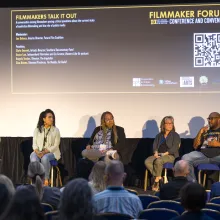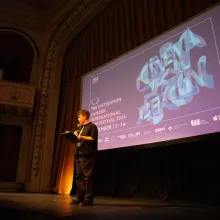

The 23rd edition of CPH:DOX wrapped last month, with record-breaking attendance and satisfied delegates at the festival’s market, but individual events at the industry conference revealed ruptures in the front of documentary unity against political threats. Filmmaker Omar Shargawi issued one of the most visible criticisms, reading a statement contrasting the festival’s support of Ukrainian filmmakers to a lack of “solidarity with the Palestinians” at an industry talk. At the closing ceremony, Artistic Director Niklas Engstrøm and Executive Director Katrine Kilgaard said their aim was “pluralism” and “to make room for a multitude of opinions and ideas, including those that challenge our own perspective as a festival.” Documentary reached out to Engstrøm for further comment via email after the festival ended.
Online Feature
One of the foremost critical thinkers of the international documentary ecosystem, Leonard Cortana was tapped by EURODOC program head Nora Philippe in 2023 to manage the inclusion program and strategic partnerships. The resulting program, BIPOC EURODOC, hosts bi-monthly member meetings and monthly public webinars with outside experts to support the ongoing education of its members. The task force also conducts focus groups to inform white papers like this recent study on film festival delegations, in partnership with the #Docsafe initiative. Speaking on Zoom from Mexico City, Cortana spoke with Documentary about the goals of BIPOC EURODOC, the politics of film festival delegations, and why post-screening Q&As are “an extremely unsafe space.”
With The Encampments, directors Kei Pritsker and Michael Workman forge a counter-narrative to the mainstream media. Embedded with the encampment at Columbia University, which became a particular focal point in this controversy, they let the students speak for themselves. The Encampments pulled in the largest single-theater opening ever for a documentary (it was also the second-highest opening PTA) before expanding to over 50 markets last weekend. Amid the film’s early theatrical success, we sat down with Pritsker over Zoom to discuss the making of the film, its context in current political events, and adjusting the distribution timetable.
Shot over three years, Flophouse America is the unflinching debut feature by Norwegian photographer-turned-filmmaker Monica Strømdahl. The documentary offers an intimate, often harrowing portrait of Mikal, a boy growing up in a crumbling motel alongside his parents, Jason and Tonya, both trapped in cycles of addiction and poverty. In her conversation with Documentary Magazine, Strømdahl reflects on the ethical challenges of filming such vulnerable subjects over an extended period, the responsibility she felt toward Mikal and his family, and how her background in photography shaped the film’s aesthetic. With Flophouse America, she not only delivers a powerful creative statement but also raises urgent questions about systemic neglect, resilience, and the role of the documentary filmmaker as both witness and storyteller.
In 2024, 7 million livestock died in Mongolia due to what some say was the country’s harshest winter on record. Australian filmmaker Kasimir Burgess witnessed the disaster firsthand while making his third feature documentary, Iron Winter. The film documents two young herders, Batbold and Tsagaanaa, upholding a rural Mongolian tradition of winter herding—protecting horses from severe dzud and wolves by amassing them by the thousands and migrating for several months in search of better pastures. Ahead of its world premiere, over a video call Burgess shared with Documentary the appeal of the winter herding story, the challenges involved in telling it, and his hopes for what audiences take away from the film.
Despite the fact that CPH:DOX has emerged as a highly successful and thriving destination for the documentary industry every spring, this year’s event was shrouded by global economic and political turmoil. If previous year’s editions rehashed familiar complaints about financing and distribution woes, this year’s threats were both more urgently physical and existential. American documentary filmmakers looking for life preservers in Europe in the face of the “MAGA-ification of U.S. gatekeepers”—as Variety called it in a festival report—found the consensus in Copenhagen was that it wasn’t going to be easy.
Now a quarter-century old, the Museum of Modern Art’s Doc Fortnight has developed into one of the most sharply curated showcases for nonfiction film in the United States. In a climate of festivals fixated on acquiring flashy premieres, MoMA’s programmers instead focus on finding the new and recent titles that interest them most to give New York a taste of the international doc scene. This year, many of Doc Fortnight’s picks significantly repurpose existing media to new ends: Eight Postcards From Utopia, B.F. Skinner Plays Himself, John Lilly and the Earth Coincidence Control Office, Give it Back: Stage Theory, Henry Fonda for President, and An Unfinished Film.
Thessaloniki International Documentary Festival’s industry platform Agora has gained prominence among documentary professionals and become one of the key events in the winter calendar. Documentary Magazine spoke to Vergou and several professionals in attendance to take stock of this year’s market, examining content trends and the current climate for business. When discussing content trends, Vergou focuses on the growing conversation about supporting filmmakers who lack access to national funding due to political reasons or who have been forced to flee their home countries due to persecution. This year, Agora, in collaboration with DOK Leipzig’s DOK Industry, launched the Doc Together initiative to provide practical support.
At Wednesday morning’s Department of Government Efficiency (DOGE) subcommittee hearing, Rep. Marjorie Taylor Greene, joined by several House
While SXSW undoubtedly has its share of buzzy (i.e., some combination of the true crime, music, and celebrity genre) documentaries, navigating through the admittedly unwieldy program can also be a fun treasure hunt. In the end, you’re likely to be gifted with at least a handful of inspiring U.S. nonfiction films no one is talking about yet. This latest edition (March 7–15) began with the added bonus of a trio of female-helmed films, all focused in different ways on one virtually off-the-radar topic: motherhood and its intersection with the law: Baby Doe, Arrest the Midwife, and Uvalde Mom.