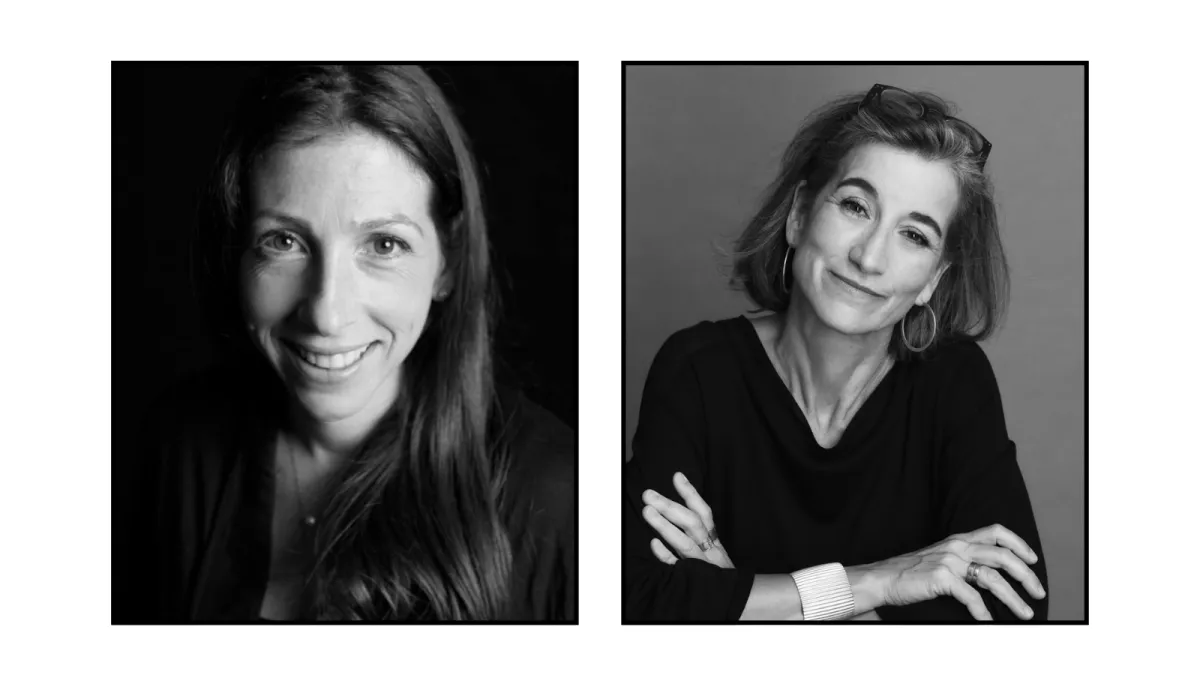
Hilla Medalia and Yael Melamede
Welcome to IDA Member Spotlight, a monthly interview series highlighting IDA members and showcasing the depth and diversity of our community. This month, we had the pleasure of speaking with Yael Melamede and Hilla Medalia.
Hilla Medalia is an Academy Award-nominated and Peabody Award-winning documentary filmmaker, producer, and writer whose work has been celebrated worldwide for its emotional depth, cultural insight, and narrative boldness. She has received six Emmy nominations for her films, and her projects have screened internationally in theaters and on major platforms, including HBO, MTV, PBS, BBC, ARTE, and Netflix.
As founder of Medalia Productions, she has directed, produced, and collaborated on a diverse range of films that explore personal identity, social complexity, and global issues. Medalia’s work often delves into intimate human stories set against larger cultural and political landscapes, bringing forward voices that challenge audiences and expand understanding. She is a sought-after lecturer and mentor at film labs and festivals around the world, sharing her expertise in production, directing, and fundraising. She is a member of the Academy of Motion Picture Arts and Sciences, the Producers Guild of America, and holds an M.A. in Film and Television from Southern Illinois University.
Yael Melamede is the co-founder of SALTY Features, the independent production company she launched more than two decades ago to create films that are thought-provoking, vital, and enhance the world. Trained as an architect, Melamede brings a design sensibility to filmmaking and is driven by a curiosity about people, power, and the often contradictory nature of human experience. Her work spans award-winning documentaries, TV series, and fiction films that have premiered at major international festivals and been distributed around the world
Melamede’s recent projects include the 2026 Academy Award-nominated short documentary film Children No More: “Were and Are Gone,” a moving portrait of a silent protest movement in Tel Aviv; Death & Taxes (2024), a personal examination of America’s tax system; the award winning ADA – My Mother the Architect (2024), an unusual portrait of success and sacrifice; Emmy-nominated Floyd Abrams: Speaking Freely (2023), an exploration of free speech in America; and Pay or Die (2023), a powerful look at the insulin crisis in the US.
Additional documentary film credits include the Academy Award-winning Inocente (2012); the Emmy Award-winning When I Walk (2013); the Academy Award-nominated My Architect (2003); and Why We Hate (2019), a six-part series executive-produced by Steven Spielberg and Alex Gibney. Melamede serves on the boards of UnionDocs and the Living City Project and is a member of the Academy of Motion Picture Arts and Sciences.
IDA: Could you share a bit about your background and the experiences that shaped who you are as a storyteller?
HILLA MEDALIA: I went to college at Southern Illinois University. I didn’t initially set out to become a filmmaker—I simply loved cinema and storytelling. That passion gradually evolved into a calling, culminating in my Master’s thesis film, To Die in Jerusalem (2007). The film was a feature-length documentary and was acquired by HBO. The experience of seeing a deeply personal film reach a global audience and have an impact affirmed my commitment to telling complex, human-centered social and political stories.
YAEL MELAMEDE: I came to filmmaking by way of a first love of still photography and then a formal education in architecture as a graduate student. That intensive training profoundly shaped how I see the world. Architecture is a discipline rooted in both aesthetics and responsibility. That duality is also true in filmmaking. I’m interested in people’s passions, their purpose, and in the tension between personal obsessions and the public realm. Across our films, whether it’s ADA – My Mother the Architect, Floyd Abrams: Speaking Freely, or Children No More: “Were and Are Gone,” I find myself drawn to people and causes concerned with something larger than themselves.
IDA: When did you begin working in the documentary field, and what initially inspired you to pursue it?
HM: I began working in the documentary field in 2004, right after college. I was drawn to the genre by a deep curiosity about people and the complexities of real life. Growing up between cultures and witnessing social and political tensions firsthand sparked my desire to explore human stories in a nuanced way. I was especially inspired by the power of documentary film to create dialogue, challenge assumptions, and give voice to perspectives that are often unheard. And I believe in our need to speak truth to power. As such, much of my work deals with the Palestinian-Israeli conflict.
YM: I began working in documentary nearly twenty years ago, drawn to its independence of spirit and to a process that unfolds over time. My architectural training taught me to pay close attention to structure and to the relationships between parts—and to trust that clarity often comes through revision. The documentary form is similar and very elastic: filming and editing remain in conversation almost until the very end, creating opportunities for discovery along the way. That long arc suits me. I’m less interested in firm conclusions than in the gray areas people inhabit.
IDA: Congratulations on the Oscar nomination for the deeply moving and impactful film you produced, Children No More: “Were and are Gone.” Could you tell us a little about the film?
HM & YM: Children No More: “Were and Are Gone” is a film that emerged from a moment of urgency in March 2025, when the ceasefire between Israel and Hamas collapsed, and 193 children in Gaza were killed in a single day. In response, a small group of activists in Tel Aviv spontaneously gathered to hold a silent vigil to oppose the war and mourn the children killed in the Israeli attacks. This film was born out of Hilla’s search for a role in that moment—questioning what could be done, what responsibility a documentary filmmaker carries during war, and what story most urgently needs to be told.
Upon encountering the vigil, Hilla was struck by the profound courage expressed through a simple, restrained act of silence and how this silence was incredibly loud. The result is an intimate portrait of the vigil, where activists are holding photographs of children killed in Gaza. Their action is deliberately non-confrontational, yet very resolute. Our goal was to mirror the protest itself: the film is patient, spare, and observational, inviting viewers to sit with stillness and discomfort. It asks what it means—and what it costs—to hold empathy across lines of conflict, to refuse to look away from what is done “in our name,” and to speak out powerfully, even in silence.
IDA: When did you begin working on Children No More: “Were and are Gone,” and what drew you to the project?
HM: The first time I stood in front of the group, I encountered the power of silence—a silence that invites reflection rather than explanation. That silence became the language of the film. Everything unfolded quickly; we felt an urgency to bring it into the world, so we began filming and editing simultaneously. The vigil began in March 2025; we started filming in June, screened in Los Angeles theaters in the last week of September, and premiered at DOC NYC in November 2025.
YM: I was immediately drawn to Hilla’s initial footage. At a time dominated by outrage and noise, these activists chose silence—and it was unmistakably powerful. As a filmmaker, I was struck by the restraint of the images and the intense reactions they provoked. The vigil revealed facets of Israeli society rarely seen outside the country: people publicly grappling with grief, trauma, anger, and accountability. It also speaks more generally to the difficulty of hanging onto empathy in polarized times and to the power of quiet, strategic, and thoughtful public protest.
IDA: What has been the film’s reception, and does it resonate with the impact you hoped it would inspire?
HM and YM: The film is complicated. Some viewers struggle with it; others connect to it deeply. We’re only beginning to bring it to wider audiences. It is now being released theatrically in the United States, which will allow many more people to see it on the big screen. In the UK, it is available on SKY, and in Israel, we are just starting to have public screenings.
The nomination has brought it much greater visibility, but the most meaningful moments have been the screenings where people stay afterward to talk. The film creates a space—one we hope can make room for grief and empathy, and open the possibility for much-needed conversation.
IDA: For our members who are eager to watch Children No More: “Were and are Gone” and stay connected with your work, what’s the best way to see the film and follow your upcoming projects?
HM and YM: We’re thrilled to share that beginning February 20, Children No More: “Were and Are Gone” will screen in theaters nationwide as part of the Academy Award–nominated Shorts program, distributed by Roadside Attractions. The film will play alongside the other nominated works in the animation, live action, and documentary categories, giving audiences across the country the opportunity to experience these films on the big screen.
Following the theatrical run, we hope to extend the film’s life through online distribution and partnerships with community organizations, universities, cultural institutions, and faith communities. The conversations that have emerged so far have reinforced how powerful it is to experience the film in a shared setting.
Updates about screenings and digital availability will be shared through SALTY Features, Medalia Productions, and our social media channels. We welcome anyone interested in hosting a screening to reach out as we continue building opportunities for thoughtful engagement around the film.
IDA: Looking ahead, what’s next for you? Are there any upcoming projects you can share with us?
HM: I have several films currently in the works. Unlike Children No More: “Were and Are Gone,” which came together with unusual speed, these projects are unfolding over a much longer period, so I’m developing a few simultaneously. The first to be released will focus on an international cyber scam. I’m also deep in the edit on a film about peace activist Vivian Silver, who was killed on October 7, becoming a victim of the very disaster she had warned against. In the wake of her death, as Israel begins its brutal attacks on Gaza, Vivian’s sons, along with her Jewish and Palestinian friends, struggle to hold onto her vision for peace, wondering, What would Vivian do?
YM: We’re continuing to work on the impact and distribution of our recent films while producing several new projects. One explores caregiving and dementia through an intimate father–daughter story that, at times, dares to be funny, even as it reflects on our broken healthcare system. Another looks at the global information landscape and how people struggle to discern truth in a digital world that incentivizes and amplifies extremist views. We’re also experimenting with new forms, including a reality competition series set in the world of game design.