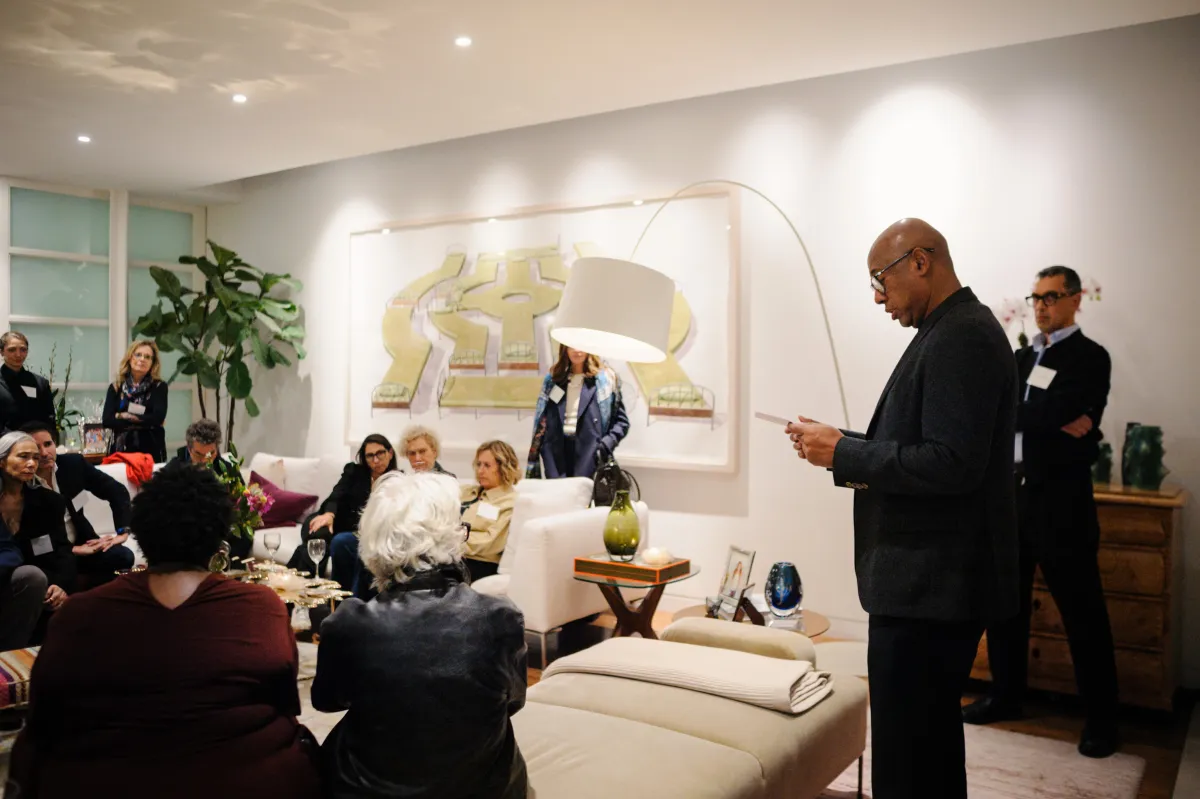
Late last year, IDA gathered documentary field leaders and friends, along with our Impact Circle community, at a private home in New York City for an intimate conversation about the state of our field. Raoul Peck spoke.
You very likely know his work — including I Am Not Your Negro, which drew from James Baldwin’s writings to make one of the most compelling accounts of race and power in documentary, and most recently Orwell: 2+2=5, an investigation, via George Orwell, into how authoritarianism corrodes language and reality itself. I’d had the chance to interview Raoul and producer Alex Gibney at the film’s US premiere at the Camden International Film Festival that September, and I asked him to speak that evening in New York. That film is the ground beneath this speech.
What he said was direct: documentary filmmakers cannot be passive witnesses to the decay of truth. Naming what we see is a political act. The collective is what we have, and if we lose it, we lose the fight. At one point, he said:
That is why this community, the documentary community, must act not only as artists but as organized citizens. Freedom of expression is not a personal privilege; it is a public contract, and today, that contract is being rewritten by others.
Since that evening, the evidence of authoritarianism has only mounted. His words are even more pertinent now than when he spoke them. That’s why we’re sharing it. Read it. Pass it on.
Dominic
The following is the text of Raoul Peck’s letter to invitees at a special IDA gathering in New York on November 10, 2025, courtesy of Raoul Peck.
Good evening everyone,
We live in a time of deep confusion, of political and civic discouragement, when the vital forces of our societies seem adrift. Too many have lost the ability to see clearly through the constant fog, this relentless storm of so-called information, of “breaking news” that breaks nothing, of noise masquerading as knowledge. Every second demands our attention, while profit turns reality into entertainment, and entertainment into life itself.
So tonight, I’ll simply share a few reflections. Perhaps you’ll find within them, in your own way, some answers.
For as long as I can remember, I have watched power try to persuade us that what we see is not what we see, that what we hear is not what we hear. This is not new. It’s the oldest form of control. But today, the tools are more powerful, more seductive.
We live in an age when public lies are no longer sanctioned by public shame. On the contrary, they are broadcast, repeated, monetized until they become indistinguishable from reality.
Authoritarianism rarely arrives wearing uniforms. It begins much earlier, in the corrosion of truth, in the erosion of language, in our willingness to accept convenient fictions. We are told, every day, that two plus two can equal five. And too often, we either nod politely or laugh at the absurdity.
But as filmmakers and storytellers, we cannot remain neutral witnesses to this decay. Orwell reminded us that “the degradation of language is the condition for the degradation of democracy.” Because once words lose their meaning, power no longer needs to disguise itself. When lies sound truthful, and when truth is dismissed as opinion, democracy collapses, not with a coup, but quietly, silently.
Our work is not only about images. It is about naming what we see, defending meaning itself, preserving language as we would protect a dying flame in a rainy forest.
“If thought corrupts language,” Orwell wrote, “language can also corrupt thought.” Once words are altered, the boundary between reality and propaganda dissolves.
Language becomes a flood of lies, euphemisms, and reversals that make moral clarity impossible. When everything is “up for debate,” nothing is sacred, and the unimaginable becomes thinkable.
When CNN or Fox News invite a conspiracy theorist to debate election officials, they don’t inform the public; they perform neutrality. And in performing neutrality, they erode reality itself.
We now live in a world where words like “diversity”,“” equity, inclusion, climate change, gender identity, public health, “vulnerable,” “entitlement,” “transgender,” “fetus,” “science-based,” “evidence-based,” “clean energy,” “Native American,” “disability,” and many others are quietly erased from official documents, websites, and reports by executive order.
Orwell was not a prophet. He simply described what he had lived: fascism, totalitarianism, and the creeping distortions of democracy in the so-called free world.
He understood that seeing through manipulation was already a political act.
We are not prophets either. But our work carries the responsibility to make visible what others choose to erase, to give voice where silence has been engineered, to defend, through cinema, our collective right to see and to understand.
Filmmaking alone will not suffice. We must also remain honest, conscientious about our role. We live in a culture that isolates us, that rewards the individual brand more than the collective vision. We are encouraged to speak as “I,” rarely as “we.”
Losing the collective mind is losing the collective fight. Life itself, happiness, love, solidarity, only makes sense within the village, the city, the society as a whole.
Instead of an exacerbated individualism or blind tribalism, we should reclaim a shared humanistic vision, as the singular species we are.
Those attacking truth do not act alone; they coordinate, invest, and plan for the long term. With our backs to the wall, we must defend together freedom of expression, equality, diversity, democracy, and above all, what Orwell called common decency.
That is why this community, the documentary community, must act not only as artists but as organized citizens. Freedom of expression is not a personal privilege; it is a public contract, and today, that contract is being rewritten by others.
We must resist the temptation of silence. That is what cinema can still do at its best: awaken the sense that clarity is a civic duty, and that none of us are exempt from it.
What else can we do as an organization?
We can protect one another. We can create emergency funds and legal defense networks for filmmakers under threat. We can demand that platforms and institutions stop hiding behind “neutrality” when faced with threats and repression. We can build bridges, between artists and journalists, between educators and audiences, to keep truth circulating, even when the air grows toxic.
Authoritarianism is not a local disease; it is global and adaptive. It wears many faces: an old man without a filter, a corporation, an algorithm, a billionaire, and even, to add insult, a trillionaire. It begins when people start thinking twice before speaking, when a scholar, a lawyer, a journalist, decides to self-censor, when we choose silence over dissent, when we empty words of their substance.
That is how we all die, not by force, but by consent.
We must reclaim the collective courage to name what we see. To quote James Baldwin, “once we lose the ability to name things, we lose the ability to change them.” And in that void, the manipulators of reality, the engineers of “2 + 2 = 5”, will not only shape history as they see fit, but also rewrite it as they go.
Orwell showed us that language can be a prison or a weapon of liberation. The choice is ours. So let us make sure, for the sake of all, that two plus two will always equal four.