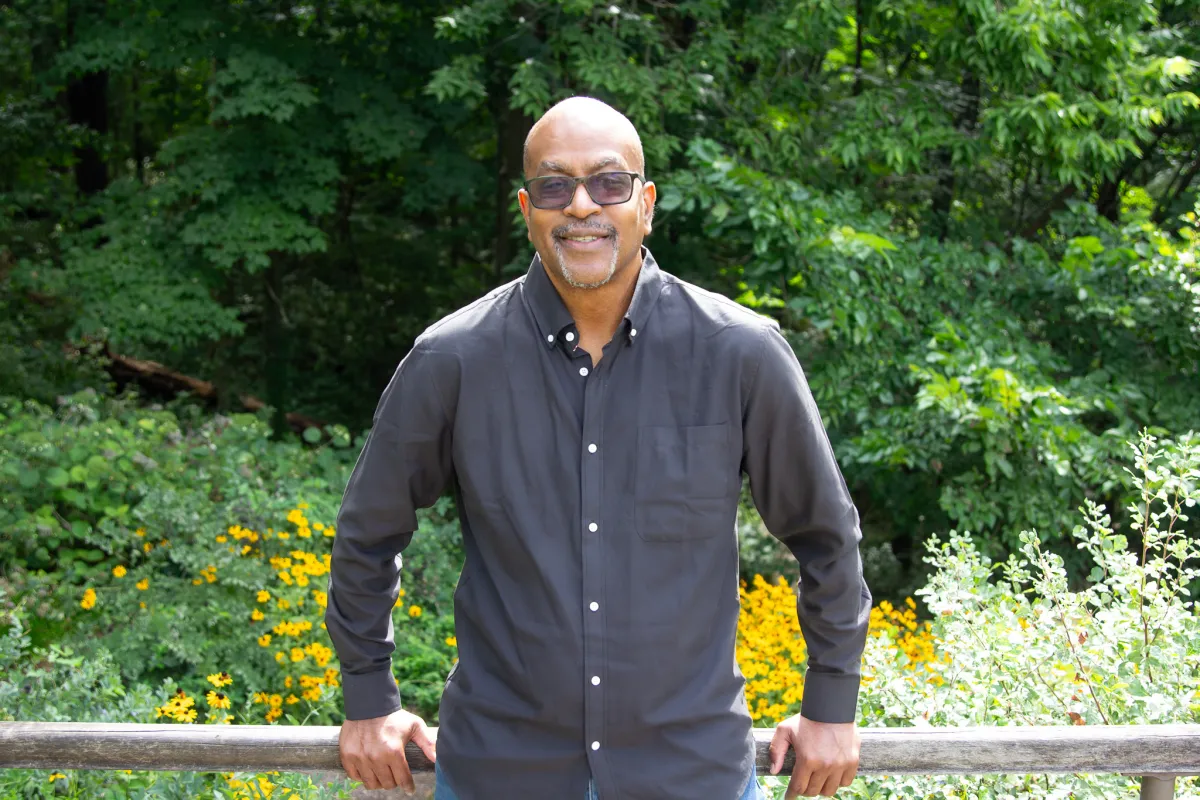
Jerald Harkness at the 2025 Indianapolis Black Documentary Film Festival
Jerald B. Harkness is the President and CEO of Studio Auteur, LLC, a content creation company specializing in producing broadcast documentaries. A national Emmy award winner, Harkness’s prolific career spans over 30 years. He has produced and directed for Paramount TV, UMC, ESPN, VH1, A&E, PBS, CBS Sports Network, and Tubi.
Recent work includes producing and directing the feature-length documentary When Everyone Swims in 2025, which won Best Documentary Feature at the June 2025 Chicago Indie Film Awards and Best Editing at the May 2025 New York Independent Cinema Awards. In 2023, Harkness produced and directed the biographical documentary The Bright Path: The Johnny Bright Story, which has been broadcast nationally on CBS Sports Network and PBS and selected for multiple film festivals. Harkness was the executive producer and showrunner of the docu-drama series True First, which celebrates forgotten and overlooked African American trailblazers and pioneers. Harkness’s first project under his company, Studio Auteur, was a documentary short titled Wesley for the multiple award-winning series The Election Effect, for Paramount TV and Facebook.
Notable awards include a National Emmy Award, Best Documentary at the International Academy of Web TV, the inaugural Spotlight Award from the Indianapolis Black Documentary Filmmaker Festival, and various film festival selections.
In 2023, Harkness donated raw footage and master tapes from many of Harkness’s previous projects to the Black Film Center Archives at Indiana University. The Jerald Harkness Collection will be available to students, scholars, and the IU community in perpetuity.
In 2025, Harkness was recognized with the Distinguished Alumni Award from the Indiana University School of Media.
IDA: Could you share a bit about your background and the experiences that shaped who you are as a storyteller?
JERALD HARKNESS: I grew up in an amazing era of American cinema in the 1970s, featuring groundbreaking and provocative work from directors like Steven Spielberg, Martin Scorsese, Stanley Kubrick, George Lucas, and Sidney Lumet. I remember being in grade school, and my dad demanded that he and I go see a movie after a blizzard hit our neighborhood. We made our way to a local movie theater, and we watched Steven Spielberg’s Close Encounters of the Third Kind. I was awestruck. I immediately knew that my path in life was to be a cinematic storyteller.
From that moment on, I set out to be a film director and producer no matter what! And I’ve enjoyed an enormous amount of good fortune to have been a documentary producer and director for the better part of thirty-plus years.
IDA: When did you begin working in the documentary field, and what initially inspired you to pursue it?
JH: I went to Indiana University for Film School in the late 1980s. This was still the analog era, where any type of film equipment was really tough to come by. I joined the Indiana Memorial Student Union, and that gave me access to a camcorder and a cutting-only editing machine. I set out to make a number of short films on campus, and other students began to recognize me as a filmmaker with equipment.
I started getting requests to film neophyte step shows, which are dance routines performed by students who have just been initiated into a Black fraternity and sorority. I became fascinated by the subject of step shows and produced a documentary about step shows during my Junior year.
That project opened my eyes to the narrative possibilities of nonfiction storytelling. I realized I could tell stories through the perspective of other people’s lives and experiences.
After I graduated, I got a grant and produced Steppin” with a professional crew. We got a distribution deal with a formidable player in the documentary world named The Cinema Guild, and my career was launched. This was in 1992. I was 24.
IDA: Congratulations on the success of your film, When Everyone Swims. Could you tell us a little about the film?
JH: When Everyone Swims is a 90-minute feature documentary that addresses the importance of water safety and drowning prevention. The narrative is a compilation of “swim journeys” in which we filmed interviews in 14 different states, across both urban and rural areas, with a variety of races and ethnicities, and with interview subjects ranging in age from 18 to 101. We also had the honor of interviewing former Olympians Summer Sanders, Cullen Jones, Lilly King, Cody Miller, Maritza McClendon, and Sabir Muhammad.
I often joke that I took the word “everyone” in the title literally because we filmed so many different people with a variety of experiences.
When Everyone Swims is being screened across America, and we’re reviewing distribution offers. We’ve been fortunate to be selected for some film festivals, including being recognized with the Best Documentary award from the Chicago Indie Film Awards and Best Editing from the NYC Cinema Independent Awards. The latter award is a testament to a fantastic crew, especially Luke Renner, who edited and story-produced the project.
IDA: When did you begin working on When Everyone Swims, and what drew you to the project?
JH: The idea of When Everyone Swims came from one of our executive producers, Jon Goynshor, who initially approached me about producing and directing. At first, I was hesitant because I had previously produced a short documentary about African American swimmers a few years earlier. But I saw an article from Mara Gay of the New York Times that stressed that drowning is a national public health issue, and the statistics for drowning were just staggering. I also saw a TED Talk by Dr. Tiffany Monique Quash, who shared the history of Africans and Black Americans in swimming, and I was stunned to learn about that rich history.
So we set out to tell the most inclusive narrative possible. My producing partner team of Joy Reid, Jason Reid, and Adrienne Lopez jumped on board to executive produce the project. Jon and I finalized a partnership with Diversity in Aquatics who helped with research and gave us access to some amazing storylines and interviews. We established some amazing partners, including One America, Cigna Health, Asphalt Green, the Grey Foundation, American Red Cross, the Indianapolis Foundation, Lilly, and the Black Film Center Archives of Indiana University.
I’m proud of what we’ve accomplished so far, and I believe the best is yet to come by way of distribution.
IDA: Can you tell our members a little about the archive you donated to Indiana University? What is the significance of that for you and the community?
JH: I would not have become a filmmaker if it weren’t for the great education and experiences I gained as a student at Indiana University. I remember meeting the founders of the Black Film Center Archives when I was in film school, and I always hoped I would create work that would be worthy of being archived.
In 2023, the interim director of the Black Film Center Archives approached me about the idea of archiving my life’s work, and I was and still am beyond honored. I’ve been collaborating with the current director, Dr. Novotny Lawrence, and his team, and they’re a joy to work with. Now, students, scholars, filmmakers, and the general public can access my documentaries from the last thirty years. I don’t plan to stop working as a documentary producer, and I hope to continue contributing to the BFCA.
IDA: For our members who are eager to watch When Everyone Swims, your other films, and stay connected with your work, what’s the best way to see the film and follow your upcoming projects?
JH: To learn more about When Everyone Swims, please go to our website at the link below.
wheneveryoneswims.org. And to follow the upcoming work from me and my producing partners, you can visit our website at imagelabmediafoundation.org.
IDA: Looking ahead, what’s next for you? Are there any upcoming projects you can share with us?
JH: We are really fortunate to have a full slate of projects in various forms of production. One project is called Coleman College: The Forgotten HBCU – A Story of Generational Pride, which involves former mayor of Tallahassee John Marks tracing the history of his great-grandfather, Oliver Lewis Coleman, who went from being enslaved to launching a school in the deep south of Louisiana to help newly emancipated men and women gain a college education.
We’re also collaborating with the Harlem Globetrotters to help celebrate their 100th anniversary in 2026, and we have a docudrama biography on Negro baseball great, Oscar Charleston, in the works. We have some other exciting projects in the works that we will make sure to share with IDA members!