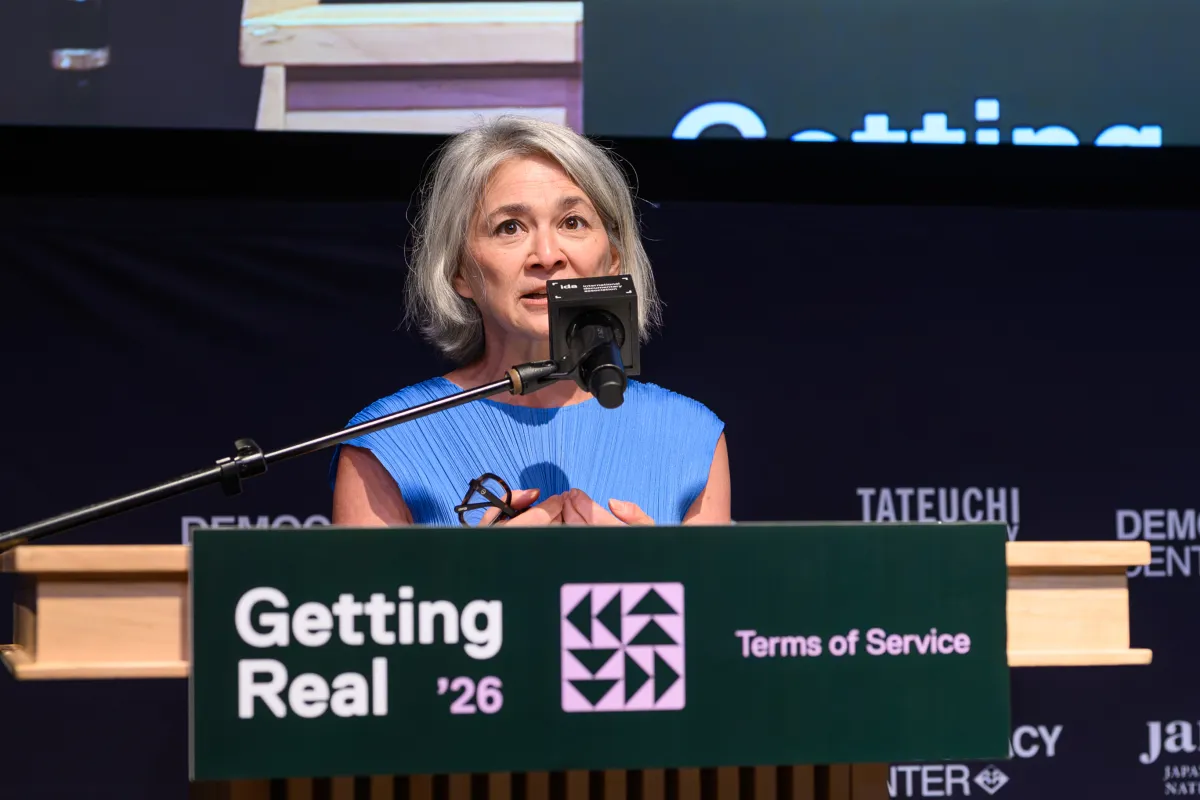


Editor’s Note: On July 23, 2026, Mandy Chang delivered a keynote address at IDA’s Getting Real ’26 conference titled “We’ve Come This Far: Let’s Not Stop Now” at the Japanese American National Museum in Little Tokyo, Los Angeles. Looking back at her own career trajectory, she aimed to answer the question of who and what is documentary in service to and what it will take to honor that commitment.
This text has been edited for publication in Documentary.
Thinking about my work and career, almost my entire life has been devoted to documentaries in one way or another. I have had the good fortune to have worked at every level of this field. I have worked in both the private and public sectors.
Now, as the first CEO of the UK’s Documentary Film Council, I’ve become a grassroots organizer, involved in documentary advocacy that represents an entire community whilst returning to my roots as a freelance producer, exec producer, and consultant.
These multifaceted roles have given me a unique vantage point from which to survey the documentary landscape. Each represents a different idea of how the best of documentary can be sustained whilst navigating the changing landscapes of policy, practice, and infrastructure.
This is a useful roadmap for reflecting on what the field owes its makers and what we owe each other, underscoring the theme of this conference: Terms of Service. So, in trying to answer the question of who and what is documentary in service to and what it will take to honor that commitment, I want to weave in some personal responses, looking back at pivotal moments that shaped and influenced me. The old saying goes, if you don’t understand the past, you can’t understand the present. We can’t bring back the past, but we can hold onto what was valuable about it.
I want to say, right away, that I believe the idea of service is embedded in most people who work in documentaries, whether or not they realize it. There are those who have made a lot of money out of documentaries, but the vast majority have not, and their motivations lie elsewhere. We are in challenging times, where the difficulty of bringing new stories into the world is not as it was, and we are having to adapt to change, find new ways, or face the diminishing of our field.
This was far from the story when I first encountered this wide-ranging form in a meaningful way. Coming to live in Britain at the end of the 80s, I discovered a truly thrilling world of documentaries. Not that great documentaries weren’t being made in Australia, but the scale and ambition of broadcasting, especially public service broadcasting, and what it offered its audiences and its makers was exciting. I discovered documentaries on television first, because they were part of a powerful ecosystem. Of course, you can’t talk about what documentaries are in service to without mentioning public service broadcasting and without mentioning the BBC, just as you can’t in America mention this without talking about the PBS system. And I include all my other international colleagues here because I’m using the BBC as a metaphor for public service broadcasting generally, and because the BBC is still the world’s largest producer of documentaries, with a mission to serve all audiences with high-quality content that informs, educates, and entertains. And that is a pretty ambitious, and in my view, worthwhile mission.
I believe the idea of service is embedded in most people who work in documentaries, whether or not they realize it.
The BBC gave its employees training, mentorship, and the opportunity to watch and learn from many great documentaries and documentarians. It was, and still is, a vital institution for training. Domestic TV provided employment internally and to freelancers. This sustained and grew important skills. It acted as a nursery slope for emerging writers, directors, crew, and producers. Generations benefited.
My early awareness of British documentary films was shaped by political stories made by directors such as John Akomfrah, one of the founders of the Black Audio Film Collective, Molly Dineen, Kim Longinotto, and Nick Broomfield. Across the pond, other pioneers were doing the same thing. Errol Morris’ Thin Blue Line (1988) made us look at documentaries in a new way, and Michael Moore’s Bowling for Columbine (2002) proved that documentaries could find success in the cinema. These films broke new ground, opening the audience’s eyes to stories that spoke truth to power in compelling ways.
From 1994 to 1997, I was a trainee director on the coveted BBC TAP scheme. Across the way, in another BBC building, the brilliant documentary strand Modern Times was getting the critics’ attention. It ran for 15 years from the mid-90s. Highly curated, it further opened my eyes to factual storytelling by encouraging experimentation in prime time, exploring British society, and provocative issues. It influenced a whole generation of filmmakers.
Feature docs were exotic and rarer, but every documentary director wanted to make one. They enabled storytelling to go deeper than ever and allowed for real creative authorship. Two UK broadcasters screened them – Channel 4 and the BBC. They opened up global storytelling to British audiences. Storyville was to become a legendary international feature documentary strand that first aired in November 1997. It was created by Nick Fraser, who built a formidable brand. At the time, Nick was commissioning and acquiring a staggering 80 films and series a year, screening the best stories from around the world, and of course, it lives on today (sadly in reduced form). It was a crucial forerunner of theatrical docs. Nick often worked in sync with fellow commissioner Sheila Nevins, whose HBO strand was equally as legendary. These films spawned an ecosystem of festivals, pitching forums, and documentary conferences.
The immense offering of documentary forms to the public has narrowed, and today that rich seam of arts documentaries has all but disappeared from our screens in the UK. Mostly, what is left is a dull diet of biopics of famous people fronted by celebrities. The critical polemics of the past have been replaced by reality show hosts.
I left the BBC towards the end of the 90s and carried on as a freelance director making arts documentaries that people could only dream of now. I got to make observational, political, and constructed-arts documentaries across a huge spectrum of subjects. I even made a film about the invention of the handheld sync-sound camera. I doubt anyone would commission such a film today. This film, The Camera that Changed the World (2011), taught me just how far we had come in documentary filmmaking, showing how technology could advance and liberate us.
The immense offering of documentary forms to the public has narrowed, and today that rich seam of arts documentaries has all but disappeared from our screens in the UK. Mostly, what is left is a dull diet of biopics of famous people fronted by celebrities. The critical polemics of the past have been replaced by reality show hosts. This feels like an insult to audiences’ intelligence, robbing them of the joy of discovery. Technology has also evolved via the internet, with an explosion of platforms, and we are entering the uncertain world of AI, trying to work out its benefits and drawbacks.
In 2013, I had the good fortune to move into commissioning. It took me back home to Australia to become the Arts commissioning editor at the ABC, my country’s own public service broadcaster, modeled on the BBC. I sat on the other side of the fence. I spent 4 years navigating the role of a commissioner on a steep learning curve, applying all I had learned and valued. I was unsure how I would take to curating, but I loved it.
The job turned out to be an apprenticeship for an amazing, free-ranging role as editor, and then as head of Storyville, in 2017. What I looked forward to most was the global nature of it all. Joining up to a whole ecosystem that operated across the world, welcomed by US and European commissioners, pooling our funds democratically and looking out for exciting stories and for each other. It was one of the most collaborative times I have had in the service of documentaries. This was an undeniable documentary service, bringing the world’s best docs to audiences—filmmakers understood this.
Commissioning exposed me to a different sense of what service means. A commissioning editor, in my view, is not a gatekeeper, as people sometimes describe them. The truth is that there is only so much funding and only so many films that can be commissioned, and this is the burden of anyone who oversees funds. A commissioner is responsible for delivering a full range of programming to their audience; in Storyville’s case, this meant seeking out and showing them the best international documentaries, from the small, quirky, funny, or humanly intimate to bold and investigative stories in the public interest. Commissioners also have a duty to help filmmakers realize their creative vision whilst telling factually accurate stories ethically, authentically, and with care and clarity. There is an obligation to support and nurture new filmmakers alongside more established ones, and to create a coherent strategy to protect and grow a valuable brand. If there is risk—and there should be—there is a duty of care to protect the filmmakers and their subjects (along with the integrity of your employer). The last and most important service is a readiness to fight to protect and even expand your domain. In an endangered climate, this is critical. As we know, anything good is always at risk from bureaucrats and cost-cutters.
People still grumble that we haven’t gone far enough (and we haven’t), but understanding that people must be supported to tell their own stories in their own countries represents genuine change.
I landed at Storyville, just as Netflix was gaining ground. No longer were we competing with other broadcasters, but with global technology platforms with significant resources.
At the same time, the idea that documentaries could not be the preserve of wealthy white Western filmmakers was hitting home. The opening up of documentaries to diverse voices and perspectives, from global majority filmmakers, and the rise of corresponding organizations supporting alternative voices were significant changes I witnessed during my time at Storyville. People still grumble that we haven’t gone far enough (and we haven’t), but understanding that people must be supported to tell their own stories in their own countries represents genuine change.
By the time I returned to the UK, the BBC and other public service media were no longer the only game in town. The rollout of optical fiber that enabled high-speed audiovisual streaming provided the foundation for streamers to transform the landscape. The first impact was in distribution and exhibition. This ultimately led to a collapse in genuinely independent UK film production. In 2024, according to a BFI survey, domestic films accounted for just 9 percent of total film production spend in the UK (BFI 2025).
The fracturing of viewing platforms fostered intense competition. The demand for documentaries with sky-high budgets was real for a while. The streamers could cherry-pick ready-made talent, just as public service broadcasting and independent film funding were in decline.
The regulations on these platforms were not subject to the same government-imposed standards as those on public service broadcasters, creating an uneven playing field. None of this was in service to either audiences or filmmakers. A wide range of films could still be seen at festivals, but remained unsold beyond this, and audiences were deprived of a rich supply of storytelling
In 2022, I went to work for global giant Fremantle. Switching from the BBC to a large commercial organization was like swimming across a deep chasm. At Fremantle, I wanted to create a documentary strategy that not only supported big, ambitious docs but also fostered new filmmakers and grew those relationships, building the company’s documentary brand with a modest funding output. This economic structure could work alongside other players in the field and benefit the filmmakers. But the timing was wrong as challenges mounted and the means of distribution shrank.
In 2025, I returned to an independent sector very different from the one I’d started out in. Many in the field were suffering. We’d grown too attached to one delivery system, and now it was radically contracting. The reasons we made documentaries, who we made them for, and how we made them were under threat. We are still analyzing and working to mitigate the collateral damage. As I speak, the BBC is in the throes of massive cuts, further decimating this great institution. And it’s not the only broadcaster affected.
The answers can’t be found on any one platform. For me, the greatest solution is working together across the UK, across doc organizations, and across countries to find answers, share what’s working, and band together to counter threats.
There’s much ado about new ways of creating and distributing content and about forging strategic partnerships to retain audiences. Broadcasters in the UK and the US have rushed to YouTube as one solution to shrinking audiences, and there are benefits. I recently heard from Raney Aronson and Marjon Javadi that the FRONTLINE YouTube channel has reached over 1 billion views, which includes 340 feature documentaries. I applaud Raney for finding ways to draw in and serve a whole new audience for FRONTLINE; at the same time, this helps protect them from interference. Others, like Arte France and the BBC, are following this example and hoping to emulate its success.
These numbers are encouraging in the short term, but ultimately, YouTube won’t save us. It may be “the new TV,” as its CEO claims, but is it the new TV we want? To answer this, I want to quote some wise words from writer Anthony Kaufman’s Substack: more than 500 hours of videos are uploaded to YouTube every minute. If a few creators a year break into the mainstream, that’s a minuscule rate of discovery—less than the 1% chance of getting into Sundance. And when you have billions of hours of content and an algorithm that isn’t your friend, chances are slim for visibility. The system incentivizes more stuff, less quality. YouTube is a system that favors Google, a for-profit multinational corporation, which wants more repeated uploads from its creators, not one upload of a great feature documentary.
The answers can’t be found on any one platform. For me, the greatest solution is working together across the UK, across doc organizations, and across countries to find answers, share what’s working, and band together to counter threats. The Documentary Film Council was formed in 2023 to address this need. Its existence galvanized me to throw my hat in the advocacy and community-building ring by taking up the leadership of this nascent organization.
The Documentary Film Council came out of work, which I, among many others, contributed to, to understand the state of documentaries, particularly feature documentaries. Its findings were published in two papers, “Keeping it Real” and “Making it Real” in 2019. It was the largest survey of UK feature doc makers ever conducted. It lays out a flawed and undervalued field, marginalized by a system oriented towards fiction and further confused by an absence of doc reporting.
It was also inspired by organizations like IDA and the Future Film Coalition. In a short time, it has grown into a national membership body representing nearly 1,000 filmmakers and industry professionals working across the UK’s documentary network. It is already doing good work, consulting with funding bodies such as the Global Screen Fund, which has led to a tripling and diversification of its funds this year. It connects people at a community level through film clubs and other activities. while giving members insights and access into emergent alternative grassroots startups and subscription communities that can empower filmmakers in the distribution and development of their work.
It’s early days, but our mission is clear: to strengthen and advocate for our documentary sector, giving individuals in the field a voice at the table. As a member-owned co-operative, it represents the voice of the community to industry and government and builds connections across the field, working to create a more inclusive and resilient future for documentaries. It also seeks to communicate the value and power of this form in the UK, especially to the government. We can and must do this—nobody else will.
This work for me is an opportunity to push through change. Policy work is all about the big picture of being in service to documentaries. It is a time-consuming undertaking, as any member of a doc organization knows. It needs focus. It needs coherent arguments in written form. And it needs case studies and data to back this up. It needs everyone’s help in getting broadcasters and streamers to give a shit about the field we love.
Clearly, we need to change. The field has grown and diversified. We will never return to that legacy broadcast environment that made our lives and work sustainable, but we should use the past to remind us of the gains we have made.
Clearly, we need to change. The field has grown and diversified. We will never return to that legacy broadcast environment that made our lives and work sustainable, but we should use the past to remind us of the gains we have made. I’d like to finish up by summarising who and what I believe docs should be in service of, and offering a few solutions of my own that show there are ways to create a more resilient and unified documentary ecosystem.
Documentaries should be in service to the truth; to diverse perspectives that can reach beyond film festivals; to filmmakers and protecting their right to make films without fear or favor, to commissioners and funders taking risks, and protecting people and the best of docs; to the ideals of public service broadcasting and a commitment to training. And last but not least, to the audiences we make them for. To provide more thoughtful alternatives to misinformation and other meaningless fodder.
And solutions? Here are a few, by no means comprehensive. I can’t pretend to have all the answers, but my colleagues and I can start to address the ones below:
- The filmmaking community must stand together because collective action is more powerful than individual action.
- For all our gripes, public service broadcasters are still powerful distribution platforms. We must fight to ensure the survival of a robust public service broadcasting system.
- Co-production relationships with our own and international public service broadcasters remain a powerful global distribution proposition and should be maintained and built upon.
- We must rebuild documentary economies around filmmakers and their audiences and brainstorm ideas for this together, whilst continuing to lobby our governments to build on existing funds and to create new ones, as we did with the Global Screen Fund. Levies on wealthy streamers, who take from the field and shift their profits offshore, could also help fund training and create additional funds to support independent filmmaking.
- The tax credit needs further reforms to make the bar to entry more accessible for documentary makers, and priority should be given to independents who need it most. I am inspired by colleagues who fought hard on our behalf in the UK to turn the tax credit into a genuinely significant economic lifeline for doc filmmakers at 40% of budgets. In 2025, inward investment productions accounted for £3.3 billion/81% of UK production spend on high-end TV. We don’t know the documentary breakdown, but it’s not insubstantial.
- While we live in a festival bubble, the general public’s worldview continues to shrink. We need more Storyville-style strands—curated online platforms that offer audiences alternative perspectives. We need to communicate to our governments the value of documentaries in a divided and fragmented world.
- We need to think differently and more creatively about how we market and format our films for distribution. The Germans take feature documentaries and turn them into 3-part series for their online platforms. What other ways can we reformat and reimagine our films to get them seen?
- If governments and people are worried about what young people are watching on unregulated platforms, why aren’t documentaries a part of our education system? It’s a no-brainer. Think of the audiences we could grow and nurture.
- We must rapidly develop AI protocols and be transparent about AI’s use, so as not to erode trust in our work as it becomes harder for audiences to judge what is real or not.
- We must lobby to retain our IP, as we successfully did with the public broadcasters
- We should demand that our regulators mandate that public service broadcasters, streamers, and the BFI provide more comprehensive data on docs to help deliver much-needed insights into our field.
I could go on, but that is enough for one organization. As right-wing governments continue to rise to power, we’re going to have to fight for independent platforms like our public service broadcasters and our right to independent filmmaking. Deep in our hearts, we know what our documentaries are in service to, and that we must continue to reflect back and illuminate our shared humanity and the world in all its beauty, ugliness, and complexity. There are a few other audio-visual forms that can do this better. Documentaries have come a long way in a long and hard-fought evolution, so let’s not stop now!