
Billed as a “four-day intensive program for filmmakers based in the Mid-South/South,” the inaugural Hot Springs Documentary Film Festival Filmmaker Retreat managed to be both exhaustingly rigorous and refreshingly laid-back. From October 10-13, six filmmakers from around the region, chosen with an eye towards diversity by location, topic, and career stage, gathered to workshop a wide range of projects under the sharp and esteemed mentorship of Nick Price, series producer of Reel South, and New Orleans-based producer Darcy McKinnon of Gusto Moving Pictures (2025’s Natchez, 2021’s The Neutral Ground).
The six were initially selected via an open call process held by HSDFF and Indie Media Arts South (IMAS), which received 54 applications this first year. (The applications were all reviewed by the Filmmaker Forum team and IMAS representatives, along with the Retreat mentors, who came to a final consensus.) Conceived as a means for filmmakers to “connect, exchange ideas, and engage with both the festival and the documentary field,” the Retreat certainly achieved its goals and then some, in no small part due to the all-inclusive getaway structure and vacation vibe. Indeed, with all costs covered plus a small per diem, and ample time to bond over drinks and meals, the filmmakers and mentors were able to actually get to know one another. This, in turn, allowed for feedback sessions that felt more like frank, no-holds-barred conversations among friends, where creative ideas could flow freely.
The first day began with a late-afternoon introduction to the all-intriguing features and shorts, with order of presentation selected via an impromptu spin of the roulette wheel. (The novelty casino prop just happened to be sitting below the big screen TV in the cozy game room at the Lofts at Creek Street, the historic luxury condos that served as Retreat hub and hotel.)
First up was Adam Forrester, a native of Phenix City, Alabama, who showed a sample from Our Wicked City, a feature delving into the history of his hometown that, much like Hot Springs (which was once a retreat for Al Capone and other Prohibition gangsters), was run by an all-white crime syndicate for years. While the segment ambitiously combined everything from recreations with actors, who become characters in their own right, to clips from the 1955 crime film noir The Phenix City Story (dir. Phil Karlson), Forrester also expressed a sentiment others in the room undoubtedly could relate to: “I don’t know what a 15-minute sample is supposed to do.”
Luckily, he received impressively specific feedback from both idea-generating mentors. After putting forth his plan to explore the question of what it was like to “grow up under a shadow of myths,” McKinnon countered with her own queries: What else beyond the creative did the director want to ask? What exactly was the sample setting the audience up to see? There were also suggestions—perhaps more archival footage was needed to establish a sense of place—from the highly engaged audience, which also included Indie Media Arts South’s Tom Hansell, another Retreat mentor.
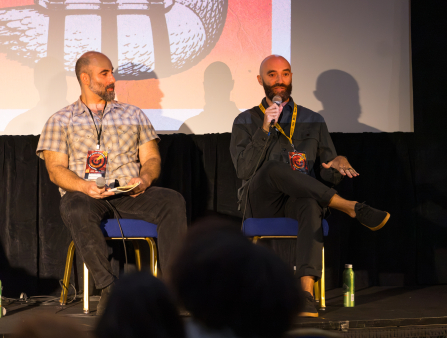
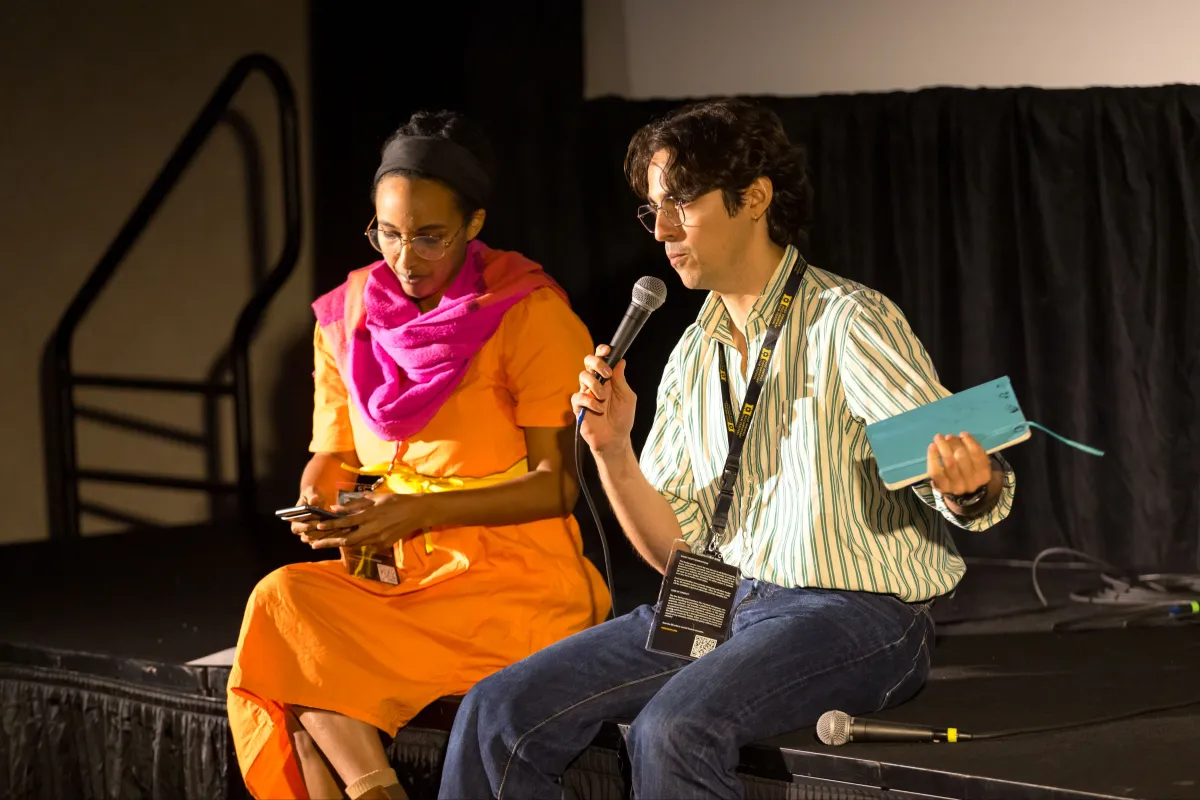
(L to R) Filmmakers Andy Sarjahani and Evan Mascagni present their film Pigeon in the Machine. Photo credit: Aaron Brewer.
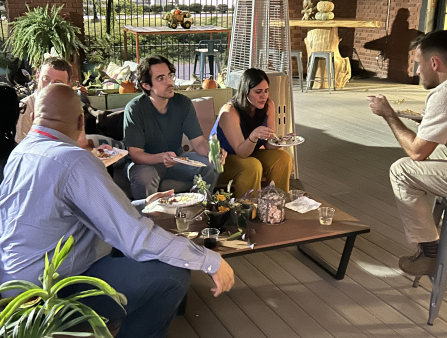
Filmmakers mingling at IMAS Party. Photo credit: Debra Fuller.
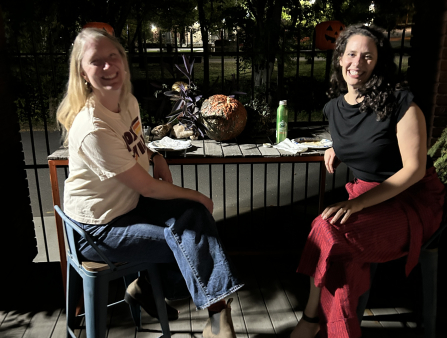
(L to R) Bridgette Cyr and Elizabeth Webb at the IMAS Party. Photo credit: Debra Fuller.
Forrester was then followed by Max Maldonado, a filmmaker and journalist (The Center for Investigative Reporting and Frontline). His short Eliza explores the impact of ICE campaigns on South Florida families through the lens of a Guatemalan girl whose parents were both taken into custody, leaving the Gen Z’er to take over their landscaping business and care for her younger siblings. The West Palm Beach, Florida native was seeking input on a variety of aspects, from character development to pacing and world-building. For her part, McKinnon wanted to see South Florida established as a character itself, perhaps by shooting out the window while Maldonado rode alongside Eliza in her car. She also thought it best to trim the short from 22 minutes to 20 for festival play (whereas Price suggested 10-35 minutes for broadcast).
Next to screen was Austin-based, El Paso-born Iliana Sosa, the most established director of the nonfiction cohort (What We Leave Behind, God Save Texas: La Frontera). Sosa is currently seeking production financing for Dreams That Come True (Sueños que se te cumplen), an extremely personal doc about the filmmaker’s decision to freeze her eggs—and her parents’ lukewarm reaction to possibly having a grandchild they may not live to meet. After viewing Sosa’s sample, equal parts poignant and hilarious, Price enthused about her decision to film the “reception of information,” her actively listening to her parents. McKinnon, on the other hand, brought up Safe (dir. Todd Haynes, 1995) and the idea that Julianne Moore’s character is in a state of the world “happening to her”—the notion of being told externally about one’s internal decision-making process. She also inquired about the fundraising strategy. Sosa admitted that many of the film-specific grants she received for her first film had ceased to be a viable strategy for doc-makers.
After Sosa’s allotted time, Hot Springs, Arkansas’s own Leslie Fisher, a writer and radio personality at the other end of the career spectrum, spoke about her short in production, Better Than a Letter, which is her first film as a director. Initially envisioned as an article, the project centers on the titular initiative, co-launched by the USO and Montgomery Ward during Operation Desert Storm, which allowed military families to record videotape messages at their local department store. Indeed, the director, along with her mother and brother, used the program to stay connected to her father throughout his lengthy deployment in Saudi Arabia.
With the distribution environment crumbling, multi-platform engagement will inevitably be necessary.
As a debut filmmaker, Fisher had many questions, from spending money on archival to donning the DP hat for interviews. In addition to suggesting she look into fair-use footage, McKinnon, who found the angle of the U.S. government working with Montgomery Ward especially rich, wanted Fisher to first determine the areas she needed help with and then bring others onboard (without sacrificing directorial control, of course). She also urged her to ask the always crucial question: What makes this not an article? Price then offered to make a list of archival films she should watch to help inform her process, while Hansell, who likewise started out in radio journalism, warned against “cutting for radio” (i.e., editing interviews and narration together without any pauses between them), an editorial mistake he himself made early on. The mentor encouraged Fisher to employ additional elements such as establishing shots, B-roll and natural sound to help set the pace that would draw viewers in.
Richmond, VA resident Bridgette Cyr, whose background is in video journalism (with an emphasis on domestic and sexual violence issues), had many questions about her film as well, specifically in regard to pacing and the use of news footage. Meant to Be Maddie is a feature that follows a trans girl (beginning when the titular character was eight) and her family over a decade as political forces encroach on their daily lives. And while Cyr’s presentation began with a purposeful, hard focus on Maddie to generate feedback, both mentors and the audience soon realized there was a broader story on screen—that of the ally parents grappling with how to navigate the current trans backlash. Indeed, by the time all six projects were later unveiled at the Filmmaker Forum for their public Work in Progress screenings two days later, Cyr had intentionally swapped her original sample for a longer cut, one that included the entire family unit responding to the transphobic climate in highly individual ways.
Last but certainly not least, presenting a project was Elizabeth Webb, an Atlanta resident from Charlottesville, VA, and the only experimental filmmaker among the Retreat participants. Hailing from a background in art and film, specifically in a conceptually-rooted practice that includes sculpture and printmaking, Webb grew up not knowing that her dad had spent much of his adult life passing as white. Her feature Artificial Horizon, which utilizes 16mm as well as other formats, investigates not only her own family history but that of the larger South, and employs the theme of plants as a means to liberation. The artist-filmmaker also expressed interest in the visual aspects of surveying and land boundaries.
The question of how much context to include about Webb’s background was likewise central to the conversation, and McKinnon noted the diversity of viewer expectations. She also pointed out that with the distribution environment crumbling, multi-platform engagement will inevitably be necessary.
In the midst of industry upheaval, doc-makers from all backgrounds could at least take warm comfort in drifting together, searching for a way forward in the same uneasy boat.
As the presentations accompanied by productive feedback came to a close, the energy was still high (even after the session’s slated two-and-a-half hours crept into four). Indeed, as most of the cohort headed to the food truck lot next door for dinner together, there was a strong sense that they were all actively learning from one another, everyone eager to glean suggestions applicable to their own projects. There was also a lingering feeling of relief that permeated the proceedings. It seemed that, in the midst of industry upheaval, doc-makers from all backgrounds could at least take warm comfort in drifting together, searching for a way forward in the same uneasy boat.
Day two began with a 90-minute morning drive up to Petit Jean Mountain, the former home/cattle ranch of Governor Winthrop Rockefeller and the current site of the Winthrop Rockefeller Institute, which hosted the first HSDFI Nonfiction Storytelling Summit. A less intimate and more expansive get-together, the event included not only the Retreat participants but also a who’s who of over two dozen Mid-South/South-based industry veterans tasked with tackling one big question: What can we do for the ecosystem?
After an in-depth tour of the sprawling campus, HSDFI board members, directors, and strategists from various organizations (including Catapult Film Fund’s Amanda Arya, Ragtag Film Society’s Andrea Luque, Sarah Childress of the Metro Nashville Office of Entertainment and Wendy Keeling of the IMAS organizing committee and Future Film Coalition, to name just a few), and even a Hot Springs philanthropist/fundraiser gathered for a series of whiteboard-based brainstorming exercises led by two of the W.R.I.’s professional facilitators. Discussion topics ranged from the umbrella “What We’d Like to See in the Future 15 Years from Now” to the greatest challenges (funding was, unsurprisingly, front of mind for many of the Retreat filmmakers). The sessions ultimately culminated in a consensus on two key takeaways: the need to develop a national, nonpolitical, no-paywall organization to coordinate resources and educational funding; and a means to collaborate at scale (with a focus on Southern Documentary Fund, Reel South, South Arts, and IMAS). And yet one still had to wonder whether the day-long Summit might have been more productive had it taken place away from its corporate-structure trappings and closer to humble Hot Springs, negating the need for a three-hour roundtrip excursion during a limited four-day retreat. Even in times of scarcity of arts support, less can often be more.
While the doc ecosystem might be collapsing, storytellers in the South continue to discover fertile ground.
Fortunately, the final two days at the Filmmaker Forum were held at the very nearby Arlington Hotel festival headquarters. And much like day one, two Work in Progress screenings (with Webb, Maldonado and Forrester presenting their samples in the first session, and Sosa, Fisher and Cyr in the second) allowed the filmmakers to receive largely helpful, thought-provoking advice from a room of their peers. (It didn’t hurt that two of the most vocal and enthusiastic peers happened to be Yoruba Richen and Grace Lee, while Firelight Media’s regional initiatives coordinator Weenta Girmay served as an expert moderator.) Equally helpful was the single-page outline handed out to attendees at the start, which gave a brief breakdown of all the projects—title, director, stage of development, context for the sample within the larger film, and perhaps most importantly, what the filmmaker was requesting feedback on. This not only kept things moving but also made way for more targeted, less spaghetti-thrown-at-the-wall suggestions from an overly eager audience.
Some of the feedback delivered confirmed prior advice, while other observations broadened the lens. For example, director/Civil War reenactor J.R. Hardman, who presented Reenactress at “The Art of the Pitch” the following day, pointed out the “filmmaking chops” of Sosa’s unnamed boyfriend, whom the title cards revealed she’d enlisted to shoot that nuanced scene with her and her parents. Was there a way to somehow place the boyfriend in the frame, or at least acknowledge the fact that he’s likewise a documentary filmmaker?
Interestingly, Sosa’s boyfriend, Iranian-American director Andy Sarjahani, who was raised in the Arkansas Ozarks, actually appeared with co-director Evan Mascagni, a Kentucky-based filmmaker of Lebanese descent, the next day to discuss their upcoming feature at “The Art of the Pitch.” Pigeon in the Machine centers on the history of the I.Q. Zoo, a quirky, Hot Springs roadside attraction founded by B.F. Skinner’s students that featured animals performing disturbingly bizarre feats. (Its most famous/infamous star was likely the chicken from Herzog’s Stroszek.) It was all further proof that while the doc ecosystem might be collapsing, storytellers in the South continue to discover fertile ground. In fact, the Filmmaker Retreat could be seen as a beacon of sorts, a place to share stories, make connections, and together find a way forward to final cut.