
For three decades, Chris Smith has profiled oddballs, eccentrics, and mavericks. Smith’s first documentary, American Movie— a darkly funny but
Online Feature
Qumra, the Doha-based industry event, named after the Arabic word believedto be the origin of “camera” and taking place from April 3–9, aims “to provide mentorship, nurture talent, and foster hands-on development for filmmakers from Qatar, the region, and beyond.” Out of the 49 selected projects, 12 feature-length documentary projects were presented in Doha: four in development, two in production, two Works-in-Progress, and four picture-locked. The line-up was rounded off by four short documentaries, all with Qatari involvement. Qumra is rooted in a fairly freewheeling format: at times, press and industry attendees mingle over lunches, mocktails, and networking events; at others, they follow separate paths. Nonetheless, the gathering unfolds across a limited number of venues, including the iconic Museum of Islamic Art and two luxury hotels in the brand-new district of Msheireb.
Encountering Sylvain George’s Obscure Night - Goodbye Here, Anywhere (2023) at the Locarno Film Festival two years ago was a revelation. The three
On January 14th,1996—his 21st birthday—Ricardo López started videotaping himself laying out his plot to attack the Icelandic popstar Björk. In this initial tape, López said Björk was a symbol of purity and innocence to him, an image which he said she destroyed by having relationships with two different black musicians, previously with Massive Attack’s Tricky and, at the time of his recordings, English music producer Goldie. Filmmaker Heather Landsman seriously considers López’s footage in her new film The Best of Me, which condenses the 20-some hours of tapes López produced into a hauntingly candid look into a deeply unwell and alienated individual. The Best of Me is being independently distributed by Landsman through the Film-Makers’ Cooperative, touring microcinemas.
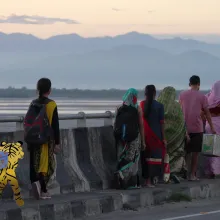
We Live Here delves into the present-day reality of the Semipalatinsk nuclear test site—known during the Soviet era as the Polygon—and the enduring devastation it has wrought on those who still live there. Director Zhanana Kurmasheva centers the story on Bolatbek, an elderly man who has spent his entire life in a village just 30 kilometers from the Polygon. While the tragedy of the Polygon has been chronicled before, often in government-backed, TV-style documentaries, Kurmasheva’s work approaches the subject differently, elevating it to a kind of myth—a legacy that strangely defines who Kazakhs are. We Live Here is steeped in a sense of foreboding. We Live Here premiered at CPH:DOX. Ahead of the film’s North American Premiere at Hot Docs, Documentary spoke to Kurmasheva about what makes residents stay in such a contaminated area, the genius loci of the steppe, and the interplay of beauty and violence embedded within it.
In December 2023, as part of the series Making a Production, Documentary profiled Meerkat Media, the New York-based cooperatively owned production company and media arts collective. As a radical experiment in shared authorship and ownership, Meerkat built a sustainable framework for making the kind of films they cared about, while still providing steady paychecks, health insurance, and medical leave to their members. Since the publication of their profile, the group has faced industry-wide challenges, including tightening budgets and shrinking opportunities. At the same time, they’ve experienced major creative high points. Over Zoom, Documentary caught up with Sterrenberg to talk about Meerkat’s recent creative highs, the challenges of balancing freelance work with collective production, and how Emergent City, which opens at DCTV tomorrow and will be broadcast on POV later this year, took shape within the group.
A cramped room inside which most of Marriage Cops takes place becomes an effective metaphor for not only the stifling sensation of being trapped in an
Marking its 20th anniversary this edition (March 27–30, 2025), Berwick Film & Media Arts Festival has established itself as one of the UK’s most boundary-defying festivals for the moving image. This commitment to dismantling hierarchies extends to the festival’s structure. Many of the featured works explore the body’s mnemonic capacities—how gesture, movement, and touch might commune with history, or reimagine how to engage with the unknowable: Underground, Black & Arab Encounters on Screen, Bounded Intimacy, an Eri Makihara program, and Nightshift.
The 23rd edition of CPH:DOX wrapped last month, with record-breaking attendance and satisfied delegates at the festival’s market, but individual events at the industry conference revealed ruptures in the front of documentary unity against political threats. Filmmaker Omar Shargawi issued one of the most visible criticisms, reading a statement contrasting the festival’s support of Ukrainian filmmakers to a lack of “solidarity with the Palestinians” at an industry talk. At the closing ceremony, Artistic Director Niklas Engstrøm and Executive Director Katrine Kilgaard said their aim was “pluralism” and “to make room for a multitude of opinions and ideas, including those that challenge our own perspective as a festival.” Documentary reached out to Engstrøm for further comment via email after the festival ended.
One of the foremost critical thinkers of the international documentary ecosystem, Leonard Cortana was tapped by EURODOC program head Nora Philippe in 2023 to manage the inclusion program and strategic partnerships. The resulting program, BIPOC EURODOC, hosts bi-monthly member meetings and monthly public webinars with outside experts to support the ongoing education of its members. The task force also conducts focus groups to inform white papers like this recent study on film festival delegations, in partnership with the #Docsafe initiative. Speaking on Zoom from Mexico City, Cortana spoke with Documentary about the goals of BIPOC EURODOC, the politics of film festival delegations, and why post-screening Q&As are “an extremely unsafe space.”