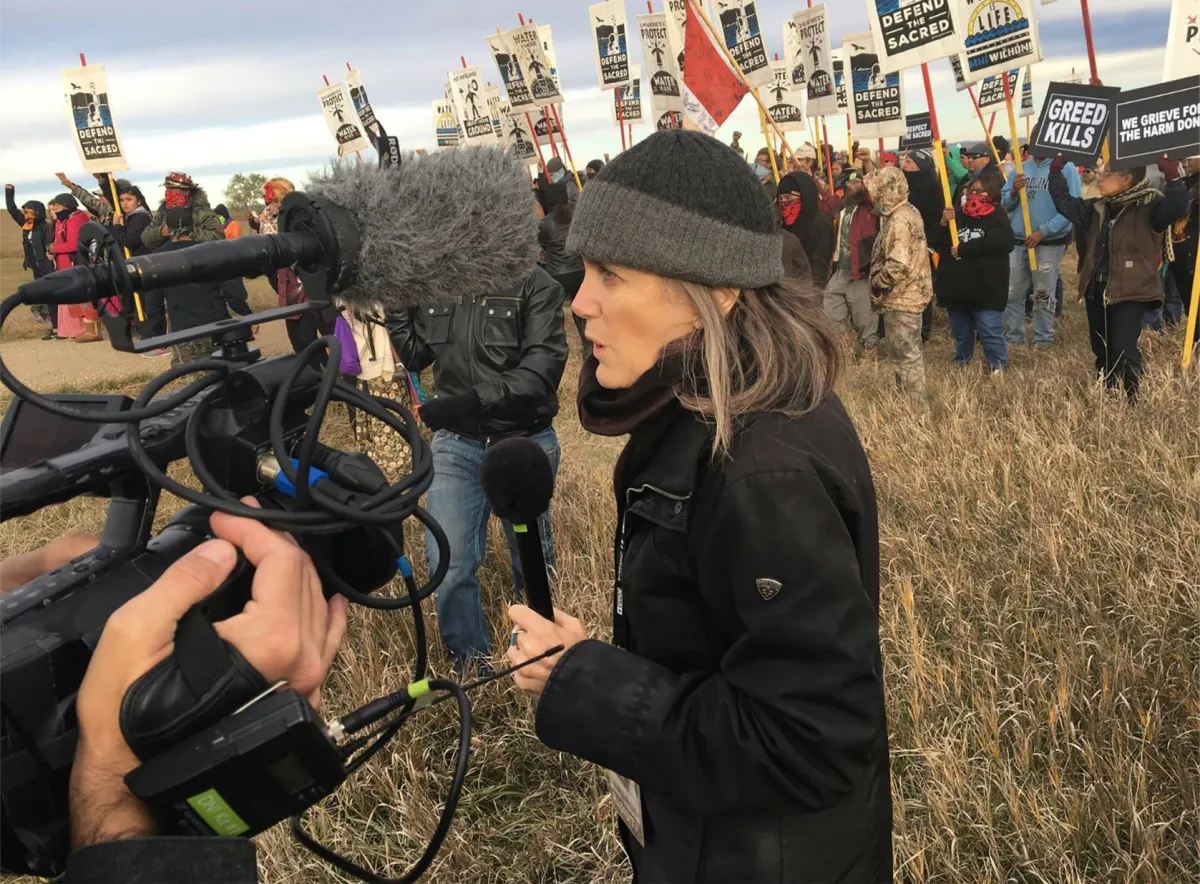


Steal This Story, Please!, a biography of veteran independent journalist Amy Goodman and a history of her longtime employer, Democracy Now!, has resonated with audiences to a degree that has pleasantly surprised its makers. Directors Tia Lessin and Carl Deal decided to distribute the documentary themselves, and it’s continually extended runs at various theaters since opening at New York’s IFC Center in May, grossing more than $1 million at the box office.
With Steal This Story, Please! continuing to do well in its theatrical run, we sat down with Lessin and Deal over Zoom to discuss their strategy, the film’s eventual digital distribution, and what it’s like to watch Amy Goodman be treated like a celebrity. This conversation has been edited and condensed for time and clarity.
DOCUMENTARY: Why did you opt to release Steal This Story, Please! yourselves? Did you consider a more traditional distributor and theatrical drop?
TIA LESSIN: We’ve put out movies in all sorts of different ways, shapes, and forms over the years. We’ve gone with boutique distributors, and we’ve done self-releases. When we were producing with Michael Moore, we were with the real big guns, like Miramax and Lionsgate. But we’ve seen a lot of self-released films get traction, and given the state of the market, that felt like our best way to make it into the theatrical space.
Our incredible reception on the festival circuit was why we decided this needed to have a theatrical release. We were at Telluride and didn’t get any bites, but we won the audience awards at Mill Valley, Santa Fe, Seattle DocFest, Palm Springs, Santa Barbara—it just went on and on. We saw the community response to this film and felt we should try this out and see how it went.
CARL DEAL: This film was made entirely independently. We got an NYSCA grant early on, but we did it ourselves, and it was a labor of love. When we saw audiences responding, we realized how well it plays in a room, and we were really committed to that. I think it would’ve been foolish not to test the waters with more traditional commercial distributors, but we also entered this without any illusions; we always figured we were going to have to do a lot of this on our own.
TL: I don’t think we’re unique in this situation. No Other Land [2024] never had formal US distribution. I think Secret Mall Apartment [2024] went out independently through Michael Tuckman. Half the documentaries on the Academy Awards shortlist this year had no distribution prospects before the shortlist, and a couple still lacked distributors heading into the Oscars, including Cutting Through Rocks [2025]. The winner, Mr Nobody Against Putin [2025], barely got theatrical distribution. It’s just tough times, especially for documentaries that are more political.
D: How did you decide who to bring on board to help with booking and promoting the film?
CD: We’ve had a whole range of experiences with different types of theatrical releases, and we brought all that to bear on this. We built this incredible team, with Michael Tuckman booking, wonderful publicists in different parts of the country, and an amazing social team. We found a lot of support for getting eyes on the film in theaters. I think all of us have a renewed appreciation for the shared experience of the theater since COVID.
TL: Michael used to run a distribution company, and he’s choosy about the films he takes on; he has incredible relationships with the arthouse community all over the country. Those are primarily the venues where this film showed—places that had their own calendar listings and community newsletters. We wanted more than a one-day release. People talked to us about eventizing the film for one day, but we felt that if a theater was willing to book it for a week, then we should go for it. Almost all the engagements have been at least a week long, and the film was held over in probably half its theaters. We just did our last screening at IFC. We were a little sad to leave but grateful for the time there. It was a lot of fun to have that kind of reception for over 10 weeks in our hometown.
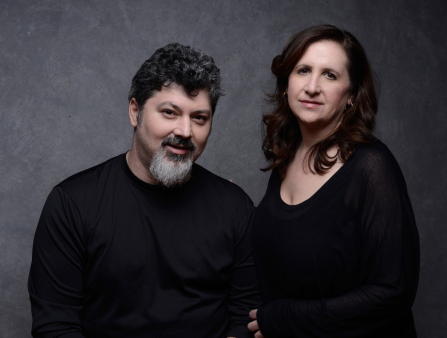
Portrait of Tia Lessin & Carl Deal. Courtesy of Jeff Vespa
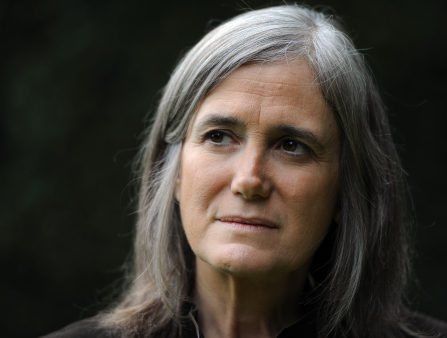
Portrait of Amy Goodman. Courtesy of Right Livelihood/Wolfgang Schmidt
D: With the success the film has been seeing, how much more do you think the theatrical run may extend?
CD: One aspect of this that’s been really successful—which is true to the brand of Democracy Now!—is that wherever there’s been demand for the film in a community, we can bring it there. I can’t tell you how many screenings we’ve done where somebody came up and said, “Such and such theater in this community should book the film,” and I’d text our booker on the spot, and the next day, we’d be booked there. We opened Fahrenheit 11/9 [2018], the last Michael Moore film that we produced, on 1,800 screens in one weekend. What we’re doing is much more hands-on and sustainable. It’s the traditional indie model of going city by city, and as long as there’s demand, we have no deadline for pulling it out. We’d like to move into the next phase of distribution in the fall, but there are great things about being independent.
TL: And the slow platform release allowed us to build relationships in each of the communities. At the IFC Center, we had a $32,000 average for a single screen on our opening weekend, the most successful documentary opening in 10 years. And we were up against The Devil Wears Prada and The Christophers. We saw people buy tickets to The Christophers at IFC because they couldn’t get into our sold-out shows and then take seats in the front row of our theater. The Music Box in Chicago told us we had their most successful weekend for any documentary in 25 years, which is as long as they’ve been keeping records. When we arrived at the Charles Theater in Baltimore for the opening, we thought it was jam-packed for The Devil Wears Prada, but then people started recognizing Amy and surrounding her and thanking her. She said, “Oh my god, there’s a crossover audience between The Devil Wears Prada and Democracy Now!” And they’re like, “No, no, we’re here to see the documentary.” We couldn’t have sustained that across 1,800 theaters, but with a platform release, we could build those audiences.
The other secret is that we partnered with radio broadcasters, community stations, public access stations, and print outlets. Some are stations Democracy Now! airs on, and others aren’t. The film is a love letter to independent media, and it felt natural. In doing so, we raised upwards of $100,000 across the country for many stations, which are in dire need after the cancellation of the Corporation for Public Broadcasting. It’s a drop in the bucket overall, but it was meaningful to us. It was important to show our support and to encourage audiences to show their support for these community stations.
D: Once you reach the next stage, what will that look like? Are you in talks about digital distribution?
CD: Yeah, we want the film available. We believe you go where the audience is. We’re not big fans of how the big streamers can shut out a lot of independent voices. The film is about the consolidation of the media and the dangers of that. But if Jeff Bezos wants to make a quarter off a streaming sale of our film, that’s fine. It’s a drop in the bucket for the world’s second-richest man, and we want the eyeballs. So we anticipate following this up with a robust digital release.
TL: We’re fans of the streamers, and we’re excited about our film reaching audiences on all those platforms. We’re fielding a few offers, and we’re about to pull the trigger.