

When Yervant Gianikian passed away this past August, he left behind a body of work without compare in documentary film. This oeuvre—most of it co-authored with his wife, Angela Ricci Lucchi—comprises some fifty works of short, medium, and feature length, and coins an approach to representing history through film that is entirely their own. Working almost exclusively with found footage, and almost exclusively with footage documenting the various horrors unfolding across Europe throughout the twentieth century, Gianikian and Ricci Lucchi tinted, magnified, and slowed down these images in order to allow their viewers to perceive them with fresh eyes.
Their films highlight celluloid’s material qualities of deterioration, cultivating a novel perspective on the past: with us constantly, and yet always just beyond our grasp, glimpsed through a veil of decay. Teaching viewers to see through this strange perspective and to live in the world between past and present increasingly becomes the unspoken subject of their films. Though they traveled to cinematheques, galleries, and biennales the world over with these pieces, Gianikian and Ricci Lucchi spurned the oft-applied categories of “filmmakers,” “historians,” or even “archaeologists,” instead preferring the humbler title, “film workers.”
Smell and Fury
They took a circuitous route to film work. Ricci Lucchi was born in Emilia-Romagna, Italy, and, after university, worked as a painter and concept artist. Experimenting with mail art in the early 1970s, she sent a questionnaire to an artist living in the Alps, whom she described in their 2015 book, Notre Caméra Analytique, as “either a genius or a madman.” Gianikian, the son of an Armenian Genocide survivor who had grown up in Suedtirol, studied architecture and was collecting historical toys found in the Dolomites when he received her letter. He wrote back with interest, and in 1974, the two promptly moved in together in Milan, inaugurating a decades-long artistic partnership with their first work, which they called “scent films.”
From the outset, they displayed an interest in destabilizing the type of gaze facilitated by the well-rehearsed cinematic encounter. After 1974, in avant-garde venues across Europe and North America, the two combined images with smells, attempting to attack the well-rehearsed cinematic encounter along a fresh axis. In Toronto, New York, and San Francisco, they showed, for example, their film shot in Cesare Lombroso’s Museum of Criminal Anthropology, Cesare Lombroso—Scent of Carnation (Cesare Lombroso—Sull’odore del garofano, 1976) alongside the bottled odor of carnations—the founding Italian eugenicist had once used the same odor in experiments to prove his hypothesis that criminals possess an underdeveloped sense of smell. Casting back to this history of violence, they sought to draw an olfactory connection to the present moment of witnessing—an uncomfortable reminder of the brutality atop which our present world was built.
They would abandon the scent films by the decade’s end, but this first collaboration introduced some of the key themes that would define their next forty years of artistry: a fascination with crimes perpetrated against the disenfranchised of the twentieth century; a desire to represent these crimes for a contemporary audience; and an eagerness to discover how they interact with the present day. On this last point, it bears emphasizing that, though their choices of subject matter might appear to be a syllabus on the history of imperialism, they disdain didacticism in the highest degree. The unstated query of every Gianikian and Ricci Lucchi film—posed again and again through their insistent connection of history to the moment of encountering it—asks: atop the mass graves of the past, how do you continue to live? This is a confrontation, but it’s also an earnest inquiry.
From the Pole to the Equator screenshots
Film Workers
Fortune smiled upon the young couple, or perhaps it’s more accurate to say that they worked tirelessly to cultivate a special relationship with the past. The two made their major breakthrough with From the Pole to the Equator (Dal Polo all’Equatore, 1987). The story begins in 1982, when Gianikian and Ricci Lucchi were informed that a Milan laboratory housing several boxes of 35mm nitrate film was slated for demolition. When they arrived to inspect the situation, they found that these boxes contained the films of one Luca Comerio: silent film pioneer, personal cinematographer of the last King of Italy, and propagandist/documentarian of the country’s slide into fascism after the First World War. The laboratory was Comerio’s own.
Not seeking simply to preserve this history, they invented a mode of working capable of critiquing it in real time. To deal with the Comerio collection, Gianikian and Ricci Lucchi employed a device and a method that they would come to call their “analytical camera.” The machine was effectively a custom optical printer built to suit the unique Lumière-era perforations of the Comerio films, hand-cranked with a lamp of variable temperature to suit their fragility and flammability, paired with a mobile camera for re-filming the archival prints with the ability to zoom in on finer details, capture in slow motion, or even tint sections of the new film. This device would be the engine of all their future endeavors with found footage, the vehicle by which they would ferry their dire messages from the past.
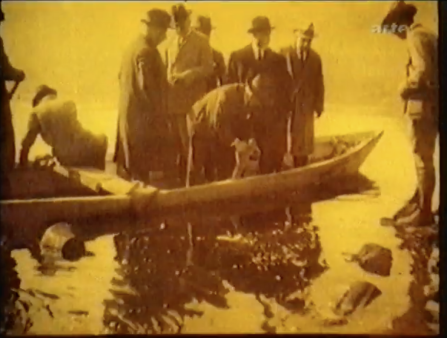
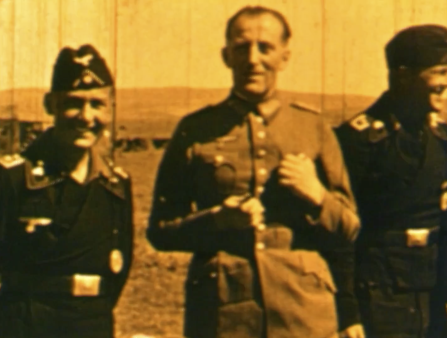
Comerio died in a psychiatric hospital in 1940, having been institutionalized for amnesia after a half-century spent capturing the rise of an Italian empire that was casting its gaze across the globe. Comerio’s films captured trophy hunts for polar bears and zebras, orientalist ethnographies in Eritrea, Alpine soldiers in trenches, and missionary schools in Ethiopia, and many of them were compiled into his own 1920 documentary, From the Pole to the Equator. His camera spun the empire into myth, but by 1982, these films were suffering from what Gianikian called “chemical amnesia.” But it would be a mistake to term their film work “restoration.” Rather than looking to rehabilitate these films to a previous better state, they sought to preserve the history alongside the amnesia. Over five years, Gianikian and Ricci Lucchi reinforced splices, catalogued the decomposing images in dozens of notebooks, and re-photographed them in 347,000 stills with their analytical camera, working under the constant threat of a nitrate fire. Humble though they may be, their mode of re-presentation relied was inseparable from their re-interpretation: twisting and perverting the faded images of a fascist past in order to bear witness to everything they meant to conceal, while preserving the viewer’s own consciousness of their place in this hideous lineage. Like the Italian audiences of the 1920s, you, too, are watching a documentary with footage shot by Luca Comerio, titled From the Pole to the Equator. Gianikian and Ricci Lucchi ask what is different, this time, but only hint at possible answers.
From the Pole to the Equator screenshots
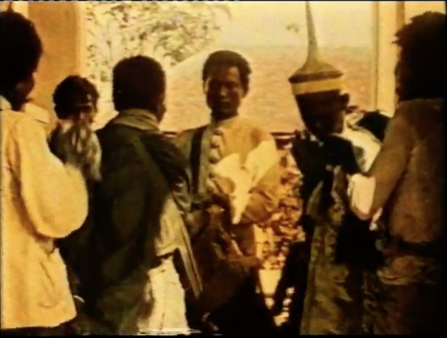
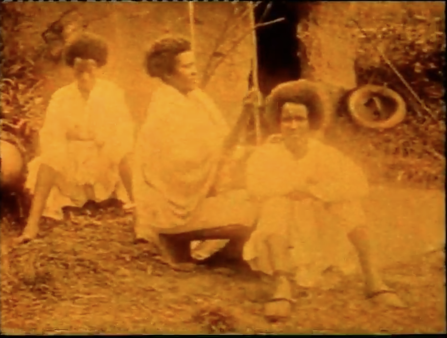
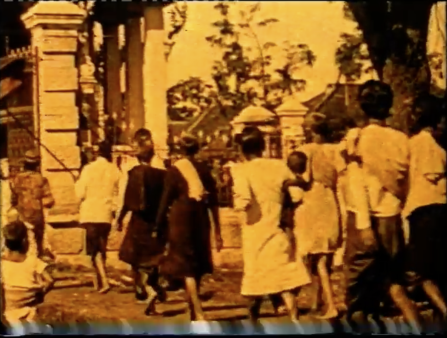
A few illustrative moments, in From the Pole to the Equator: tinted desert-orange with the framerate slowed to a crawl, Ethiopian villagers stare at Comerio’s camera unsmiling, until a white man in a pith helmet cuts through their ranks, distracting their gaze; a group of villagers dressed up in pilgrim garb perform a dance for a supervising nun, while their family members seated behind them seem to look off into the middle distance; in green-tinted negative, an aristocratic mother and daughter walk hand-in-hand down a palm-lined street. The images of From the Pole to the Equator are not all so ostentatiously colonial, and yet an understanding of their imperial portent seeps from one sequence to the next—the repeated subjugation of one people by another, and photography’s naturalization of the new hierarchy. But Gianikian and Ricci Lucchi’s work is not merely to expose the white hunter’s gaze, but also to counter it with their own, however subtly. In another moment from the film, a white missionary instructs a group of African children to make the sign of the cross, using her left hand; they all respond with their right—the possibility of resistance exposed by the film’s cross-gaze, lingering on the children’s gesture. Here one finds the faint glimpse of a roadmap amid this devastating history of the making of modern Italy. Subjecting viewers to these mounting catastrophes, they offer a new perspective that seeks to preserve life amid tragedy, never ceasing the search for humanity in its bleakest moments.
All the same, while the contents of the images bear forth these thwarted hopes and still-potent threats, their surfaces are busy with a kaleidoscopic interplay of tints, nitrate blisters, dust, and splice lines. The effect is such that whatever revelations a viewer unearths remain thick with the stench of decay. As cracks in the facade allow one to observe previously hidden qualities, portions of the frame remain obscured; no memory can be complete or perfect. The effort of remembering vies with the gravitational force of amnesia—the films’, Comerio’s, and Italy’s. The work continues after the projector stops.
Trasperenze screenshots
The Future of the Past
Gianikian and Ricci Lucchi’s work is a continual reckoning with the past, a relentless drive not to close the book on history’s darkest moments. As their career stretched toward the new millennium, their work from this time demonstrates a growing insistence on the intimate connections between past and present. Diana’s Looking-Glass (Lo specchio di Diana, 1996) begins with the intertitle: “From the dreams of imperial conquest, to the realities of the African campaign.” Spanning a wider historical purview than any previous work, the film’s first images show Italian soldiers pulling two ancient ships—thought to have been constructed by the Roman emperor Caligula in the first century AD—from Lake Nemi, which Mussolini had ordered drained for this purpose in 1926. Shots of divers, winches, and excavated Classical treasures appear through blue and green washes that seem to submerge them again the moment they are retrieved—a clear analog to the archival work done by Gianikian and Ricci Lucchi. That same year, as part of the vicious “pacification of Libya” waged by Mussolini, the dictator rode into Tripoli on horseback, manifesting the Roman imperial destiny he felt his Italy was owed in Africa. For these scenes, Gianikian and Ricci Lucchi deploy a simple blood red wash. Further intertitles trace the later developments: 1936 completed Italy’s annexation of Ethiopia; in 1944, with Mussolini executed, fleeing German soldiers burned his museum dedicated to Caligula’s ships to the ground. Diana’s Looking-Glass thus posits the rise and fall of imperial ambitions in an infinite loop, a cycle as eternal as the moon’s reflection on Lake Nemi, which gives the film its title. Attempts to resurrect these lost pasts are doomed to drown or go up in flames, well befitting the blue and red tints and the bubbling nitrate emulsion. As these historical artifacts are summoned up from the deep once more, the film’s unspoken question rings a little clearer: what will be done differently, this time? How can we choose life over this death drive?
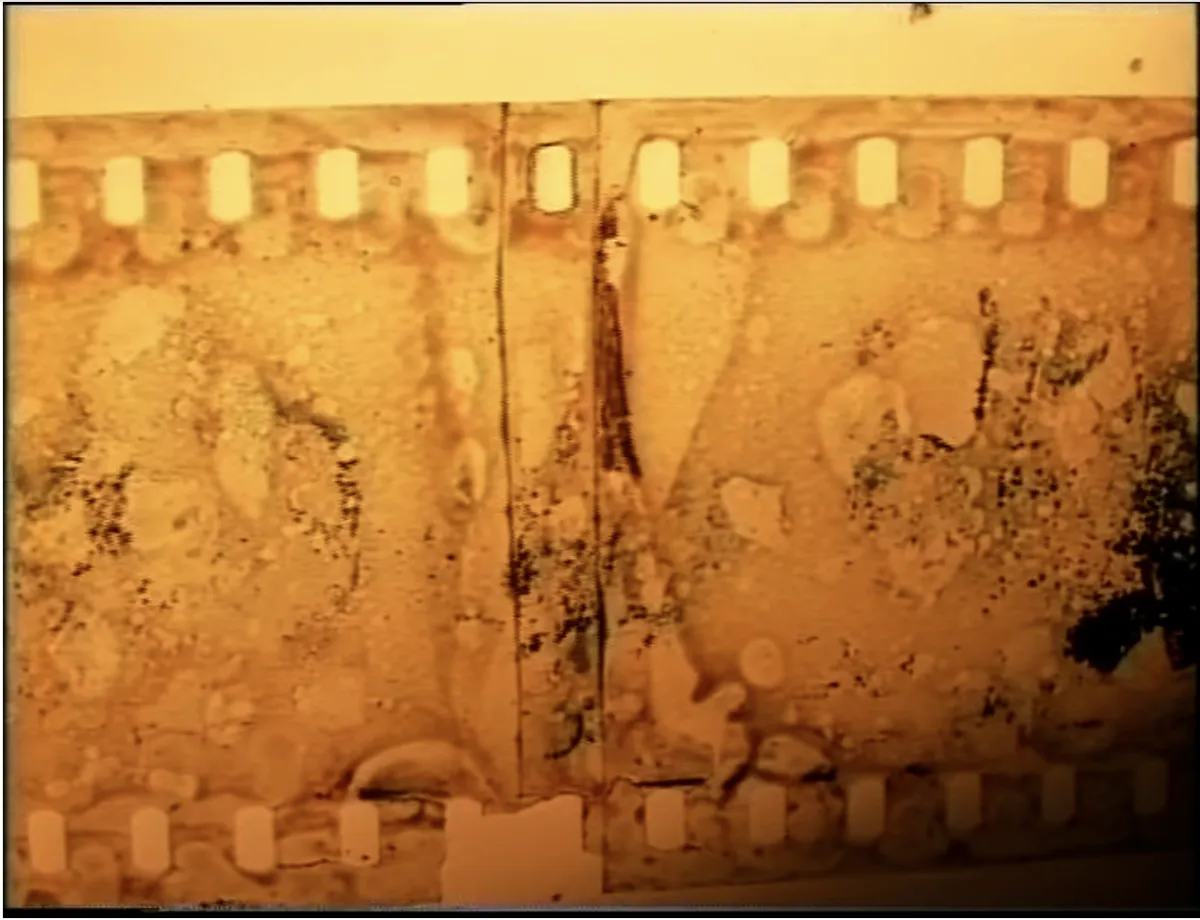
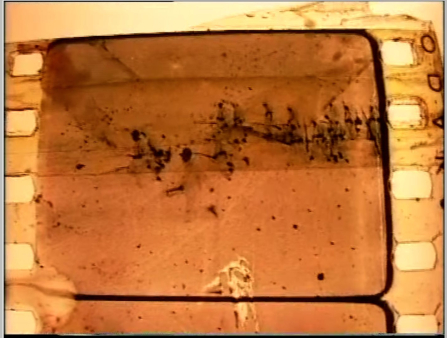
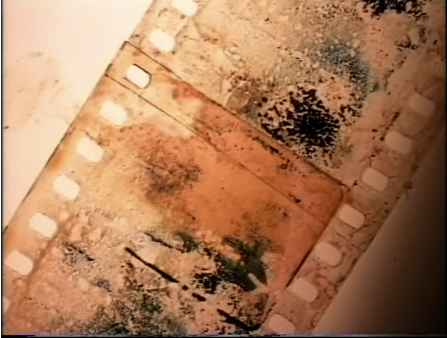
Trasperenze (1998) offers a few clues, albeit obliquely. The six-minute piece is one of the few Gianikian/Ricci Lucchi pieces shot on video—spurning, for once, their analytical camera—but is perhaps more oriented toward the material film strip than any other work in their filmography. The camera, handheld, here, hovers over a series of hopelessly broken film fragments, focusing on their torn perforations, damaged emulsions, and broken splices. If one squints past these obstructions, focusing through the dust and chemical abrasions, a keen-eyed viewer can also make out the almost familiar sights of the Gianikian/Ricci Lucchi oeuvre: crowds of villagers, soldiers marching, a man possibly digging a grave. Trasparenze thus seems to teach one of the most basic and difficult skills of film inspection, so antithetical to our typical relation to film viewing that it focuses one’s eyes not within the image’s illusion of depth but rather on the plastic surface of the film itself. Reverberating between surface and depth, the short communicates something essential about the experience of viewing a Gianikian/Ricci Lucchi film: a sense of being caught in the middle of image and reflection, and a desperation to recover the past that is constantly frustrated. Trasparenze exposes this dynamic interplay and preaches dexterity: to move forward while glancing backward, to continue living despite and amongst the death all around.
Their films give a sense, like few others, of what it feels like to live through history, of the moment of watching the film as intimately tied to the time depicted in the images onscreen, which are simultaneously irrecoverable. What Trasparenze teaches, however indirectly, is the underlying message of each of their films, and the greatest gift bequeathed by Gianikian and Ricci Lucchi: the painstaking cultivation of a third perspective, between image and reflection, past and present, death and life.
I diari di Angela screenshots
A Working Life
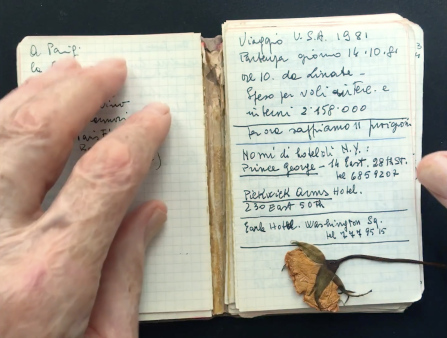
Treading this middle path is the labor of a lifetime. In their final films, Gianikian and Ricci Lucchi would raise the eternal question: how do you live?, from its subtextual layer and anchor it firmly in their own shared biography. The project began after Ricci Lucchi’s death in 2018. When asked by MUBI Notebook if he had begun work on the films before her passing, Gianikian responded: “We decided early on that we would always continue our work together. So we will continue making films together, also in the future.” Entitled Angela’s Diaries (I diari di Angela, 2018-2026), the three-part series preserves Ricci Lucchi’s authorship by taking their voiceover from Gianikian’s reading of her production diaries, which span some 60 notebooks, and pairing these words with the constant video diary shot by Gianikian. The invisible hand of the analytical camera falls away, replaced with a somehow richer and more intimate sense of time and history in its absence.
In these films, which track the pair’s collaboration and partnership from the scent pieces onward, we see Gianikian and Ricci Lucchi attend openings and retrospectives, travel throughout Europe in search of archival material, and speak with survivors of the many catastrophes of the twentieth century. In a particularly moving episode from 1979, we witness the couple’s visit to Gianikian’s father as part of their preparation for Return to Khodorciur—Armenian Diary (Ritorno a Khodorciur—Diario armeno, 1986), a film inspired by Gianikian’s father’s diary entries from the time of the genocide. The scene begins, as is typical for Angela’s Diaries, with Gianikian shooting Angela’s diary through his digital camera. With a quivering voice, he reads aloud: “Going toward Nemrud Degi, we collected the earth for Gianikian’s dad.” The film cuts to Gianikian’s 8mm film diary of their visit, showing his father in a cap and cane, gesturing toward the nearby Dolomites. The elder Gianikian takes over the narration, reading from his diaries: “Every day they died, in the hundreds….” He proceeds with an extended list of the casualties of the genocide from his youth. Grief—for his wife, his father, his father’s father—creates an almost vertiginous effect, pulling Angela’s Diaries further into the violence of the past, and yet these films repeatedly cut from such traumas to scenes of Gianikian and Ricci Lucchi laughing, driving, and cooking together. Following their travels to St. Petersburg, Sarajevo, Tehran, and Yerevan, the films offer a movingly direct retort to their own ever-present, unspoken inquiry. A life spent remembering does not entail a life not lived. Much to the contrary, continuing to live amongst these specters of the past—keeping them at arm’s length, never out of shouting distance—is our imperative.
Perhaps most humbling are the moments when these scholars of living in time cope with it in relatively mundane ways. At the end of the first chapter, when Ricci Lucchi motions away Gianikian’s camera, not wishing to be filmed, he teases her, “I’ve got a filter to remove the wrinkles.” In the same interview with MUBI Notebook, Gianikian calls this first entry “a monument for her.” As the rest of their shared oeuvre makes the implicit demand not merely to live through but also with history, these last entries make the final and poignant connection to their own life together and to a more commonplace, if no less devastating, phenomenon: grief. The Angela’s Diaries series, more directly than any other film in their filmography, urges us to persist alongside the ghosts. “Our life is film, it is cinema,” Gianikian continued. “And I still want to go on.”