
Editor’s Note: On July 22, 2026, Petna Ndaliko Katondolo delivered a keynote conversation with IDA’s Executive Director Dominic Asmall Willsdon at IDA’s Getting Real ’26 conference at the Japanese American National Museum in Little Tokyo, Los Angeles. The discussion was framed around his prepared text, “Beyond Narrative Sovereignty: Storytelling, Memory, and the New Humanities,” which has been edited and adapted for publication in Documentary.
Before his talk, Katondolo invited those gathered to enter a practice he calls “Erikuma.” As he explained: “Erikuma is an embodied practice of seeking consent before any prise de parole or filming. Through a shared vocal hum, we attune ourselves to the rhythm of the heartbeat and extend our awareness through the 360-degree movement of the Dikenga—toward one another, the land, the ancestors, the surrounding space, and all that is present. This collective calibration opens a physical and spiritual circle of belonging, preparing the ground for community-making, reciprocal listening, and meaningful dialogue.”
Hadisi njo!
Njo Hadisi!
Whenever I am invited to speak about cinema, I find myself returning not to a film school, nor to a festival, nor even to a camera.
I return to my grandmother, and my great-grandmother, and my great-great-grandmother. Because before I ever learned how to make films, I first had to learn what a story is. When I was a young boy, I announced to my parents that I wanted to become a filmmaker. They listened carefully. Then they smiled and said, “Before you make such a decision, you should first ask your grandmothers.”
At the time, I was living with them after my grandfather had joined the ancestors. So I walked to where they were sitting and told them proudly, “I want to study filmmaking.” They looked at one another. Then one of them asked a question that completely surprised me: “Why?”
I answered without hesitation: “Because I want to learn how to tell stories.” They laughed. Not to mock me but to remind me of something I had forgotten. Then my grandmother said words that would take me decades to understand. “You come from a genealogy of storytellers. You already know how to tell a living story. Why do you want to go to school to learn something you already know?”
I didn’t know how to answer. After a long silence, I tried again: “I don’t want to learn storytelling. I want to learn how to tell stories with moving pictures.”
This time, they nodded. Only many years later did I realize they had never questioned my career choice. They were asking something much deeper. What happens when a living story becomes an image? What is gained? What is lost? And perhaps the most important question of all: Who decides? Without knowing it, my grandmothers had given me the question that would shape the rest of my life.
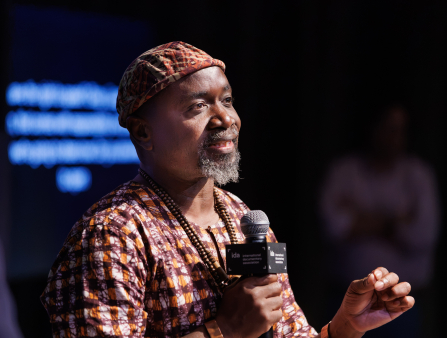
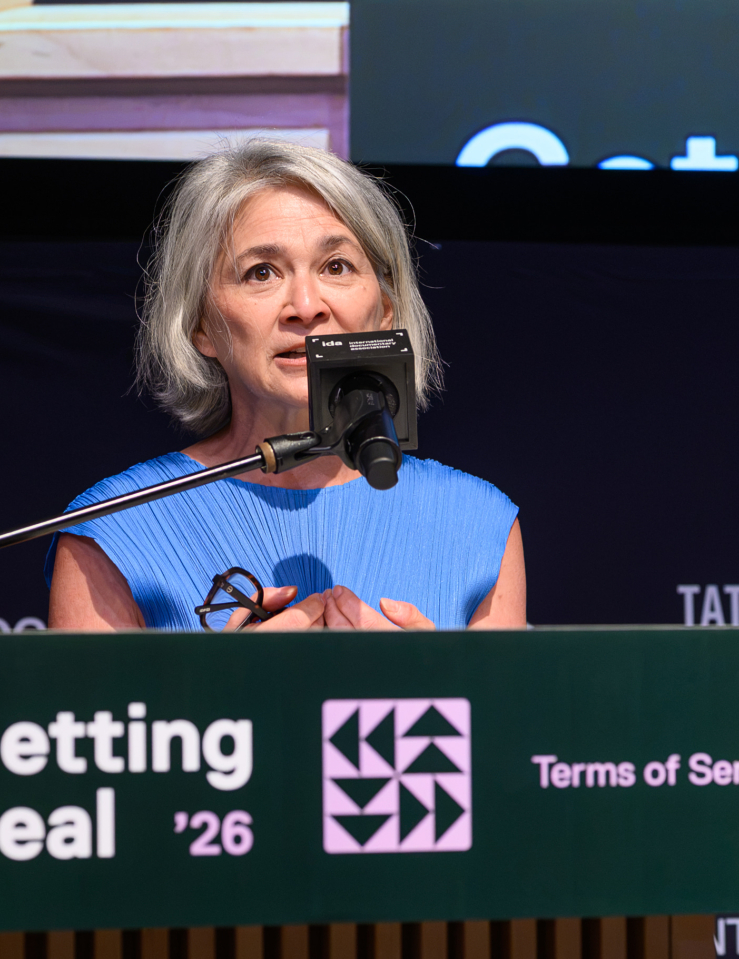
Petna Ndaliko Katondolo delivering his Getting Real ’26 keynote.
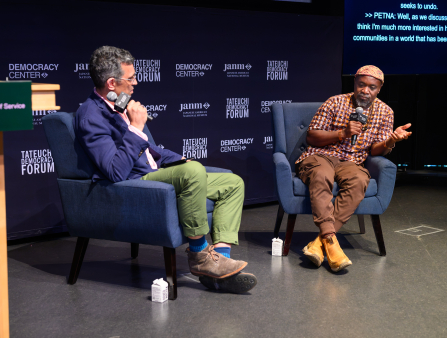
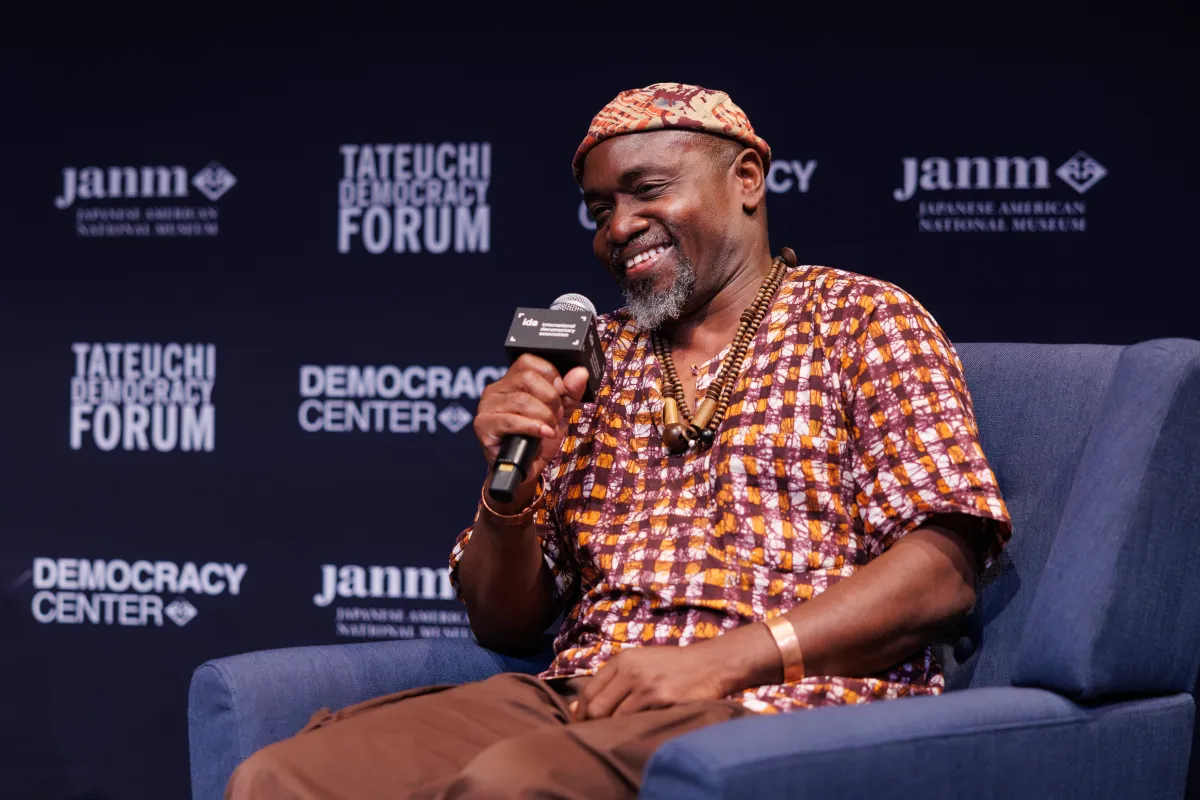
IDA’s Executive Director Dominic Asmall Willsdon (L) joined Katondolo (R) to discuss his work at Yole!Africa, among other topics.
So I became obsessed with cinema. Not simply with watching films. But with understanding them. My friends and I would gather to watch films projected onto enormous white screens. When the films ended, everyone else went home. We ran toward the screen. We touched it. Then we ran behind it. We searched everywhere. We were convinced that somewhere behind the screen, there must be a hidden village where all these people lived. How else could they appear? How else could they disappear?
Eventually, we discovered the projector. Suddenly, everything made sense. Or so we thought. If the projector produced films, then surely we could build one ourselves. So we did—with cardboard, old radio batteries, a torch bulb, cut paper, a magnifying glass, and a white bedsheet.
Night after night, we projected shadows onto that sheet: shapes, fragments, improvised adventures. Without realizing it, before we understood cinema, we were already experimenting with something much older than cinema itself: light, memory, imagination, the desire to gather people around a shared image.
Years later, when I was twelve years old, another image entered my life, one that would change everything. I watched a Hollywood film. When it ended, I ran home crying. Not simply sad; devastated. My mother held me until I could finally speak. Then she asked gently, “What happened?” I told her, “All the Black people in the film were bad. They betrayed one another. They had no dignity. No honor. No humanity.”
She listened quietly. She never interrupted. She never corrected me. She simply allowed me to finish. When I had said everything I needed to say, she looked at me and smiled. Then she said something I have carried with me every day since: “It seems you understand very well what troubled you.” She paused, then she added, “So you already know what you must do.”
At twelve years old, I thought I was making a promise to my mother. Today I understand that I was doing something else entirely; I was entering into a covenant with life itself, a promise that I would dedicate my life to creating spaces where people might encounter themselves differently. Not through propaganda, through pity, or through romanticization. But through dignity, complexity, relationship—through humanity.
Everything that has happened in my life since then—every film, every classroom, every community, every experiment, every mistake, every beginning—has simply been my attempt to remain faithful to that promise. That promise eventually became Yolé!Africa.
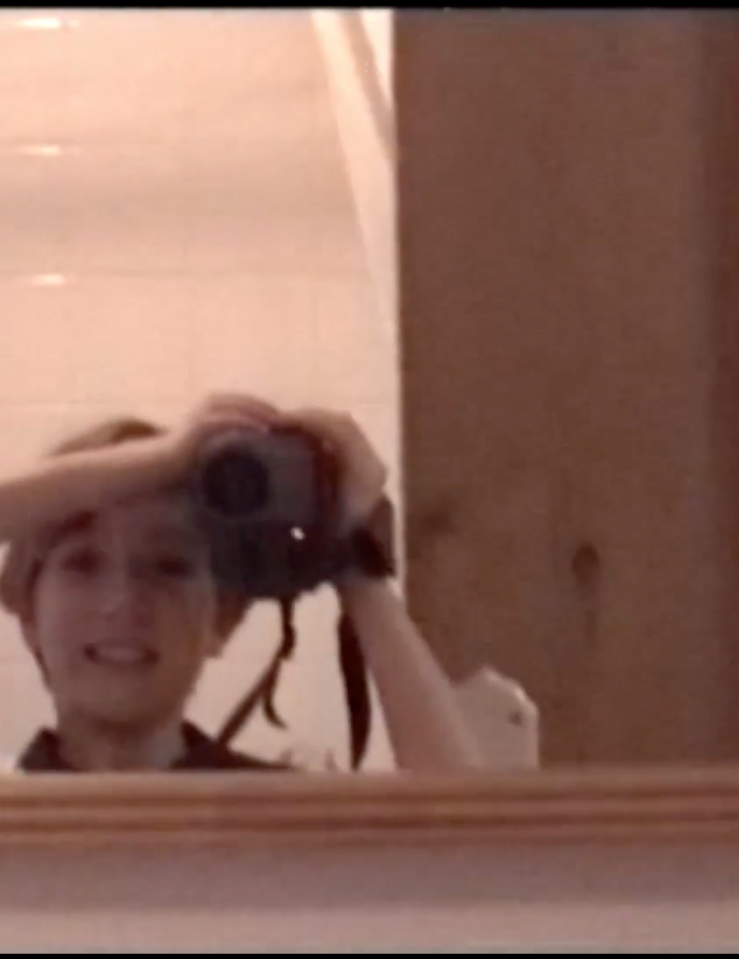
But before Yolé!Africa, there were still many lessons waiting for me. At first, I believed films were made by projectors. Then I discovered cameras. My mother eventually bought me one.
The more I worked with cameras, the more I realized that cinema had very little to do with cameras. It had everything to do with learning how to see, not simply with our eyes but with our attention.
I thought I had finally uncovered cinema’s greatest secret. The camera makes films. Then another lesson arrived: The camera does not make films. The person behind the camera does. And suddenly my curiosity changed. I became less interested in cameras and much more interested in perception: Why do we see what we see? Why do we overlook what is right before us? Who teaches us where to look? And perhaps even more importantly: Who teaches us what not to see?
Those questions would eventually lead me far beyond filmmaking. They would lead me toward archives, memory, ecology, and sovereignty. And eventually, they led me back to my grandmothers. The more I worked with cameras, the more I realized that cinema had very little to do with cameras. It had everything to do with learning how to see, not simply with our eyes but with our attention.
The camera records light. Yet every image begins long before light reaches the lens. It begins with a decision. What calls us? What invites our attention? What do we choose to remain in relationship with? Every frame, I came to understand, carries a way of seeing the world. Every image reveals a philosophy—not because it tells us what to think, but because it quietly teaches us what is worth noticing. This curiosity gradually led me toward archives, less interested in what they contain than in how memory finds its way into the world.
Growing up in eastern Congo, many of the people who shaped my understanding of life would never have described themselves as historians: my grandmothers, traditional healers, midwives, farmers, fishermen, storytellers, people gathered around evening fires, children inventing games. Sometimes these worlds appeared in books or museums. More often, when they did, they appeared as folklore—beautiful perhaps, but seldom recognized as living systems of knowledge. Yet they carried entire philosophies of living, entire ways of understanding time, community, care, and belonging.
That realization slowly transformed my understanding of memory: Memory does not live only in documents. Memory lives wherever relationships are cultivated.
I became less interested in asking, How do I tell someone else’s story? and increasingly interested in another question: How do I become worthy of participating in that story?
Long before databases organized knowledge, the land was already remembering. Long before cloud storage, the forest was already keeping memory alive. Long before algorithms learned to recognize patterns, rivers had already been carrying stories from one generation to the next. Before algorithms, there was the land.
The land has never simply been a place where history happened. It is itself a living archive—an archive that does not merely preserve information but that continually cultivates relationship. Recognizing this became the beginning of what I now call “Ancestral Ecology.” Folks sometimes ask me whether this is an environmental philosophy. It is. But not only. It is an invitation to understand life through relationship. It begins with a simple observation: Nothing flourishes alone. A tree grows because of soil, fungi, water, insects, sunlight, wind, and countless relationships we rarely notice. A river exists because of rain, mountains, forests, and the communities that care for it.
Human life is no different. We become ourselves through one another, through those who came before us, through those who walk beside us, and through those whose names we may never know but whose lives make ours possible. My grandmother taught me that knowledge works in the same way. Knowledge is not something we own; it is something we enter. Something we inherit. Something we care for. Something we transform. Something we eventually pass on.
This changed my relationship with filmmaking. I became less interested in asking, How do I tell someone else’s story? and increasingly interested in another question: How do I become worthy of participating in that story?
That question eventually became the foundation of a filmmaking practice we now call “Soul-full Soil Cinema,” a cinema rooted in what we at Yolé!Africa describe as “Ejo-Lobi,” a way of inhabiting time where memory is not behind us and the future is not waiting somewhere ahead. Both are already alive within the choices we make. Soul-full Soil Cinema begins with a simple conviction: Life exists through relationship. Cinema can cultivate our awareness of those relationships.
In this understanding, filmmaking becomes more than creating images. It becomes a practice of listening. A practice of care. A practice of hospitality. A practice of belonging. Its purpose is not simply to produce films. It is to cultivate the conditions in which life can recognize itself. And perhaps this is why I eventually understood what my grandmother, great-grandmother, and great-great-grandmother had been asking me all those years ago. Their question was never,
Will you become a filmmaker? Their question was, What kind of human being must one become before one can be entrusted with another person’s story?

Petna Katondolo at work. Courtesy of Alkebu Film Productions.

When people encounter Yolé!Africa for the first time, they often assume they are visiting a film organization. Some leave thinking we are an arts center. Others think we are an environmental initiative. Some see a school, others see a community organization. The truth is Yolé!Africa is all of these and none of these. It is our attempt to cultivate places where life can flourish through relationship. Because over time, I came to understand that cinema is not born in the editing room. It begins much earlier.
A film, in many ways, is simply one expression of a much larger ecology. If the relationships that give birth to it are fragmented, the images will often carry that fragmentation. If those relationships are nurtured with care, curiosity, reciprocity, and belonging, something else becomes possible. That understanding slowly transformed the question I had been asking since childhood. I no longer wanted to know only how films are made. I wanted to understand what conditions allow stories to remain alive. That question eventually became Yolé!Africa—not as an institution, but as an ecosystem of relationships.
Today, that ecosystem lives through four interconnected places. Each one carries its own rhythm, responsibility, and its own way of caring for life. Together, they form a single conversation. In the heart of Goma is Yolé!Africa, a place where young filmmakers, musicians, photographers, journalists, and artists discover that creativity is not only about expression.
It is also about listening, learning to encounter the world with curiosity, and finding one’s own voice while remaining open to the voices of others.
Just outside the city is Yolé!Farm. Many people wonder why a film organization would cultivate food. For us, the answer has always been simple: Stories and seeds share something essential.
Neither grows in isolation. Both require care, time, community, and trust.
Then there is Yolé!Ekolojia, a place where ecological knowledge, community media, ancestral wisdom, and artistic creation meet one another, where young people learn that caring for forests and telling stories are not separate practices. Both ask us to pay attention, to listen, and to imagine futures in which more forms of life can flourish.
And across the waters of Lake Kivu, on Idjwi Island, is Yolé!Asili, perhaps the place that most reminds me of my mother, my grandmother, my great-grandmother, and my great-great-grandmother. This is a place of belonging, of intergenerational learning, where children play alongside elders; where conversations unfold at the rhythm of the lake. There, one begins to understand that community is not something we build once. It is something we cultivate every day.
A film, in many ways, is simply one expression of a much larger ecology. If the relationships that give birth to it are fragmented, the images will often carry that fragmentation. If those relationships are nurtured with care, curiosity, reciprocity, and belonging, something else becomes possible.
Looking across these places, people sometimes ask me, “Which one is the most important?” The answer is always the same. None of them exists alone. Just as a forest cannot be reduced to a single tree, Yolé cannot be reduced to cinema or agriculture or ecology or education. Its purpose is to cultivate the relationships from which all of these naturally emerge. This is why I have gradually come to understand sovereignty differently. I once believed sovereignty meant having the power to tell our own stories. Today, I see it as something much deeper. Stories matter because they help us remember who we are in relationship with. The story is not the destination. The story is the path that leads us back to one another.
Perhaps narrative sovereignty is only one expression of something even more fundamental: the sovereignty to care, to nourish, to imagine, to remember. The sovereignty to participate in the continual renewal of life itself. And when we begin there, cinema becomes something very beautiful. Not an industry or merely an art form, but a practice of cultivating the conditions in which communities can continue telling their own living stories.
Reflecting on narrative sovereignty, I’ve realized I no longer find myself asking, How do we reclaim our stories? Instead, another question keeps returning: What kind of world allows stories to remain alive?
Perhaps this is where sovereignty truly begins, not with ownership but with stewardship.
Not with control, but with care. Not by having the loudest voice, but by cultivating the conditions in which many voices can continue to emerge.
This is why I have come to believe that filmmaking is not only about creating images. It is about cultivating the conditions in which communities continue imagining themselves. Soul-full Soil Cinemais not simply a cinematic practice but a way of inhabiting the world; a way of asking, every day, What relationships am I helping to cultivate? Because perhaps that is what every film is ultimately doing—cultivating relationships. Or forgetting them. And perhaps that is also what every institution, every school, every archive, every festival, every community is doing.
Reflecting on narrative sovereignty, I’ve realized I no longer find myself asking, How do we reclaim our stories? Instead, another question keeps returning: What kind of world allows stories to remain alive?
The question is never simply what we produce. The question is always, What kind of life becomes possible because we were here? That is the question I hope we continue to ask together—not only as filmmakers but as educators, curators, artists, organizers, parents, neighbors, human beings, and perhaps one day, ancestors. Because one day, someone we will never meet will inherit the worlds we are creating now—our images, our silences, our doubts, our forests, our rivers, our languages, our institutions, and our ways of caring.
And I hope they will also inherit the imagination to believe that another way of living together has always been possible. The imagination to recognize that community is not an achievement. It is a daily practice.
When I think back to that conversation with my grandmother, great-grandmother, and great-great-grandmother, I finally understand what they were trying to teach me. The goal was never simply to learn how to tell stories. The goal was to learn how to keep stories alive—in people, in communities, in language, in rivers, in forests, in soil, and in memory. Alive in the generations still waiting to arrive.
Perhaps that is our work—not simply to become better storytellers but to become people whose lives allow more stories to flourish. To become people worthy of the trust that every story places in us. To become good ancestors.
Hadisi njo!
Njo Hadisi!
Apipawe!