
Next February, Catalan filmmaker Pere Portabella will be a century old.
Amidst his eclectic body of work, which ranges from experimental horror films and operatic dramas to found-footage essays and polymorphic musicals, lies a deeply singular approach to documentary filmmaking.
In April, a comprehensive retrospective at the Buenos Aires International Festival of Independent Cinema (BAFICI) included a generous selection from his earliest shorts—made clandestinely during the final years of Francisco Franco’s dictatorship—as well as his monumental diptych, Informe general sobre unas cuestiones de interés para una proyección pública (General Report on Certain Matters of Interest for a Public Screening, 1976) and Informe general II. El nou rapte d’Europa (General Report II: The New Abduction of Europe, 2015), filmed four decades apart.
The program revealed a filmmaker whose documentary practice is a rare combination of political commitment and formal restlessness.
Although Portabella screened films at the Cannes Film Festival on several occasions and is widely regarded as one of the most important figures in Spanish cinema of the last sixty years—despite his clandestine activity and constant battles with censorship—he remains a largely overlooked filmmaker. Until 2006, when Pere Portabella received his first North American retrospective at the Gene Siskel Film Center, his films were barely known in the United States and had never been released on DVD or VHS. More recently, many of his films have become available on streaming platforms, yet his contribution to the documentary form has still not been fully examined.
At first glance, his oeuvre might suggest a kind of Dr. Jekyll and Mr. Hyde figure. On the one hand, he is the modernist auteur of non-linear narratives such as Nocturno 29 (1968) and Pont de Varsòvia (Warsaw Bridge, 1989). On the other hand, he’s the man who dared to capture an underground gathering of former political prisoners in El Sopar (1974). This seemingly riven personality—between uncompromising artistry and the commitments of a leftist intellectual—coexists with further contradictions.
Born in 1927, the year associated in Spain with the avant-garde circle known as the Generation of ’27—which included primarily poets such as Federico García Lorca and Rafael Alberti, but also encompassed figures like painters Joan Miró, Salvador Dalí, and Maruja Mallo, as well as the filmmaker Luis Buñuel—Portabella came from the Catalan industrial upper bourgeoisie. His economic stability enabled him to move into film production, beginning with Carlos Saura’s Los golfos (The Delinquents, 1959) and Luis Buñuel’s Viridiana (1961), before turning to directing his own films. But he was always a traitor to his class, even going so far as to suspend his filmmaking career to serve as a socialist senator and member of parliament between 1977 and 1984.
These contradictions between his artistry and his politics are the driving force of his style. What Erika Balsom describes in his work as “the apparent split between a politics of the signifier and a politics of the signified” can also be understood as an intricate oscillation between a ludic engagement with form and a sustained desire to intervene in Spain’s political processes. Even in his most obscure, nearly abstract fictional experiments, a documentary murmur persists, surfacing as a latent testimonial impulse. And when he turns to documentary, an avant-garde sensibility permeates every gesture, even in works that—beginning with their titles—might appear devoted to a purely informational purpose.
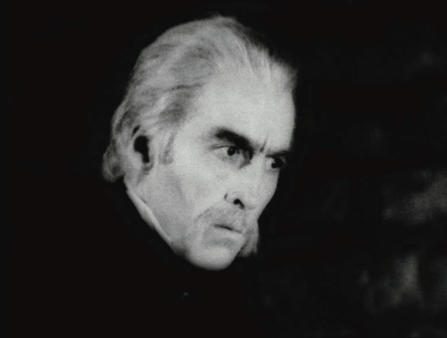
Vampir Cuadecuc.
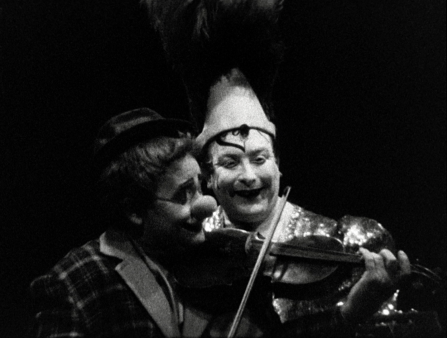
Umbracle.
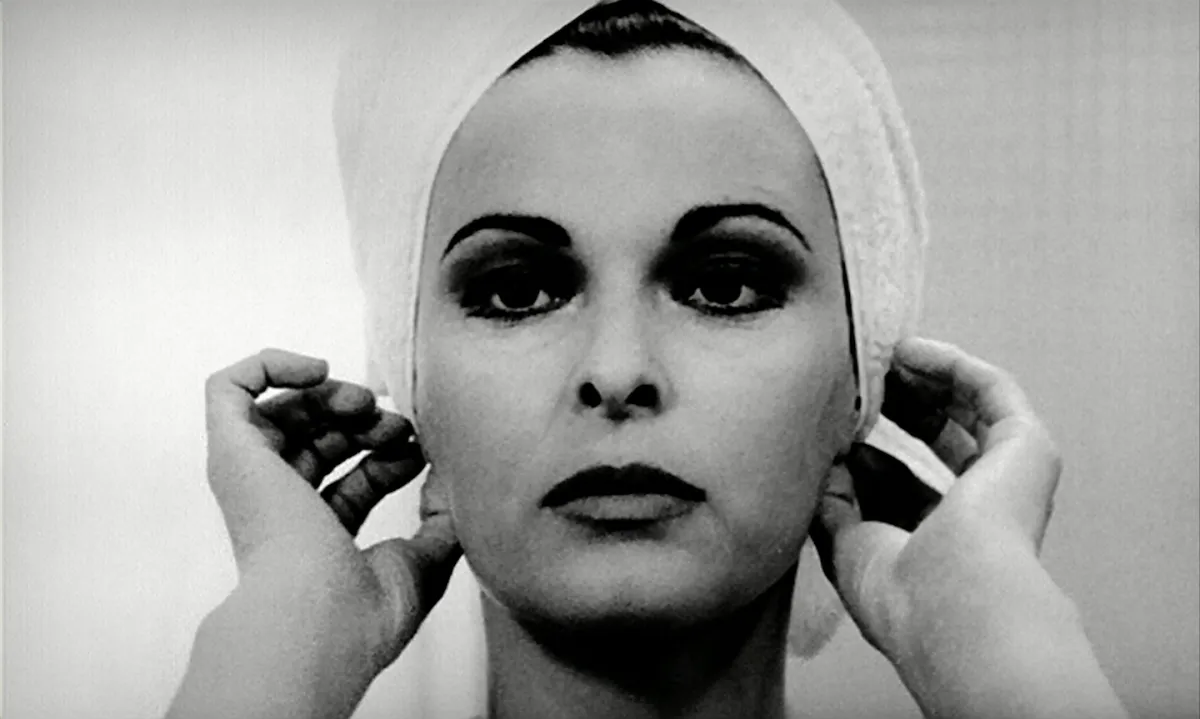
In Nocturno 29, his first feature, self-absorbed bourgeois figures wander through Catalonian landscapes and sumptuous houses, captured in harsh black-and-white cinematography. Delirious sequences collide, evoking an afterlife of Surrealism. Then, abruptly, as someone watches television, a recording of a military parade bursts onto the screen, followed by images of barking dogs in a kennel. These documentary irruptions shatter the film’s dreamlike drift. While they can be read as allegories of Franco’s regime, their force lies elsewhere as well: by disrupting the entrenched fiction of bourgeois life, Portabella attacks the self-enclosed logic of European auteur cinema.
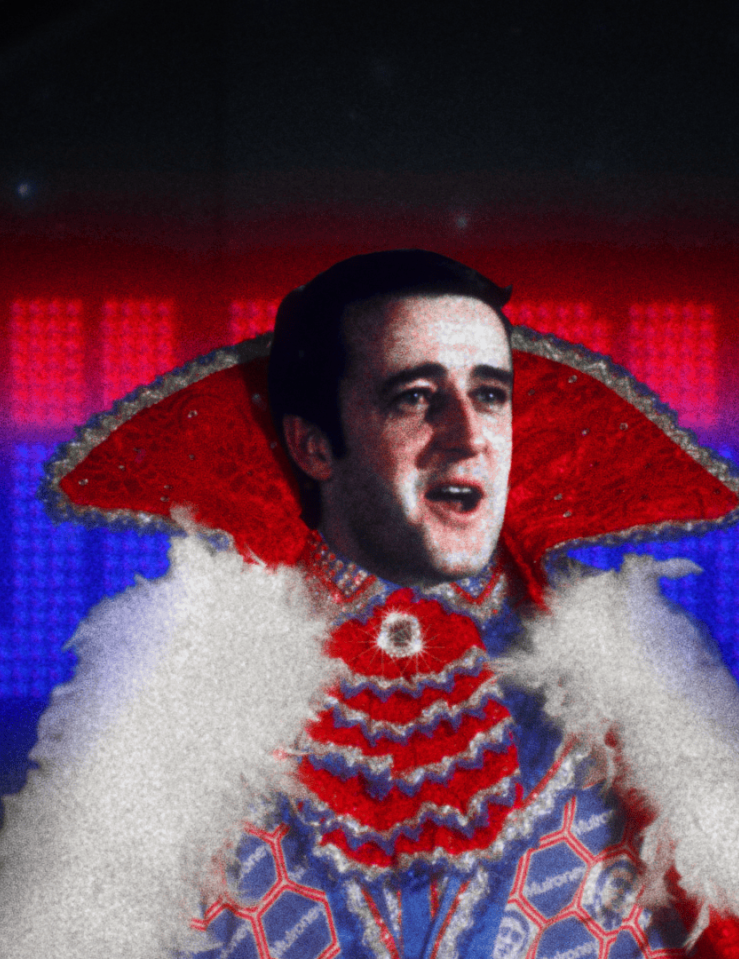
A deconstructive impulse is also at work in Vampir-Cuadecuc (1970), which at first positions itself as an analytic making-of documentary of Jesús Franco’s Count Dracula (1970), starring Christopher Lee. Soon, though, Portabella’s film mutates into an eerie vampire fiction, then into a making-of of the making-of, before slipping back into fiction again, and so on. Portabella vampirizes Franco’s shoot while allowing Lee’s presence to drain the lifeblood from his essayistic project. The critique of industrial film production and a vampire tale set against the backdrop of dictatorship ultimately devour one another, culminating in a cinematic bloodbath between documentary and fiction.
Umbracle (1972) begins in a similar register. A man (Lee, once more) wanders through a museum in Barcelona, buys a cigar, and witnesses an abduction on the street. Suddenly, this fictional drift is interrupted by a direct testimony from film historian Román Gubern, who discusses the censorship code governing Spanish cinema. Commenting on Rule 12, which “forbids the images or scenes of cruelty to people or animals, or of terror”, he exposes its hypocrisy: “the police in this country use terrorist methods on the streets, brutality against citizens, workers, students.”
The references to Francoist repression are direct. In Nocturno 29, commentary on the political situation is as subtle as Luis Cuadrado’s use of high-contrast cinematography, in which blinding whites overtake the frame, as if the White Terror—the violence against dissidents carried out by the Nationalist faction—were suffocating the film itself. In Umbracle, by contrast, the film folds back on itself through its embrace of documentary, reflexively interrogating the role of underground filmmakers. Speaking in Catalan—a language forbidden at the time—film critic Joan Enric Lahosa observes that “legal unviability offers the filmmaker the possibility of researching ways that will be more meaningful with his media.” For Portabella, the turn to documentary does not entail an abandonment of formal sophistication; rather, it becomes a means of interrogating his own methods and of opening the work onto new cinematic possibilities.
Even in his most obscure, nearly abstract fictional experiments, a documentary murmur persists, surfacing as a latent testimonial impulse.
An even earlier work already signals his impulse to move beyond his bourgeois milieu. In Poetes Catalans (1970), we witness an underground gathering of poets in a noisy auditorium, organized in solidarity with political prisoners. The event is described by one speaker as “an act of presence of Catalan culture,” and one of its rallying cries is “poetry among the people.” A powerful cinematic energy emerges from the interplay between the recitation of poems and the audience’s effusive responses—voracious applause, cries for freedom and amnesty—captured with the immediacy of direct cinema. The atmosphere is so vivid, so politically charged, that a new form of joy seems to surface in the faces of the elderly poets. The enclosed space of the theater becomes a clandestine echo chamber for the demands of an entire population.
Portabella’s avant-garde approach to documentary practice also becomes evident in his dialogues with other arts. That includes four short films dedicated to painter Joan Miró made in the early 1970s (screened together at BAFICI under the title Suite Miró), and his co-writing work alongside poet Joan Brossa. But his most enduring collaborator is the experimental musician Carles Santos, responsible for nearly all of his scores and the subject of four short films presented at BAFICI as Suite Santos. These remarkable works operate on the threshold between cinema, music, and performance art. In Acció Santos (1973), the musician plays a Chopin piece at the piano, then listens to a recording of his own performance, before putting on headphones and leaving the spectator in silence for the same duration. In La Tempesta (2006), fragments of naked bodies are struck by jets of water while an opera by Rossini plays on the soundtrack.
In Die Stille vor Bach (The Silence Before Bach, 2007), on which Santos also collaborated on the script, the boundary between documentary and fiction becomes largely irrelevant, as the film embraces a musical structure of theme and variations. We move freely from a tourist guide in Leipzig disguised as Johann Sebastian Bach to a period reconstruction of the composer’s family life, and then to a range of more or less fictional figures embodying Bach’s music—always recorded with direct sound—in disparate contexts: the actor portraying Bach at the organ of St. Thomas Church, where he is buried; a group of young cellists in the subway; a children’s choir; a pair of truck drivers, one playing a harmonica, the other a bassoon. Even an automated pianola plays itself. Despite this heterogeneity, the film never feels fragmented. It flows in tune with Bach’s music, weaving multiple narrative lines into an intricate yet harmonious polyphonic and counterpoint composition.
The musical impulse at the heart of Portabella’s cinema resonates throughout his entire oeuvre. The prologue of the first General Report (1976) transports us to an abbey in the mountains. A somber tune by Santos, evoking his late-sixties horror scenes, sets the mood for a drifting camera that comes to rest at the tomb of Francisco Franco. At this point, Portabella could finally aspire to make a film for a public screening, as the full title makes explicit.
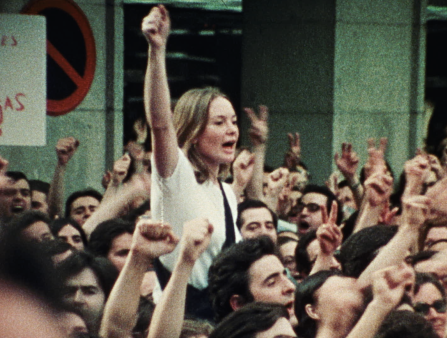
General Report.
General Report II.
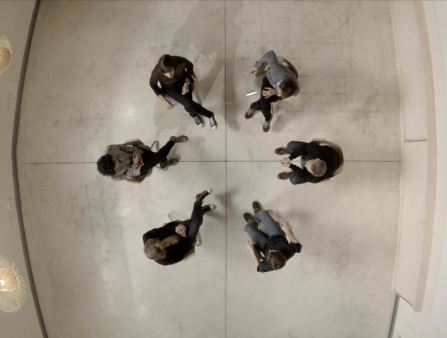
Made in the immediate aftermath of Franco’s death, the film both reckons with the recent past and confronts an uncertain present—one in which the democratic structures of contemporary Spain were still in the process of taking shape. Over two and a half hours, the film unfolds as a counterpoint between extended gatherings of leaders from major leftist parties and a series of polymorphic variations. Actor Francesc Lucchetti wanders through the empty rooms of the former residence of the Generalísimo, traverses the ruins of abandoned towns in the north of the country, or projects a Francoist propaganda movie on an editing table. A Basque revolutionary song animates the landscape; fragments of the Universal Declaration of Human Rights overlay fictional scenes of torture; an interview with a party leader is interrupted by the director’s reminder: “Don’t forget that we are making a movie.”
The form itself expresses a yearning for democracy. General Report is a parliamentary film: its composition encompasses a plurality of tendencies. Communists, socialists, Christian democrats, and even a monarchist are given space to speak. Catalan, Galician, and Basque are all heard. Reenactments coexist with interviews, appropriation with observation, and Brechtian gestures with raw immediacy. If the project’s monumentality and militant impulse recall Fernando Solanas and Octavio Getino’s La hora de los hornos: Notas y testimonios sobre el neocolonialismo, la violencia y la liberación (The Hour of the Furnaces, 1968), it never strays far from the provocations of Raúl Ruiz’s Diálogos de exiliados (Dialogues of the Exiles, 1975). The interminable conversations among politicians—not to mention the striking absence of women—some of them abruptly interrupted by the editing—become a symptomatic expression of a confused and fragmented left. There is no doubt that Portabella is a committed socialist; yet, as an avant-garde artist, he is also a ferocious critic of everything that moves.
General Report II (2015) engages with a profoundly different social landscape. It unfolds as a fresco of the multiple, overlapping crises affecting Spain and Europe: the economic pressures of neoliberalism, the specter of climate catastrophe, and the demands for direct democracy in the wake of the 15-M movement. In and around the Reina Sofía Museum in Madrid, extended conversations among intellectuals and politicians attempt to take the measure of the present, while images of street protest intermittently disrupt the film.
As in the first General Report, the approach oscillates between directness and critical detachment. Portabella is clearly interested in what Antonio Negri, Paul B. Preciado, or even a group of Catalan oceanographers has to say, yet he does not hesitate to interrupt a conversation with a shot of a gunshot from Luis Buñuel’s L’Âge d’Or (1930). Two professors sit in a café discussing current affairs, while the camera lingers on the waiter’s gestures. A crane shot glides across a large table as captions list the names of museum board members, but the chairs remain empty. A recurring movement: the camera slowly advances toward a projectable surface—a window, a painting, a wall, a screen—onto which images from the outside world suddenly irrupt. Why not simply cut to the next sequence? Because, for Portabella, the impulse to plunge into reality is inseparable from the need to reflect on the medium itself. In the end, a sequence of automated machines producing plastic culminates in a wall of transparent boxes. Images of street protests appear, projected onto the surface. But the plastic remains visible.
Portabella’s oeuvre reveals a tireless artist, one who persistently constructs and deconstructs an inventive dialogue with the documentary form. By piercing the flesh of his ghostly fictions with sudden documentary irruptions or shredding his informative reports with the sensual scrutiny of an avant-garde sensibility, Portabella is always drawn to the pulse of reality, while leaving the fabric of his works wide open to the assaults of experimentation. There is no doubt: as an artist, Pere Portabella is a century-old vampire.