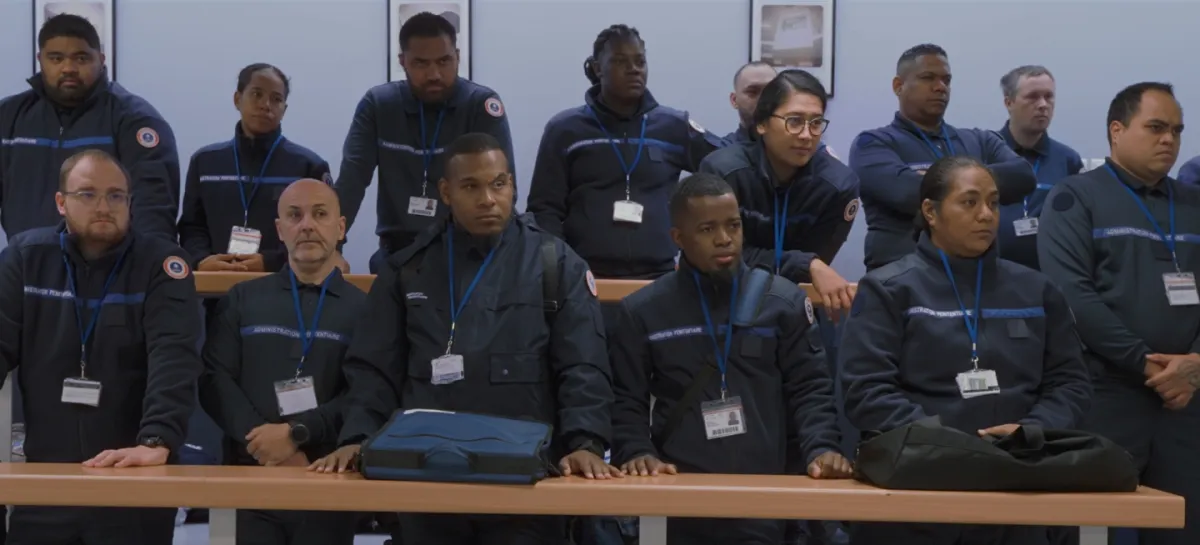


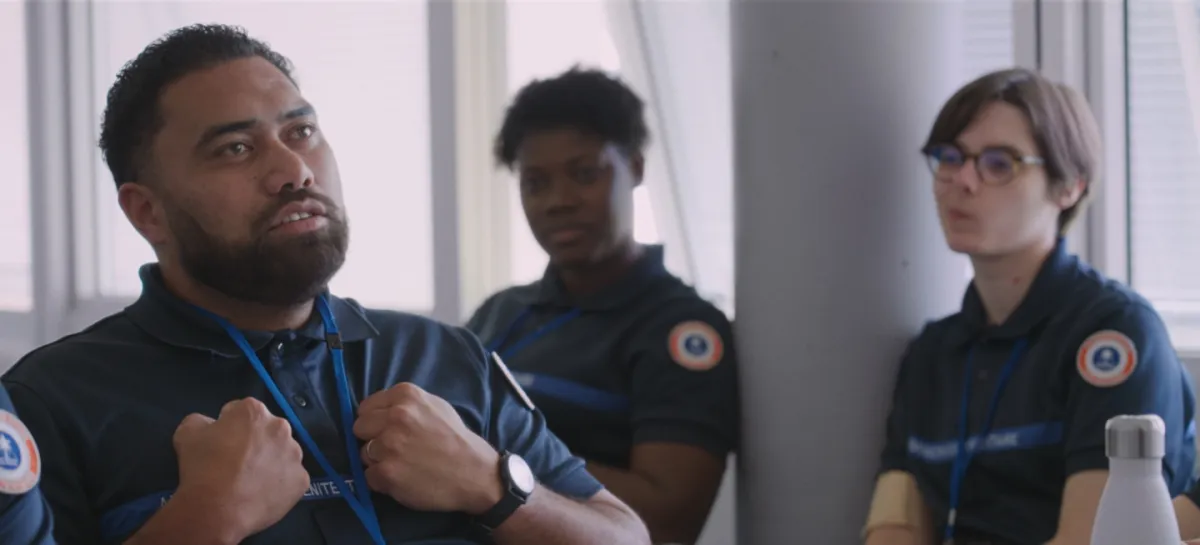
Guillaume Massart filmed Detention (2026) over six months at France’s national academy for training officers in the penitentiary system. While its chronicle of classes and instruction shows many of the procedural aspects of managing prisoners, it’s foremost a dissection of the inculcation of authority and the enforcement of social contracts. Because it’s set in classrooms rather than during the internship practicum of the student guards, it’s also a film about prisons that does not take place in a prison, but is no less eye-opening in its stark view of the principles of control and force underlying incarceration in the name of France.
That approach naturally connects the film to philosophical traditions—Massart mentions Montesquieu—but the young guards in training are largely a practical-minded, Gallically civil bunch just trying to get through their studies. It all feels worlds apart from the sea of pop culture, opportunistic politics, and underreported family experience that inform the American viewpoint on prisons and crime. Operating the camera himself with just a boom operator, Massart leans into a serial style of ad hoc case studies in ethics and philosophy rather than the arcs of individual guards or fostering a foregone air of tragedy and scandal. The apparent success of the training is, as he tells me, damning enough.
I spoke with Massart at a café in Cannes, where Detention had its world premiere in ACID, the autonomous festival-within-the-festival showcasing independent filmmaking. This interview has been edited for length and clarity.
DOCUMENTARY: What sort of access did you have to the penitentiary training and was anything off limits?
GUILLAUME MASSART: The training lasts for six months, and I had access to everything, really. The only class I could not film was renseignement pénitentiaire, prison intelligence, where you listen to what inmates say on the phone and try to collect intel. They have some particular inmates that are particularly dangerous so they have to stay aware of what’s happening, if they have connections with the outside.
I was staying at the campus where everyone was sleeping, and eating and living with them every day for six months. I said to the students that I would only film during class. I would not capture intimate moments, so they have some space to live and to express themselves, to release the pressure when I'm still there but not filming. They could get drunk or whatever if they needed and I would not film at those moments.
It was kind of dangerous for the film at some point, because at the end of the shooting, I had 250 hours of rushes, and I was like, What did I do? Because it was all classroom material! But it was my choice.
D: How did you think through that challenge? I didn’t feel any sort of limitation while watching it.
GM: Before I did the shooting, I had already done the whole training once without a camera. All in all, I spent one year in this school. So I got the feeling while watching the classes without filming but taking notes, that it would be possible to make the film by staying in the classes and making the prison come into the frame without being filmed. I would not go with [the students] on their internship. I would never set foot in the [prison]. We would feel the prison. The main interest for me was the discourse of the school and how they define the prison. Is there an idea of what a better prison could look like?
D: The opening scene is extremely effective because we don’t know what exactly is happening, and neither do the students. The instructor tells them to stay standing and asks them what they think about that order. You immediately set up this sense that we’re going to watch the building of a society and of rules. So you’re interested in the individual versus authority—even in Enlightenment terms—and how that plays out?
GM: The opening scene is a concentration of everything that is going to happen in the film. What strikes me is that he’s telling them: Let’s recognize that you have authority over people and you can do whatever you want with this authority. See how I did it with you? In five minutes, I could do that. But at the end, he doesn’t say, Don’t do that! He says you can do it. And he does not say you should not. Look at what you will be able to achieve, and the possibility that you can abuse your authority. But he doesn’t ask, Are you going to abuse your authority? That’s very ambiguous. Everything in the film is like that. When I first scouted out the training classes, one of the teachers quoted Montesquieu: “Everybody who is in a position to have some power is able to abuse it.”
D: That scene embeds the idea of free will quite early on.
GM: Yeah, that’s it. But there’s no indication of what is good and what is wrong. It’s only: You have this power in your hands. That’s what you have all through the film. Every time you talk about the rules of detention, there’s some way to go around them. But you still can find a way to be legit. Like in the last sports scene [arm holds training in a gym]. That becomes a class of law in some way about self-defense, legal holds, and the framework in which you can use them. It’s very surprising because you don’t know exactly what he means. At some point, he says, “I’m not telling you to lie.” But in some way, you hear, I’m telling you to lie. I’m giving you the way of lying that is going to be legitimate and acceptable.
When we started editing, I was not sure that it would all still be readable—I was scared that the irony would be lost in translation because of the culture. I understand now that, yes: A prison is a prison.
D: The position that the audience might take is really interesting, because I think when we see a documentary about a prison, because of all the abuses, we’re conditioned that it’ll probably be an exposé. And that affects how I’m viewing things, because then I’m primed to look for people doing wrong or bad things. But you don’t shoot like that.
GM: No, I did not want that. I wanted the classes we chose while editing to be the best ones, those where the teachers were really excellent, and their pedagogy would be sharp. We wanted the training to be perfect, so that we understand that the problem of the prison is not that guards are badly trained, and that’s why prison is bad. No. You train people really well, everything is correct and clear, but prison is still awful.
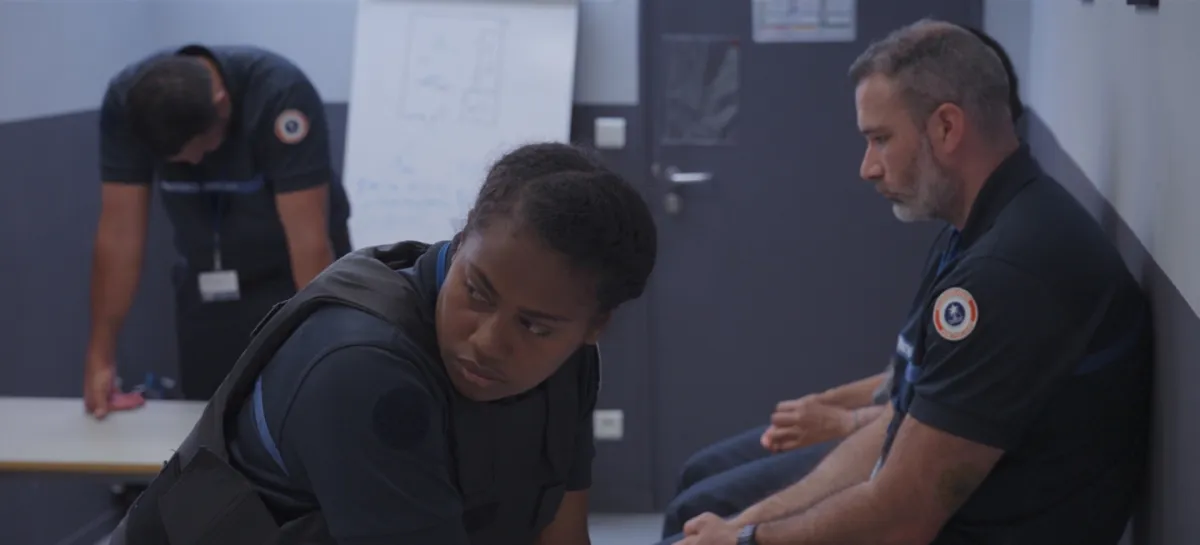
D: And you include discussions about treating suicidal prisoners, which reflect this absurd idea about prisons: we have to keep you alive so we can continue punishing you.
GM: Yeah, it’s crazy. In this class, [the instructor] says the main job of guards is to check whether the inmates are present and alive.
D: Right, that phrase they keep repeating: présent et vivant.
GM: It’s the main thing. You cannot commit suicide. Nothing belongs to you, even your own life.
D: That brings us to the role-playing session, when one guard plays a suicidal patient to train another. To me, it felt and looked a bit like a fiction movie. Was that intentional, in how you shot it?
GM: Yes, but something happens there that does not happen in the classrooms. There you have an actor who’s playing an inmate. You have those false cells. It’s a decor. It’s like a set. So I had to shoot it this way. In the actual prison, there’s a wall there, where I’m filming. It’s an impossible perspective. I decided not to step inside the cell. I’m not in the action. It feels like fiction because at the beginning, you don’t see the actor who plays the inmate right away. He’s smoking a cigarette, and he’s also in shadow. But he’s not that bad. He’s a good actor.
D: It’s a different kind of classroom. And in terms of the choice of shooting scenes of instruction, I did think of Frederick Wiseman. He has this quote from an early interview that he liked to shoot moments of decision-making to show the ideology in action. Was he an influence?
GM: Thank you. Yes, I had Basic Training [1971] in my head. And also [Harun] Farocki at some point. The theoretical cold approach, but I cannot be as cold as him. I’m not that German. But if Wiseman would have shot in this school, you’d have shots in the corridors with the cleaning crew and everyone and how they live. I was not able to do that huge of a movie. It would last for like six hours. But the quote from Wiseman you said is quite similar to what the film really is. In some way, it’s closer to the Wiseman from the 70s than the late Wiseman.
I also had in mind a director that is not really known, Sylvina Landsmann. She’s an Israeli director that made a film called Soldier/Citizen [2012], and it’s filmed in a classroom. It’s about how at the end of military service, there are classes to learn how to act now that you’re going back to the civilian world. You cannot be harsh with people as easily. You cannot treat Arabs badly as easily. They have to learn to become human again in some way. The film is completely crazy. It’s like a deontology class—how to become a real person again and not military anymore and not abusive anymore. She shoots mainly during those classes, and you have debates between the teacher and the students who do not accept what the teacher wants to tell them. But where I shot, the students accept more of what the teachers say. It was interesting to me to see how she filmed in the classrooms where you don’t have much to film—the space is ugly, so what’s interesting is the dynamic of the exchanges and the faces and the bodies and the body language. It was a real inspiration to me.
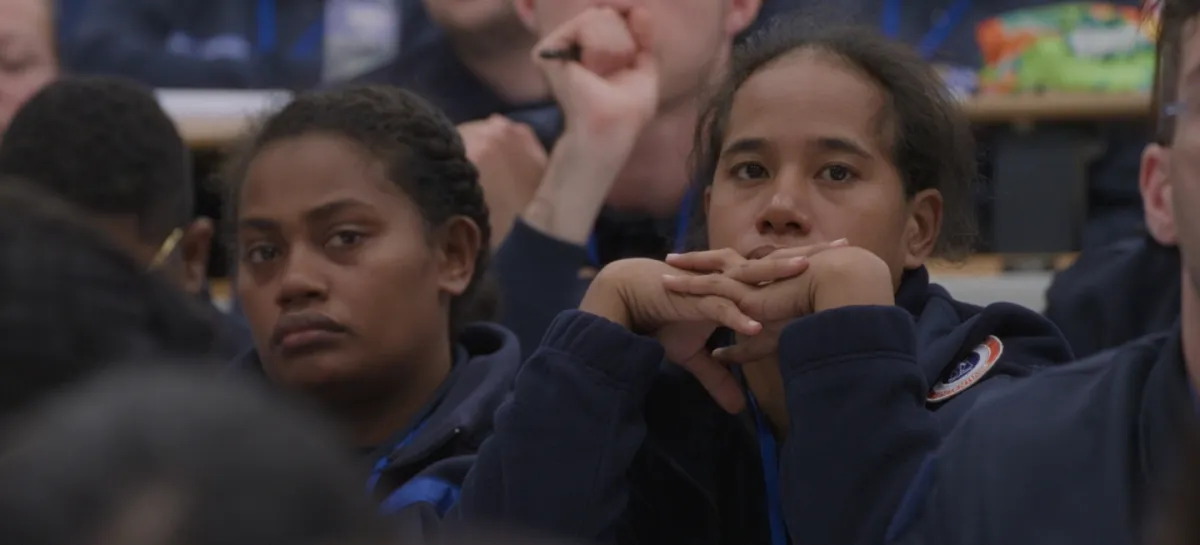
D: As your film went on, I did feel you could see a couple of students getting more accustomed to wielding authority, in their faces. What surprised you the most after watching these students all this time?
GM: That even when they’re full of doubt, they still go for it. Because they need to have a job. They don’t consider doing something else, even though when they went [into prison] during the internship, they saw things that were very awful for them. Everything they rejected, now they accept it. They changed so much that I felt they sailed away from me. At the beginning, they’re like me, they’re not in uniforms, they can bond, and there’s something between us. I thought I would meet people that were there because they wanted some action. But that’s not what happened. There were people that did not know why they were there. And I could even have some empathy for some of them. And they changed so much that in the end, we cannot bond anymore. Sometimes it’s heartbreaking. For some of them, I felt, Please don’t do this, you’re doing something that’s very hard on you, when we were having a chat, and they told me, “I saw someone die on the landing, someone being stabbed.” And they were like, “Well, okay, but still it’s a job.” Some of them were also telling themselves that they would change [the prison] from the inside. I said, “No, you’re lying to yourself.”
D: You include glimpses of corruption in the prison. For example, one student mentions getting death threats from another student.
GM: The student [who reports the death threat] came back to the school after the internship [expressly] so that she could say that those death threats happened. And the next day, she quit. And I was happy for her.
D: How did you decide to end with the graduation rehearsal?
GM: It was not easy to know what the ending would be. We didn’t want to do the obvious ending where they go away, and we see them go into the sunset. So we had this idea of graduation, and well, okay, it’s also a cliché, but at some point, I saw that it was going to rain that week. Then we learned that before the graduation ceremony, there was a rehearsal. The rehearsal is like the rest of the film, which is always a rehearsal of what’s going to happen. I was praying to God that it would really rain. I thought, Okay, they will comply—they will stand under the rain, and we will feel that reality is always going to be harsher. I did not expect that they could not even wear their winter clothes. The same instructor who says in the first scene, “I can give you an order that is not legitimate,” says at the end, “Okay, the directions say that you cannot put on winter clothes.” Then they sing “La Marseillaise,” and they become France. [laughs]