
Well-regarded as a champion of independent and alternative cinema, South Korea’s second-largest festival proudly tackles the contemporary political
Festivals
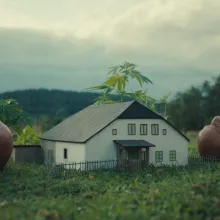
While Karlovy Vary may be best known for its star wattage and warm midsummer embrace of fiction auteurs, this year’s 59th edition (July 4–12) once again made a powerful case for documentary’s enduring vitality. Across the official selection, sidebars, and special screenings, nonfiction titles proved indispensable in reflecting Europe and the region’s evolving identities, eccentricities, and contradictions. This festival dispatch includes reviews of Grand Prix-winner Better Go Mad in the Wild, TrepaNation, Action Item, and Divia.
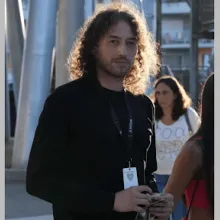
Since its founding in 1971 in the small town of Giffoni Valle Piana in southern Italy, the Giffoni Film Festival has grown into a global reference point for cinema made for—and with—young people. In this interview for Documentary, Minervini shares insights about his journey as a programmer of GEX:DOX, the distinctive qualities of Giffoni, the challenges and opportunities of curating documentary films for young audiences, and the spirit that animates this dynamic festival section. This interview has been edited.

It’s only us; there’s no them. That’s the provocation at Tribeca’s 2025 Immersive exhibition, titled In Search of Us, mounted in partnership with Onassis ONX and Agog. The exhibit seeks to challenge the act of othering that is so entrenched in media landscapes with “us vs. them” ideologies. About half of the show is comprised of documentary or documentary-adjacent work. This dispatch includes review of four exemplary nonfiction works.
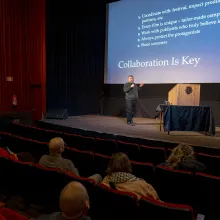
This article is a condensed and slightly adapted version of a talk I delivered on June 8, during the Skjaldborg documentary film festival in Patreksfjörður, Iceland, titled “The Press Playbook: How To Get Your Doc in the Spotlight.” What follows reflects both the structure and tone of that session—direct, personal, and grounded in real-world practice.
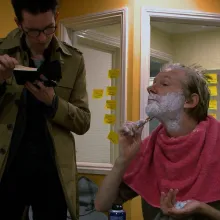
It is all too easy to overlook nonfiction film at Cannes, where documentary is, if you go by institutional classification, largely a vehicle for chronicling the history of cinema. This year, the most compelling documentaries were found in the parallel festival showcases. The winner of the Œil d’Or (Golden Eye for the best documentary at Cannes) Imago, from Deni Oumar Pitsaev, was in Critics’ Week. Likewise, ACID had the most formally challenging documentary this year at Cannes, Sepideh Farsi’s Put Your Soul on Your Hand and Walk, and it was Directors’ Fortnight that premiered a Ukraine documentary with stunning and often inventive cinematography, Militantropos, by the Tabor Collective.

Last year, national and international press widely reported on what The Globe and Mail described as “the most tumultuous year in the festival’s history,” complete with sweeping personnel changes, social and financial pressures, and the temporary closure of their flagship Ted Rogers Cinema. Though Hot Docs managed to pull through for its 32nd year with a new executive director (Diana Sanchez, formerly of TIFF) and a replenished staff (some of the programmers, including department head Heather Haynes, returned after their prior exodus), what frightened this hamstrung fixture of Toronto’s flailing film scene was dismally clear. Social issues don’t entirely permeate the programming, nor do their chosen films observe such issues in totality, but Hot Docs has always strived to stay in tune with urgent matters of the present, especially through films that align their audience’s point of view with what will one day be the right side of history.

Marking its 20th anniversary this edition (March 27–30, 2025), Berwick Film & Media Arts Festival has established itself as one of the UK’s most boundary-defying festivals for the moving image. This commitment to dismantling hierarchies extends to the festival’s structure. Many of the featured works explore the body’s mnemonic capacities—how gesture, movement, and touch might commune with history, or reimagine how to engage with the unknowable: Underground, Black & Arab Encounters on Screen, Bounded Intimacy, an Eri Makihara program, and Nightshift.
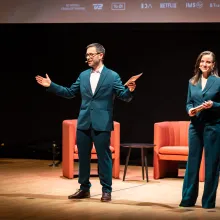
The 23rd edition of CPH:DOX wrapped last month, with record-breaking attendance and satisfied delegates at the festival’s market, but individual events at the industry conference revealed ruptures in the front of documentary unity against political threats. Filmmaker Omar Shargawi issued one of the most visible criticisms, reading a statement contrasting the festival’s support of Ukrainian filmmakers to a lack of “solidarity with the Palestinians” at an industry talk. At the closing ceremony, Artistic Director Niklas Engstrøm and Executive Director Katrine Kilgaard said their aim was “pluralism” and “to make room for a multitude of opinions and ideas, including those that challenge our own perspective as a festival.” Documentary reached out to Engstrøm for further comment via email after the festival ended.

Despite the fact that CPH:DOX has emerged as a highly successful and thriving destination for the documentary industry every spring, this year’s event was shrouded by global economic and political turmoil. If previous year’s editions rehashed familiar complaints about financing and distribution woes, this year’s threats were both more urgently physical and existential. American documentary filmmakers looking for life preservers in Europe in the face of the “MAGA-ification of U.S. gatekeepers”—as Variety called it in a festival report—found the consensus in Copenhagen was that it wasn’t going to be easy.