

Editor’s Note: Established in 2001 and given occasionally by the board of directors of IDA, which publishes Documentary, IDA’s Pioneer Award is presented to individuals or institutions who have not only made extraordinary contributions to advancing the nonfiction form but have also generously donated their time, vision, and leadership to the community. Past recipients include Jean Tsien, Ted Sarandos, Firelight Media, and Agnès Varda. The following feature spotlights the 2025 honoree, Impact Partners, a trailblazing Brooklyn-based equity investment advisory and fund that has supported over 150 independent documentary films.
Conventional wisdom holds that profitable documentaries require commercially viable subject matters and generic—although often polished—forms. Such thinking also suggests that social issue documentaries can only rise above their challenging financial prospects and rough production values by appealing to the urgency of the issues they take on. Refuting that framework and nurturing instead a new kind of approach to support and funding for documentary filmmakers is the aptly named Impact Partners. The Brooklyn-based group has consistently demonstrated that these seemingly competing demands need not be mutually exclusive. Through a carefully curated slate of social issue documentaries, the company has established a reputation for reconciling financial and social responsibilities.
Co-founded by Geralyn Dreyfous and Dan Cogan in 2007, the company is most notable for introducing a pooled equity investment model to documentary funding at a time when equity financing was uncommon.
Impact Partners was built on a commitment to serve its documentary constituency as well as its investor base. Dreyfous and Cogan had observed at the time that despite the growing number of folks who love doc filmmaking and want to see more daring works, there were very few sources of capital outside of grants or broadcast commissions at PBS and HBO. Their unique business model was adopted to help facilitate an alternative initiative for both investors interested in supporting documentary filmmaking and talented documentarians with worthy stories to tell who were underserved by the existing financing infrastructure. Impact Partners’ robust roster of critically acclaimed films, which includes The Cove (2009), The Hunting Ground (2015), Of Fathers and Sons (2017), Bisbee ’17 (2018), and Union (2024, an IDA Enterprise Documentary Fund grantee), is the result of their endeavors: all of their projects are partially funded by the pooled investments of their members.
On the surface, it may seem strange to implement an equity investment system to fund issue-driven documentaries. Yet Impact Partners understands it as an intuitive way of pooling resources for the documentaries that come their way. Over the years, they’ve pioneered a process that matches filmmakers with the right investors. When a project, usually in either the production or postproduction stage, reaches out to Impact Partners, its development team, led by Executive Director Jenny Raskin and VP of Production Kelsey Koenig, writes a report on the project of interest. The report includes pros and cons alongside a decision on the total amount to be invested. Then they present a recommendation to their investor members, who are asked to initially commit based on the strength of the proposal. Each individual’s investment amount is then determined by the number of members who sign up for the project. If eight members invest in a $400,000 project, they would each contribute $50,000.
If the finished film performs well in the market, its investors will recoup their funds—and potentially earn extra returns. A significant part of Impact Partners’ success story, aside from its impressive back catalog, is that historically, investors have received premiums from most of the projects to which they contributed. Since its founding and through recent upheavals in the documentary market, the company has remained faithful to its dual bottom-line approach, fulfilling financial responsibilities to investors while serving as a vehicle for promoting social justice through the documentaries it finances.
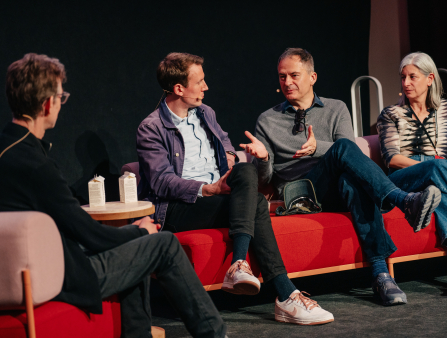
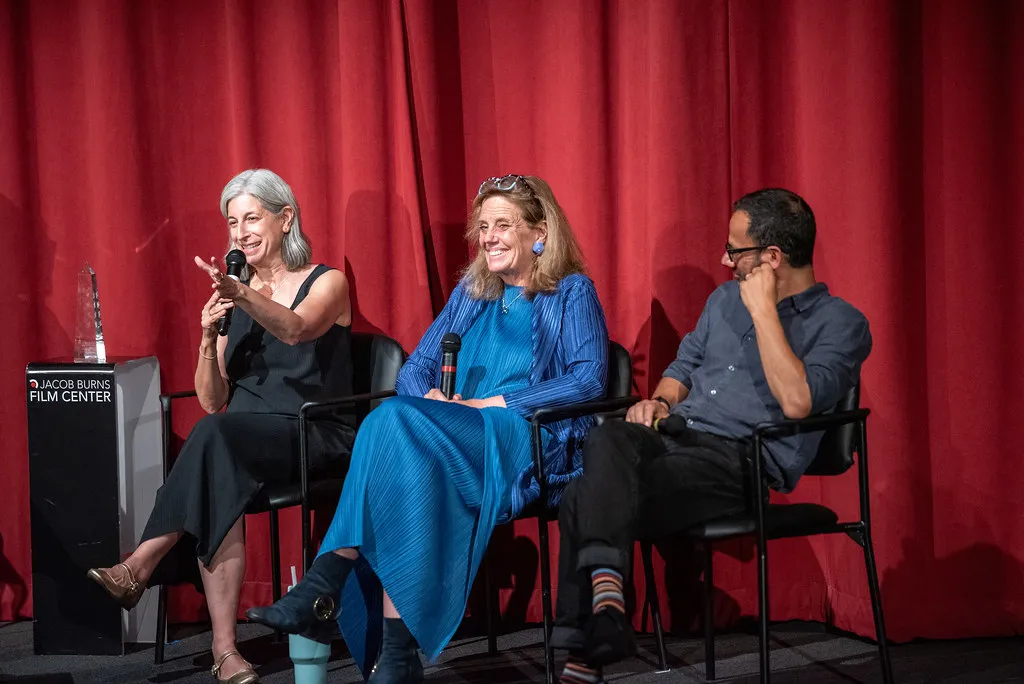
Jenny Raskin (R) at a talk at CPH:DOX 2025. Image credit: Joakim Züger. Courtesy of CPH:DOX
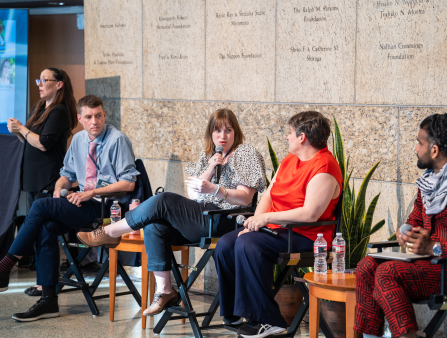
Kelsey Koenig (C) at GR ’24. Image credit: Urbanite LA
One of the main challenges to delivering on a dual bottom line is when funders and filmmakers aren’t able to speak each other’s language. Some funders who are well-intentioned but unfamiliar with the fundamentals of filmmaking may struggle to connect with artists. Likewise, filmmakers eager to tell stories they believe in may not be attuned to the concerns of the financiers who want clarity on how their money is spent.
Such scenarios, rife with potential misunderstandings and miscommunications, are where Impact Partners intervenes to create sustainable relationships built on open dialogue and trust between the two parties. According to Cogan, as a policy, Impact Partners ensures that the final cut lies with filmmakers. However, investors are also expected to provide creative feedback during the editing process, give advice on crafting impact campaigns, and even offer occasional emotional support during trying times. Filmmakers, in return, operate with the understanding that investment comes with certain expectations, such as working under predetermined schedules, the details of which are mediated and communicated via the company’s development team.
The experience Raskin and Koenig bring to their roles has been instrumental in helping filmmakers and investors navigate the challenges that come with Impact Partners’ funding model. When the development team first reviewed the still-developing materials from Brett Story and Stephen Maing’s Union, for instance, the Amazon Labor Union’s legal battle was still ongoing. That meant the project’s narrative arc was unsettled. The risks were also unusually high due to the implication of critiquing a conglomerate with an enormous media division and the lack of guarantee on how the labor struggle would unfold. But Raskin and Koenig instantly noticed that what they had on their desk was a very special project. Impact Partners greenlit an investment in Union because they believed in the importance of the film’s subject matter and the care for storytelling Story and Maing brought to the project.
When asked if there is anything specific she looks for while reviewing submitted materials, (Impact Partners receives, on average, about 1,500 a year), Raskin says, “When I see a story that touches on an urgent social issue in the hands of filmmakers with singular artistic visions, I get excited.” After its Sundance premiere and through its eventual on-message self-release strategy, Union received ecstatic responses from critics who were struck by the film’s seamless integration of political urgency and artfulness, which is precisely what Raskin seeks.
The goal is to build a healthy ecosystem that guarantees sustainability for not just Impact Partners but also independent documentary filmmaking as a whole.
Any investment, particularly when it comes to funding documentary projects, involves some degree of risk taking. Due to the very nature of their form, documentaries evolve and morph throughout preproduction, production, and even postproduction. A film’s shape and messaging are sometimes retroactively determined only after the unfolding event captured on camera concludes. More often than not, great documentarians turn this unpredictability into an aesthetic framework through which they structure stories and push the formal boundaries of the medium. As Cogan told Documentary, “If your [documentary] is identical to the original idea with which you began the project, then you failed.”
Raskin and Koenig’s deep knowledge of documentary production’s specificities and their profound conviction in the medium constantly drive their dual bottom-line model. Their experience and intuitive approach to working with filmmakers was particularly instructive in the case of Detropia (2012). Initially pitched under a different title—Detroit Hustles Harder—Heidi Ewing and Rachel Grady’s project aimed to tell a hopeful story of the Rust Belt city undergoing revitalization. Based on the strength of the trailer Ewing and Grady presented, Impact Partners secured funding for the film. However, soon after the duo rented apartments in downtown Detroit to live there for a year, they quickly realized how overblown the media coverage of the revitalization had been. They soon transformed their project into an essayistic documentary about the lingering impacts of deindustrialization in Detroit and the hardships faced by its residents.
At the time, some of Impact Partners’ member investors were understandably uneasy with this radical shift in the project they had funded—especially because, according to Raskin, the message of the finished film ended up being antithetical to what was promised in the pitch. Yet what ultimately won out was every stakeholder’s shared commitment to supporting great filmmaking and meaningful engagement with social justice causes. The disagreement and disappointment soon gave way to unwavering support for the film, with the understanding that everyone involved had engaged in good faith and had done what was best for the project. The change of course made for a more assured finished film. Detropia went on to have an impressive festival run beginning at Sundance, and later at True/False, Cleveland, and BAMcinemaFest.
The eventful production history of Detropia speaks volumes about the kind of community and infrastructure Impact Partners has built over the years. Every year, Impact Partners hosts two retreats for member investors: a Sundance retreat and a Spring Convening in New York, where the company is based. At Sundance, investors attend a panel conversation with filmmakers and an annual meeting during which Raskin presents a roundup of the previous year at Impact Partners and pitches from new films. In addition, the company organizes an industry-facing party and other events revolving around the Impact Partners titles screening at the festival. At the Spring Convening, which is curated around a particular subject or theme each year—such as the editing process, social impact campaigns, ethics, or craft—investors have the opportunity to engage in deep conversations with filmmakers about their creative processes.
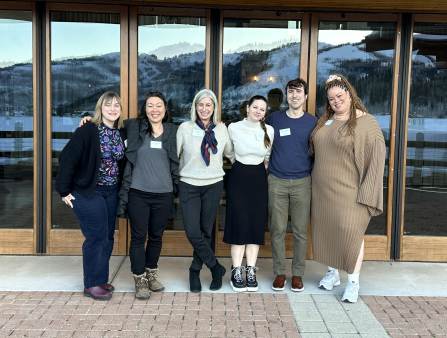
Impact Partners staff of (L to R) Kelsey Koenig, Amy Augustino, Jenny Raskin, Skye Ward, Chris Boeckmann, and Chelsea Williams at Sundance 2025. Courtesy of Amy Augustino

Detropia. Courtesy of Loki Films
Having grown from 3 to 50 in number over Impact Partners’ 18-year-old history, this tight-knit community represents an eclectic group of investors who have come to the company either through word-of-mouth recommendations or direct reach after having followed their impressive work. Some are individual investors who are deeply curious about the creative aspects of documentary; others represent foundations that promote specific advocacy causes. Each investor gravitates toward individual projects based on their own topical and aesthetic preoccupations. The diversity in their political and aesthetic interests is neatly mirrored in Impact Partners’ diverse portfolio.
Their differences notwithstanding, all members are united around the organization’s core principles of investing in fiscal sustainability and social impact in equal measure. They know very well that not every Impact Partners project will turn out to be Won’t You Be My Neighbor? (2018), which earned over US$22 million at the domestic box office during its wildly successful theatrical run. There’s an understanding that no matter a film’s financial performance, there are other ways of measuring its—and Impact Partners’—success. This can take the shape of increased public awareness around urgent issues, but success can also be gauged by building solid relationships with filmmakers and potential future collaborators. The goal is to build a healthy ecosystem that guarantees sustainability for not just Impact Partners but also independent documentary filmmaking as a whole.
As part of their commitment to nurturing a healthy industry infrastructure for filmmakers, Impact Partners launched the Documentary Producers Fellowship in 2015. The initiative was an effort to mentor a generation of emerging producers who can carry the torch of independent doc filmmaking and pave new paths. At the time of the fellowship’s launch, the company was one of the few institutions that set aside resources specifically for cultivating new producers. Jess Devaney, a 2017 fellow and the president of Multitude Films, characterizes her experience as truly formative. Surrounded by a cohort of like-minded producers in similar career stages, Devaney was able to connect with veteran producers who generously shared their knowledge and insights over the course of multiple workshops. “I’m still in touch with my cohort and the mentors I met during the fellowship, and these are connections that continue to positively shape what I do,” says Devaney.
Impact Partners has also inspired others to launch their own initiatives, contributing to the world of independent documentaries. Bonni Cohen, who first collaborated with Impact Partners for her 2011 film The Island President (dir. Jon Shenk), and Lisa Kleiner Chanoff, a former member investor, founded Catapult Film Fund in 2010 to provide early development grants to filmmakers in need. Given that Impact Partners typically focuses on supporting projects already in development and providing finishing funds, Cohen and Chanoff wanted to establish an organization that could serve as an incubator for new ideas, thereby creating a symbiotic ecosystem where the two companies address the different needs of the industry. “My career and my philosophy have been in parallel with Impact Partners and, to me, they’re as much a think tank that charts the course of our industry as they’re a production company,” says Cohen. She is not alone. Filmmakers and producers who have worked with Impact Partners over the years see them as a beacon of light that guides them through the ups and downs of this oft-uncertain industry.
***
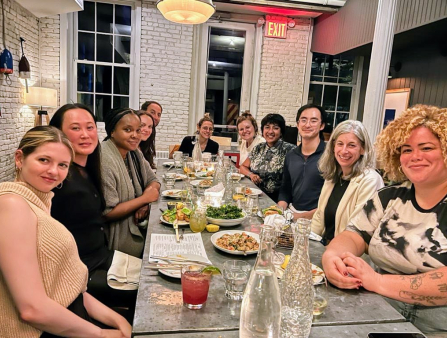
Impact Partners 2021 Producers Fellowship dinner. Courtesy of Impact Partners

Going Varsity in Mariachi. Courtesy of Alejandra Vasquez
The question of sustainability amid the current documentary landscape also affects Impact Partners. “These days, I think we need to operate with a triple bottom line model that actively invests in talent and infrastructure to ensure that documentary has a future,” says Raskin. Indeed, the volume of documentaries bought and distributed in the market has dipped significantly in the past couple of years, and a growing number of acquisitions and development deals exist almost exclusively to cater to current mainstream market whims. The concerning market trend is further exacerbated by the climate of political fearmongering and drastic funding cuts to PBS under the latest Trump administration.
Alejandra Vasquez, whose feature debut Going Varsity in Mariachi (2023, co-dir. Sam Osborn) was co-financed by Impact Partners, is especially concerned about those who are trying to make their first films now. “Until recently, early-career filmmakers like myself would think ‘there’s always PBS,’” she says. “But we live in a different reality now.” Vasquez feels lucky to have received more than just financial support from Impact Partners for her debut. Not only was she helped through parts of the process she was unfamiliar with as a first-time filmmaker, but she also got extremely detailed and thoughtful creative feedback during postproduction. Far along in the editing process, for example, Vasquez was having trouble with a downbeat moment in the film where a mariachi team loses in a competition and their coach becomes frustrated as a result. It was Raskin’s notes, which recommended adding some voiceover, that helped the director identify what was not working and what could improve the scene.
Despite the grim reality of documentary filmmaking at present, Vasquez finds solace in the fact that Impact Partners, with a passion for the medium and a profound understanding of storytelling’s nuances, is there to shepherd newcomers.
Organizations like Impact Partners can play pivotal roles with their forward-thinking and creative approaches to supporting documentary. Reassured by the noticeable success that recent films like Union and No Other Land (2024) experienced with their independent distribution strategies, Impact Partners is looking to allocate more time and resources to further exploring alternative distribution models for bold, risk-taking projects that are not welcomed by the current market. As always, the team will continue to invest in talent that comes from every sector, country, and career stage. “The idea that drives us all at Impact Partners is that the rising tide raises all the ships,” says Koenig.
What initially began as an innovative solution to the gaps in documentary funding has spawned other like-minded initiatives and a generation of producers and funders, for whom Impact Partners symbolizes the resilience of independent filmmaking and offers an exemplary model of socially responsible business. While many in the industry feel deep pessimism about what lies ahead for documentarians amid economic hardships and political censorship, Impact Partners is once again at the forefront of innovation, tirelessly looking for new ways to ensure that great nonfiction filmmaking has a future.
This piece was first published in Documentary’s Winter 2026 issue.