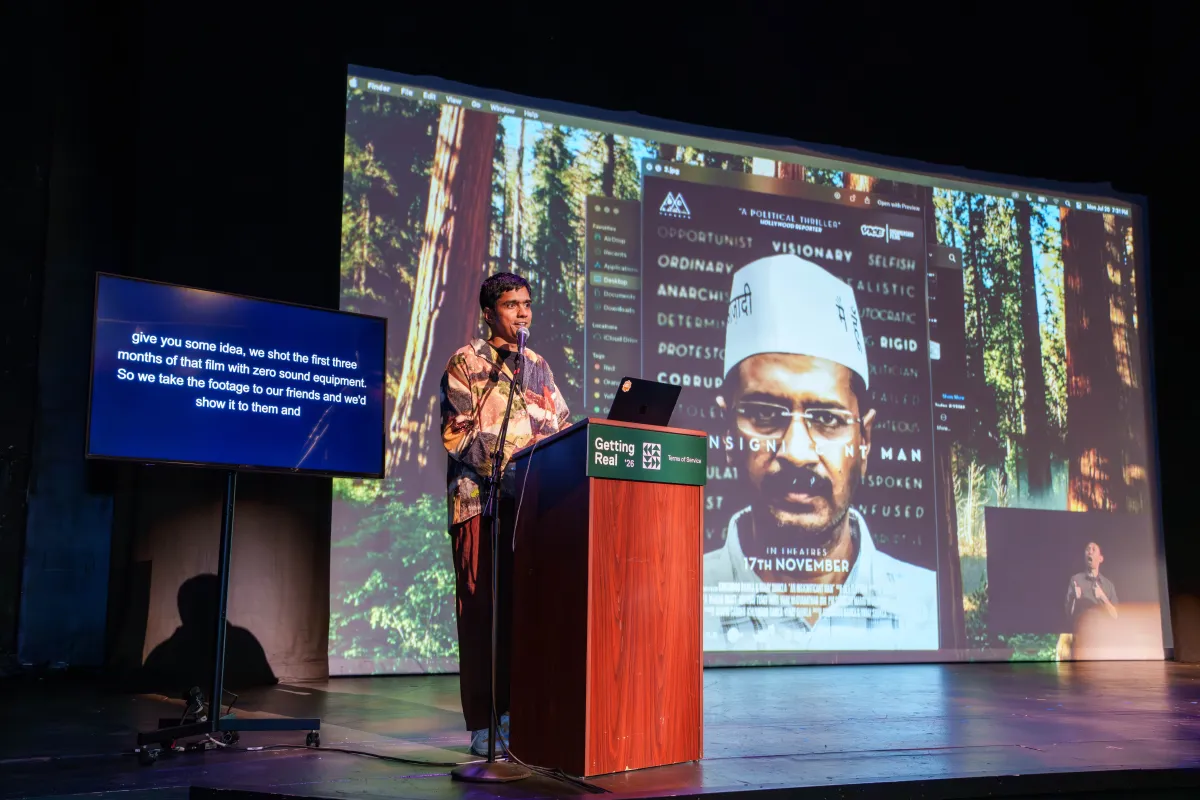


“We are living in a drought,” Indian filmmaker Vinay Shukla (An Insignificant Man, 2016; While We Watched, 2022) told a crowd at the opening night event of Getting Real ’26. His words set the tone for IDA’s biennial documentary conference, held July 20–23 in Los Angeles during a nascent heat wave. “What do we do while we wait for the rains? Who are we as we wait, and what do we do as we wait?” In reflecting further, Shukla looked back at ancient civilizations to see how they dealt with droughts. “Most of them learned to adapt,” he said. “Better water storage; they consumed water more efficiently; they built their lives around crops that weren’t as water-intensive.”
Shukla’s extended metaphor resonated with the conference’s hundreds of attendees—mostly emerging and established documentary filmmakers, plus a handful of nonfiction industry leaders—who were all there searching for and speaking about ways to navigate the current drought in the documentary field. If the 2024 edition of Getting Real was about immediate reactions to the sudden seismic shifts in the nonfiction marketplace, this year’s conference was more about the survivalist and innovative strategies emerging in the Mad Max–like desert of our current harsh realities.
Don’t expect bountiful new reservoirs or easy solutions for the industry’s arid climate, but consider the following as some of the means and methods discussed for sustenance.
Going Local
One of the conference’s enduring messages was the need to move from the federal to the local, away from the likes of national broadcasters and global platforms, and toward “place-based” strategies that work with community partners, whether local media, local funders, or local content-aligned organizations. In response to the defunding of the Corporation for Public Broadcasting, the dumbing down of corporate media, and the world’s totalitarian tilt, workshops and panels repeatedly focused on ways individual filmmakers can and should integrate more with their communities and with each other.
As Keynote speaker and former Storyville and Fremantle executive Mandy Chang said, “Ultimately, YouTube will not save us. The answers can’t be found in one platform,” she continued. “For me, the greatest solution is working together across documentary organizations, across festivals, across countries … sharing what’s working and also banding together to counter threats.”
Chris Hastings, the former head of the WORLD Channel and now the CEO of Rochester, New York’s public media station WXXI, spoke repeatedly about a more community-based path forward for documentary filmmakers. “What’s important for me is to reintroduce the ‘local’ into why public media exists,” he said during the panel titled “Ground Level: Public Interest, Local Trust.” “The sustainability of the system has really nothing to do with federal funding,” he continued, referring to the fact that PBS has always been rooted in its local programming, all the way back to Mister Rogers’ Neighborhood, which started as a show on WQED in Pittsburgh in 1967. “It has everything to do with community, and the makers who are willing to partner. So you need to build a relationship with your local station,” he added. “We partner or perish.”
On the same panel, Kevin Colligan, CEO and President of the new company Local Public, admitted, “We’re not Netflix; we don’t have those budgets, but we have people all around the country who know their areas and have deep trust, so we have advantages that Netflix doesn’t have.”
Playing on the idea of Free Ad-supported Streaming Television (FAST), Colligan’s Local Public TV is pioneering what he calls “FUUST” (“For User and Underwriter-Supported Television”) channels, where creators and channels can get new revenue from sponsors and digital pledges. Currently, Local Public operates streaming apps for 18 independent PBS stations, continues to scale up, and is also developing a new digital distribution and licensing exchange program for public media affiliates’ documentary productions, similar to PRX (Public Radio Exchange) for radio. “We’re looking to reinvigorate local production and distribution, and keep stations viable,” said Colligan.
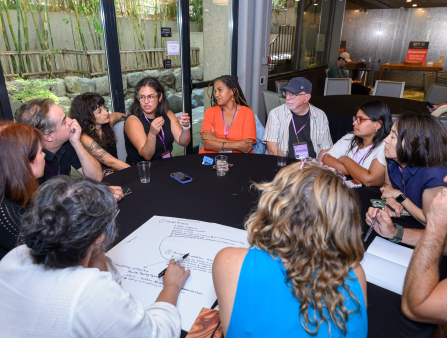
Attendees at the open breakout session “Making it Local (With Viewers Like Us).”
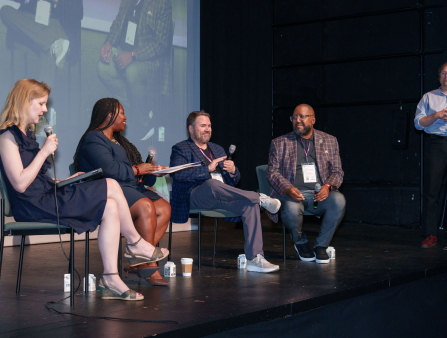
(L to R) Justine Nagan, Sharese Bullock-Bailey, Kevin Colligan, and Chris Hastings at the “Ground Level: Public Interest, Local Trust” panel.
During a breakout session called “Making It Local (With Viewers Like Us),” another welcome initiative—combining the local with the national—was announced by filmmaker and NPR Senior Editor Razi Jafri: the creation of NPR Studios, a new documentary division of National Public Radio that has received three years of seed funding from the Doris Duke Foundation.
“Imagine a local filmmaker partnering with a member station to develop or produce a documentary rooted in that community, combining the filmmaker’s cinematic language and storytelling abilities with the local stations’ reporting relationships and local knowledge,” Jafri said. “Things are broken,” Jafri continued, “but there are also lots and lots of resources that are still out there.”
Similar synchronicities and partnerships were also discussed throughout the three-day convening. During the same session, media and nonprofit leader Joaquin Alvarado, veteran of the Center for Investigative Reporting and the Corporation for Public Broadcasting, spoke about independent documentaries as the third piece of a united triangle, along with local print and radio. He cited such bodies as the American Journalism Project (which has raised over US$250 million), Press Forward (which has invested more than US$400 million), and the vast network of local community foundations—it seems most U.S. regions have one—all as potential partners and funders.
“We have succeeded in getting community foundations to invest in their press and media stations, and they’re not yet connected to the doc community, so this is where we can connect the dots,” Alvarado told Documentary postconference. “I’m not saying we’re going to get those numbers for independent docs, but there are certainly tens of millions of dollars if we’re strategic about getting it.”
“Documentary is journalism, too,” echoed Memo Torres, founder of L.A. TACO and the “Daily Memo” at the “Making It Local” breakout session. For Torres, who pivoted from making food videos to providing vital reporting about ICE raids in Los Angeles, during times of authoritarianism, documentary filmmakers and journalists “have to work together, not compete with each other.”
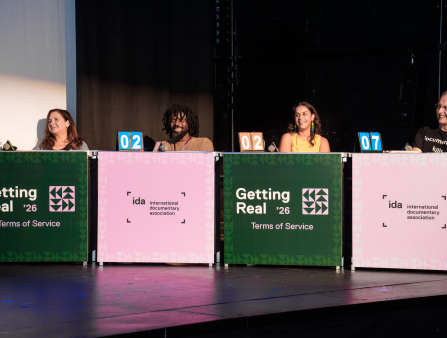
(L to R) Tia Lessin, Kachi Benson, Taira Malaney, and John Archer take part in “What's the Deal? Distribution Game Show.”
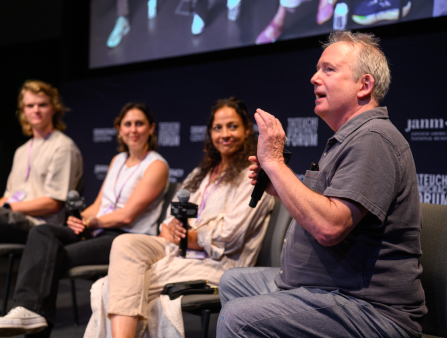
(L to R) Sam Denby, Sky Dylan-Robbins, Sohini Sengupta, and moderator Ted Hope during the “State of the Business” panel.
Don’t Wait
The conference’s other significant wellspring of information revolved around filmmakers bypassing gatekeepers to do the work of marketing and distribution without waiting for outside offers—from festivals to buyers—to rain down.
During a panel on distribution, Amy Hobby, co-founder of Distribution Advocates, advised filmmakers to spend just two hours each week on their project’s distribution plans.
“Don’t wait,” said Taira Malaney, director of the environmental documentary Turtle Walker (2024), which had a robust community screening program that sales agents warned beforehand could impact an eventual deal. But during Getting Real’s “What’s the Deal? Distribution Game Show” event, Malaney said their grassroots impact is exactly what fueled the film’s overall success. “If we had started our distribution campaign right after a festival, we would have been a lot further along than we are now,” she said. “Lean into your audience, through social media or community screenings. Audiences will turn up.”
Similarly, nonprofit cooperative Tikkun Olam Productions, producers of Israelism (2023), spoke (in a conversation moderated by me) about how they were unable to land a spot at major festivals or a distributional deal but booked hundreds of community and college screenings, played on Al Jazeera and VICE’s YouTube channels as well as larger VOD platforms, and held successful virtual Kinema screenings, where in total, they were able to generate US$425,000 and raise an additional US$150,000 in impact grants and donations. (Most of that revenue, they indicated, did not come from traditional VOD platforms like Apple, but their own efforts like the Kinema and community releases.) Tikkun Olam also pivoted in other fruitful ways. For instance, producing a video podcast called Beyond Israelism, expanding upon the subject of their documentary for the news site Zeteo. The collective’s nimble, self-driven—and yes, successful—approach was particularly welcomed during the conference as provable evidence that filmmakers can, in fact, move forward with their own plans.
“We are the market makers,” Creative Arts Agency agent Amanda Lebow said at another event called “The Hot Seat,” where questions are submitted to decision makers like Lebow. The comment came as a surprise to many in the audience who had expected a more traditional view (e.g., waiting for a sale to a streamer or broadcaster) from a representative from the Hollywood agencies.
But Lebow said agents like her can actually be helpful “during a contracting market … because it’s more about architecting an entire plan. If the buyers are not interested in the film, it’s finding all of the pieces that can go together.” Of course, Lebow admitted they’re interested in partnering with streamers, “but there are so many more options for films than there were before,” she said.
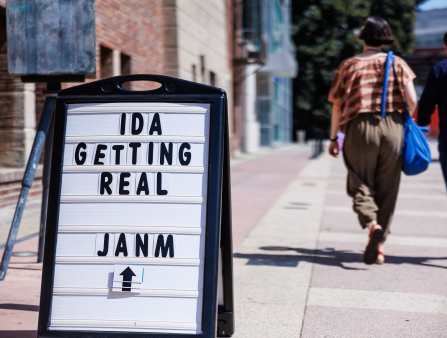
Sandwich board at Getting Real ’26.
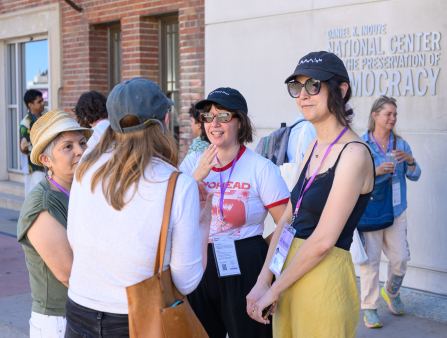
Attendees mill around outside in between sessions at the Japanese American National Museum (JANM) in Los Angeles, CA.
During one of the conference’s final talks, “The State of the Business,” former Amazon executive and veteran fiction and documentary producer Ted Hope similarly championed the idea of forging original paths for releasing documentaries. “No one here was waiting for permission. Nobody was waiting for acceptance. They’re building things to make it work,” he said, referring to his fellow panelists Sam Denby (who co-founded the subscription short-form web platform Nebula), Sohini Sengupta (a longtime marketing executive who is starting a new third space entity called Doverlane), and Sky Dylan-Robbins (founder of Video Consortium).
But how to actually make it work?
“When something is broken or not working,” said Sengupta, “there are no rules, so we can try all kinds of things.”
For Sengupta, Hope, and the others, one of the primary ways they’ve identified to help the production and distribution of independent documentaries comes down to marketing and awareness, which filmmakers could more readily control.
“At the end of the day, almost everything’s a marketing problem,” Dylan-Robbins said, advocating for filmmakers to think about “ecosystem building” and “radical collaborations”—in other words, “to create a world” around your film, she added.
Sengupta agreed, suggesting filmmakers need to think about marketing “from the very beginning so that you can talk to your audience,” she explained. “You can get as many influencers as you want, and they may create conversation around films, but they do not bring people to theaters, and they do not bring people to click and watch something. Who does? You do, as the filmmaker. If you are actually talking to your audience consistently, and going to the places where they’re at, that’s who’s going to show up for you. That’s marketing.”
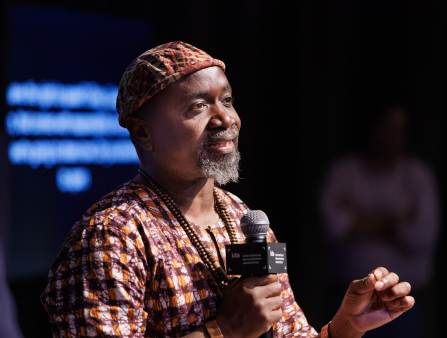
Petna Katondolo during his keynote conversation with Dominic Asmall Willsdon.
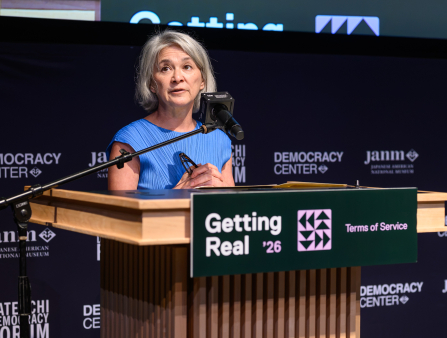
Mandy Chang delivers her keynote talk on the last day of the conference.
If Getting Real’s conference two years ago showed there was still a longing for filmmakers and communities working together around long-standing models, this year’s attendees and panelists seemed skeptical of all institutions, from sales agents to film festivals to even the New York Times (as filmmaker Alan Berliner suggested during a confessional talk about his years-long battle with the newspaper over suppressing his 2019 documentary Letter to the Editor). Nothing and no one was to be trusted, except your own ingenuity and engines.
For filmmakers, the message was clear: They, along with their communities, need to be the primary drivers of their work, its funding, its production, and its distribution, no matter the extra labor and cost to themselves. And this is happening globally, as Getting Real held presentations by Palestinian filmmakers, the Taiwan-based independent streaming-and-impact platform Giloo, and Congolese filmmaker Petna Katondolo, who also echoed the themes of the conference (“I’m much more interested in how to make communities in a world that has been fragmented,” he said).
In these “challenging times where … we’re having to adapt to change in new ways or face the diminishing of our field,” as Mandy Chang noted, documentary filmmakers—at least as it seemed in Los Angeles in July—are being forced to rethink and reconceive their roles during this period of severe retrenchment.
As Vinay Shukla said, “I have learned all highs are followed by lows, that all good things are followed by not so good things, and that rains are followed by droughts. It doesn’t matter how you behave during the rains; what matters is who I become during the droughts.”
This piece was first published in Documentary’s Fall 2026 issue.