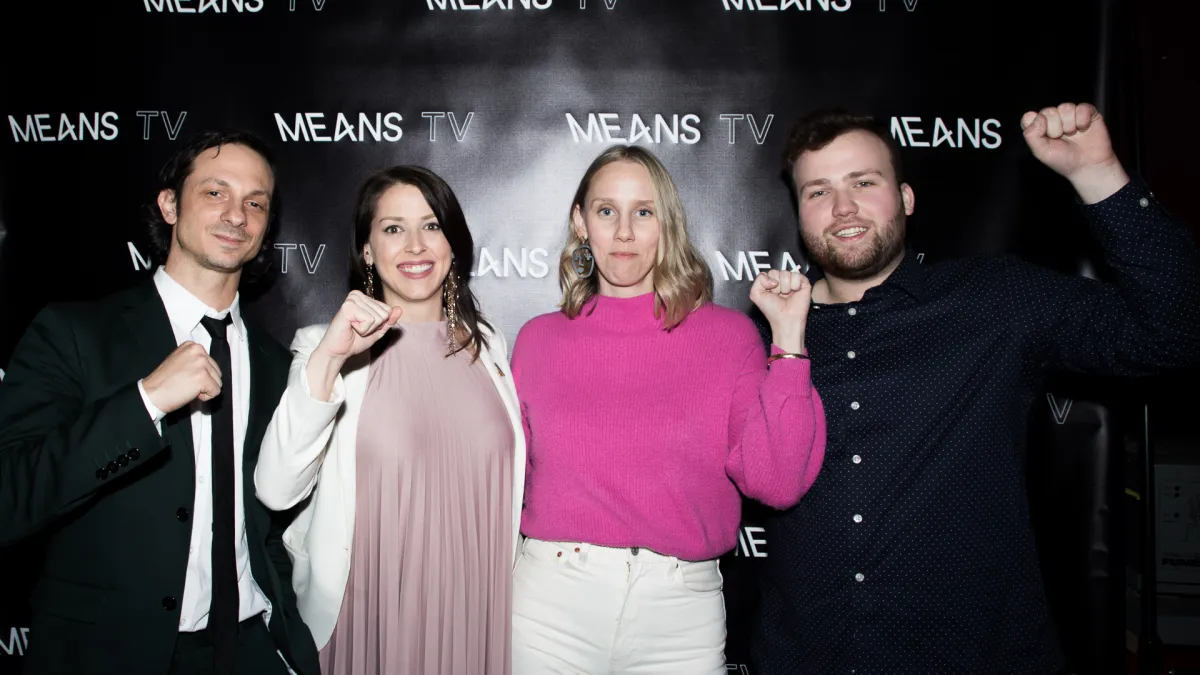


In 2019, documentary filmmakers Nick Hayes and Naomi Burton founded Means TV, an online platform that calls itself “the world’s first worker-owned, anti-capitalist streaming service.” Their catalog is updated constantly, but its contents—which include scripted feature films, longform independent documentaries, video games, and short videos—are well in the high hundreds.
According to Hayes, the platform has approximately 8,400 subscribers and has seen year-over-year increases of 10 to 15 percent since 2023. At US$10 a month, it stands at about the same price as Criterion Channel, Hulu, and Netflix. In a media landscape fueled and funded by private capital, the existence of such a worker-owned initiative offers an alternative path forward for independent filmmakers.
The impetus for the creation of Means TV dates back to Hayes and Burton’s time working as independent producers in Detroit’s commercial film sector throughout the 2010s. Frustrated by how much money was being poured into insurance and automobile company commercials, the couple decided to create their own production company, Means of Production, and dedicate themselves to working with unions, nonprofits, and other organizations that shared their values. In 2018, they got their big break working on the campaign video for Alexandria Ocasio-Cortez’s first bid for Congress. One year later, they decided to use the US$30,000 generated through Means of Production to finance a launch campaign for Means TV. Their campaign raised US$200,000 for the nascent streamer, establishing a new platform for filmmakers and content creators who share aligned leftist political beliefs. On top of distributing and exhibiting leftist content, Means TV remains unique within the streaming landscape because it is structured as a cooperative; namely, a values-driven business which puts worker and community benefits at the core of its mission.
The business (which remains ad-free for users) is owned and self-managed by its worker members, who participate in democratic decision-making processes regarding the business’s organization and receive dividends from its profits. At Means TV specifically, members are divided into three discrete categories: employee members, who represent the company’s full-time staff and earn at least 30 percent of its year-end profit; royalty members, who encompass filmmakers, certain film distributors, and other content creators who contribute their work to the platform, all of whom earn at least 20 percent of the year-end profit; and contractor members, a collection of regular independent contractors with whom Means TV works and who earn at least 5 percent of the year-end profit.
The structure is transparent (all of this information is available on the platform’s website) and community oriented. At a moment when the film distribution landscape looks particularly bleak, Means TV opens up a new possibility for film distribution—or perhaps it recovers one. Film cooperatives have existed for decades, and are perhaps most associated with the 1960s and 1970s, when such efforts found traction amid a newer generation of independent filmmakers.
What the cooperative model promises now, as it did for filmmakers then, is newfound autonomy, community, and a possible means of resource pooling and profit sharing. Yet as the histories of many of those earlier co-ops bear out, the economic model proposed by film cooperatives may well have a ceiling, offering an alternative model that requires a care—and a political bent—that struggles when positioned as an answer to industrywide troubles and whose sustainability has proven hard to maintain. Jonas Mekas, whose “First Statement of the New American Cinema Group” serves as a manifesto of sorts for what would become the Film-Makers’ Cooperative in 1962, perhaps put it best: “Common beliefs, common knowledge, common anger and impatience bind us together.” His was an attempt at creating a new model for filmmakers devoid of the rules upheld not just by Hollywood studios but even by tastemakers in New York City.
Crucially, though, Mekas also made a point of distinguishing the group and its mission from the likes of United Artists by pointing out precisely what an initiative like Means TV hopes to upend when it comes to filmmaker-owned cooperatives: “We are not joining together to make money.”
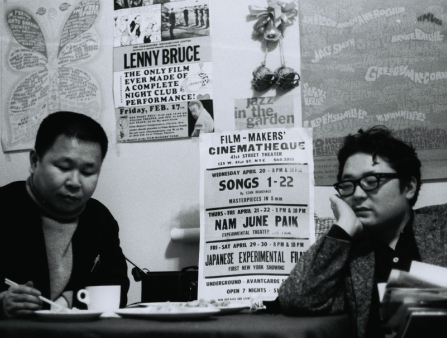
(L to R) Critic Jyūshin Satō and filmmaker Takahiko Iimura at the offices of the Film-Makers’ Cooperative in New York City, 1966. Photographer unknown. Courtesy of the Film-Makers’ Cooperative
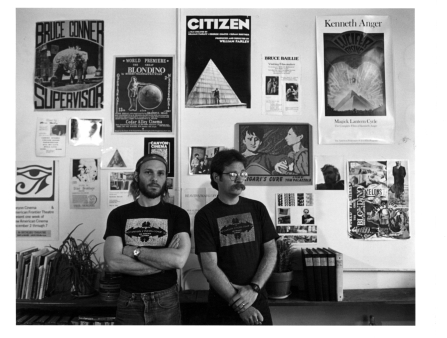
Michael Wallin and Dominic Angerame at Canyon Cinema, 2325 Third St., San Francisco, July 1983. Courtesy of University of California, Berkeley Art Museum, and Pacific Film Archive
The Film-Makers’ Cooperative was founded in New York in 1961 as the distribution arm of the New American Cinema Group, a membership cooperative formed between 22 New York artists, including Mekas, Shirley Clarke, Ken and Flo Jacobs, and Jack Smith. The Film-Makers’ Cooperative operated as a for-profit distribution center into the ’80s, and was propped up to exhibit local films that were shunned by mainstream distributors. Its founding members had also hoped it could act as a production hub for local independent filmmakers, but according to David Schwartz, the current president of the board of directors of the Film-Makers’ Cooperative, “this proved to be unwieldy from a bookkeeping perspective.” Nevertheless, Ken and Flo Jacobs used this idea as the premise for the creation of the Millennium Film Workshop in 1966. The hydra-headed New American Cinema Group, the Film-Makers’ Cooperative, and the Millennium Film Workshop offered experimental filmmakers in New York means of representation, distribution, and production, respectively. This ambitious model bolstered the canonization of landmark experimental films such as Stan Brakhage’s Anticipation of the Night (1958) and Marie Menken’s Eye Music in Red Major (1961) in the United States; both of these titles, among numerous others, will be included this fall in the Museum of Modern Art’s retrospective series dedicated to the Film-Makers’ Cooperative and the Millennium Film Workshop.
The Film-Makers’ Cooperative’s first base of operations was inside a loft on Park Avenue, and it represented one of several initiatives Mekas was spearheading to bolster independent and experimental film exhibition in the United States. “The founding principle was that anybody who wanted to put their films in the co-op for distribution could do it,” Schwartz says. As its collection grew, it was forced to seek more real estate; luckily, one of its members, the experimental filmmaker Leslie Trumbull, had some space on the ground floor of his apartment building on Lexington Avenue, and that’s where the Film-Maker’s Cooperative settled from 1967 to 2000. After some years at a another downtown space, it is now based inside a modern Park Avenue office building.
Yet, despite its changes of address, the Film-Makers’ Cooperative’s mission and makeup have remained more or less the same since it began. It was founded as an alternative, member-run distribution organization dedicated to the distribution and exhibition of experimental works, personal documentaries, and political films, and its network consists of museums, galleries, festivals, colleges, universities, cinematheques, and artist collectives. Decades later, it is still an organization devoted to distributing and exhibiting such films. Its founding principle, that there be no barriers to the submission of new films, remains in place. So does its standing agreement that licensing proceeds are split 50/50 between filmmakers and the cooperative. These principles, combined with the Film-Makers’ Cooperative’s impassioned advocacy for films that did not have a place in the exhibition landscape, such as Kenneth Anger’s Scorpio Rising (1963) and John Waters’s Mondo Trasho (1969), inspired countless groups around the world to band together and form their own film co-ops.
Both the Canyon Cinema Cooperative and the London Film-Makers’ Co-op announced their formation in October 1966. The Hamburg Filmmakers’ Cooperative followed in 1968, the Toronto Film Co-op in 1969, and the Paris Films Coop in 1974. All of them developed unique catalogs culled from local independent filmmakers, made their own licensing arrangements, and faced their own set of adversities. Their histories reveal the tensions and challenges of running a filmmaker co-op over an extended period.
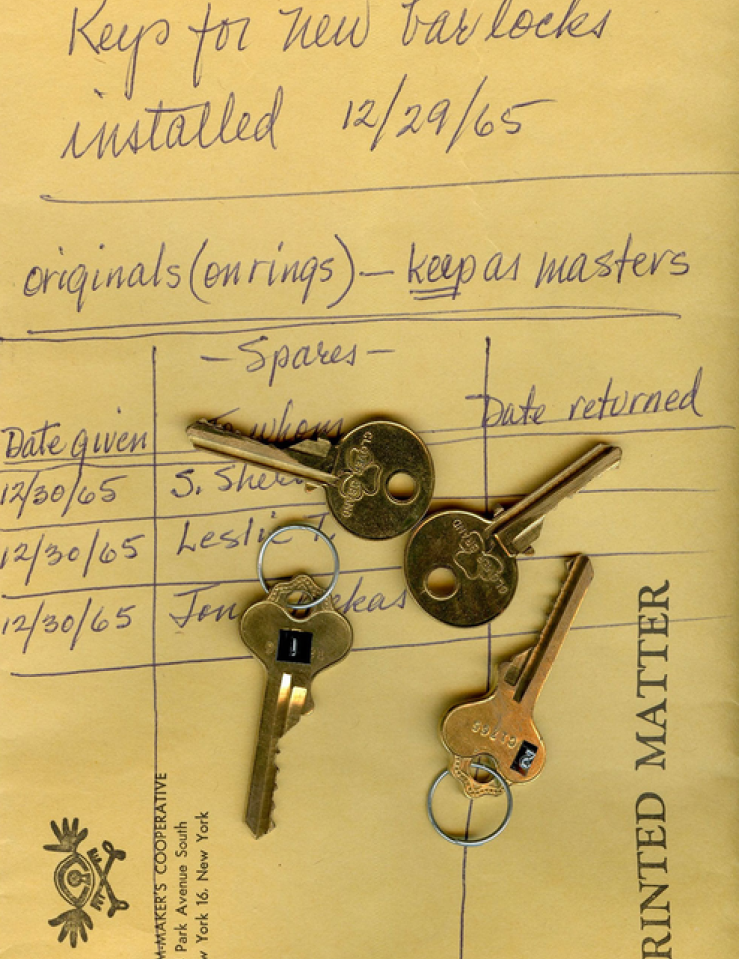
Keys to the Film-Makers’ Cooperative’s first location at 414 Park Avenue South, New York City. Photographer unknown. Courtesy of the Film-Makers Cooperative
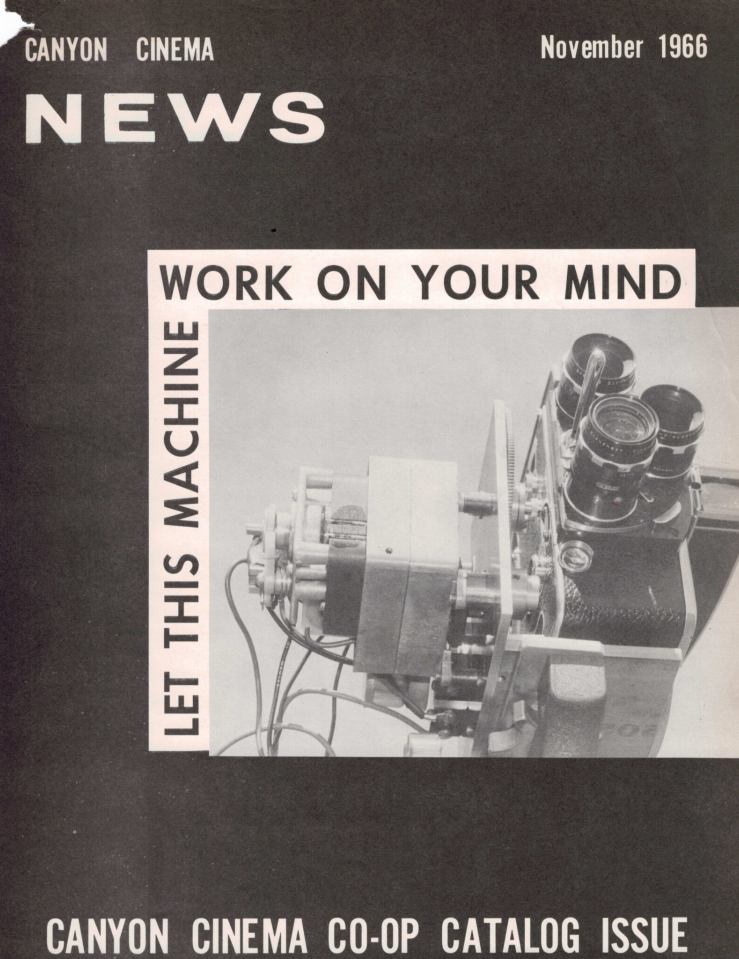
Front cover of Canyon Cinema News, November 1966. Courtesy of Canyon Cinema
Internal disputes and economic strain eventually led to the shuttering of the Hamburg and Toronto co-ops in 1972 and 1978, respectively. Meanwhile, the longevity of the others has depended on a move away from truly cooperative models. Paris Films Coop, unable to maintain the rights of certain titles in their collection due to bureaucratic copyright transfer laws in France, created a separate distribution wing named Cinédoc in 1979; and, in the ’90s, bolstered by cultural incentives from the socialist Mitterrand administration, rebranded itself as Cinédoc Paris Films Coop, a still-active nonprofit association dedicated to preserving and distributing experimental films in France. Likewise, the London Film-Makers’ Co-op merged with London Electronic Arts in 1997 to create the Lux Centre, a multipurpose space that functioned as a gallery, cinema, archive, and production hub. Unfortunately, this endeavor was short-lived. Due to rising rents, it was forced to shut down in 2001, resulting in the subsequent creation of the British experimental film distributor LUX in 2002. Around the same time, Canyon Cinema Cooperative became Canyon Cinema Foundation, adopting a nonprofit model that enabled it to access state funding to cope with rising rents in the Bay Area and preservation grants to manage its growing film collection (including many 8mm and 16mm prints). Absolute autonomy, in many of these cases, was traded for the promise of more stable, consistent state funding. Although each of these new iterations of the aforementioned cooperatives still promotes, distributes, and now preserves independent film, their priorities have at times been forced to change in response to requirements and incentives set by external funding bodies.
On the topic of preservation, most, if not all, cooperative representatives interviewed for this article voiced how difficult it has been to evolve and scale up the work of their respective cooperatives—needing, at times, to find new ways of staying afloat financially that have required them to do away with operational and funding aspects of their original co-op structures. These are organizations founded by tight-knit groups of independent directors who never imagined their fledgling distribution companies would become repositories of canonical works of independent cinema. “The co-op wasn’t originally conceived as an archive,” says Schwartz. “That wasn’t seen as a priority by its founders, but it became one; as prints got older, some started fading and needed to be replaced.” At this moment, Canyon Cinema holds about 4,000 films, and both LUX and the Film-Makers’ Cooperative hold around 6,000 films each. The open-submission policy, which both Canyon Cinema and LUX have since done away with, resulted in untenable film collections that have created further economic strain because they require manual attention, archival equipment, and physical space.
“This egalitarian, horizontal way of working was not satisfying because only a few filmmakers were really working hard, and like in any human group, there were different appreciations of work,” says Dominique Willoughby, executive president of Cinédoc Paris Films Coop. “We wanted to promote the best films, and because anybody who had a strip of film could say, ‘I’m a filmmaker,’ and leave a box at the co-op, some films have never been shown or rented; this is the limit of the system.” Since it was granted nonprofit status in 1993, the Film-Makers’ Cooperative has become more involved in preservation projects than in promoting new films. While this safeguards the future of their earliest works, it also changes their relationship to their collection, forcing them to focus on films made decades ago rather than newer works by up-and-coming filmmakers interested in building on the cooperative’s legacy. Put more simply by the executive director of Canyon Cinema, Brett Kashmere (one of two full-time staff members at the organization): “There are so many filmmakers now, we just don’t have the staff capacity to distribute everything that comes to us.”
What Lefrant and Light Cone suggest is that there is a viable model for these kinds of organizations so long as their scope and scale are commensurate with their capabilities.
Whether filmmaker cooperatives have the ability to scale—to have enough staff, resources, and real estate to continually serve and recruit members—is precisely the problem that has plagued them for decades. And while some, like Canyon Cinema, have been strained by such issues, others have found strength in their ability to grow out their slates and services.
In 1982, Yann Beauvais and Miles McKane created Light Cone in Paris. Also inspired by the Film-Makers’ Cooperative, Light Cone’s mission is to distribute, promote, and preserve experimental film. It was set up as a nonprofit cooperative, and followed in the footsteps of fellow Parisian film co-ops Collectif Jeune Cinéma and the Paris Films Coop. In France, it is standard practice for arts nonprofits to register as “associations” so they can access state funding without altering their unique organizational models; moreover, associations are expected to use their profits to advance their mission and are prohibited from using those earnings for anything else. Reporting for Independent Eye magazine in 1991, filmmaker Rose Lowder wrote that Light Cone had grown its collection from 20 films to 700 in less than 10 years. Now, it represents over 7,000 films, including 57 from Lowder, who has become one of their most-rented directors. “The collection grows exponentially,” Emmanuel Lefrant, the director of Light Cone, tells Documentary. “Last year, I had 330 new acquisitions. More than 300 films are coming in every year, and it’s going up more and more every day.”
But where such numbers would suggest a strain on their infrastructure, Lefrant takes pride in them. Light Cone, which only accepts bodies of work, starting at a minimum of three films per filmmaker, moves titles in European spaces (like museums and galleries) that make that scale workable: the more films in the Light Cone catalog, the more films go out as rentals. Not only does their collection grow exponentially, but so do their profits. “We rent about 200 films every month,” Lefrant shares. “That ends up representing Light Cone’s income; it’s 70 percent of our budget and only 30 percent comes from the state, which, for a nonprofit organization, is very rare.” Because Light Cone’s financial agreements with filmmakers remain rooted in its cooperative premise, 70 percent of all rental earnings are remitted as royalties. It’s a win-win situation, so long as the Light Cone staff (currently six full-time employees) keeps promoting their collection and cultural institutions continue renting out their titles.
“If Marine Le Pen wins the election next year and we lose all of our federal funding, we’re still going to survive because we’ll still have 70 percent of our budget,” says Lefrant. “That makes you more autonomous, more independent, more free.”
What Lefrant and Light Cone suggest is that there is a viable model for these kinds of organizations so long as their scope and scale are commensurate with their capabilities. It helps, of course, that their specialized slate has allowed them to cater to a market and an audience outside of the mainstream—notably most of their clients are galleries and museums, institutional bodies that have secured reliable funding from private and state initiatives and are able to pay high licensing fees compared to regular, independent cinemas. “Within the past year, distribution has increased exponentially,” Matt McKinzie, artistic director of the Film-Makers’ Cooperative, shares. “There’s so much interest in the films from the heyday of the ’60s and ’70s,” Schwartz added. “Whenever those films screen, there’s an audience.” Although the sums generated by these initiatives pale in comparison to those of most major releases, they remain worthwhile for independent documentarians and artist-filmmakers whose work would otherwise be ignored by commercial and more established independent distributors alike.
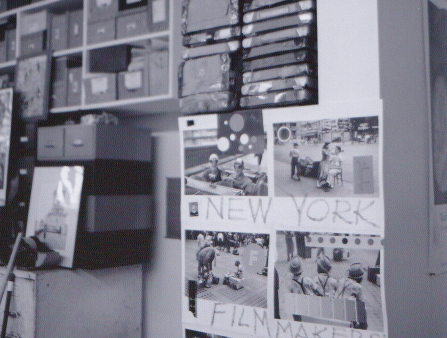
The Film-Makers’ Cooperative’s old office in the Clock Tower Building on 108 Leonard St. in NYC, July 2010. Courtesy of the Film-Makers’ Cooperative
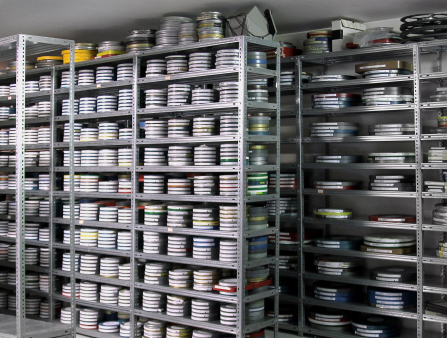
Light Cone operates as a filmmakers’ cooperative, guaranteeing to the authors (or the rights-holders) the ownership of both the physical copies and the moral rights of the distributed works. Courtesy of Light Cone (Paris)
As Mekas foretold, film cooperatives are not money-making machines. Although they require profits in order to survive, their financial model is as anti-capitalist as it gets in the current film distribution landscape. This is why their creators and consumers share ideological affinities; their existence represents a humble, oppositional, and community-driven rejoinder to distribution companies focused on trend-based, profit-seeking incentives.
“We think it’s a very viable model, and the best way we can advocate for the cooperative model is to be successful and compete against non-cooperative models,” says Nick Hayes of Means TV—arguably still in its infancy and yet to weather some of the challenges older cooperatives have had to grapple with. But at its heart, the turn toward filmmaker cooperatives insists on its very name: a push toward thinking collectively, with an eye, perhaps, not to profits but to community.
“It’s not a very lucrative pursuit,” Erica Schreiner, a video artist and member of the Film-Makers’ Cooperative, says apropos of her involvement in the organization. “People who do it really believe in it.”
Although Schreiner’s visibility as an artist has increased since she decided to submit her work to the Film-Makers’ Cooperative, she has never seen the organization as a means to make money. For her, the Film-Makers’ Cooperative serves as a repository for her work and a source of community. Forrest Sprague, whose work is also in the collection, feels similarly. “It’s less about what the co-op can do for me, or my films, in terms of exposure, and more about what I can do for other artists,” he says.
This piece was first published in Documentary’s Fall 2026 issue.