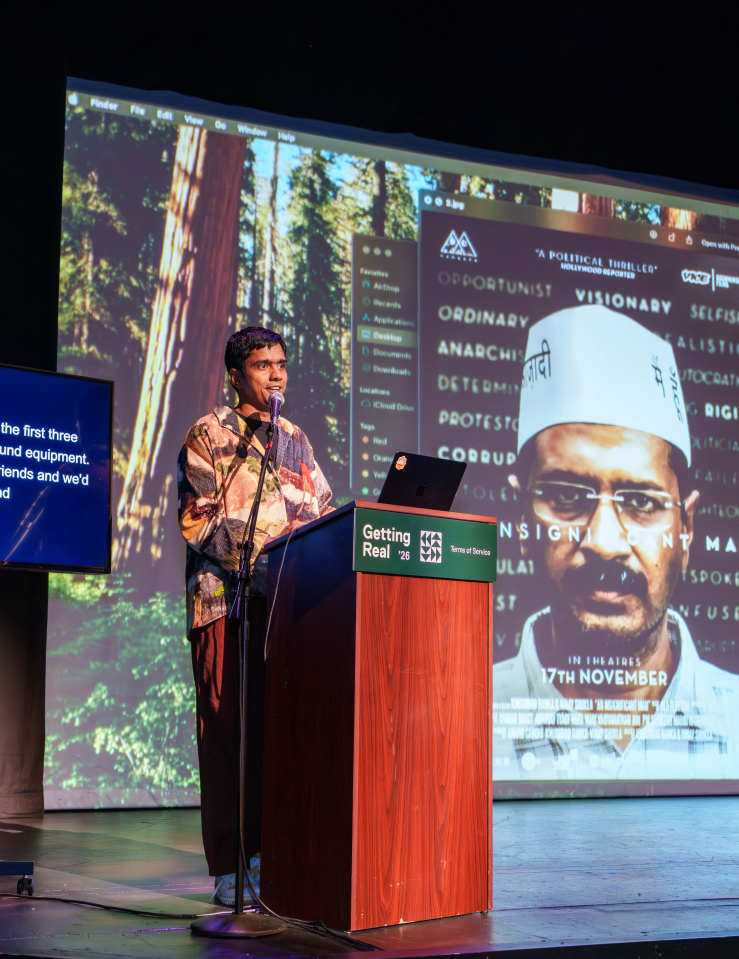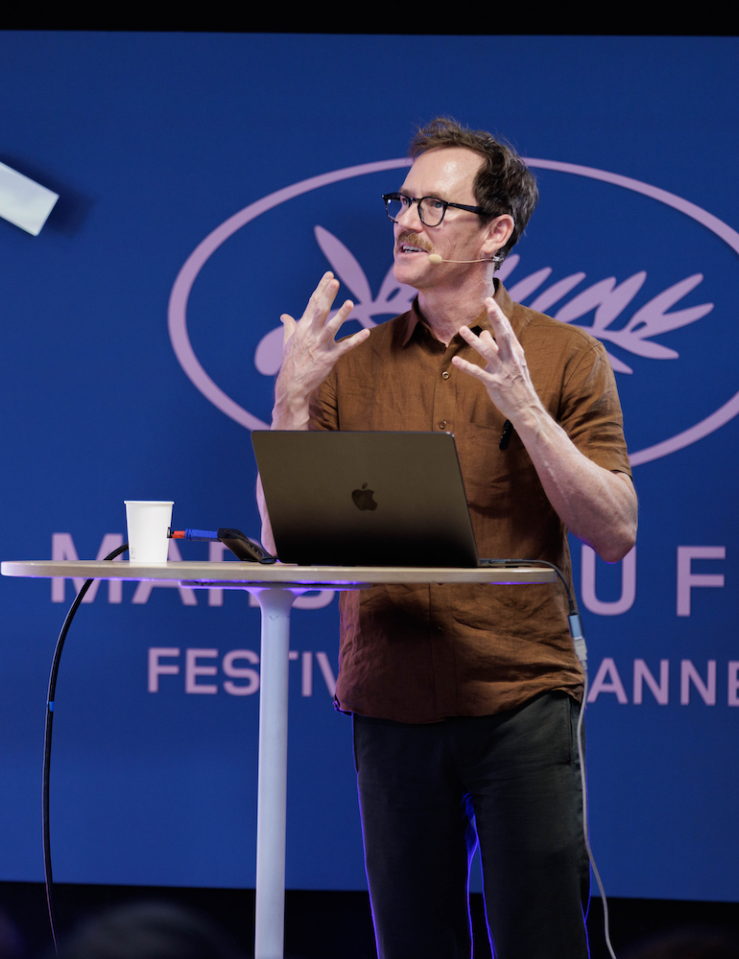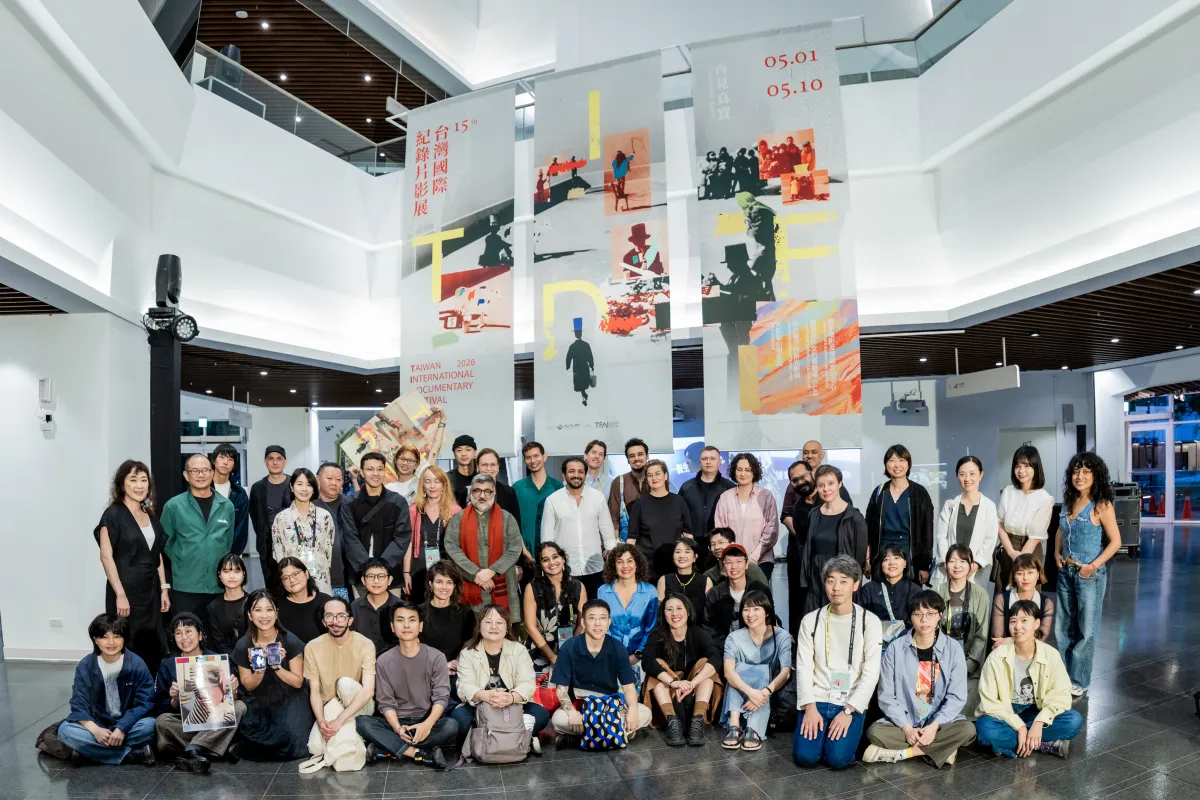


TIDF is a festival that treats documentary more as an adjective than a noun. The 15th Taiwan International Documentary Festival, which ran May 1–10 in Taipei, opened not with a film but with a lecture performance by Palestinian-Egyptian filmmaker Saeed Taji Farouky—a programmatic declaration that the act of documentation, not its product, was the subject under examination. On most evenings, the festival community organized around this particular rigor: Filmmakers and audiences mingled freely at the festival bar, where other invited programmers introduced their film festivals and organizations in an informal way—which was promptly rewarded by a drink coupon. Many programmers even invited filmmakers to chat with them afterward for a submission waiver. Conversations flowed in and outside the venue on rainy nights, and so did the endless supply of Taiwanese snacks (my favorite was a sour plum–flavored seaweed). The bar closed at midnight, but there were still crowds outside at 2:00 a.m. each night without fail.
The confident feeling of community and ease that can be felt on the ground is matched by the festival’s programming, which prioritizes quality and experimentation over external factors, distinguishing it from its peers. Premiere status and length seem to matter little: Of the 45 films across the Asian Vision, International, and Taiwan competitions, there were only one international and one world premiere, and shorts and features competed together. Instead of generic masterclasses, TIDF devoted time to extended Q&As focusing on specific films. The two mainstay sections on Taiwanese film history—Reel Taiwan and Taiwan Spectrum—respectively showcased four newly restored works by LEE Daw-ming, a major Taiwanese documentary filmmaker who was awarded the Outstanding Contribution Award by TIDF in 2024, and 12 shorts and features that tell fraught stories of Taiwanese individuals who fought for the Japanese army during the colonial era, spanning 1937 to 2024.
This year’s edition also featured three focus programs, one each on Canada (cocurated with Montreal’s RIDM), Palestine, and the Sensory Ethnography Lab. As part of the Stranger Than Documentary short film program, eight films by Tomonari Nishikawa, a Japanese experimental filmmaker who passed away last year, were screened on film.
The Nishikawa screenings were some of the first to sell out days before the festival started. Seeing the notices of many sold-out screenings and the long queues outside the Taiwan Film and Audiovisual Institute (TFAI) before it even opened in the morning (TIDF implements free seating), one could easily feel the eagerness of the festivalgoers in Taipei. They aren’t passive viewers, either. The Q&A sessions that followed most screenings ran long, most of them over half an hour. The questions from the audience members were serious and well thought out. Instead of sharing what personal experience the film reminded them of or “more of a comment than a question,” the inquiries touched on, among others, specific creative decisions in the films and the intent behind them.
TIDF has also become a refuge to many documentarians in the wider Sinophone world who tackle politically challenging subject matter. The festival has a special noncompetitive section dedicated to these filmmakers and their works: Salute! Chinese Independent Documentaries. Based on my observation, after the screening of films shot in China and Hong Kong, which were produced elsewhere, audiences were asked not to record the postscreenings in any form—a quiet measure to protect the makers from potential trouble with Chinese authorities.
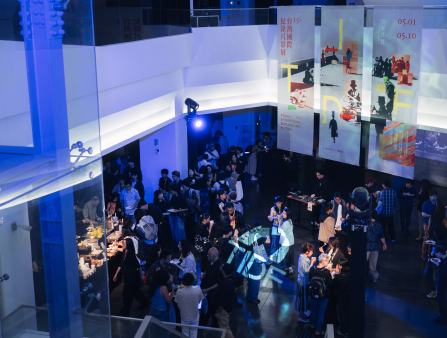
Closing night party.
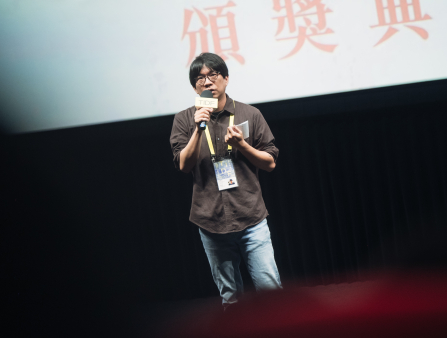
Wood Lin, the festival director, at the Opening Ceremony.
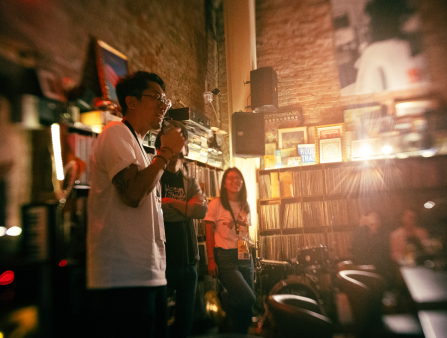
Meet the Festivals each evening at the festival bar.
Air Base, which had its Asian premiere at TIDF and screened as part of both Salute! And the Asian Vision Competition, exemplifies what the section protects. The first new work in a decade by Chinese independent filmmaker LI Luo (Li Wen at East Lake, 2015), it is replete with mockery against the futility of pandemic-related measures taken by the Chinese government. In 2023, Li invited his friends to his hometown, Wuhan, shortly after the restrictions were finally lifted, to stage eccentric and amusing scripted prompts. A man attempts to control the foot traffic on a pedestrian bridge and pretends to control the car traffic below; another man parks shared bicycles on the sidewalk in neat order and meticulously distributes fallen leaves in their baskets so that each one has an equal amount; yet another hammers nails into the beach sand, apparently in an effort to curb the waves of the river. The most amusing and recurring scene sees a broom stuck on a metro station escalator. Commuters all notice it and carefully navigate around it with near-reverence, but no one removes it.
Through an insertion of a vertical online video, Li draws a parallel between the Chinese public’s submission and Ina the bear, released into the wild after 20 years of captivity in a Romanian zoo, which kept walking in a small circle in an imaginary cage. The malaise and spiritual deadening of Chinese society during and after the pandemic, which lasted significantly longer than in other countries, are captured inventively through these repeated gestures. While these acts may seem somewhat on the nose toward the end, Air Base still offers a chance to reflect on and process the absurdity.
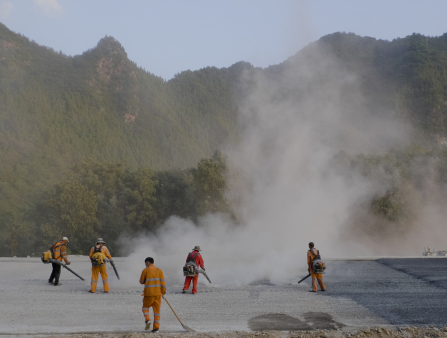
Another highlight of the festival that also came from Salute! was HU Sanshou’s Xiangzidian Village: The Stage, one of the rare world premieres at TIDF. Hu is a festival regular. All but one of his films have screened at TIDF, and his 2021 feature, The Burrows, won the top Asian Vision Competition prize in 2022. Since 2013, he has been a participant of the Folk Memory Project, an initiative started by the Chinese independent documentary trailblazer WU Wenguang and his Caochangdi Workstation to document stories from rural China. The Stage continues Hu’s sustained attention to his hometown, the titular Xiangzidian village, and the highway construction that would cut through it. Whereas his previous feature, Resurrection (2024), documented an exhumation process and interviewed villagers about their memories of the deceased, The Stage tells the life stories of and relationships between his family, friends, and neighbors via Hu’s voiceover, over long-take wide shots of rugged and rubbled landscape. The villagers’ anxiety that the town will soon be no more is palpable; one memorable shot juxtaposes gravel piles with a range of green mountains.
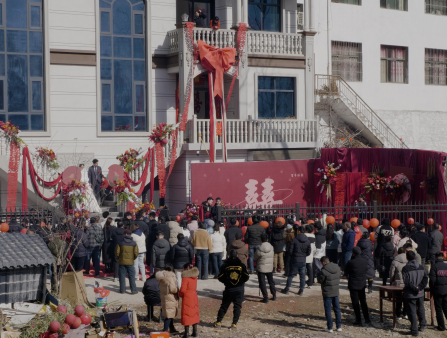
The film recalls WANG Bing’s Youth trilogy (partly because of the Chinese Spring Festival and wedding scenes), but Hu’s whispering vernacular narration evinces a more intimate understanding of and care for his village and community, the place and people with which he spent most of his life. The village’s life seems to revolve around the highway both metaphorically and literally, as the villagers turn its half-built foundation into a stage for walking, gossiping, and praying. Living up to the aims of the Folk Memory Project, the final scenes of The Stage show Hu screening a previous film for the villagers more than a decade on. His camera slowly pans across faces curiously watching their family and relatives on screen—some of whom, Hu shared during the Q&A, had passed away. Walking out, I imagined a future screening of The Stage in Xiangzidian that would give the next generation a chance to remember what once was.
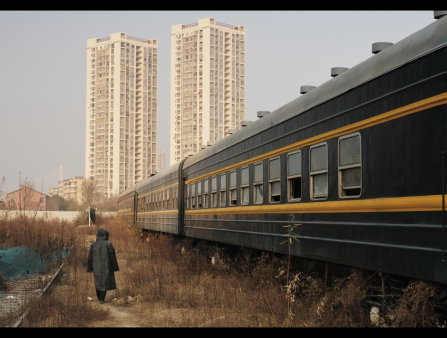
Air Base.
The Stage.
What stayed with me throughout and after TIDF, perhaps even more than the films, were the lecture performances and listening sessions. The former was given a special spotlight during this year’s edition: not only opening with Farouky’s performance but also featuring three others. The festival catalog describes these performances as “tak[ing] the act of documentation and the concept of the archive as points of departure.” One of them demonstrated, with some frustration, how far those points can be from the actual destination.
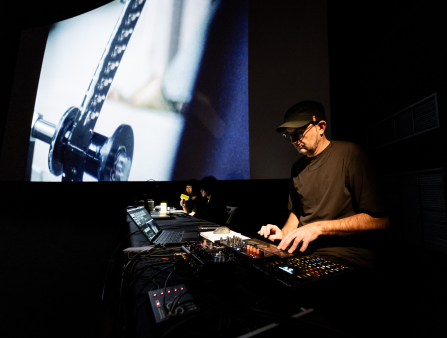
In Mountains of Time: A Collection of 1930s 16mm Reversal Film, Taiwanese filmmakers HUANG Pang-chuan and LIN Chunni (This Is Not a Film by Deng Nan-guang, 2023) trace how they bought eight rolls of unknown 16mm reversal film on a Japanese auction site in 2022, and then had them cleaned, ironed, scanned, and digitized at a lab in Japan, a process which they in turn shot on 16mm film. Once they were able to view the footage, which mostly showed Japanese university faculty and students hiking in Taiwan, Huang and Lin identified it as the 1930s work of CHIJIWA Suketarō, an architect and teacher at what is now the National Taipei University of Technology (NTUT). This entry point led them to NTUT’s archives, where they found class photos, newspapers, journals, and even private correspondence between some of the people who appear in the footage. All of these details are methodically explained by Huang and Lin, while stills and clips of the footage are shown on screen to the ambient live score by Taiwan-based filmmaker and sound artist Yannick Dauby. The lecture began, in fact, with a crash course on film that went on to introduce what light tables, sprocket holes, and gauges are and how the lighter and safer formats of 9.5 and 16mm films revolutionized and democratized filmmaking in the 1920s.
I kept waiting for a turn from the descriptive to the analytical—into broader topics implicated by the contemporaneous Japanese colonial domination of Taiwan, but the 80-minute session ended without that turn. Instead, the audience listened to which camera Chijiiwa used, and based on how much film cost back then, how he may have been financially comfortable. Speculation about the relationships between Chijiiwa and his colleagues and students extended no further than what the visual and textual documents could directly support. By the time the filmmakers presented a table cataloguing the eight rolls of film with their length and content, the session better resembled a report on found footage—gripped by archive fever—than a lecture performance that examines the social, historical, or political implications of what’s captured on the footage. In Mountains of Time, the archive becomes both the means and the end, leaving more questions than it answers.
The listening session Reality Through Sound?—consisting of a selection of sound works, mostly field recordings, cocurated by Dauby and sound designer and frequent SEL collaborator Ernst Karel—proved more generative as a lecture performance. Some of the recordings underlined how sound is impacted by its immediate surroundings, such as Toshiya Tsunoda’s muffled and understated Bottle at Park (1993), which is the result of placing a microphone in a glass bottle left at a park. Others were more straightforward, as in the case of a nine-minute audio excerpt from Hair, Paper, Water… (2025), TRUONG Minh Quý and Nicolas Graux’s ethnographic meditation on water and language that won the International Competition Grand Prize, or an audio of an unprocessed GoPro recording that accompanies the credits of the 2013 SEL film Leviathan (Karel designed the sounds of both films).
Mountains of Time.
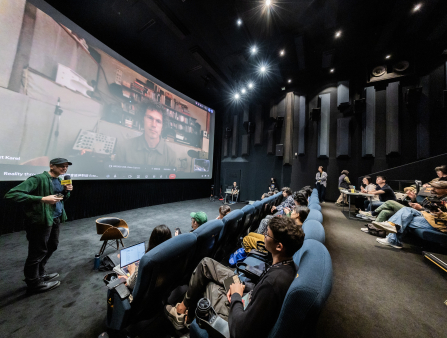
"Reality Through Sound."
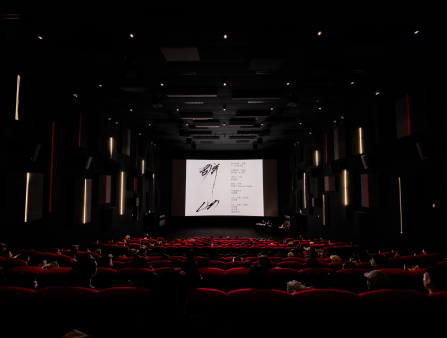
When I asked Karel whether a listening session needs to be held in a cinema, he answered that this program was designed as “a sound piece for the cinema” and that, given the standardized and reliable multichannel sound system, cinemas should be used more often for sound alone. The TFAI’s state-of-the-art cinema indeed justified that argument. But what intrigued me the most was what the session did to the screen. It was not turned off; each sound work was preceded by an intertitle with the artist’s name, title, length, and description. Once your eyes adjusted to the darkness, you could gradually see the rectangular grey shape of the projector running without projecting anything (a decision most likely practical than creative), drawing attention to the screen’s size, shape, limits, and absence of visuals. In certain evocative moments, such as during Yenting Hsu’s pristine recording of scratching and clinking glass discs, I couldn’t help producing what Dauby called “sound-image” in my mind and projecting it onto the empty screen.
The postsession’s extended dialogue between Dauby and Karel was as revelatory as listening to their curated works. Dauby proposed that the first tools of a documentary sound recordist should be a pen and a piece of paper—that listening should come before the extractive practice of “taking” sounds. He also proposed that interviews should be audiorecorded, not filmed, so they are less intrusive as well as easier to edit and refine for the audience later. As Karel put it, “We don’t need to see everything we hear.” In their curated session, the two sound designers also seemed to have decided that we don’t need to understand everything we hear. The recordings of an Atayal elder telling a story and a conversation via a VHF walkie-talkie between two individuals in different villages weren’t accompanied by subtitles. Although Dauby admitted that there were no subtitles simply because the session wasn’t prepared with an international audience in mind, the effect was the same as the stance taken in Stephanie Spray’s subtitle-less Untitled (2010), screened as part of the SEL retrospective: sound foregrounded over linguistic comprehension. Karel’s closing reminder that films can give an illusion of a more complete understanding of reality than sound works, which make their partiality obvious, leaves room for uncertainty and unknowing in a productive way.
A final note goes to An Chu’s Taiwan Competition entry Paper Houses and Horses (2025), which takes as its subject matter the mortuaries that hold funerals for deceased children whose bodies are kept for years in the absence of their parents. Chu creatively portrays these institutional funeral rites through a sudden surreal scene of the funeral home staff dancing and a 3D model environment populated with digital ghosts of dancing children. If most hybrid films try to seamlessly hide the staged parts, Chu’s short hides its nonfiction portion, which, as Chu himself admitted, consists only of the opening and closing observational shots of burning paper horses and kids playing with firecrackers on the street. Programmer CHUNG Pei-hua later pointed out to me that the film was previously shortlisted in and won the Special Jury Prize in the narrative short category at Taiwan’s Golden Harvest Awards.
TIDF welcomes “all films considered documentaries by [the] filmmakers,” and if the selection of Paper Houses and Horses seems to give the audience a moment to reflect on what constitutes a documentary film, the programming of the lecture performances and listening sessions also proudly reflects TIDF’s inquisitive spirit and commitment to “re-encountering reality” through different forms. That same spirit extends to the audience the festival has cultivated for nearly three decades—one willing, and equipped, to take its questions seriously.
This piece was first published in Documentary’s Summer 2026 issue.