POV, the longest-running showcase of independent documentaries on PBS, turns 35 this year. Its executive producer since May 2021, Erika Dilday, had her hand at the helm of this 35th season. She came to POV from Futuro Media Group, a multimedia journalistic nonprofit committed to telling overlooked stories, where she was CEO. Before that, she was executive director of Maysles Documentary Center. Here she talks about the current season of POV, what her father taught her about diversity, the logistics of scouting for films, and her upcoming keynote address at IDA’s Getting Real 2022 conference
Latest Posts
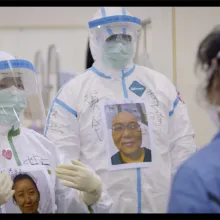
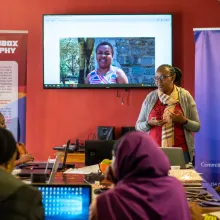
The year 2020 was a pivotal one for Kenyan documentaries—and for Docubox, the East African film fund created by Kenyan filmmaker and administrator Judy Kibinge in 2013. Christopher King and Maia Lekow’s The Letter, one of the recipients of Docubox’s inaugural development and production funding round, was Kenya’s pick for the Academy Award for Best International Film. Even though the film—a poignant investigation of elder abuse in a Kenyan rural community— was not shortlisted, it enjoyed considerable acclaim and was screened at several high-profile film festivals. Softie, another film that
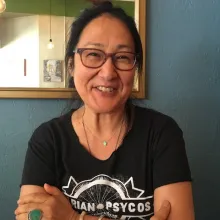
Rea Tajiri is an award-winning interdisciplinary artist and educator who creates installation, documentary and experimental films. Her work situates itself in poetic, non-traditional storytelling forms to encourage dialog and reflection around buried histories. Tajiri is a Sansei who grew up in Rogers Park, Chicago and Van Nuys, California. She earned her BFA and MFA degree from the California Institute of the Arts where she studied post-studio art. Upon graduation, Tajiri began working in video art, two early shorts were included in the Whitney Biennials of 1989 and 1991. One of these works
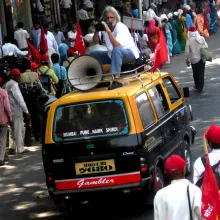
“For more than four decades,” his 2020 New York Times Magazine profile notes, Anand Patwardhan “has been India’s leading documentary filmmaker.” X-rays of Indian modernity, his frequently expressionistic films tug at the frayed edges of an unraveling nation to reveal the threads—of class inequity, casteism, masculinity, religious fundamentalism, and nationalism—that warp and weft through the fabric of what the ruling Bharatiya Janata Party calls the New India. Among other things, Patwardhan has documented a non-violent mass uprising in 1974 that led to the Emergency ( Waves of Revolution)

“Who is telling what story, from what perspective, using what form, through what gatekeepers?” This four-part question, posed by Chi-hui Yang of the Ford Foundation during his 2018 Keynote at the Getting Real conference, continues to influence how several film festivals approach their programming. It was especially taken to heart and elaborated upon by the Camden International Film Festival (running from September 15-18 in-person; September 15-25 online) team, and this year’s edition is perhaps strong evidence of how deeply they have integrated the questions into their process: The 2022 hybrid
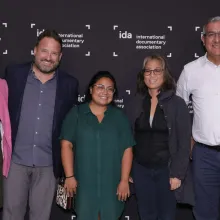
Dear Documentary Community, In 2014 I participated in a “Here’s What Really Happened” session at IDA’s first Getting Real Conference. I was invited by then IDA Executive Director Michael Lumpkin and former IDA Director of Education Ken Jacobson to share in a confidential setting what challenges producer Molly O’Brien and I had raising money and completing our feature documentary project Cesar’s Last Fast. The experience was cathartic. Molly and I could barely contain the frustrations we had experienced securing the support to complete the film—even after the film was invited to premiere in the

Telling the story of an artist is a daunting endeavor, one that, in the right hands, transcends chronology and testimonials from contemporaries and critics to center the life, work and interiority of the artist themselves. The creative process is so singular, arcane and mystical that it takes an equally bold artist to tackle their protagonist. The best documentaries that have accomplished this, in my opinion— Tupac Resurrection (Lauren Lazin), Judy Garland: By Myself (Susan Lacy), Listen to Me, Marlon (Stevan Riley), I Am Not Your Negro (Raoul Peck)—defer to the artists, who, in their words
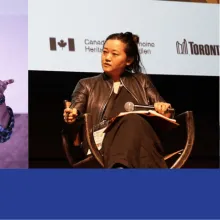
This year marks the fifth edition of Getting Real, IDA’s biennial conference, where documentary filmmakers and industry professionals will meet and dialogue in a hybrid gathering curated and programmed by Abby Sun, Conference Director and IDA’s Director of Artist Programs, as well as programmers Chris Boeckmann and Jonathan Ali. Through a digital platform, Getting Real ‘22 will enable a global audience to connect to the in-person Los Angeles gathering. The theme of this year’s conference, Flipping the Frame, reconsiders the traditional power dynamics in the documentary space. According to the
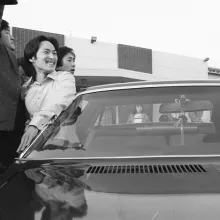
Essential Doc Reads is our curated selection of recent features and important news items about the documentary form and its processes, from around the internet, as well as from the Documentary magazine archive. We hope you enjoy! Hollywood productions of real people’s stories often miss the mark, but documentaries aim to balance this scale. Frank Shyong from the Los Angeles Times dives into the missteps of Hollywood’s portrayal of the story of Chol Soo Lee, a Korean-American wrongly convicted of murder, and how Eugne Yi and Julie Ha’s documentary Free Chol Soo Lee restores justice to Lee. Too
By GRACE LEE, Chris Pérez, Amir Shahkhalili AND Marcia Smith Dear IDA Community, We hope this note finds you well and enjoying the waning days of summer. It has been a busy few months but we wanted to give an update on some of the activities of the IDA board since our executive committee’s last newsletter. Like the organization itself, the IDA Board of Directors is in a transition period. The composition of the board has changed and board members are deepening their understanding of best practices in nonprofit governance. Co-chairs Grace Lee and Chris Perez, as well as ED Rick Pérez, have been