Essential Doc Reads is our curated selection of recent features and important news items about the documentary form and its processes, from around the internet, as well as from the Documentary magazine archive. We hope you enjoy! Variety’s Addie Morfoot speaks to American Experience Executive Producer Cameo George about the show’s new, 34th, season. "I have always thought of American Experience as the single most important history series in the doc world, and the chance to build on the incredible legacy of the series, freshen it up a bit, and open the door to a wider range of filmmakers and
Latest Posts

This past year, a respected colleague who had attended many industry events with executives from public television noted to me how, "They choose not to see you." That observation stuck with me as emblematic of what many have recounted to me, and unfortunately, what I too have experienced in my decades in the system. As recently as February 2020, as we were delivering our series Asian Americans, a promo editor who worked on many national PBS productions willfully refused my feedback notes, believing it was not necessary to listen to an Asian American executive (on a series about Asian American

Dear IDA Community, February 6, 2022 marked IDA’s 40th anniversary. In 1982, filmmakers-turned-psychotherapists Linda Buzzell and Larry Saltzman, among many other filmmakers and allies, identified the need to start an organization "...to encourage and to honor the documentary arts and sciences; to promote nonfiction film and video; to support the efforts of nonfiction film and video makers all over the world." While the original mission of IDA is fundamentally unchanged today, the documentary world itself has profoundly transformed since the organization’s founding. As IDA enters its fourth
Screen Time is your curated weekly guide to excellent documentaries and nonfiction programs that you can watch at home. Start your year with the magical Aretha Franklin performing songs from her best-selling gospel album. Alan Elliott and Sydney Pollack’s Amazing Grace unearths Franklin’s 1972 performance at Los Angeles’ New Temple Missionary Baptist Church, and resurrects it into this breathtaking documentary that leaves us glowing in the aftermagic of the vision that is Aretha Franklin. Watch the film on YouTube. Over at the Criterion Channel, you can now watch a fantastic curation of the

I find the term “gatekeeper” discomforting. I cringe every time it is mentioned in reference to someone in a position of power in our industry. Even though I prefer the term “decision maker,” that is just playing around with semantics. I am a gatekeeper and I struggle with it. In the past two years, people of color have risen to positions of power across our documentary field—from public media, to platforms and studios, to nonprofit organizations like IDA. It would be fair to deduce that certain events expedited our rise to these positions. The intersectional reckonings of the past year, and

Nearly three years after being deported following the world premiere of Alex Rivera and Cristina Ibarra’s The Infiltrators at Sundance, activist Claudio Rojas, who has a prominent role in the film, has been reunited with his family in South Florida. Rojas’ deportation had been decried as a clear act of retaliation for the criticisms he made against ICE in the film and members of documentary and immigrant rights communities have been organizing for his return ever since. Hundreds of members of the documentary film community signed letters to the Trump Administration in 2019, and again to the

One of the timeliest films of this past year—having premiered in the World Documentary Competition at Sundance 2021 (where it would go on to win the Special Jury Award for Cinema Vérité Filmmaking) mere weeks after the January 6th insurrection at the US Capitol—Camilla Nielsson’s President follows a 2018 campaign season filled with accusations of rampant voter fraud and a corrupt election commission, which ultimately culminates in an explosion of violence. Except in this particular case, the aforementioned nefariousness took place in the African country of Zimbabwe, where there is no “big lie”
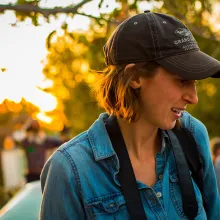
Allison Walsh is an independent documentary filmmaker, freelance videographer and fine artist, who is committed to political advocacy and documenting social issues in the Midwest. Walsh’s films have screened around the world, including Paris Art and Movie Awards, Festival Sayulita in Mexico, BSF in Barcelona, and Pride Film Fest, Femme Filmmakers Showcase in Chicago. Walsh is the founder and program director of the Big Picture Film Festival, an international film festival in Peoria, Illinois. She is a recipient of the Kartemquin Emerging Storytellers Fund, Illinois Arts Council Individual
This year’s International Documentary Film Festival Amsterdam (IDFA) was (once again) a hybrid affair. Which left me, like many nonfiction aficionados attending remotely from around the globe, feeling a bit conflicted. On the one hand, I really longed to return to covering in person—to see, say, Dziga Vertov’s newly restored “lost masterpiece” The History of the Civil War—screened only once before, exactly a century ago—at the grand Tuschinski (recently rechristened “Royal Theater”). Or to swing by De Brakke Grond for DocLab Live. (Though, to its credit, IDFA DocLab did provide a free online

In the crowded documentary field, short documentaries don’t always get the love they deserve. Our friends at Argo understand this well and have built a whole platform that celebrates and streams short films. We are excited to partner with Argo to highlight their latest playlist A Sense of Place, which includes four documentary shorts that were nominated for IDA Documentary Awards in previous years. IDA Members with a Doc Maker membership or higher get three months of complimentary exclusive access to Argo. To learn how to access your Argo benefit, visit here. Not an IDA Member? You can visit