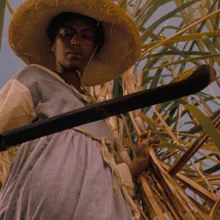
“Did the Ethiopians really defeat the white men at the Battle of Adwa, or was the victory simply boasting?” Haile Gerima asked his father as a young boy. Shouting war songs, and harnessing their traditional art of war skills—“shaking spears and swinging swords"—the Ethiopian patriots “tangled the enemy,” his father assured him. “Anytime an Italian bullet hit them they exclaimed, ‘What flea is this?’” Gerima recreates this exchange in his 1999 documentary on the First Italo-Ethiopian War, Adwa: An African Victory. Over time, Gerima came to understand the drama in the storytelling, the
Latest Posts

Meet the latest cohort of 10 films receiving production grants. The Enterprise Fund supports feature-length documentary films telling urgent, revelatory stories underpinned by rigorous journalistic approaches and exemplary artistic achievement.
In its ongoing mission to serve, empower and engage a diverse range of voices, perspectives and experiences from the documentary community, the International Documentary Association (IDA) is calling for applications for its Documentary Magazine Editorial Fellowship program Funded in part by grants from the National Endowment for the Arts (NEA) and the Hollywood Foreign Press Association, this fellowship is designed to enhance opportunities for writers from underserved and underrepresented communities to participate in the editorial planning process at and contribute content to Documentary

Between September and October 15, we celebrate the culture and contributions of the vast and diverse Hispanic communities that call the US their home, while honoring their stories. These stories of courage and grit in the face of struggle—and often disenfranchisement—give us a glimpse into what it means to be Hispanic and American. To celebrate this year, we’ve put together a list of Latinx documentaries that you can stream online. After Maria Directed by Afro-Latinx filmmaker Nadia Hallgren (director of Becoming, the Emmy-nominated doc about former First Lady Michelle Obama), After Maria

Dear Readers, Just as we thought it was safe to reflect on, process and move forward from the maelstrom that was 2020, the Delta variant—a faint whisper when I was assigning articles for this issue, now a thunderous roar as we go to press—is throttling our momentum, if not our resolve. Nonetheless, we persist, in a beyond-2020 world, applying the lessons we learned from the deep dive we all took—as a business, as a community and as an organization—to redefine our core values and reengage with a renewed vigor. Given the ingenuity that festivals, distributors and exhibitors exuded in reimagining

Dear Documentary Community, It has been about four months since I assumed the role of Executive Director of IDA. What excites me most about this position is the opportunity to help usher in a new era in the documentary field―a period committed to advocacy and equity, while continuing to embrace and celebrate all that we love about the form, the vast range of styles and perspectives, and its growing popularity with audiences around the world. For IDA, this means deepening the intent to further advance systemic change through all our programs. It informs how the grants team is currently

Though abolishing the police is still viewed as a fringe idea here in America, what happened to a Black female student in South Carolina is exhibit A for doing just that, in at least one public institution. Pulled from her desk and dragged across the floor by a white officer, the shocking act was immortalized in a viral video back in 2015. Which in turn sparked outrage, but also changed lives. And one life in particular—that of healer-activist Vivian Anderson, who subsequently left New York City for Columbia, South Carolina. And there she stayed, single-handedly taking on the Herculean task of

One of the most powerful, timeless documentaries I've ever seen is When We Were Kings (1996), directed by Leon Gast and produced by Taylor Hackford and David Sonenberg, about the 1974 heavyweight championship match between Muhammad Ali and George Foreman, held in the Democratic Republic of Congo (formerly Zaire). Since the documentary's release, several fiction films have been made on the same topic, but this is still the best film, across genres, that I've seen on the subject because it has something that the other films don't have: the real Muhammad Ali, up close and personal. What strikes
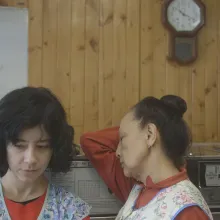
Screen Time is your curated weekly guide to excellent documentaries and nonfiction programs that you can watch at home. At IDA, we deeply mourn the passing of Melvin Van Peebles, the “the godfather of modern Black cinema.” Van Peebles was an actor, poet, artist, filmmaker and playwright, among other things. Celebrate his humbling legacy with filmmaker Joe Angio’s How to Eat Your Watermelon in White Company (and Enjoy It) on Amazon Prime. In Swimming Out Till the Sea Turns Blue, filmmaker Jia Zhangke speaks to three authors who, like Jia, all hail from China’s Shanxi province. Through their

International Podcast Day is just around the corner! With more and more people tuning in to podcasts every year—especially as COVID-19 has kept us all at home for perhaps longer than we’d hoped—many of us count on podcast storytelling to stay both informed and entertained while taking our much-needed screen breaks. For this year’s Docs to Listen, we’ve put together a list of podcasts telling true tales of the past that have captured listeners’ attention: Bangalore in Stories (PodMacha Studios) “Made in Bangalore, for the world.” From snakes on the dance floor, to the first Asian heavy metal