

On January 4, 2023, a collection of scientists in Utah published a bombshell study about the rapid collapse of the Great Salt Lake. Because of the cumulative and ongoing diversion of water for agriculture, they reported, the lake could go completely dry in five years. Moreover, left on the receding lakebed are dust and sand full of toxic metals, including arsenic and lead, which are kicked into the air by wind and cover the valley in a carcinogenic cloud until rain (in the increasingly dry region) can wash it away. As the dust clouds grow bigger and move further, they threaten 2.8 million people with what’s been described as “an environmental nuclear bomb.”
Abby Ellis’s first feature-length documentary (after spending years producing at VICE and PBS Frontline, where she directed 2019’s Flint’s Deadly Water and 2021’s Shots Fired), The Lake tracks the complex political effort to reverse the man-made catastrophe in the overwhelmingly conservative state of Utah. Instead of operating as a didactic environmental film, Ellis uses her camera to inhabit the subjectivity of the scientists and politicians who recognize the threat to their community and are trying to act to fix it. At first, the film is overcome by a familiar hopelessness, where even those trying to stop disaster spend much of their time in private, overcome by the despondency of watching bleak TV news and “doom scrolling” on social media.
But amid those conversations about collapse and increasingly bleak reports, Ellis finds inspiration in the sheer survival instinct of the people fighting an impossible political situation. Ellis’s film follows extremophile microbiologist Bonnie Baxter, who, as we learn, has sacrificed her own health to study the lake. Baxter was one of the public faces of the GSL report, along with Ben Abbott, an ecologist who we witness starting to take on an activist role in preserving the lake when political talks kept stalling. Abbott often emphasizes and even deepens his LDS faith by fighting to save the lake: “[God] brought us here to these valleys not to die and disappear,” he says. Stuck even further between a rock and a hard place is the Great Salt Lake commissioner, Brian Steed, who acts as the in-between of the scientists (whose findings he agrees with), the ag sector that resoundingly rejects calls to change their consumption, and the frustrating ambivalence of Gov. Cox, who slips into electable talking points when called to act. “We’ll all be accountable to God about how we use the water,” Abbott says.
As if to emphasize this existential turning point in Utah’s history, The Lake is playing as a part of the U.S. Documentary Competition at Sundance’s final outing in Park City. Documentary caught up with Ellis to talk about why she borrowed elements of the horror genre to craft her feature film debut, what makes her chosen subjects so compelling, and why the film is a reminder that the clock is ticking on these environmental crises. This interview has been edited.
DOCUMENTARY: You’ve done a lot of TV documentary work, including making films with PBS Frontline, but I want to know why you decided to develop The Lake as a feature.
ABBY ELLIS: I was at Frontline for about seven years. I loved the work that I was doing there, and I loved the journalism, but I was really eager to stretch my creative muscles and make something that’s a little bit more character-driven, a little bit more cinematic. Environmental films can be pretty dry. So I was hoping to do something different to lure an audience that might not tune in to a film focused on the environment.
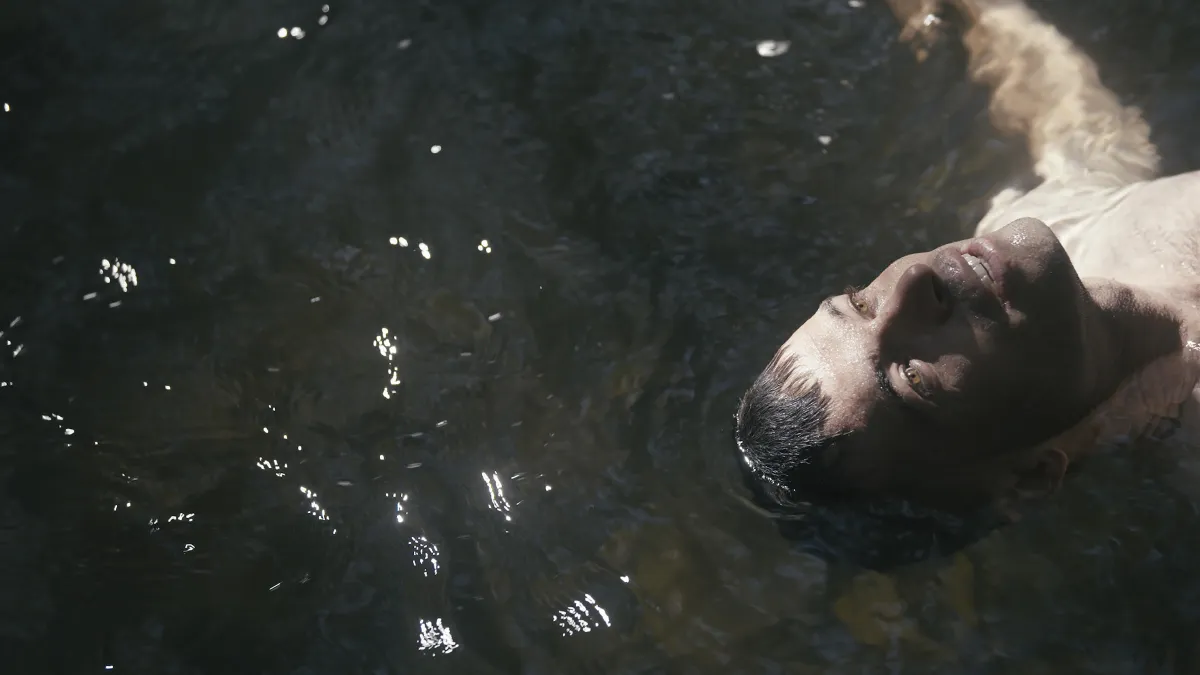
D: Oftentimes, the film moves like a thriller. You’re shooting your subjects backlit, and in a lot of the conversation sequences, it seems like they’re having their conversations with each other for the first time, shot in shot-reverse-shot. Were you staging those sequences at all?
AE: For the most part, those conversations were happening on their own. It’s a matter of being so incredibly on top of our characters, who they were talking to at the time, and what they were looking at, and what their schedules consisted of.
Environmental films can be pretty dry. So I was hoping to do something different to lure an audience that might not tune in to a film focused on the environment.
— Abby Ellis
D: How did you come to your specific subjects?
AE: One of our main characters, Bonnie Baxter, had been featured in all of the local press about the issue. She had been studying the lake for 27 years. She was the first person we reached out to. As time went on and the issue evolved, more people started coming to the forefront. The governor appointed the Great Salt Lake Commissioner [Brian Steed], and I thought, What better way to represent the government and the state than through a character appointed by the state? And then we chose to film Ben Abbott because he was doing more organizing around the issue. It was clear that he was communicating this issue in a way no one else had for a long time. We wanted each of them to fill a different role. So Ben, for example, was the voice of the people and the person we would relate to the most.
D: He is such an interesting character, and you often foreground how his Mormon faith is part of what’s driving him to save the Salt Lake, where someone like Gov. Cox uses that instead to eschew his own responsibility and say, “You can just pray it away.”
AE: I actually took that Gov. Cox comment about praying for water differently. I saw it more as, “This is how bad things are.” We’re in very desperate times, and this is a place full of people who pray and who really, actually believe in the power of prayer. So I think he said that on top of appointing Brian Steed to the commissioner’s office. But I like how there are a lot of people who exist within the LDS faith in the film, and some of their interpretations of that faith are a little different. What I really loved about Ben was that he walks a very tricky line as a scientist in a conservative state, and feels accountable to no one but God in terms of how we use our resources on this planet. That was a very useful tool for him to move forward on what was otherwise a very difficult situation.
D: There’s a point where somebody says, “People care less about saving the lake than they care about protecting their livelihoods.” But by the end of the film, people realize the lake is their livelihood, and they start moving out of the state, which prompts Cox to treat the issue as an immediate, serious problem.
AE: This is a classic issue in environmental crises. People often just think, “This is an environmental problem. We’re gonna have birds and species go extinct.” But at the end of the day, this is about survival. When it comes to our environment, it always affects everybody. In this process, it had to be about people convincing other stakeholders—whether it’s agriculture, government, development—that their lives are going to be impacted by this as well. By the end of the film, we start to see them turn the corner and convince people of that, which is something I hope we can do everywhere else in the country.
I don’t think it’s a horror film, but we leaned into the horror genre a little bit because crises of the environment are stories of horror.
— Abby Ellis
D: Things start to change, but Bonnie says it best at the end when she says, “People are waking up, but I hope we’re not too late.”
AE: The interesting thing is, there are about 120 terminal lakes around the world. Many of the ones that have begun to decline have prompted governments to promise restoration efforts, but as Ben Abbott points out in the film, none of those lakes have actually recovered. Saying we’re going to do it doesn’t necessarily mean that it’s done. So what I like about Bonnie bringing us back to earth a little bit is a reminder that the clock is ticking. We do not have time to waste.
D: Bonnie is so moving, too. By the end, her health is failing because she’s studying the lake so closely. She has to ask herself, “Is it worth sacrificing my health if we’re getting nowhere?”
AE: Exactly. And Ben says to her, “You are the sentinel in this. You are the canary in the coal mine.” And I think that’s true. Her health is doing okay, but it’s something she is going to need to monitor. She is someone who has been studying the lake for years, and now the lake is moving into our communities. We are all at risk for what she had been at risk of for the last 20 years.
D: The film has an apocalyptic tone to it, especially at the beginning when these scientists and politicians look at the news on their phones and just scroll. Even as they work to figure out what’s going wrong, there’s a passive terror because there’s nothing being done about it.
AE: I don’t think it’s a horror film, but we leaned into the horror genre a little bit because crises of the environment are stories of horror. We’re not seeing them in that light as often as I think we should. We’re talking about arsenic dust clouds enveloping a city of 2.8 million people. It’s horrifying. You would write an apocalyptic screenplay about that.
D: There’s the sequence where Ben gets the call that the dust cloud is heading to his house, and he has to bring his kids inside and lock all the windows.
AE: That really happened. The only thing missing from that scene is that this had never happened before—that the dust had gotten that far that time of year. WeWwe were really documenting it in real time as “the monster,” so to speak, got bigger and went further.
D: One of the big concessions that they win by the end is more monitoring, but that, of course, just confirms the problem. It doesn’t fix it.
AE: I think it’s pretty horrifying that they hadn’t been monitoring up until this point—you can’t just close your eyes. The arsenic is there. The lead is there. We don’t even know what else is in there. I’m excited that they got this money to install dust monitors, so we can better track these heavy metals. I think once they start monitoring, they will likely realize they are out of compliance.