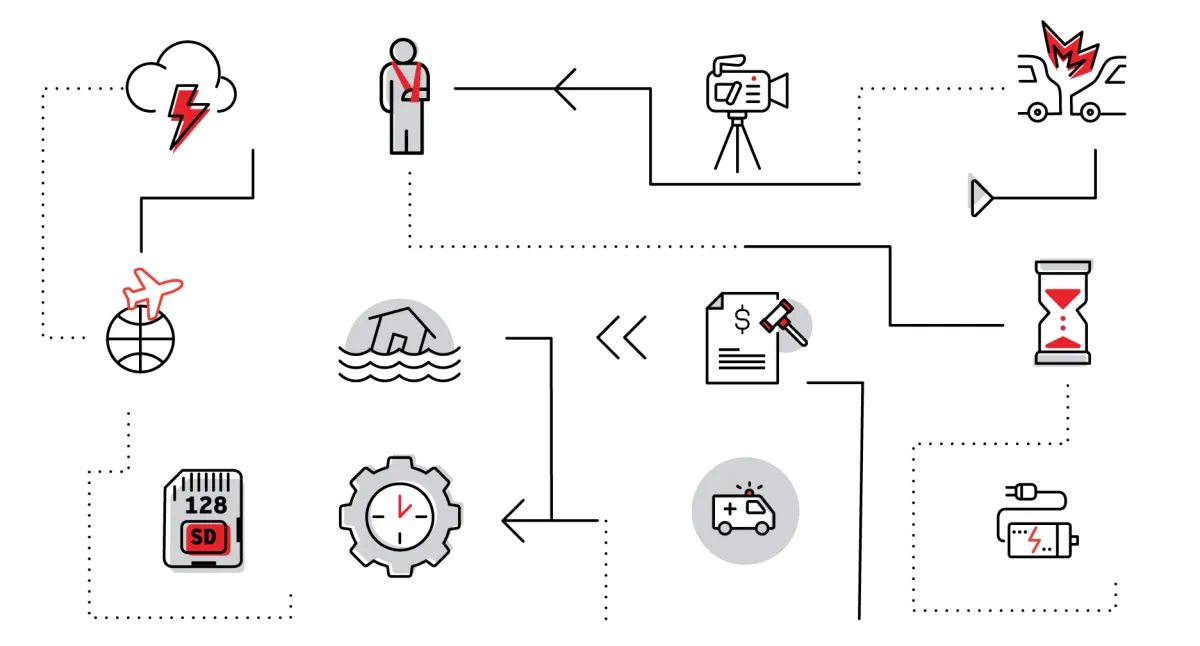



Film production is an exercise in controlled chaos. Schedules slip, equipment breaks, personnel fall ill, cars are damaged, locations are shut down, and sometimes, a single incident can eat through a material portion of the budget. Fortunately, production insurance exists to absorb those risks so that a creative project doesn’t collapse under the weight of an unforeseen event.
This primer focuses on the core insurance coverages most film and documentary productions encounter: DICE, General Liability, Automobile Liability, Umbrella Liability, and Workers’ Compensation. Together, these policies form the backbone of a standard production insurance portfolio.
DICE: The Heart of Production Insurance
DICE—short for documentary, industrial, commercial, and educational insurance—is the policy that protects the production itself. Unlike liability insurance, which protects against harm to others, DICE is primarily concerned with damage, delay, and disruption to the project. DICE provides coverage for a variety of events commonly experienced on a film or television production. Following are brief explanations.
Media Coverage
Media coverage reimburses a production for additional expenses caused by damage to original footage—whether that i negative film stock, digital media, or faulty processing. If footage is lost or corrupted and must be reshot, this portion of DICE helps cover the added cost.
Extra Expense Coverage
Extra Expense is designed to keep a production moving when something goes wrong. If delays occur due to damage to props, sets, wardrobe, production vehicles (e.g., trucks, vans, grip vehicles), picture vehicles (e.g., vehicles appearing on camera), miscellaneous equipment, or rented or leased premises or locations, then this coverage pays for the extra expenses incurred to stay on schedule. This coverage not only applies when physical damage to a property occurs but also extends to delays caused by the threat of such damage (think lightning, civil authority shutdowns, imminent peril, or non-industry-related strikes).
Property Coverage: What’s On Set
Fortunately, in addition to the delay coverage explained above, DICE also includes coverage for physical damage to the property used in the production itself. This encompasses many of the items discussed in the preceding section and extends to a third-party’s property in the production’s care. Importantly, loss of use is included under third-party property damage, meaning if someone else’s property becomes unusable because of the production, that loss may be covered. Notably, this coverage extends to equipment that is owned or controlled by production (e.g., cameras or computers) and would not cover any damage caused to an unaffiliated third party’s property—see the general liability provision below. Also, property owned by a third party that gets damaged due to production’s presence at a location is covered. This coverage is key, as many equipment rental agreements provide that the production is not only responsible for the cost of any physical damage to the equipment, but the damages that arise from the rental house’s loss of use as well.
Optional Essential Elements Coverage
Essential Elements Coverage can be added when a project depends heavily on specific individuals, locations, or other “essential elements” to a project’s creative. This coverage is particularly useful (and sometimes required by distributors) when a film is a biographical piece about a prominent individual. With this coverage, if on-screen talent, director, host, or other above-the-line personnel become ill, injured, or die, and production is delayed, interrupted, or abandoned as a result, this coverage reimburses the production for the additional expenses incurred. Similarly, if a key film location becomes unavailable due to a covered event, then production would be reimbursed for expenses incurred. Rates for this coverage are based on the number of personnel to be insured, Gross Production Cost (“GPC”), statements of health for the covered persons, and/or statements identifying location utilization.
General Liability: Protecting Against Harm to Others
General Liability insurance addresses third-party bodily injury and property damage—the most common requirement for locations, festivals, and distributors. With limits typically set at US$1M per occurrence/$2M aggregate, this coverage responds to such claims as slip-and-fall injuries on set, damage to property not owned or controlled by the production, and claims arising from contractual obligations to insure others.
General Liability also covers legal defense costs, settlements, and judgments. These costs can amount quickly, so it’s important to obtain policy limits that are tailored appropriately to the specific risks faced by a particular production. Fortunately, Umbrella Liability exists to increase policy limits, as discussed below.
Automobile Liability: When Vehicles Are Involved
Automobile Liability provides coverage for third-party bodily injury and property damage arising from the use of vehicles in the production, whether owned, rented, or hired. This policy typically carries a $1M limit and includes legal defense costs, property damage, and bodily injury claims, as well as settlements or judgments.
It’s important to note that physical damage to production vehicles is not covered here, but instead under DICE (Miscellaneous Equipment), if elected.
Umbrella Liability: Extra Protection When Limits Are Not Enough
Umbrella Liability increases the limits of underlying policies such as Commercial General Liability, Automobile Liability, Third-Party Property Damage, and Employers Liability.
Umbrella policies are available in tiers, commonly ranging from US$1M to US$5M, and are often required by studios, financiers, or international partners. They exist to protect the production from catastrophic losses that exceed primary policy limits.
Workers’ Compensation: Coverage for the Crew
Workers’ Compensation insurance is statutory, meaning it is required by law in all states except Texas. It provides coverage for employees who suffer work-related injuries or illnesses. Workers’ Compensation typically covers medical expenses, lost wages, or disability benefits. Unlike the other insurance policies, Workers’ Compensation is state regulated; as a result, the policies vary from state to state. Some state policies may include coverage for injuries incurred in a state different to the issuer, some may not. What most of the Workers’ Compensation policies will have in common, though, is exclusions for injuries incurred abroad. This is where foreign film packages will be needed.
Coverage and rates are regulated at the state level and are based on payroll amounts, job duties, and filming locations.
Additional Common Coverages
Guild Travel Accident
This policy covers accidental injury or sickness for cast and crew while traveling away from home, benefiting both union and nonunion members. For productions filming outside the United States, Out-of-Country Medical coverage can be added on a per-person, per-day basis.
Accidental Death & Dismemberment (“AD&D”)
AD&D provides benefits for accidental injury, illness, or death for individuals not covered under Workers’ Compensation, such as interviewees or local hires.
Foreign Filming Packages
For productions filming abroad, a foreign package may be required, typically including Foreign General Liability, Contingent Auto Liability, and Contingent or Primary Foreign Workers’ Compensation.
What Will It Cost?
Insurance premiums are largely based on GPC, with tiered pricing that generally decreases as a percentage of the budget while the overall budget amount increases. DICE and General Liability rates scale with GPC, while Auto Liability depends on vehicle costs, location, and state regulations. Workers’ Compensation remains payroll driven and state regulated.
Practical Considerations for Producers
Policies are typically written on 12-month terms, including preproduction. It is of particular importance that documentary productions pay mind to these policy terms to ensure no lapses in coverage, as such productions typically span multiple years. Coverage should ideally extend through delivery, as abandonment claims can arise in postproduction. Finally, while not all of the following are common items for documentaries, it is pertinent to note that hazardous activities, stunts, pyrotechnics, and the use of drones, watercraft, or aircraft must be declared in advance.
Claims Tips
Should a production development cause any of these policies to become applicable, they all follow a similar claims submission and determination process. Insurers will require notification of the claim as soon as reasonably practicable and thereafter commence an investigation. The insurer reviews the claim to confirm the cause, coverage applicability, and policy limits, and may request additional documentation throughout said process. If approved, the claim is paid subject to the policy terms, deductibles, and any applicable exclusions.
Although the involvement of production legal counsel isn’t mandatory, using counsel often expedites the claims timeline. Unfortunately, we’ve all heard too many horror stories about how long producers and filmmakers spent quibbling over an insurance claim that was ostensibly not controversial. This often occurs because of a misunderstanding in the policy language or in what was needed to support the claim. The aid of counsel instantly mitigates those pitfalls. More importantly, if counsel is communicating with the insurer’s claims representative directly, counsel will ensure that the insured’s interests and rights are fully comporting with the terms of the policy.
Final Thought
Film production insurance isn’t about disaster expectation—it’s about disaster preparation. These policies exist so that when something inevitably goes wrong, the project doesn’t end. Understanding what each coverage does allows producers to make informed decisions, protect their teams, and keep the story moving forward, even when reality intervenes.
IDA members are entitled to an exclusive production insurance program. For more information, please visit https://www.documentary.org/membership/insurance.
This piece was first published in Documentary’s Spring 2026 issue.