

What’s in My Bag is Documentary’s strand of photo spotlights of the setups that help create the stories of our times. For these pieces, we ask cinematographers in the field for essential tools of the trade and the accessories that help us do our best work.
When I’m shooting documentaries, producers often ask me, “Can you do it without an assistant? Can you complete the shoot alone?” I always firmly answer, “Absolutely not.” My assistant needs to carry my bag and assist me at all times. My camera bag weighs 25 jin (close to 30 pounds) and is filled with indispensable “treasures” for my filming.
I use a professional camera bag with an inward-opening design and double zippers on both the top and bottom, so the bag doesn’t need to be set down when accessing equipment.
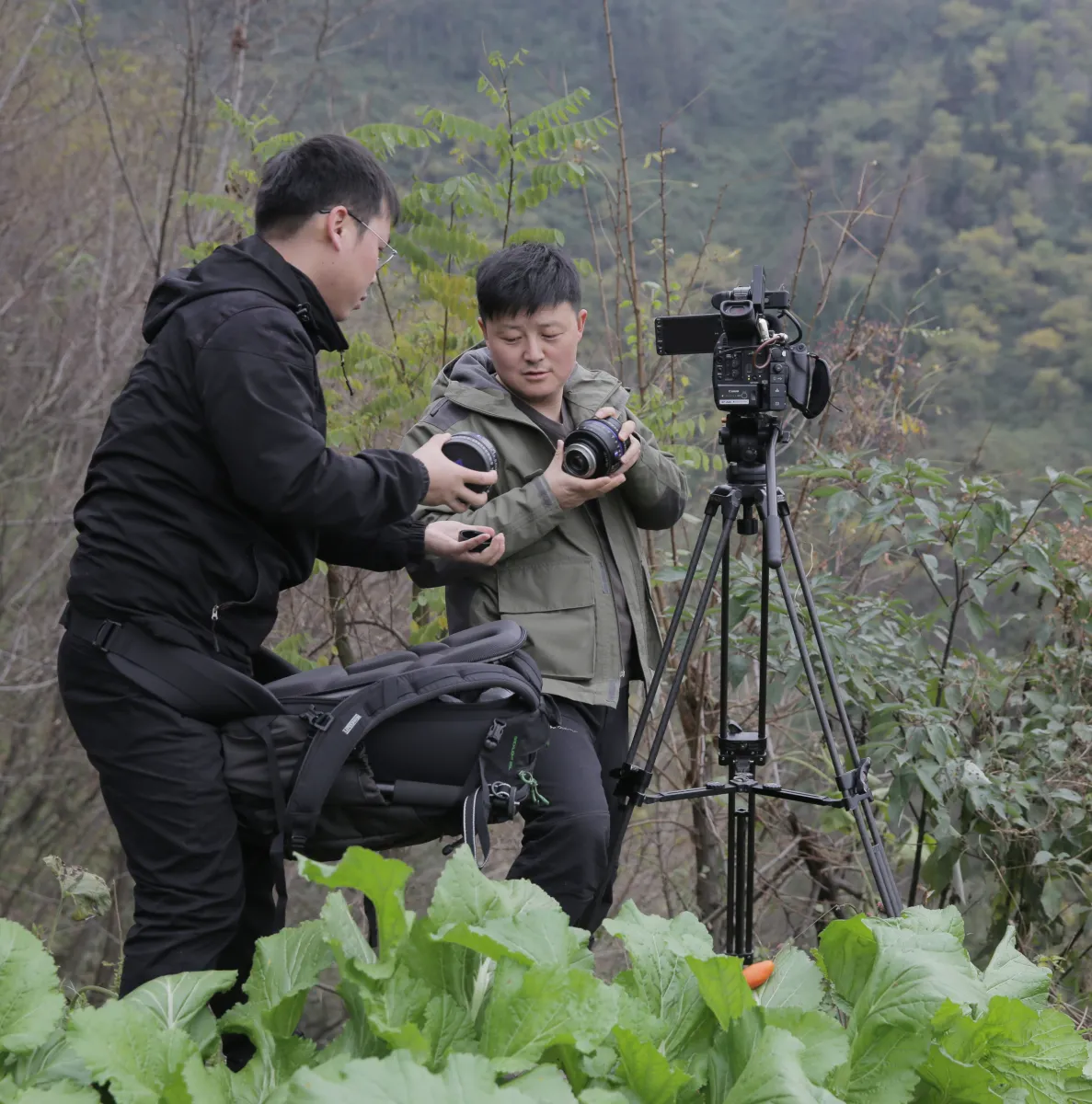
Back when I first started shooting, I could handle a full day on my own—just carrying my bag and a tripod. That was mainly because I was using all-in-one cameras, so there was no need to swap lenses or deal with extra accessories. But around 2010, when DSLRs started being used for video, I began experimenting with prime lenses for filming because I wanted the footage to feel more cinematic. I had four lenses at the time, and every time I needed to switch between them, I’d end up fumbling around—it usually took me about a minute. Sometimes, before I even managed to mount the lens, the subject would suddenly say something great, and I’d miss the moment. All I could do was shrug it off and feel frustrated with how slow I was.
That’s when I realized I really needed an assistant, someone who could help me swap lenses in under six seconds. That was the only way to keep things efficient and not miss those fleeting moments.
The upper part of my bag holds the camera, audio adapter, directional microphone, and wireless microphone. Full-frame mirrorless cameras are the ones I use most frequently. The lower section of the bag primarily contains my four most frequently used lenses, all of which have EF mounts and are fully manual focus, and can be adapted for use with cameras of different brands.
In addition, I carry monitoring headphones for real-time audio-level control during shoots. The bag also includes cable ties, electrical tape, commonly used adapter screws, screwdrivers, a multi-tool, and audiovisual adapters. My memory card case not only holds active working cards but also stores menu settings for different camera models and my commonly used custom shortcut configurations, enabling quick switching between setups for different shooting projects.
Moreover, I carry a high-power flashlight and a small LED flashlight, both with multiple lighting modes to meet different fill-light needs across various scenarios. I also carry a Leica rangefinder, which I use during shooting breaks to check my estimated distances and train my distance judgment over time. I always pull focus manually because I prefer better control over the image and don’t want to rely on autofocus. I find this helps me control the movement and arrangement of people within the frame. By shifting focus, I can guide the audience’s attention, directing the visual hierarchy. In this way, each of my shots gains a sense of flow and rhythm, while also giving me the feeling of becoming one with the camera. Because of this, I rely on a combination of visual distance estimation, focus ring markings, and LCD focus peaking to maintain precise control over focus. In addition, the rangefinder allows me to quickly communicate with subjects and assistants on set and precisely mark positions.
I remember one time I went with the director and the art department to scout a rehearsal space. The director felt the light coming through the windows was too strong and wanted the producer to buy a piece of black fabric to cover them. I took a quick look and casually gave them the length and width. They weren’t sure how accurate my eye was, so I pulled a rangefinder out of my bag and measured it right there. Turns out my estimate was off by only about an inch. That really changed how they saw me—suddenly, everyone was impressed and giving me a thumbs-up.
By shifting focus, I can guide the audience’s attention, directing the visual hierarchy. In this way, each of my shots gains a sense of flow and rhythm, while also giving me the feeling of becoming one with the camera.
I also like to turn the rangefinder into a bit of a game. During breaks, when we’re all sitting around a table eating, I’ll ask people to guess how far the kettle in the middle of the table is from their eyes. Whoever gets closest to the real distance doesn’t have to pay for the meal. After everyone makes their guess, I take out my rangefinder and give the exact answer. I’ve managed to get a few free meals out of that; can’t complain!
Lastly, I always keep an HDMI cable in my bag. At the end of each day, I immediately connect the camera to a monitor to review footage and discuss it with the director. Viewing the images on a large screen helps develop a cinematic sense—the visual impact of the same shot differs significantly between the camera’s small screen, a computer display, and a large monitor. A photographer must learn to anticipate how the image will look when enlarged, even when framing on a small screen.
I keep emergency supplies at the bottom of my bag, such as medicated oil (for bruises and insect bites), Band-aids, iodine disinfectant swabs, and alcohol wipes, as well as personal essentials including an umbrella, a sun hat, purified water, a neck gaiter, and eye drops.
In the side pocket of my bag, I carry a monopod. When collapsed, it measures just 40 cm (16") and can be securely attached to the side of the bag; when extended, it reaches 160 cm (5' 3"). Its lever-lock design allows for quick one-handed operation. During long dialogue scenes, it supports the camera and significantly reduces physical strain. Paired with a monopod base, it provides the stability needed for interviews. And compared to a bulky tripod, it is fast, lightweight, and flexible.
In exceptional circumstances, it can even serve as a self-defense tool. When shooting outdoors, we often have to climb rough mountain paths. That’s when I’ll take out my monopod as a hiking stick to help keep me from slipping. I remember one year we were filming in the mountains of Mêdog County in Tibet, and we ran into a venomous snake on the trail. Our guide immediately borrowed my monopod, lifted the snake off the path, and tossed it into the bushes. Only then did the crew feel safe enough to keep going.
That’s everything in my camera bag. This kit doesn’t just call for an assistant with the stamina to carry it; it demands a sharp, well-synced partner who can switch gear and coordinate in seconds. Only then can we race against time on documentary shoots, capture fleeting moments, and maximize the visual quality of the images.
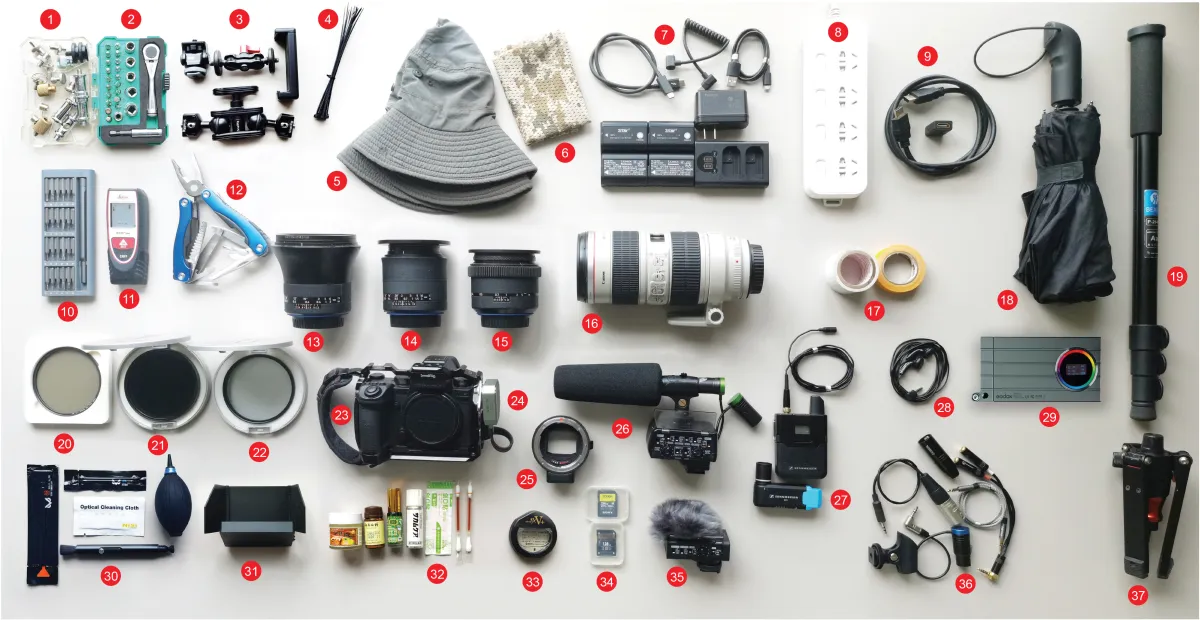
Annotated List:
1. Thread adapter
2. Ratchet and socket set
3. Magic Arm with a mounting bracket
4. Cable tie
5. Sun hat
6. Neck gaiter
7. Batteries and chargers
8. Power strip
9. HDMI cable
10. Precision screwdriver
11. Leica laser rangefinder
12. Multi-tool
13. Zeiss Milvus 21mm f/2.8
14. Zeiss Milvus 35mm f/2.0
15. Zeiss Milvus 50mm f/2.0
16. Canon EF 70-200mm f/2.8 L IS III USM
17. Gaffer tape and electrical tape
18. Umbrella
19. Monopod (BEXIN P264B)
20. CPL filter
21. NDX filter
22. 1/4 black mist filter
23. Panasonic LUMIX S5 IIX
24. SSD 1T
25. EF–L adapter
26. Panasonic DMW-XLR1 and microphone
27. Sennheiser AVX-MKE2
28. Headphones
29. LED light
30. Lens-cleaning tools
31. LED screen hood
32. First-aid kit
33. Eye drops
34. SD cards
35. Panasonic DMW-DMS1 directional digital audio microphone
36. Audio adapter cable
37. Monopod base
This piece was first published in Documentary’s Summer 2026 issue.