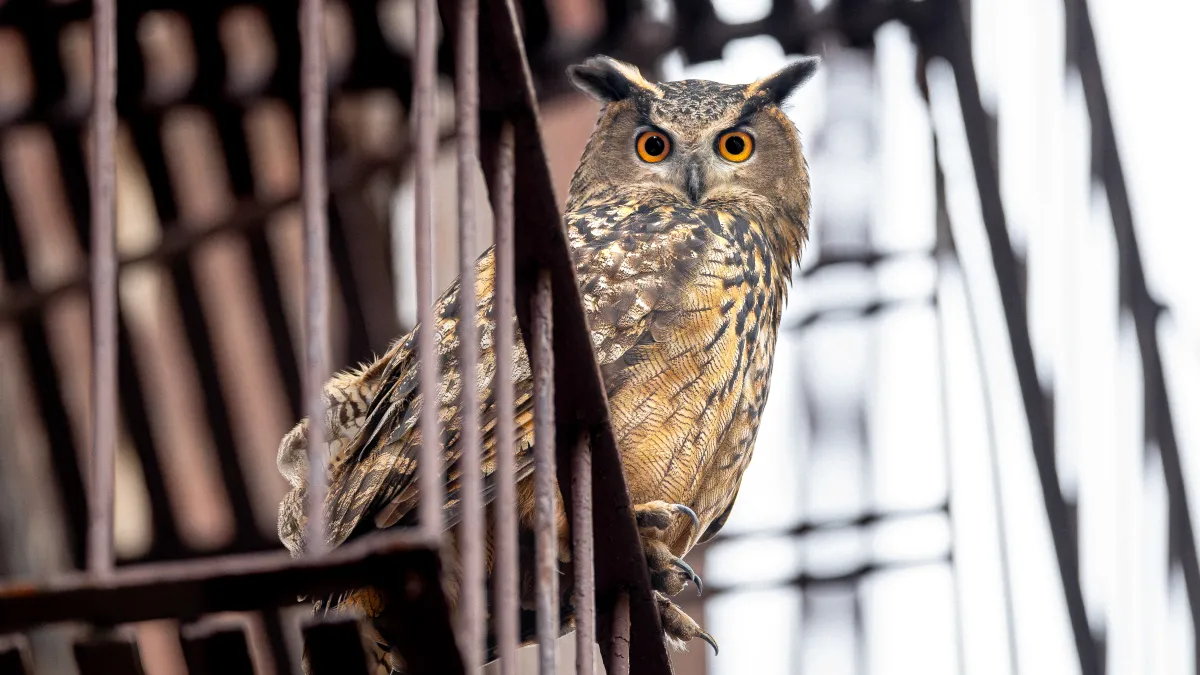


Flaco, a male Eurasian eagle-owl, became a New York City icon after he escaped from the Central Park Zoo in February 2023. Born and kept in captivity for thirteen years, Flaco quickly taught himself to fly and hunt and survived freely in the Big Apple. For just over a year, Flaco made a home in Central Park, perched on oak trees and fire escapes, flew from the Upper West Side to Lower East Side and drew birders, tourists, and the local residents alike to watch him—and to make art about him and the city they were falling for again. He died a year after his escape, after colliding with a building.
Wild Inside, director Penny Lane’s eighth feature film, documents Flaco’s journey and the debates Flaco’s story generated around wildlife conservation, animal welfare, and urban ecosystems. Featuring stunning footage sourced from a myriad of NYC birders as well as interviews with citizen scientists, wildlife experts, and New Yorkers who fell for the bird, the film holds the wonder of the Flaco frenzy in present tense while paying tribute to both him and other nonhuman lives that so frequently perish prematurely in a harsh urban setting.
Unusually, the HBO Documentary/Sandbox film world premiered at Central Park. The day after, I caught up with Penny over Zoom to further discuss birding, interspecies empathy, crowdsourcing most of the film’s footage, and the film’s unusual distribution strategies. After the splashy premiere, the film brought in over $19,000 in box office receipts during its robust IFC Center opening weekend. This interview has been edited for length and clarity.
DOCUMENTARY: You describe yourself as a longtime birder. Can you tell me more about that?
PENNY LANE: I became a birder in my late 20s, at least 20 years ago. It was a real moment. Any birder will describe this moment in similar ways. The writer Jonathan Franzen described it really beautifully in an interview, where he talked about how it’s one of the rare moments in your adult life where the world expands. You realize that your consciousness has been missing all this, and your world expands and it becomes more magical and more wild. And once it turns on, it doesn’t turn off.
D: The film does a great job of capturing this sense of wonder, of being with something that’s totally different from you.
PL: It’s not a mode that I’ve worked in much. It’s a good point.
D: How did you capture all those feelings—this sense of wonder, the obsessiveness, the thrill, and the concern?
PL: We crowdsourced so much of the Flaco footage. There are maybe five shots of Flaco in the movie that my crew got; the hundreds and hundreds of shots of Flaco were crowdsourced from everyone else. A big part of the production was reenactment. It was shooting the reverse angles, Flaco POV, establishing shots. A birder’s goal is always to get a good close-up portrait, and they don’t do a wide of the tree or the park, and they don’t turn the camera around on themselves. So we used movie magic to create the feeling that we were there with our cameras every day, and that you were there with Flaco every day.
The film takes place over a full calendar year, and we wanted the seasons passing to be really present and important and feel alive to the moment. There’s no locked down tripod shots. Everything is handheld, in movement. We’re on the run with the birders. We’re watching them watch Flaco watch us. And I tried to put [other] critters in to bring the feeling of all the other inhabitants of New York in as much as possible.
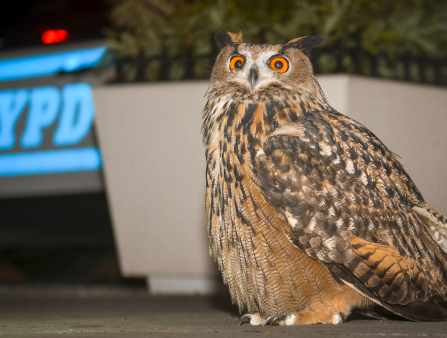
Photo credit: Benny Polatseck
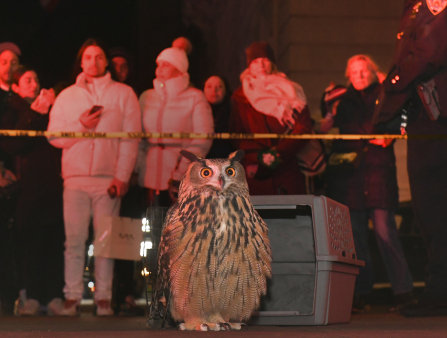
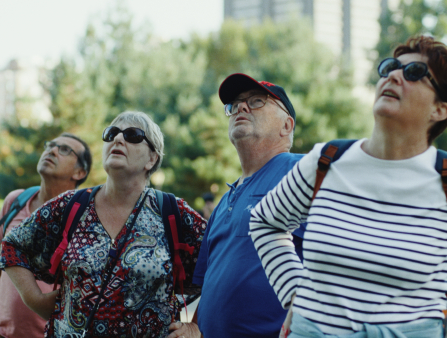
D: I love the opening scene with on-the-ground, low-angle shots from Flaco’s POV looking up at humans on the streets.
PL: That was hugely important. So much of the film is about trying to use our empathetic imagination, which is something that the human animal has. We have the ability to try to imagine what it’s like to be someone else, and that’s how we have a civilization. Extending that to nonhuman animals—without hitting anyone over the head with it, putting the viewer inside his point of view whenever we could—felt like an important intervention into the story.
D: Can you share more about the crowdsourcing? What was it like working with a living and still-growing archive?
PL: It was amazing. I knew from the very beginning this would be a crowdsourced film because I knew that we probably wouldn’t get that much footage ourselves. Nature photography takes so much dedication and time.
So we did tons and tons and tons of producing for this. We made a crowdsourcing website and did a round of local press. I went on WNYC and a local AM station, and I pitched the public to share their Flaco media and stories. We found characters and media that way. We also did street flyers, walking the streets where he’d been seen,handing flyers to people at coffee shops, putting things up in windows. We found incredible people from the street outreach, people we never would have found if all we’d done was media and the website.
D: The end credits list an unusual number of production assistants for a documentary. Can you help explain why this doc needed so many?
PL: My producer Gabriel Sedgwick would have a better answer, but we did tons of shoots and had a lot of on-the-ground needs. We were shooting in Central Park late at night, and frankly, we sometimes needed PAs to walk our expert interviewees in and out of the park at 11 p.m. It really was the most complicated producing project we’ve ever had, no question.
[GABRIEL SEGDWICK (via email): A lot of our shoots were quite logistically complicated: we sometimes had multiple camera crews filming in different locations in Central Park at the same time, for instance, which required significant production team manpower to ensure coordination and smooth flow. We also received a tremendous amount of footage that we had not filmed ourselves, such as the birders’ own materials, which needed to be catalogued and processed in our office. So we needed significant manpower to help with both filming and non-filming tasks throughout the entire duration of making the film, which lasted approximately 2.5 years.]
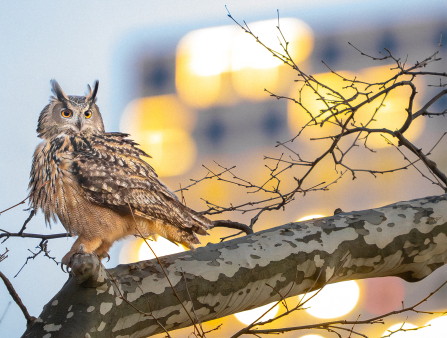
Photo credit: David Lei.
D: You mentioned last night that when Flaco left the park for the Lower East Side, the project was briefly derailed. Were there other moments when your expectations changed? What about Flaco’s death?
PL: I know enough about the birding scene to be like, “That’s going to be the most documented owl in human history, and there will be people that will be following him day in, day out.” When we pitched the project, I knew he was going to die. I pitched the project as I want to film him until he dies. That was the proposal we made to HBO, who came on first with development money; we brought in Sandbox later. I know that’s how hawks, eagles, and owls die in New York—rat poison or get hit by a car. So I said, “We might be filming this over the next 10 years. We might be filming this over the next 10 weeks. We don’t really know.”
Selfishly, the year was so great for narrative reasons. I’m also happy he got a year—a lot more than I ever thought he would. But none of us thought he was going to die when we were out filming on the Upper West Side on the one-year anniversary of his freedom. None of us were prepared when it happened. I thought maybe we’d see him get sick. He just died so suddenly.
Then we had to hustle because I had pitched this project that might take 10 years to shoot, but now we had the ending, so it changed the production timeline. We went into a higher gear and finished a lot sooner than we thought we might.
D: You mentioned Flaco’s law last night. Was there any expectation while you were wrapping up or during production of the project about its impact?
PL: Flaco’s law happened pretty late in the post production. What I saw was how Flacco turned on a million zillion people who were not birders, and made them interested in birds, in native ecosystems, in urban wildlife. Some people at the screening last night had no idea that there’s coyotes in Central Park! That’s what I felt the impact was. It’s really only over time that I’ve started to realize that Flaco’s law—or laws, because there’s three of them; one got passed, two more they’re trying to pass—is maybe going to be the most lasting impact. Depending on what happens, because it’s just a pilot program [for now].
D: Nowhere seems more fitting for the world premiere than Central Park. Did you have this idea from the beginning?
PL: We definitely talked about it from the beginning and daydreamed about it, but I didn’t think it was going to happen. None of us did. It was like, that’s a cool idea. Getting the local councilwoman, Gale Brewer, on board helped us get it over the line with the Central Park Conservancy because she sponsored it, and that’s her district.
This isn’t a movie I made for film festival audiences. This is a movie I made for the public
—Penny Lane
D: It seems such a special and unusual screening. It’s public…
PL: I hope that’s true. It was very special for us. We’re putting the movie in theaters, so it’s a bit of a gamble that this kind of word-of-mouth event screening could help launch the film in a way that would get people talking about it as it’s rolling out into theaters. So far, it’s worked. It’s opening at IFC tomorrow, which is not that far from Central Park, and I was like, “Are we boning our like opening weekend? Is anyone gonna go?” It felt a little risky to give away 1500 free tickets when we’re trying to pack that theater. But we’ve already sold out the first two of the four Q&A screenings for the weekend.
This isn’t a movie I made for film festival audiences. This is a movie I made for the public, and I think it has a lot of commercial potential. I could have spent the whole spring saying, “I’m playing a handful of film festivals in random places,” but I just wanted to try something different.
D: What other distribution strategies are you planning?
PL: We have an incredible outreach team. Every time we book a theater, they look for birding groups, conservation groups, and wildlife rescue groups in that community, and we ask them to sponsor the screening—which is not a financial thing. We ask them to give a five-minute introduction to the movie that describes their organization, what they do, and how people can get involved with either looking for birds in the wild, or wildlife rescue, or conservation, or protecting urban wildlife, whatever makes the most sense in that community. And we ask them to post about the event, send it to their own email list. The movie hasn’t opened yet, but so far it seemed to have really good results.
D: Has writing on Substack for the past year shaped your thinking on audience engagement and film distribution?
PL: A little bit. It’s definitely made me more bullish on content creation in general and that people don’t just come to you, no matter who you are. Even if you have a long career—I’ve made eight feature films over 15 years—there are still people who are fans of mine that don’t know that I have a new movie out. You cannot ever take it for granted. Every year the information ecosystem gets more and more and more noisy, and more and more and more competitive; we’re all competing with TikTok and video games and you name it. So I’m trying to make sure that I’m consistently sending out signals in all that noise. It’s like SETI: “Hello, is anyone out there?”
Substack is so great because they give you so much data, and you have this direct relationship to [readers] that’s really intimate. I’ve put tons and tons of effort into all my social media content for the last year, really paying attention to what works, what brings people in, and what keeps them. Whatever embarrassment I ever felt about that has just got to go. We’re all trying to find people to pay attention to the work we do, and if we care about the work we do as documentary filmmakers and want our messages to reach people so that we can change the world, we can’t afford to be snobs.
Editor’s Note August 6, 2026: Lane’s quote on film festivals has been updated.