

It was halfway through the four-day Independent Film Exhibition Conference (IND/EX), when I underlined the word of the year in my notebook: eventize.
In the venue’s largest hall, during a “candid conversation” between two pioneering creatives, former Director of Sundance Film Festival, Tabitha Jackson, and former president of the Brooklyn Academy of Music, Gina Duncan, the topic inevitably came up during a lengthy diagnosis of the needs of modern audiences. Newly named director of New York’s Film Forum, Jackson relayed an essential promise of the famed venue: “The forum is a big part of Film Forum.” This was an institution devoted to “creating a space for real conversation” and memorable experiences. And how, collectively, might we do that? “Eventize, eventize, eventize.”
Presented by Art House Convergence and Film Festival Alliance since 2024, IND/EX is the largest biennial assemblage of film festival organizers, art-house cinema leaders, indie exhibitors, distributors, and yes, even a number of filmmakers. As the IND/EX conference has now been sunsetted, as recently announced by the two organizations, the 2026 edition seemed buoyed by a welcome sense of optimism about the state of US theatrical exhibition. Spread over 9 floors at Venue Six10 in downtown Chicago, the conference went deep into the issues at the heart of independent exhibition—film curation, audience development, ethics, and what drives the work.
The conference is organized by industry veterans representing organizations large and small from every corner of the country, and offers both expansive conversations like that between Jackson and Duncan, as well as a full slate of panels ranging from the practical “The Art of Facilitation,” to the high-minded “Which Should Lead: The Numbers or the Vision?”, to the just-plain-fun “Let’s Make Movie Merch!” There was the usual endless coffee and bubbly water, the beloved “Trailer Wars” pitting in-house custom content in a live winner-take-all tournament at a local bar, the annual survey results of “Art House Audience Trends,” and the usual distributor presentations from major indie players like MUBI, Neon, GKids, Sony Pictures Classics and a special screening of Sorry to Bother You with director (and Art House Theater Day ambassador) Boots Riley holding court.
Art House Convergence began in 2008 as an annual conference, held in the Utah mountains the week before the Sundance Film Festival (and forged by Sundance Institute’s Art House Project). Like Sundance, the gathering eventually left Utah, but the conference still exists in the years between the larger IND/EX events. These days, the independent non-profit organization—with approximately 2,000 members across North America and Western Europe—serves as a year-round advocacy organization for indie exhibitors.
I’ve been attending the Art House Convergence gatherings for eleven years. First, as a wide-eyed note-scribbler easily awed by the golden sparkle of the smallest bits of insight, now as a hardened prospector in search of the rarest gems of knowledge, but always grateful for the community conversations that reinforce the work and confirm our collective purpose.
This year felt different than any previous post-pandemic year. There were plenty of challenges shared by the programmers, executive directors, and arts workers gathered together to learn, connect, and let loose. Yet the mood was distinctly positive. The existential anxiety of a public health crisis, work stoppages, and the threat of couch-bound streamers had waned enough to open headspace for conversations like “Which Should Lead: The Money or the Vision?”
That panel discussion featured four art house leaders: Cara Ogburn, artistic director of Milwaukee Film; Emelyn Stuart, owner of the Stuart Cinema Cafe; Jamie Webb, development manager at Full Frame Documentary Film Festival; and Lani Simeona, operations and programs supervisor at The Cary Theater (the panel was moderated by Justice Obiaya). Their conversation ping-ponged through the eternal challenge of mission-driven work: How do we prioritize challenging art, audience accessibility, and nurturing new voices while being faithful financial stewards in an industry where money is always tight? Programmatic balance, for one, they suggested. As art houses become critical third spaces, leaders argued that playing big films for local audiences was part of the mission and an important part of building the financial cushion to take other risks. Likewise, they pushed back against the idea that playing classic repertory hits was lazy programming. In their eyes, this was effective audience recruitment. “Know the bangers that work,” in the words of Cara Ogburn, Artistic Director of Milwaukee Film; get new faces through the doors with recognizable films and then introduce them to more challenging work.
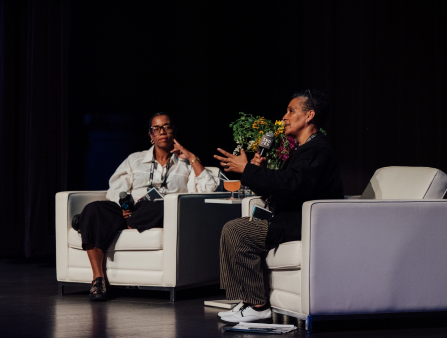
(L to R) Gina Duncan and Tabitha Jackson in conversation at IND/EX 2026
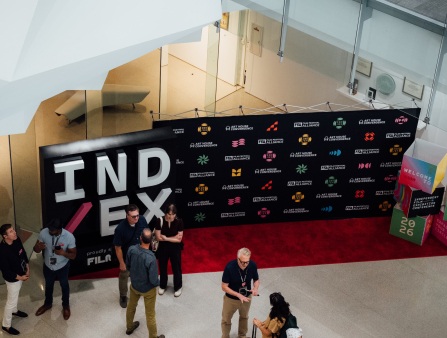
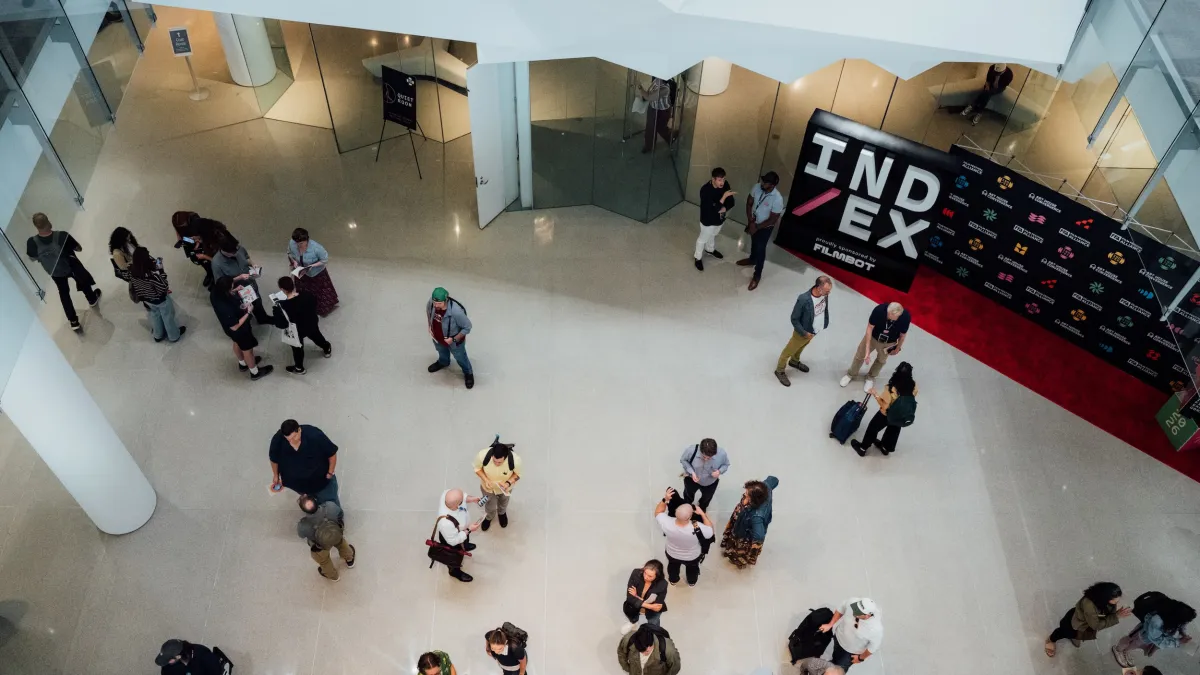
Attendees at this year’s IND/EX conference.
Good box office returns seemed to be underlying much of this tone-shift as plenty of indie exhibitors and festivals were seeing numbers comparable with the pre-pandemic before times. More than one boasted record attendance during the previous year. But this shift wasn’t guided solely by playing bigger titles—it was driven, in part, by the very thing Jackson and Duncan talked about: no matter where I went, I couldn’t escape the sense that everyone was talking about spending endless time and energy into “eventizing” their programming.
As both a documentary film producer and nonprofit cinema director, I know exactly what they meant. To “eventize” a screening has become common verbiage for acknowledging the value of post-screening dialogues, committed buy-in from community partners, and FOMO-driven crowds. I’ve dropped the word plenty of times myself, often to mean vastly different things.
One thing is clear: Event cinema isn’t a new phenomenon. But it seems the verb-ing of the word is—you won’t find eventize in the dictionary. The noun, of course, comes from the Latin “eventus,” meaning “occurrence, accident, event, fortune, fate, lot, issue.” More helpfully: “The consequence of anything.”
That feels appropriate to the current state of documentary exhibition in particular, where connecting the dots backward from wide-ranging results can often feel like a fool’s errand. Everything from hard work, good (or even bad) luck, happenstance, persistence—or outright fate—results in outcomes ranging from sold-out screenings mid-week, paltry sales despite a big-name draw, to middling returns on a surefire hit. It’s hard to know what is ever working. Our fortunes are the consequence of anything, or perhaps everything.
The IND/EX attendees, like documentary filmmakers, know first-hand the feeling of organizing a great event, as well as the exhaustion of rebuilding the wheel over and over again. This desire to find a replicable model for singular successes was the center of many of the conversations at the conference.
Here are some of my non-exhaustive takeaways from my time at IND/EX, gathered from stimulating panels, mostly business meet-ups, bleary-eyed conversations in the coffee line, and hasty reunions over evening drinks.
To ‘eventize’ a screening has become common verbiage for acknowledging the value of post-screening dialogues, committed buy-in from community partners, and FOMO-driven crowds.
1. Audiences Are Growing
On the opening day, the Art House Convergence set the stage by sharing performance results and takeaways from the most recent National Audience Survey, in partnership with Avenue ISR. Box office revenue was up 9% at participating indie theaters in 2025 compared with the prior year. New audiences at these theaters were hyped as driving some of that growth, with 25% of these new patrons saying they first started attending their preferred theater in the last three years, and the average new respondent was 40 years old—11 years younger than the average arthouse moviegoing patron. Across all respondents, 73% agree that the theater “creates a forum for important community conversations,” which is good news for doc makers. But there’s bad news in the data too: patrons 40 and younger were more likely than their older peers to be interested in all 14 surveyed “genres” except one: documentary.
2. Youth-Centered Hope Springs Eternal
Those young audiences were a hot topic. In a discussion titled “Vibe Check: Harnessing the Power of Gen-Z,” a group of IND/EX volunteers including Charlotte Hensley, Jessica Dortch, and Josh Peterson (all former CineYouth interns at Chicago International Film Festival) held court about the motivations of these new audiences, offering firsthand experience that went beyond the statistics and numbers that so often define them. An overriding interest was a rejection of an overly digitized world. Film prints, shared gasps and laughs in theaters, even small things like punch cards and mementos from screenings, were singled out as key draws for attending in-person screenings. One thing that could help doc filmmakers reach this audience? They respond to word-of-mouth from Letterboxd friends and Instagram Reels, as well as to printed fliers posted in their neighborhoods—things that register as honest, authentic markers of interest from their communities.
3. Self-Distribution Is Gaining Traction
At “Meet the Distributors?” distributors from Sony Pictures Classics to Greenwich Entertainment manned tables to pitch their films to the circulating programmers. It certainly seemed like fewer documentaries were represented by the established players than I remembered in years past. Perhaps with this in mind, IND/EX also embraced eventizing to present a special one-of-a-kind pop-up event (with great snacks and direct human-to-human networking potential!) called “The Booking Fair,” a joint initiative with Kinema, the tech company looking to facilitate filmmaker-led distribution. The event aimed to boost the profile of 10 film teams (5 documentary and 5 narrative) working without a traditional distributor by putting them in a room with dozens of programming decision-makers. Vibes seemed good, with cheerful film teams giving rapid-fire pitches to circulating programmers, who cautiously expressed a desire to support these projects if they could.
It wasn’t all traditional distributors at the aforementioned “Meet the Distributors.” Fiction filmmakers like Fucktoys’ Annapurna Sriram and theatrical bookers like Jessica Rosner (Hundreds of Beavers) were also in the room for the second year in a row, still pushing their films for theatrical play, a sign that demand was still strong. Yes, these two films are natural crowd-pleasers, but they did an incredible job of taking the work seriously without taking themselves too seriously. Not everyone can lean into costumed beavers at screenings or tongue-in-cheek sex-positive marketing, but everyone can build genuine relationships with their intended audience. The film teams made themselves available to audiences and created real-world and online communities around their films, all of which extended the theatrical life of their films.
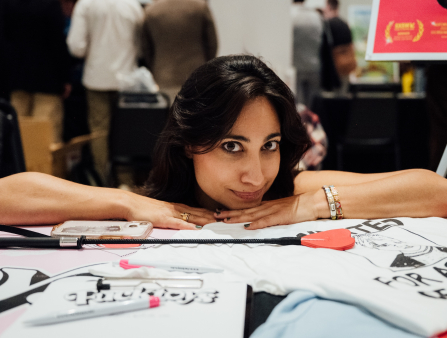
Filmmaker Annapurna Sriram poses in front of Fucktoys’ branded swag.
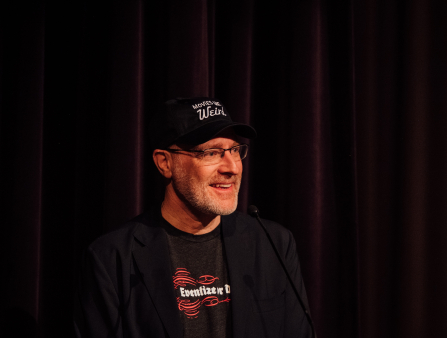
Eventive’s Iddo Patt wears an “Eventize or Die” t-shirt during an IND/EX panel.
4. Supporting Artists Is a Work in Progress
In a session exploring “The Ethics of Exhibition” (inspired by the FIAPF Code of Ethics), director of Indiana University Cinema, Dr. Alicia Kozma and her colleague Seth Mutchler, assistant director of Cinema Technology at Indiana University Cinema, went deep to discuss the guiding principles of the exhibition industry. Much of the conversation focused on how to curate challenging cinema while remaining accessible and responsive to local communities. This delicate balance of comforting and provoking audiences being one of the hallmarks of good programming. When the conversation pivoted to labor issues, one participant reminded the assembled group that filmmakers needed to be cared for, too, to ensure they are financially and emotionally rewarded during the laborious phase of releasing their films. As the conversation continued, the group expressed both a true desire and a real financial challenge for exhibitor support of filmmaker appearances. The many heads nodding all around me suggested this was a nearly universal concern.
5. Showing Up (Still) Matters
There was no shortage of references to the value of in-person appearances by filmmakers and passionate advocates. Anecdotally, festival programmers seemed to believe documentaries were still strong programming and their audiences were responding. But unsurprisingly, having a guest to foster deeper engagement with the film was a major driver of attendance. There are clearly financial challenges within this model, but the results seemed consistent. One way to extend the film team’s reach without stretching travel expenses and capacity? Activating proxy guests. Veteran booking agent Michael Tuckman was repping Penny Lane’s Wild Inside and had built a list of “verified Flaco fans,” influencers around the country with an affinity to the film’s star, Flaco the Owl, who were willing to show up in support of the film. Results to be determined as the film releases in August, but it sounds like a smart tactic that could be a replicable model: deputize enthusiasts to serve as a voice for the film.
6. We Remain Wedded to an Attention Economy
There were fond memories of the days when docs were most often booked as standard new releases: week-long runs with consistent audiences backed by marketing budgets and a place in the cultural discourse. That is, alas, no longer the norm. When asked what is working these days, programmers said yet again that filmmakers should be flexible,ready to partner, and yes, you guessed it, open to eventizing their release. But programmers expressed a real desire to help documentaries find their audiences. As Lani Simeona, Programmer at the Cary Theatre, mused about her own approach, “Is this bad? Is this good? It’s all subjective. Do we have an audience? Does someone need to see this?” Theaters wanted to do their part by putting their own resources behind the effort, and many were experimenting with new programming initiatives. One example: Milwaukee Film’s still-new Dialogues Documentary Festival is entering its third year as a fall showcase for dozens of nonfiction films that might otherwise not have a chance to get noticed during the constant churn of new films.
Undergirding all of these conversations was a consistent and familiar conflict: everything that seems to be working well for documentary exhibition takes time, energy, and money. “Eventizing” isn’t cheap or easy, but it is effective.
Audiences are hungry for memorable experiences, deep conversations, challenging art, and real human connection—exhibitors, filmmakers, distributors and the like just need to meet them where they’re at. Thinking back to that conversation between Jackson and Duncan, I was reminded of another quote from Duncan that I happily scribbled down and underlined in my notebook: “The idea that people won’t spend money on a movie is bullshit.”
Independent exhibition seems to have turned an economic corner after a half-decade of existential challenges. That’s good news for nonfiction filmmakers. But there’s a lot of work to do collectively to go beyond eventized cinema and reestablish documentary as a sustainable part of the indie ecosystem.