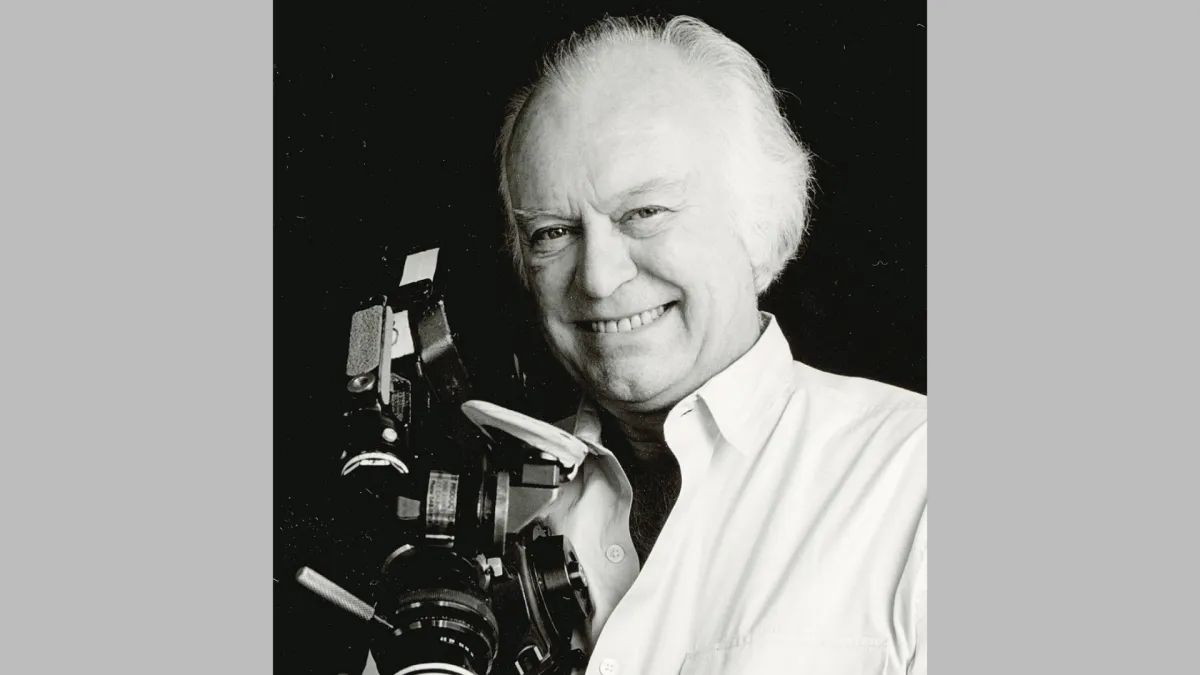


A giant of documentary filmmaking, Bill Jersey, passed away peacefully at age 99 this past July, at his home in New Jersey, with his wife Shirley by his side.
Born in Queens on June 9, 1927, Jersey got his start in filmmaking at Good News Productions in Pennsylvania before eventually moving out west, where he became an established figure in the Bay Area filmmaking community.
Jersey’s breakout success was A Time for Burning (1966), a documentary about a white Lutheran minister’s unsuccessful attempt to connect with a nearby Black community in Omaha, NE. The film, which was eventually nominated for an Academy Award and selected for preservation by the Library of Congress, became a benchmark Civil Rights documentary and established Jersey as a prominent adherent of the new cinema vérité movement.
Jersey continued to produce and direct probing documentaries over the next 50 years, many under the banner of his production company, Quest Productions, on subjects as varied as evolution and religion, wartime dehumanization, Jim Crow, the mob, industrial design, criminal justice, and the Supreme Court.
But beyond his own work, Jersey also made an outsized impact on the next generations of documentary filmmakers who got to know, work with, consult with, observe, and learn from him. I am one of those people.
BJ, as many of us knew him, was an invaluable mentor to me. In the early 1990s, he graciously took an interest in me, a young nobody. I sat with him while he watched through a two-hour cut of my first feature film, Tell the Truth and Run: George Seldes and the American Press (1996). He alternately smiled, frowned, and slapped his thigh in delight. His subsequent insightful, often harsh but always encouraging critique helped turn a passable film into one I was proud of, and sent me on my way to a now decades-long career. I turned to him for consultation on every one of my films since, and he never disappointed.
What follows is a portrait of Bill Jersey, told through the remembrances of those who knew him in different ways but were all profoundly touched by his presence in our lives.
Shirley Kessler
Jersey’s wife and widow
Bill very much enjoyed looking at a film to try to determine what its problems and issues might be and try to help someone make it better. He took everybody’s film as seriously as he did his own. It was always like a puzzle for him. He could really play around, tackle, and engage with the filmmaker and editor in a way that, for him, was free of all the anxiety and whatever you have about your own film. He was having a good time and doing what he loved most doing.
Bill came out of that group of cinema vérité people in New York. He was introduced to the Maysles Brothers, and these people who did that kind of vérité work, where you didn’t have the typical narrator. It was just the raw footage that was cut to make a film. And during that time, a man named Willard Van Dyke [a master photographer turned documentary filmmaker] became his mentor, initiated him in the camera, and the use of the camera and the interview. Bill derived so much from that relationship and never forgot it.
Jeffrey Friedman
Filmmaker; Co-director/editor, The Celluloid Closet (1995)
When I met with Bill in the mid-1980s, I made it clear that I wanted to move up from assistant to full-fledged editor. He gave me a big break on his film Faces of the Enemy (1987). He basically threw me in the deep end, handing me a pile of thematically related footage and setting me loose.
I wallowed in that footage for days, trying to find connections that made sense. After a week or so, Bill came into the editing room and, clearly anxious about my lack of progress, announced that he was considering bringing on a supervising editor to help guide me.
This was the push I needed. There was no way I was going to let this creative challenge defeat me. That night, I stayed in the cutting room till the wee hours, shuffling color-coded index cards on a corkboard, and started editing an opening sequence. The next day, when Bill reviewed what I’d done, he was visibly pleased. There was no further mention of a supervising editor. Thus began an exhilarating collaboration that taught me not only to take charge as an editor but to think like a filmmaker, which he generously acknowledged by giving me a co-director credit on the film.
Bill was a strong personality and very demanding. His brutal honesty could be intimidating, but the flip side was that when he complimented my work, I knew it was sincere. He gave me the confidence to grow as a filmmaker.
Rob Epstein
Filmmaker; Director/co-editor, The Times of Harvey Milk (1984)
Early in my career, I got a job producing and directing an episode of We the People, a four-part PBS documentary series about the Constitution and its impact on the lives of Americans. Bill, too, was one of the series directors.
When it came time to start the edit, I was in a panic. I didn’t think I had the goods. But Bill, having shot some of the material himself, knew what we had in the can.
One night, Bill sat with me in the edit room and calmly and patiently helped me put together a scene, shot by shot. Then a sequence, then another one. He never seemed to doubt that we would find the film. In that one hour-long session, Bill gave me back my confidence in the material, in myself. Bill had enough confidence in himself to give other people the confidence to find their own way. As the series producer, Bill also assigned Jeffrey Friedman as my editor. That began a nearly 40-year collaboration between Jeffrey and me.
Connie Field
Coproducer/codirector, Freedom on My Mind (1994)
We were a group of documentary filmmakers on Hollis Street (Emeryville, CA) in 1976, and Bill was the one who built the screening room for all of us. Vivian Kleiman was working with Howard Dratch and Allen Frankovich on On Company Business (1980). I was making The Life and Times of Rosie the Riveter (1980), Dave Peoples was downstairs editing The Day After Trinity (1981) for Jon Else, Marilyn Mulford working on Chicano Park (1980). Then we had to move and went to the Chiron building on Horton Street, where the Jewish Film Festival moved in. Then we were kicked out again. So Bill took the reins. He went to Saul Zaentz and through discussions with him we were able to all move into the Fantasy Building [as in Zaentz’s Fantasy Records and then, beginning with One Flew Over the Cuckoo’s Nest, Fantasy Films], in 1985. Thus, Saul Zaentz became the grandfather of the East Bay independent film community.
Vivan Kleiman
Director/producer, No Straight Lines: The Rise of Queer Comics (2021)
I shared office space and worked on a few projects with Bill Jersey over several decades. He schooled me on his basic principles of documentary storytelling: focus on the emotions of a scene and not the expository, open with a scene that immediately makes the viewer curious about hearing more. With his height and sonorous voice trained in the church choir of his youth, BJ was at once generous and demanding, intellectually challenging and often quick-tempered, with a measure of the sexism typical of his generation.
Mark Page
Writer, Evolution: What About God? (2001)
The hallmark of every Bill Jersey project was his generous, humanistic approach to his subjects. In 2002, WGBH and Vulcan Media asked Quest to produce the final episode in their series Evolution. It was envisioned then as a report on the divisive battles over evolution in American politics, science, and religion, with the anti-evolution forces cast as the villains and Darwin’s proponents as the heroes/victors. Bill told them he had a better idea. Instead, we made Evolution: What About God?, a sensitive look at Christian high school and college students struggling to come to grips with evolution and how it challenged everything they’d been taught about God and the world—a perfect example of Bill’s approach to making documentary films. It turned out to be the ideal ending to the series.
Aaron I. Butler
Editor, Euphoria (2019-2026)
I always thought I was going to be a lawyer, but in all my spare time, I was making short films to entertain my friends. So when my senior year at UC Berkeley came around, I bypassed the LSATs and instead applied to 20 film production companies in the Bay Area. None replied. I decided to make one last call to a place called Quest Productions at the Saul Zaentz Film Center, and Shirley Kessler picked up the phone, which led to a meeting with Bill Jersey.
Bill asked to see my work. I showed him one of my short films. He called me an artist, which no one had ever done before, and asked if I’d like to work on a film with him. Are you kidding? So we began shooting what would eventually become the PBS documentary Learning to Fly (1999).
Bill took me under his wing and became an incredible mentor to me. He had these invaluable sayings like “Emotion before information,” which I still use to this day in my work. He was tough and not easy to please, but it was always in service of the story. He pushed my work to be more creative and more emotional.
He hired me full-time as his editor and cameraperson, and I worked with him for 4 amazing years. So I never went to law school or film school. Bill became the best film school you could ever imagine.
I absolutely would not have had this career if it weren’t for Bill Jersey. I still mention him in almost every interview and podcast I do, and I spend as much time as I can mentoring the next generation of storytellers to pass on everything I learned from him.
Pierre Valette
Producer/editor/camera, The Rise and Fall of Jim Crow (2002)
You had to have thick skin to work with Bill. He set a high bar and expected those who worked with him to work hard to achieve it.
After only a few months on the job, he handed me his Aaton 16mm camera and told me that we were going to France, and I had the weekend to learn how to use it, which involved complex skills like loading magazines in the dark and pulling focus without the aid of a viewfinder. I was terrified, but figured that if Bill had faith in me, I could do it. I did.
He taught me about chiaroscuro—to use the contrast between light and dark to dramatically highlight form. You can see that technique in his paintings. He loved the craft of photography, but it was his storytelling and connection to people that set him apart. He was a master interviewer, quickly getting to the meat of the matter. He put his subjects at ease with a disarming interest in their lives, though he would push them if they gave surface or insincere answers.
In the edit room, he was uncompromising. If a cut took too long to draw in the viewer, he would have us scrap hours—days!—of effort, and start over. “You know it doesn’t work,” he would say. Yeah, we did. But the work was always collaborative. In the edit room, he’d seek the collective input of all those he’d invited in. We worked hard, but he always knew how to pause, have a laugh, linger over a long meal after a shoot (he insisted on great meals doused with wine), and enjoy the camaraderie of working together—all while teaching us to be better filmmakers.
Jason Cohn
Codirector/coproducer, EAMES: The Architect and the Painter (2011)
When I met Bill Jersey, I was in my early thirties, and BJ was precisely 40 years my senior. The initial project he had in mind involved the story of a 96-year-old environmental activist named Martin Litton, who was also an avid aviator. BJ wanted footage of him flying his Piper two-seater over the snow-capped Sierras. Bill stuck a Sony PD-150 in my hand and shoved me into the passenger seat of the prop plane. Soon I was soaring above the clouds at the side of a pilot who looked like Father Christmas and who stood a fair actuarial chance of not being alive to land the plane.
Bill’s reputation was formidable. He was one of the pioneers of cinema vérité in America and the acknowledged godfather of Berkeley’s documentary scene. Bill liked me because I was good at words. But the truth is, he largely disdained writing in films and used the word “journalist” as an insult. He thought images should do all the heavy lifting, and he preferred going into interviews without much idea what the person might have to say. What mattered was the rapport he would develop with the interviewee. Knowing too much going in would interfere with that.
I worked on several projects for Bill before working up the nerve to ask him if he’d co-produce a film I was interested in: the story of the Los Angeles industrial designers Charles and Ray Eames. Bill knew next to nothing about them, but he did own one of their chairs. In fact, he had made a student film about how much he loved that chair. That’s a pretty good breakdown of the difference between Bill and me as filmmakers. I was that hated thing: a journalist. Before shooting a frame, I had read every book and article published in English on the Eames Office. Bill, on the other hand, couldn’t tell you the first thing about the designers, but he had already rhapsodized on film about one of their designs.
We approached the Eames film from diametrically opposite directions and fought constantly. It was a struggle to hold my position against my mentor, and while he didn’t like words, he was mighty good at using them in an argument. Bill was no longer my boss. Despite the age difference, we were now colleagues. But we were also family. He was my documentary father figure and our fights started taking on a familial edge. I recall Bill’s hand shaking so much during one of our arguments that coffee was flying out of the cup.
Ken Schneider
Cocreator, Los Hermanos/The Brothers (2020)
I knew Bill Jersey from the Fantasy building, where we enjoyed conversations with each other. After viewing a work-in-progress of a film I was editing, Bill gave two pages of notes, and this one really landed: “Make the bad guys look good.” It was a plea for nuance, for complexity, and I loved that. I’ve channeled it in every film since.
Alan Snitow and Deborah Kaufman
Codirectors/coproducers/co-writers, Town Destroyer (2022)
He “got” what we were trying to do. He advised us to stay on track, i.e., telling us not to try to do things (such as work for others) that are not in character for us. And he warned us against being distracted by complimentary offers that would sidetrack us. We visited him in Pennsylvania, where he hosted one of our films and watched the cardinals outside the window where he painted. We will miss him.
Abby Ginzberg
Director/producer, Barbara Lee: Speaking Truth to Power (2020)
Bill Jersey taught me a lesson that I have tried to share with other filmmakers seeking advice over the years: “Approach the film you are making by making it the best film you can.” His advice was always in the context of helping each of us make the best film we could, not the best film he could imagine. His support for other filmmakers was legendary. He always made time to give us feedback, which was inevitably on point and helpful. I am a better filmmaker for having known Bill. I hope I have passed on a tiny bit of the wisdom he so generously shared with so many of us.
***
I spoke with Bill by phone a few weeks before he passed away (as I later found out, several others who are quoted here had done). He was sharp as a tack and upbeat, much as I’d always experienced him. He told me, without any self-pity, that he was totally bedbound, but still painted every day. We chatted about times gone by and about the state of the world today. I told him how much his presence in my life meant to me.
My relationship with BJ taught me, above all else, how valuable mentorship is—that the lives we live are richer when we accept mentorship (when young) and then offer it (when older), and that how one mentors can profoundly change lives.
Bill Jersey’s life was a life well-lived. He will be missed.