

Matthew Rankin makes maximally Canadian films in both narrative and documentary form, digging deep into his country’s history and TV archives to uncover oddball artifacts and histories. The archival documentary form served as a training ground for him at the beginning of his career.
In an early work, 2006’s Kubasa in a Glass (co-directed with Walter Forsberg), Rankin explored the commercial TV archives of his native Winnipeg; in a way, Ladies and Gentlemen, Brian Mulroney is a return to the spirit of his roots, spelunking through the televisual record on a much more elaborate scale.
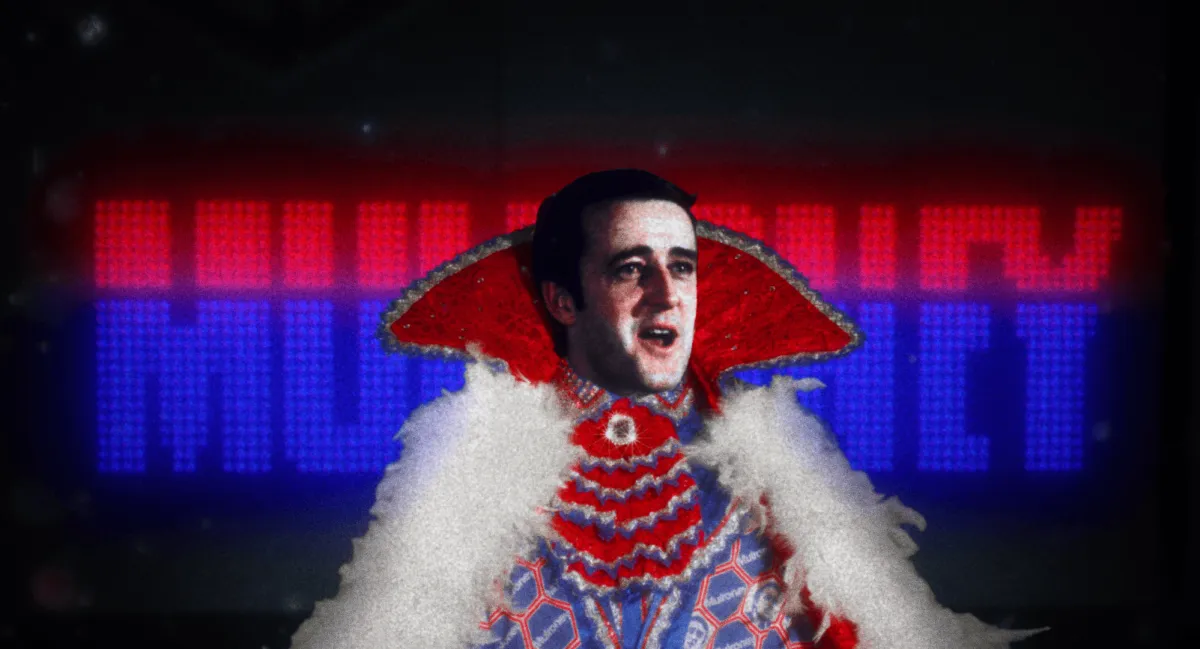
Over 105 minutes, Rankin contemplates the rise, fall, and rise again of Mulroney, a Quebecois lad from humble roots whose desire to be prime minister eventually manifested into reality. Described as having “Robert Redford hair,” Mulroney was a rare font of obvious charisma in a sea of jowly conservatives. Rankin starts in 1976, at the convention of the Progressive Conservative Party, where Mulroney was one of many contenders to lead the party, before flashing backward to establish both his and the party’s history, then moving forward to his 1984 ascendancy to power; the actual ministership itself is outside the movie’s scope. (It didn’t go well: towards the end of his term, his lowest approval rating was 12%.) Instead, over six chapters, Rankin anatomizes the PCP’s history, Mulroney’s personal ambitions, and the micro-maneuvering that brought him back to power after failing to win over the PCP in 1976. His means include archival footage, animation, and a healthy dose of graphics that meticulously mimic past styles of National Film Board of Canada films (rendered by Guy Maddin’s regular collaborator, Galen Johnson) to structure the film’s six chapters.
Before the film’s premiere at TIFF (where it won the People’s Choice Award for the Midnight Madness section), I interviewed Rankin via email, where he talked about why he aims for flamboyant artifice to tackle capital-H history, why he loves the “formalism of propaganda,” and what Johnson’s eye for outmoded title design brought to the project. The following interview has been edited for length and clarity.
DOCUMENTARY: There’s a school of archival filmmaking that essentially only decides what to cut and retain while leaving the film-of-record itself essentially untampered with, as in Emile de Antonio’s Point of Order! (1963) Obviously, this isn’t your approach, and your interventionist tactics go back to Kubasa in a Glass, which likely wasn’t content to just string together Winnipeg ephemera. How has your thinking about archival filmmaking evolved over the years?
MATTHEW RANKIN: Kubasa in a Glass actually has very few interventions in it. It is overwhelmingly comprised of full, unedited TV commercials produced in Winnipeg between 1974 and 1993. The order in which they are arranged builds an argument about Winnipeg’s municipal pathologies, but there is minimal tampering—more curation than culture-jam.
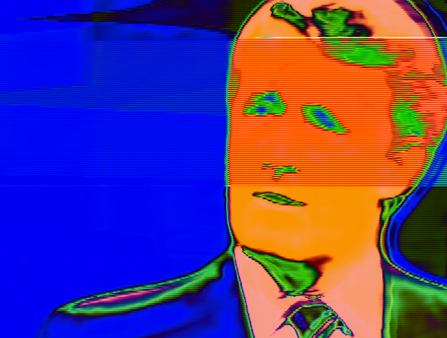
In Ladies and Gentlemen, Brian Mulroney, the footage is much more intensely meddled with, but I would like to stress that it is very obviously meddled with. All artifice is brazenly on display to advance a fact-based historical argument. Typically, we hide artifice to contrive the experience of authenticity. I’ve done innumerable TV interviews where reputable journalists ask me to pretend to do something: pretend to talk on the phone, type at my computer, spontaneously enter the room and sit next to my cat, be unaware that a camera is filming. These are completely fictional mise-en-scènes that are also normal conventions of journalism, intended to faithfully document a true and factual process. There is a cheat, but it remains invisible behind a sophisticated veneer of verisimilitude. You’re not meant to see the artifice because the whole point is to believe what you’re watching is reality.
I like to doubt what I’m watching—particularly when it comes to historical subjects. History is a processed order we impose on the raw chronology of time and is subject to infinite contortions, so I try to make my interventions as flagrant and flamboyant as possible. To me, it’s a more honest use of artifice.
D: How long did production take from start to finish, and how did that time break down?
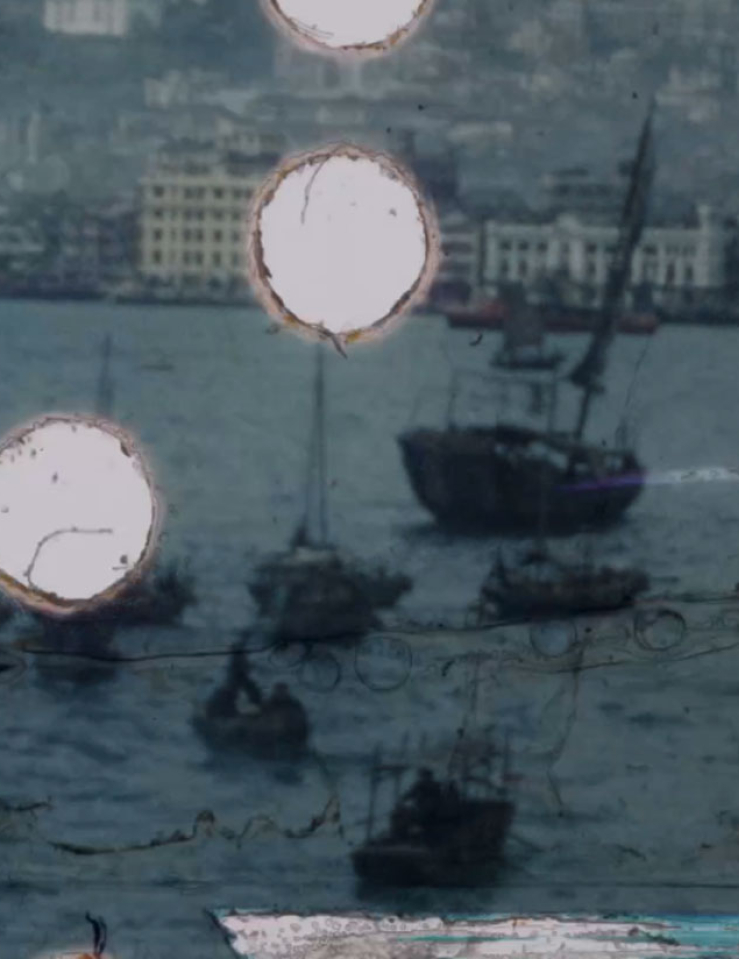
MR: I really started burrowing into the archives in February of 2022, and we just finished the film a few weeks ago, but there have been many extended breaks. In late 2022, I had another film enter production: Universal Language (2024). So, I directed another whole feature film during the time it has taken me to finish Mulroney. Most of the production time was dedicated to collecting and organizing footage, the sheer volume of which is astronomical. I have nearly 80,000 individual pieces of film and video.
D: The opening convention sequences are very close to vérité reconstructions. There’s a lot of attention paid to reverse angles. How much redundant and overlapping coverage did you end up being able to choose from, or was everything creatively reassembled from a single source?
MR: The 1976 Progressive Conservative leadership convention is an extremely well-filmed event. The Canadian documentarian Peter Raymont made a wonderful film for the National Film Board of Canada [Flora: Scenes from a Leadership Convention, 1977] about Flora MacDonald’s campaign for the ’76 leadership, and the bulk of that film takes place during the convention. One of my first questions when I met with the NFB archivists was whether or not any of that footage had survived. The first answer was, “No, it’s gone forever,” but they dug a bit further into the vaults and managed to unearth a hitherto uncatalogued trove of some fifty 16mm reels which Raymont had filmed. The material is extremely rich, and jamming it together with warped cathode video and deliciously high-contrast telecine transfers from various other archives really energized that first section of the movie.
D: Probably like most United States residents, I know little about Canadian political history beyond the very basics: the Trudeaus, the Ford brothers. I understand your movie’s thesis to effectively be that Canadian conservative politics, and hence Canadian political conflict as a whole, centered not just on Quebecois separatism but also on how that province’s voting leanings affected the entire country. To what extent have I understood your historical narrative correctly, and to what degree is that relevant to the film’s intended effect?
MR: You’re right, the nationalist tension between francophones and anglophones has been a major fault line in Canada. Federal political parties, if they seek to govern, must find some way to reconcile these “Two Solitudes,” as we call them. Canadians have rarely voted in Conservative governments because the Tories have historically been such lousy reconcilers and often even hostile to Québec. Mulroney was their biggest moment. Neither before nor since have Québec and the rest of Canada been so politically united as they were behind Brian Mulroney’s Progressive Conservative banner in 1984.
For myself, I was drawn to Mulroney because we are having such a weird reckoning with authoritarian conservatism across the world right now, even on this side of Lake America. I wanted to take another look at this earlier generation of Progressive Conservatives (such a passive-aggressive Canadian oxymoron!) and see what they might tell us about the present. Their struggle was to create a moderate, centrist, big-tent conservative party where there was as much room for French-speaking feminist tree-huggers as there was for reactionary WASP psychopaths who believed that water fluoridization would turn everybody into Soviets. It was an improbable coalition, and I think we can see which way the tide went.
I intensely dislike the spirit of films that try to tell me how to think or how to vote, but often I find the cinematic language they employ—from Vertov’s Bolshevik epics to Lyndon B. Johnson’s 1964 “Daisy” agitprop—to be infinitely enchanting.
—Matthew Rankin
D: Do you have any thoughts or preferences about how the movie might play both for Canadians of different ages, but also for non-Canadians like me with minimal baseline knowledge? To what extent, if any, should the viewer ideally be knowledgeable about Mulroney’s career?
MR: I don’t think you need to know anything. For example, I don’t understand 50% of what is happening in Succession, but that doesn’t stop me from getting into it. If I had memorized Rupert Murdoch’s Wikipedia page, I’m sure I would have quite a different reading on that show, but there are other paths into it for me. There is great pleasure in being plunged into a world we know nothing about, observing characters and identifying their patterns. Do you have to know all about Brooklyn before watching a Spike Lee movie? No way! You’re in Spike’s world. You’ll watch and figure out how it works, and that’s part of the fun. Minimal curiosity is all you need.
I’m interested in people who aspire to power, who seek to rule established systems and wield the big levers of history. The political intrigue of Brian Mulroney outsmarting his enemies and building his political brand under the prime-time gaze of ’80s broadcast television could just as easily be happening in Wisconsin, and I think the Canadianness of it all just makes it more ridiculous.
D: To what extent, if any, was the project driven by the desire to make it financially and professionally viable to do an NFB viewing deep dive, and were there any particular eras of educational or government cinema you were drawn to?
MR: There was never any thinking about making money or advancing anybody’s career with this one. I realize that selling out no longer has much shame attached to it. I meet with young filmmakers now, and it is their dream to sell out. It’s all they think about! And who can blame them—this economy is completely brutal, and we have to move fast now that the eugenics-filled eyes of AI are staring us down.
Mulroney is a satirical film. By its very nature, it is an anti-establishment piece. The film even makes fun of the NFB itself to no small degree. But I do love propaganda—or I should say, I love the formalism of propaganda. I intensely dislike the spirit of films that try to tell me how to think or how to vote, but often I find the cinematic language they employ—from Vertov’s Bolshevik epics to Lyndon B. Johnson’s 1964 “Daisy” agitprop—to be infinitely enchanting. This is true of Canada also. Until the 1980s, largely through the National Film Board, the Canadian government produced an enormous body of institutional films, most of which I would describe as “ecstatically banal.” Some of these attempt to rouse Canada’s preternaturally flaccid patriotism, usually through depictions of abundant natural resources and triumphant sod-turning ceremonies and so forth. All of it is deeply hilarious to me.
D: A lot of energy is spent on recreating period-perfect simulacra of eras of NFB title cards and color values, and I presume Galen Johnson’s contributions were crucial in this respect. How did you go about building a reference library for those shots? Presumably, they relate to the larger NFB archival viewing you conducted to select the footage you use for illustration.
MR: Galen is, of course, a bona fide titling master—the Saul Bass of his generation. He is a brilliant artist and filmmaker, and I was oftentimes positively stunned by the exactitude of his font-identification skills. Sometimes I would make mock-ups or give visual references for him to improve upon; sometimes I would just give him words to use, and he would go off and create freestyle. He really got this thing 100% and has a vast appetite for outmoded graphic design across multiple eras.
The archival project Canada Modern was a major tuning fork for us, as well as the graphic designers Fritz Gottschalk and Stuart Ash, who devised so many of the visual identities in the “Governmental Style” of Canadian propaganda throughout the 1970s. Old NFB optical titles were also an inspiration.
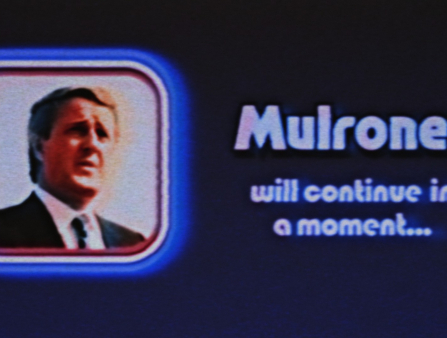
But Mulroney is structured very much in the stream-of-consciousness form of the ’80s-era broadcast day, and I knew I wanted to dig into the many moods and graphic modulations of analogue TV. Beyond that, Galen and I looked at obscure American cop shows, John Ford Westerns, wholesome family sit-coms, station IDs, emergency broadcasts, and a vast range of corporate logos and brand identities.