
Interview

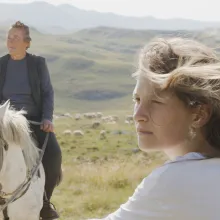
In Imago, the Chechnya-born filmmaker Déni Oumar Pitsaev journeys to a Chechen enclave in Georgia named Pankissi, where his mother has secured a plot of land for him to settle down. He spends time with his mother, with whom he’s close, and a hearty cousin and a friend, but he has barely seen his father since his parents divorced when he was nine months old. That’s on top of a childhood marked by his and his mother’s stays in Kazakhstan, Chechnya, and—when the Russians attacked Grozny in 1996—St. Petersburg, where she changed his Chechen name for his protection. After Imago won L’Œil d’Or, the best documentary prize of Cannes, Documentary interviewed Pitsaev about starring in a film about his life journey and the balance between pre-planning and responding in the moment.
Amid the past few decades of Holocaust-focused works, queer artist Kinga Michalska has found a unique approach to “the Holocaust memory documentary” in their native Poland. Their feature-length debut, Bedrock, is a psychological journey through the contemporary sites of former concentration camps and mass graves. It also poses the rhetorical question: What does “never again” really mean? Bedrock premiered in the Panorama section at the Berlinale, where Documentary spoke with Kinga Michalska.
Founded in 2008, Doc Alliance is a collaborative network of seven key European documentary festivals—CPH:DOX, Doclisboa, FIDMarseille, Ji.hlava, Vision du Réel, Dok Leipzig, Millennium Docs Against Gravity—dedicated to promoting arthouse non-fiction cinema and supporting emerging filmmakers. For over 15 years, the initiative has played a pivotal role in strengthening the continent’s documentary scene by fostering inter-festival collaboration and increasing exposure for independent work. Spearheading many of its recent efforts is Galya Stepanova, the network’s coordinator and one of the driving forces behind its growing industry profile. Ahead of this year’s Cannes Film Festival and its Marché du Film (May 13–24), Documentary magazine sat down with her to discuss the Doc Alliance Award, long-term strategic goals, and how the network is adapting to better serve new voices and cross-border exchange.
Alina Gorlova, Yelizaveta Smith, and Simon Mozgovyi’s riveting Militantropos , its title a mashup of “milit" (soldier in Latin) and “antropos” (human
When does childhood end? This slippery question becomes the crux of Chinese filmmaker Deming Chen’s second feature documentary, Always. The film, which won the top prizes at CPH:DOX and Jeonju over the past two months, centers on an 8-year-old boy, Gong Youbin, and his family in a small village in southern China’s Hunan province. Before the film’s North American premiere at Hot Docs, Chen and Producer Hansen Lin shared with Documentary the feedback they received at different labs and forums, the selection of poems for their film, and the approach of prioritizing emotions, rather than logic, in crafting the story.
On April 27th, Pope Francis was scheduled to officially canonize the first saint from the Millennial generation. Before his untimely death from leukemia at age 15, Carlo Acutis (born 1991), had combined his enthusiasm for computers and his fervent Catholic faith by creating websites to document miracles. The film was produced by Castletown Media, which has in recent years found box office success in partnering with Fathom Events to release films touching on Catholic themes. Jesus Thirsts, for instance, was one of last year’s biggest nonfiction hits. We spoke with Castletown executive director Tim Moriarty, who co-directed and produced Roadmap to Reality, about the film, its funding, its release strategy, and how the Pope’s death has impacted the company’s plans.
For three decades, Chris Smith has profiled oddballs, eccentrics, and mavericks. Smith’s first documentary, American Movie— a darkly funny but
Encountering Sylvain George’s Obscure Night - Goodbye Here, Anywhere (2023) at the Locarno Film Festival two years ago was a revelation. The three
On January 14th,1996—his 21st birthday—Ricardo López started videotaping himself laying out his plot to attack the Icelandic popstar Björk. In this initial tape, López said Björk was a symbol of purity and innocence to him, an image which he said she destroyed by having relationships with two different black musicians, previously with Massive Attack’s Tricky and, at the time of his recordings, English music producer Goldie. Filmmaker Heather Landsman seriously considers López’s footage in her new film The Best of Me, which condenses the 20-some hours of tapes López produced into a hauntingly candid look into a deeply unwell and alienated individual. The Best of Me is being independently distributed by Landsman through the Film-Makers’ Cooperative, touring microcinemas.
We Live Here delves into the present-day reality of the Semipalatinsk nuclear test site—known during the Soviet era as the Polygon—and the enduring devastation it has wrought on those who still live there. Director Zhanana Kurmasheva centers the story on Bolatbek, an elderly man who has spent his entire life in a village just 30 kilometers from the Polygon. While the tragedy of the Polygon has been chronicled before, often in government-backed, TV-style documentaries, Kurmasheva’s work approaches the subject differently, elevating it to a kind of myth—a legacy that strangely defines who Kazakhs are. We Live Here is steeped in a sense of foreboding. We Live Here premiered at CPH:DOX. Ahead of the film’s North American Premiere at Hot Docs, Documentary spoke to Kurmasheva about what makes residents stay in such a contaminated area, the genius loci of the steppe, and the interplay of beauty and violence embedded within it.