

By constructing a feature documentary almost entirely from police documentation, Geeta Gandbhir’s new feature, The Perfect Neighbor, is the latest high-profile undertaking in an increasingly popular and uneasy territory of nonfiction media: evidence as entertainment. In 2023, Ajike Owens, a Black mother of four, was killed in Florida by a white woman in her neighborhood, Susan Lorincz. Owens was close friends with Kimberly Robinson-Jones, the sister of Nikon Kwantu, Gandbhir’s husband and creative collaborator. As Gandbhir tells me over Zoom, Gandbhir and Kwantu came to Florida originally to “keep the story alive in the news, because we work in media.”
Civil rights lawyer Ben Crump, who had previously headed the legal team for George Floyd’s family, submitted a legal request to the sheriff’s department on behalf of Owens’s mother. In response, the department sent him a mountain of documentation, rendering it public record.
“It was a total mess on a hard drive,” Gandbhir recalls, “a jumble of material. Ring camera footage, cell phone footage, dashcam footage, detective interviews… as an editor, I felt compelled to go through it.”
Crump’s team had given the drive to Gandbhir, who began her career as an editor for Spike Lee and his frequent collaborator Sam D. Pollard, to see if there was anything that should be shared with the news. Despite there being no context to any of the material, Kwantu noticed timestamps in the jumble that led the filmmakers to realize the recordings stretched back two years.
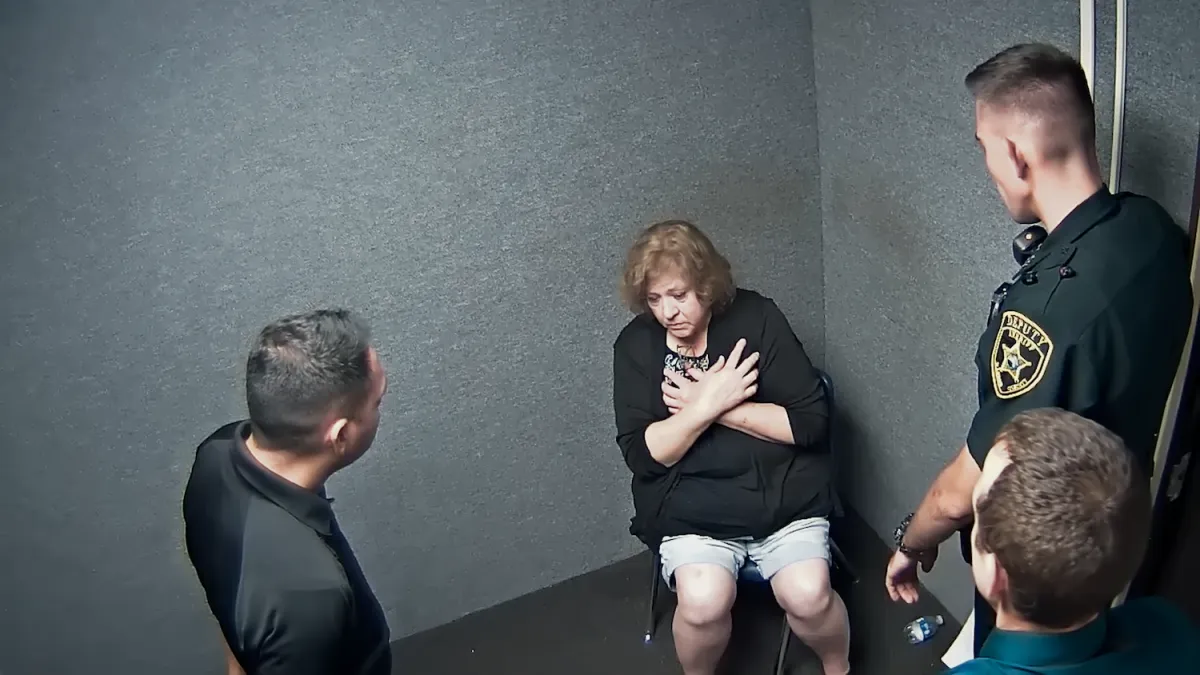
The vast majority of Ghandbhir’s film—save for a brief coda of original footage and a few interstitial shots—is this footage: produced, or in some instances, archived as evidence, by the sheriff's department of Marion County, Florida. The vast amount of assembled footage is made possible by Lorincz’s chronic 911 calls in the year leading up to the shooting. Lorincz erroneously believed that the neighborhood’s children were infringing on her property and making too much noise while playing football. The attending officers were, as is now common practice in the U.S., fitted with body-worn digital cameras.
There is no guarantee that this type of footage would be made available to the public or for filmmaking everywhere in the U.S. Disclosure of body-worn camera recordings to the public legally varies state by state, resulting in a mess of convoluted and often contradictory legislation. Many states do not dictate a conformed practice for the collection, holding, and dissemination of bodycam material, leaving these rules to the discretion of the local department. A 2023 ProPublica investigation found that—from a sample of 79 killings captured on camera—fewer than half of the recordings had been made publicly available. In Florida, 1995’s cheerily titled Government in the Sunshine Law guarantees public access to state media. These records, with varying degrees of success, long queues, and a variety of related fees, are accessed via a Freedom of Information Act request, colloquially known as a “FOIA.”
In social conversations after a fall spate of festival screenings and the film’s release on Netflix’s streaming platform, one phrase kept cropping up: cop-as-cinematographer. Thinking of a police officer strapped with a camera as if he or she were a Steadicam operator on a film set opens many questions, both about the tech being used and the uneasy intersection between media creation—The Perfect Neighbor was Netflix’s most-watched film in the U.S. shortly after its streaming release, dethroning the seemingly unseatable KPop Demon Hunters—and law enforcement. In a recent interview with retired NYPD lieutenant commander Shamsul Haque, he briefly notes that “when the department came up with the idea of body-worn cameras, officers rejected it. We didn’t want it. But now [the officers] love it.”
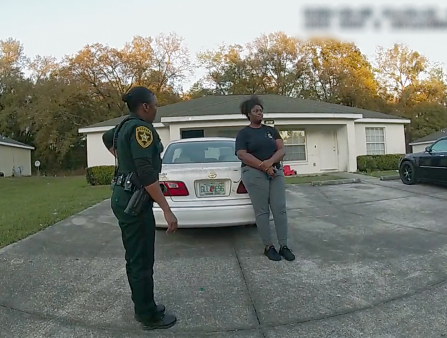
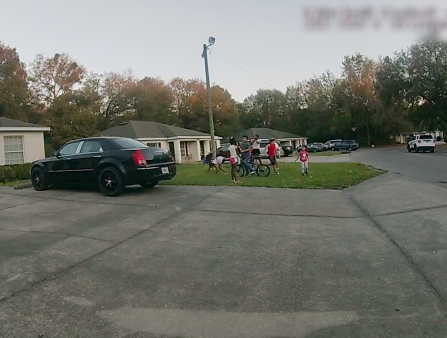
Bodycam footage.
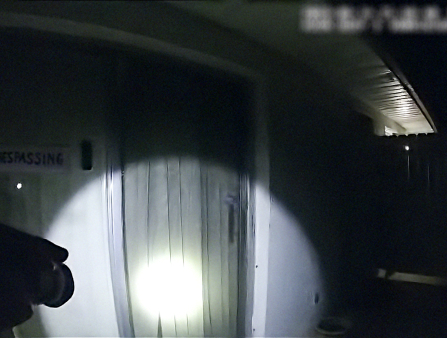
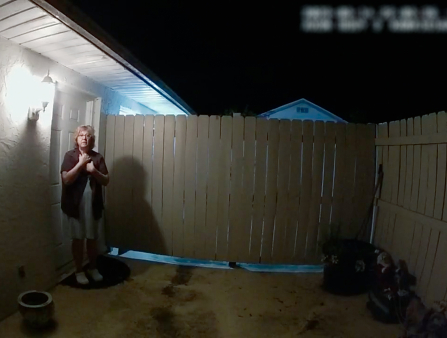
Why would officers love an accountability measure literally affixed to their person? After the killing of Michael Brown in Missouri in 2014, the Obama administration opened up US$75 million in funding to police departments across the country for purchasing bodycams in the name of accountability—an overwhelmingly popular decision at the time that has seen controversial dividends. For one, the cameras don’t work well to deter police violence. In the decade since, the Washington Post has reported that the number of American civilians killed annually by the police has only increased. In addition, civilian oversight committees that were established in cities after the 2020 killing of George Floyd (during which a body camera fell off the officer who killed him and failed to capture the incident) routinely have their recommendations overruled despite access to the footage.
In addition, bodycam requirements have been a substantial boon to ballooning police department budgets across the country, with federal funding expanding for departments to purchase, utilize, and train with new tech. In a 2024 article in the Yale Journal of Law & Liberation, civil rights attorney Alec Karakatsanis makes the argument that even before Brown’s death, the government and private tech companies were circling each other as a mutually beneficial way to fund research into cloud-based media management, virtual reality, and artificial intelligence.
Axon, known formerly mostly as a producer of police tasers, emerged alongside its principal competitor, Motorola, and the upstart WOLFCOM as the largest suppliers of body-worn video devices. By 2022, The Intercept reported that Motorola was focusing on lobbying for and implementing facial recognition software, while Axon had cornered the market on VR police training programs, cloud-based storage for the automatically uploaded footage, and AI-assisted technologies such as language translation and auto-generating incident reports. If the inner workings of Axon sound familiar, it may be because a tour of its Arizona headquarters appears at length in Theo Anthony’s 2021 documentary All Light, Everywhere, which gives a historical and critical analysis of the optics of policing. Axon’s website currently boasts the “rugged” Axon Body 4 (“capture every moment… capture more truth”). Still an ominous, glowing rectangle attached to the officer’s chest, it provides real-time support, geotagging, and a 160-degree field of view.
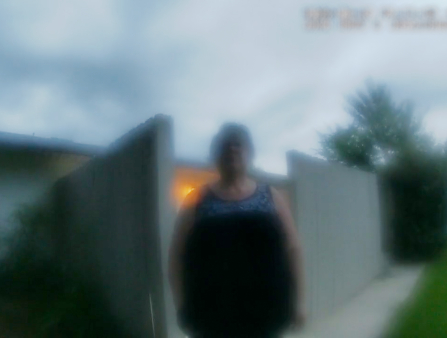
Criticisms of the cameras, which are toggled to record and stop by a large central button, include that they essentially create databases of surveillance whenever an officer enters, say, a Black community or a site of protest, documenting faces other than the intended subject. Also, the unfixed position of the camera results in blurry images due to movement. The front-facing lens makes viewing the officer impossible, obscuring intent, unlike dashboard cameras. The overwhelming majority of prosecutions in which bodycam footage is submitted as evidence involve private citizens, not police officers.
Gandbhir also recognizes the criticisms of body-worn cameras: ‘Police body camera footage is a violent tool of the state for people of color.’ But she also offers the hope of détournement. ‘I wanted to flip that on its head, because what you see in the footage is that the police unintentionally capture this beautiful little community.’
“I’m going to say this,” Geeta Gandbhir tells me, when asked if she finds any hope in The Perfect Neighbor. “You see the best and the worst of our society.”
At the film’s opening, in February 2022, 58-year-old Susan Lorincz has summoned the police to a community of one-story grassy rental homes, where she lives alone, in Ocala, Florida. Lorincz speedily recounts her myriad frustrations with Ajike Owens’s children and then claims that Owens, who most in the community call AJ, threw a “No Trespassing” sign at her, injuring her leg. This claim is immediately debunked in a chorus of sighs by the rest of the neighborhood. “That lady [Lorincz] is always messing with people’s kids,” says one woman. Children ride bikes, cartwheel, and play nearby as Lorincz lobbies for a battery charge.
“You see the best in that beautiful community,” Gandbhir continues. “It’s interracial, diverse, and a lot of the kids are mixed, and they’re all living together, playing together. [All of the families are] raising their kids together.” The parents in the film repeatedly refer to all of the children on the block as their own and indicate they think of them as family. “So that is the best of America, and the best of what a society can be, I think.”
Gandbhir also recognizes the criticisms of body-worn cameras: “Police body camera footage is a violent tool of the state for people of color.” But she also offers the hope of détournement. “I wanted to flip that on its head, because what you see in the footage is that the police unintentionally capture this beautiful little community.”
It’s true that Ghandbir and her editor, Viridiana Lieberman, glean moments of innocence and freedom from the rounded edges of the police camera’s frames, though it is painful that a viewer never gets to experience the community at peace. We exclusively see the families, friends, and children from the perspective of potentially dangerous forces of authority, or from the disgustingly intrusive voyeurism of Lorincz’s cell phone camera as she huddles inside, filming the children playing nearby through her window.
Lorincz—who has been heard yelling slurs at the children—is clearly weaponizing the police against the community, a luxury afforded to her as a white person. She seems a vindictive, abrasive alien on the family-centered, racially diverse street. The community is civil and understanding toward the police officers, who gradually agree that Lorincz is a nuisance. Until Owens’s shooting, no one in the neighborhood but Lorincz calls 911. After the second incident in The Perfect Neighbor, one officer says to her partner as they walk away from Lorincz’s house, “You off?”, referring to his bodycam. When he erroneously responds in the affirmative, she continues: “What a fuckin’ —!” The camera then cuts.
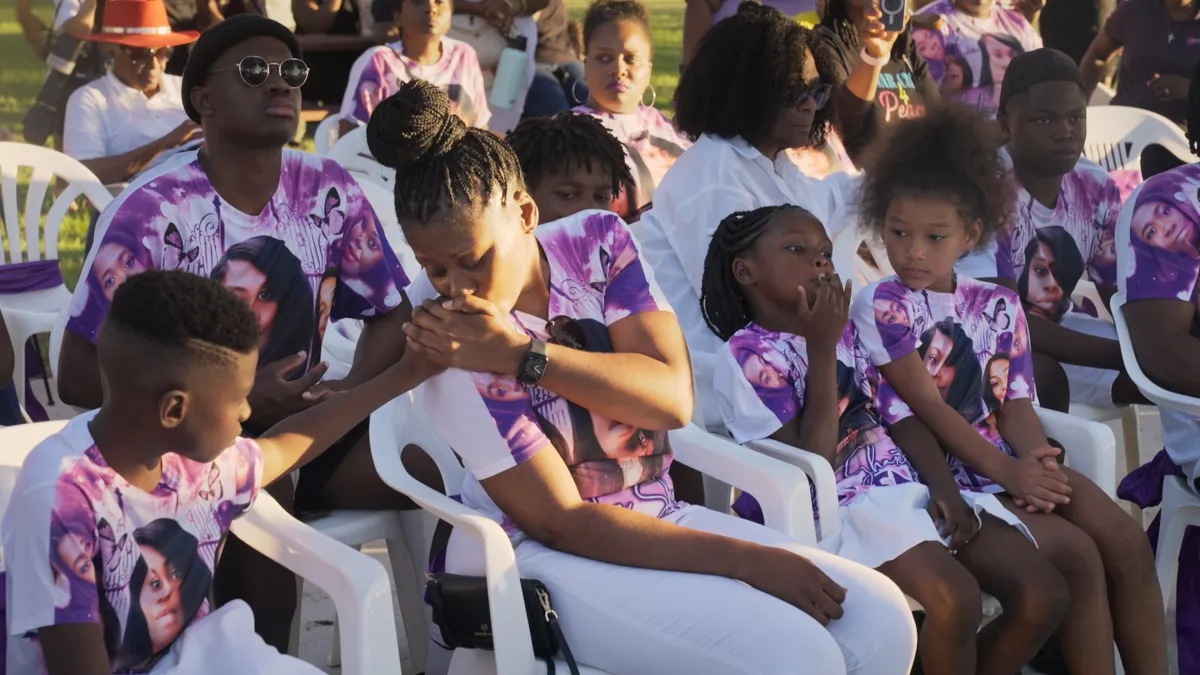
Observational footage of Ajike Owens’s memorial, from The Perfect Neighbor.
The film’s four documented 911 calls accumulate with an oppressive effect and are supplemented by audio montages of police interview testimony against Lorincz. We learn she has been setting off her own car alarm to make it appear as though the children are breaking in, and blasting an air horn whenever anyone comes near her house.
Unfortunately, we don’t get to know Owens, who appears briefly and sporadically in the footage, nearly as well. The film distressingly counts down to June 2, 2023, when Owens walks to Lorincz’s home with her young son, Izzy, to confront the older woman about an earlier outburst directed toward her child. Owens knocks on Lorincz’s door, and Lorincz fires a handgun from the other side, through the door, striking Owens.
The Perfect Neighbor documents the insidious ineffectuality of policing in keeping a diverse community safe: the cops are a constant presence in the neighborhood, at Lorincz’s beck and call, but in an actual moment of violence, their absence is notable: footage of the killing is culled from a home security camera across the street.
As seen in the film, in the initial days after the shooting, Lorincz was not arrested due to a required investigation into whether Lorincz was acting in accordance with Florida’s Stand-Your-Ground laws, which received national attention after the acquittal of George Zimmerman, Trayvon Martin’s killer, in 2013. Thirty-eight states have some variation of a stand-your-ground defense, which covers acts of self-defense if an argument can be made that the perpetrator feared for their life.
While this is the position Lorincz takes when speaking with the police, it is quite obviously illogical—Owens was unarmed and on the other side of a locked door—and Lorincz was arrested after four days. Concerned that Lorincz would not be charged, Gandbhir joined the community in organizing around the case. Stand-Your-Ground defenses have a notorious racial slant, as is mentioned in the film’s final text: white Americans are much more likely to find success with self-defense claims, particularly when their victims are Black.
After receiving the hard drive from attorney Ben Crump, Gandbhir embarked on a several-week-long project of putting all of the material in chronological order in an edit timeline. Body-worn cameras capture 720p to 1080p .mp4s, depending on the device, and are compressed by the web-ready H.264 codec, which translates very easily into editing software. This ease contrasts with surveillance and interrogation cameras, which capture at variable frame rates to save disk space, often making transcoding and sound syncing a nightmare. Still, there were considerable challenges. Often, there were only two cops at the scene; on the night of Owens’s killing, there were at least ten. Synchronization was complicated by the fact that officers were constantly switching their body cameras off and on, throwing off sound sync between vantage points.
Gandbhir describes the labor of the chronological narrativization as a project to mitigate grief; an application of the primary skill of the professional documentary editor toward ‘making sense’ of tragedy.
Among the material was footage of a prior, unrelated arrest of Lorincz in 2023; Lorincz, fearing that she was locked inside an auto repair yard, repeatedly rammed the gate with her truck and sped away, telling officers that this was due to PTSD and a severe panic disorder. “It shows that she was erratic, it shows that she was unstable,” Gandbhir explains. The sequence’s inclusion in the film raises questions around why Lorincz was allowed to purchase firearms and why she hadn’t been flagged by the police.
Gandbhir describes the labor of the chronological narrativization as a project to mitigate grief; an application of the primary skill of the professional documentary editor toward “making sense” of tragedy. As she told Owens’s mother, Pamela Dias, “I have nothing else to offer you [in this tragedy]. I only know how to make films.” This sentiment is certainly relatable to others in the field—as an archivist and editor, I have been privately asked both to edit victim impact statements for trials and potential activist media use, and to inspect, describe, and collate the media archives of the recently deceased for personal familial use and artist estates.
I found these offscreen layers of context—Gandbhir’s personal connection to Owens, her immediate involvement in processing the material, and the ensuing “grief work”—both affecting and perhaps necessary to understand the film, and their omission from the actual film unfortunate. The audience is denied both an important journalistic disclosure and the emotional thrust of why Gandbhir is telling the story in the first place. The film’s acquisition by entertainment powerhouse Netflix makes a difference, as disclosure would typically be required by a network’s Standards and Practices department. But as a streamer protected from FCC regulation, Netflix is not required to clearly delineate any filmmaker’s connection to the legal and communications aspects of their films. In The Perfect Neighbor, Crump is given a special thanks credit, but no on-screen context is given for the film’s origin.
Realizing the breadth of the narrative presented once the footage was strung out and assembled, Gandbhir later approached Dias and asked if she would be interested in a feature film iteration, as a further way of turning the family’s “pain into purpose,” and Dias agreed. Gandbhir did not conduct interviews for two reasons: one, she did not want to “retraumatize the community,” and two, she found the police footage to be free from accusations of bias: “In today’s world, everyone thinks the media is biased, that it would just be my perspective, that we are on the ground directing. With this, you’re seeing things as they unfold, which to an audience, is undeniable.”
Bodycam footage.
The interplay between police-produced footage and entertainment is nothing new, with the most famous example being the long-running FOX vérité television series Cops, which trailed officers making arrests as early 1989. The series was finally canceled stateside in response to the George Floyd protests, but distribution continues internationally, with the show still in production in 2025. Much like how police departments can conceal or delay releasing incriminating footage of officers to the public, Cops allowed police departments final cut of each episode. A similar arrangement occurred during the production of Chris Hansen and NBC’s To Catch a Predator from 2004 to 2007, itself the subject of one of the year’s best documentaries, David Osit’s Predators, which thoughtfully posits the ethics of a collaboration between cop and filmmaker.
The testimony of detectives provides much of the backbone for the relentless churn of disposable true crime documentaries and docuseries produced for streaming consumption by Netflix and Hulu over the last decade—deconstructed and critiqued in yet another of the year’s great movies, Charlie Shackleton’s Zodiac Killer Project. This is to say nothing of the FOIA-fueled uploads by YouTube content creators. Some of these users who specialize in body-cam footage, such as “Code Blue Cam,” average over ten million viewers per video. Others focus on regurgitating interrogation videos. “JCS - Criminal Psychology,” for example, has 5.6 million subscribers and, in some cases, upwards of 20 million watches per video.
Gandbhir admits that she has considered how the film’s success might impact state regulations around bodycams—currently eight states have statewide mandates requiring officers to wear the cameras—and the media savvy of the police wearing them. That Gandbhir’s film is born into this particular moment of uncritical obsession over available law enforcement footage is, of course, no fault of the film, though it certainly benefits from it—Netflix purchased The Perfect Neighbor at Sundance for US$5 million. YouTube videos voraciously reacting to the film and its villain, Lorincz, have already cropped up in considerable quantity. Watching the film on Netflix’s platform segues its final moments, footage of Lorincz’s trial and sentencing intercut with end credits, into the first episode of Ryan Murphy’s series about the serial killer Ed Gein.
The Perfect Neighbor ultimately catalogs an odd moment where public attention is enraptured by police-produced footage. Its value for entertainment, both activistic and exploitative, appears to have eclipsed its original intent.
This piece was first published in Documentary’s Winter 2026 issue.