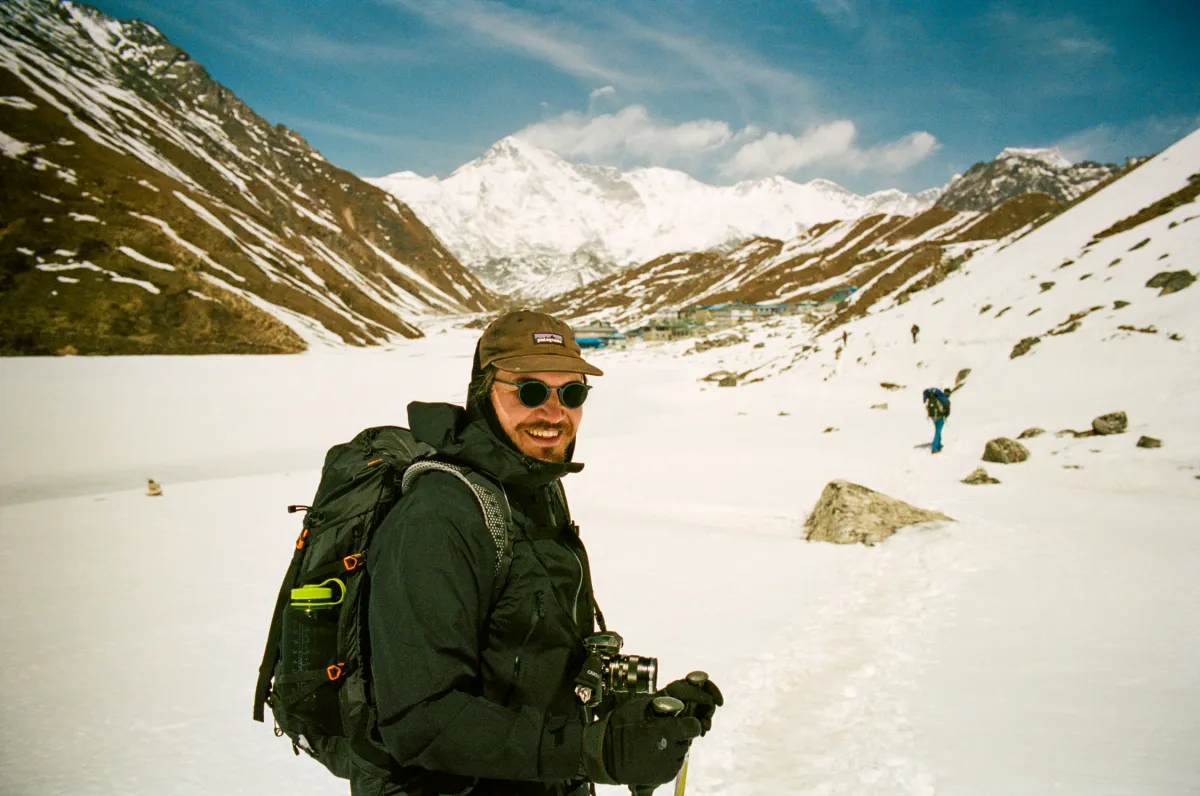
Jeremy Power Regimbal is an award-winning filmmaker and photographer whose work spans feature films, documentaries, and advertising, with a focus on intimate storytelling and social impact.
In his early twenties, Jeremy founded The Lab Magazine, a globally distributed publication built around long-form, unfiltered conversations with cultural icons including Willem Dafoe, Sam Rockwell, Wes Anderson, Marina Abramović, and Noam Chomsky.
At 27, he made his feature directorial debut with the psychological thriller In Their Skin (2012), which premiered at the Tribeca Film Festival and was released theatrically by IFC. His documentary-driven commercial work for brands such as MasterCard, Nike, and Chevrolet has been recognized by AdWeek, Creativity, and Ad Age, and earned a Young Director Award nomination at the Cannes Lions Festival.
Over the past decade, Jeremy has lived and worked extensively in Nepal, directing Between the Mountain and the Sky (2025), an intimate feature documentary produced by the Emmy-winning Duplass Brothers. The film has screened at more than 40 festivals worldwide, winning over 30 awards, including the Audience Award at Mountainfilm Telluride, and has received a North American theatrical release. Alongside the film, Jeremy led a global impact campaign that reached more than 15 million people and helped raise over $2 million in support of BlinkNow, the nonprofit at the heart of the story.
Through his production company, MPWR CONTENT, Jeremy blends cinematic storytelling with a deep commitment to social good, creating films and photography that amplify underrepresented voices and help catalyze real-world change.
IDA: Could you share a bit about your background and the experiences that shaped who you are as a storyteller?
JEREMY POWER REGIMBAL: I grew up in northern Canada, in a remote, forested area. My parents were back-to-the-land hippies, and we grew up wild and unsupervised, running through the woods. That freedom shaped my imagination in a fundamental way.
Honestly, filmmaking never felt like a real option as a kid, but I loved watching movies. The only place to rent VHS tapes where I grew up was a diner in a nearby tiny town, about a 40-minute drive through the woods. I still remember the excitement when something new showed up, and we’d take it home to watch on our old tube TV with rabbit ears.
I didn’t go to film school. My older brother, now a cinematographer, told me to spend my money on a camera and a computer instead. After high school, I moved to Vancouver and worked every job imaginable on big film sets. I eventually fell in love with editing and cut hundreds of music videos, which became an invaluable training ground.
In 2010, despite everyone saying it was the worst possible time to launch a print publication, I co-founded The Lab Magazine.
IDA: When did you begin working in the documentary field, and what initially inspired you to pursue it?
JPR: Between the Mountain and the Sky is my first feature documentary, so I think when it started ten years ago was the real start of my documentary journey. Before that, I had made short documentary pieces, mostly for brands. I enjoyed them, met great collaborators and learned so much, but I hadn’t yet found a story that felt worth committing that much of my life to.
I also think that through The Lab Magazine, I fell in love with the interview process and what happens when people feel safe enough to be honest. I noticed how different conversations became when they felt like two humans talking, rather than a journalist following a script.
There is also just something completely magical about watching a great documentary that gives you a raw, unfiltered glimpse inside the human journey, and I have always been drawn towards discovering how to capture those moments without feeling the camera’s presence.
IDA: Congratulations on the success of your deeply moving and impactful film, Between the Mountain and the Sky. For our members who may be new to the project, could you tell us a little about the film?
JPR: Between the Mountain and the Sky is a deeply personal documentary filmed over ten years, following “CNN Hero” Maggie Doyne and Top Malla as they build a family and home for more than fifty orphaned children in Nepal. At its heart is an unimaginable loss that changed everything—and changed my role as a filmmaker. I broke the traditional boundaries of documentary, fell in love with Maggie, and became part of the story I was telling.
Blending decades of archival home videos with intimate verité footage, the film explores grief, resilience, and the healing power of love. After premiering at Mountainfilm in 2024, we chose an impact-driven, direct-to-audience release. That approach has created real impact, helped raise significant funds for the community at the heart of the film, and built a genuine audience that I know will carry forward into future projects.
IDA: When did you begin working on Between the Mountain and the Sky, and how did your collaboration with Maggie first come about?
JPR: This film didn’t begin with a pitch deck or a plan to be a feature. It grew organically. I originally met Maggie in 2015 at the DO Lectures, and after the accident at the children’s home in 2016, we reconnected while she was in the US trying to put her life back together.
At first, I wasn’t filming. I was just present. Sitting quietly, listening, trying to help her find glimmers of joy between tears. Over time, we fell in love at the most unexpected moment. My first trip to Nepal was meant to capture photos and video of Maggie’s oldest children before they left for college, but once I met the fifty children and saw the home they had built, I knew I had to go all in.
I remember feeling that if I could capture the feeling and idea of love showing up at someone’s darkest moment, it could change people. My good friend and producing partner Eric Tu gently encouraged me to keep filming, reminding me I could always throw the footage away if it felt too personal. I’m so glad I captured it all—it was a magical period of life that reshaped my understanding of family, love, and hope.
IDA: The film is visually stunning, emotionally resonant, and deeply empowering. As you were making it, did you anticipate the kind of impact it would ultimately have on audiences?
JPR: Not at all. Honestly, making it felt like a diary entry I couldn’t ever share. The response has gone far beyond anything I imagined. We’ve had eighty-year-old men tell us they haven’t cried in thirty years and that the film made them want to live differently. Activists have told us they were close to giving up and that it recharged them. Teenagers, who honestly surprised me the most, have connected deeply and told us it gave them hope.
But what I’m most proud of is that we chose to self-release the film and center impact over everything else. Through screenings, we’ve raised over two million dollars for BlinkNow, the nonprofit at the heart of the story.
IDA: The filmmaking process must have been both emotionally demanding and creatively challenging. How did you navigate the uncertainties and shifts that arose during production?
JPR: That was one of the hardest things I’ve ever done, but I was incredibly lucky to have a community that showed up at exactly the right times. I was constantly balancing being present for people I love while wanting to do the film justice. As I became more involved in the family, it started to feel wrong to always be holding a camera, so I brought in a small, trusted crew. I built deep trust with cinematographer Robert Mentov, who put years into this film and lived with us in Nepal.
It was ten years of ups and downs, running out of money more times than I can count, and constantly questioning whether the film was too vulnerable or too intimate; You know, the fun, creative journey. Ha! Executive producers Karen and Tom Mulvaney stepped in early when things could have easily fallen apart. The Duplass Brothers also came on as executive producers and were incredibly supportive, understanding how personal the film was and giving me the time and trust to find it.
IDA: Looking ahead, what’s next for you? Are there any upcoming projects you’re able to share with us?
JPR: We are still very much in the middle of releasing Between the Mountain and the Sky. There is a long road ahead with educational distribution and online release, and more impact screenings.
At the same time, I have been quietly working on another very personal documentary that I am not quite ready to talk about yet. I also finally have the time to edit a few short films I shot last year, and write some narrative projects, which feels like a gift after living inside one project for so long.
I am always looking for stories that feel intimate, human, and worth the time they ask of you, and we continue to share short documentary work connected to stories in Nepal through BlinkNow.org
IDA: For our members who are eager to watch Between the Mountain and the Sky and stay connected with your work, what’s the best way to see the film and follow your upcoming projects?
JPR: We actually just closed our recent online screening window on our site, but I would genuinely love to share the film with the IDA community.
I’ve set up a private, pay-what-you-want link just for this, and that truly means whatever feels right, even if that is zero dollars. What matters most to me is people seeing the film and hearing what it brings up for them.
You can watch it here.
The main site for the film is BetweenTheMountain.com, where you can find the trailer, upcoming screenings, and ways to host a screening in your community if that feels right. I also share updates and behind-the-scenes moments on Instagram.
Mostly, I’m just grateful to be able to share this film with a community of fellow filmmakers, and I would truly love to hear what you think after watching. Thank you!