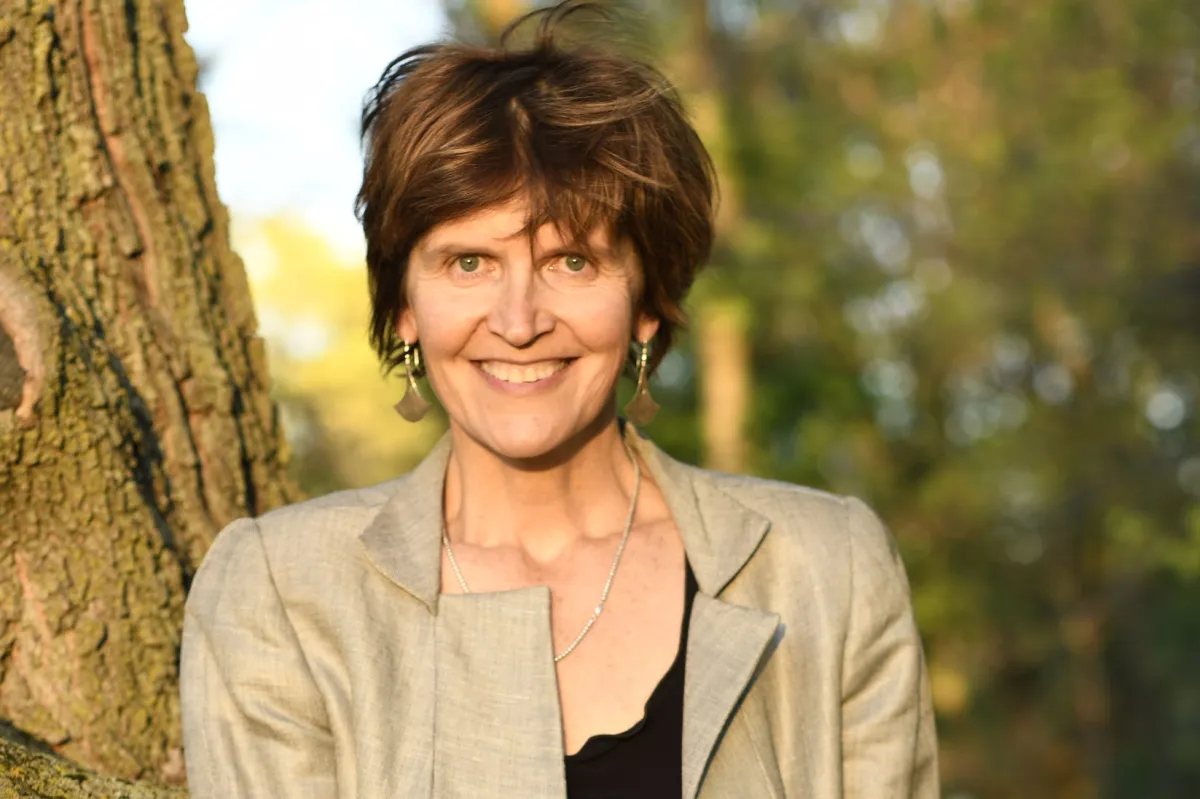
Alison McAlpine
Welcome to IDA Member Spotlight, a monthly interview series highlighting IDA members and showcasing the depth and diversity of our community. This month, we had the pleasure of speaking with Alison McAlpine.
Alison began her career as a published poet, playwright, and theatre director. The success of her commission to write a TV opera inspired Alison to make her first film, the award-winning mid-length Second Sight (2008). The BBC commissioned two versions. Ghostman of Skye (BB2, 2009) was “Pick of the Day” or “Critics Choice” in every major UK newspaper. Cielo, Alison’s award-winning first feature, premiered at the New York Film Festival in October 2017 and was released in its final version in 2018. The film has been presented in over 400 international film festivals and cinemas, as well as winning several awards. Named as one of the 10 best documentaries of 2018 by Esquire and as one of the best films of 2018 that you didn’t see by The Guardian, Cielo has also been critically acclaimed by Variety, The Village Voice, The Globe and Mail, and Le Devoir. perfectly a strangeness, Alison’s first short film, premiered at the Cannes Film Festival, Official Competition, 2024, and had its North American Premiere at the 2024 Toronto International Film Festival. It was “Best of Fest” at IDFA 2024, and has since travelled to over 80 international film festivals, playing in 27 countries and winning 20 awards. Called “one of the most cinematic documentaries of the year” by Deadline’s Matthew Carey, perfectly a strangeness was nominated for Cinema Eye Honors, Best Nonfiction Short Film 2026, and has been nominated for the Academy Awards 2026 in the Best Short Documentary Film category. A 2021 Guggenheim Fellow, Alison is currently working on several new films.
IDA: Could you share a bit about your background and the experiences that shaped who you are as a storyteller?
ALISON McALPINE: I began filmmaking after a career as a poet, playwright, and theatre director. Creation myths, family tales, and the oral traditions of British Columbia, where I grew up, were my first inspirations. In Ireland, I discovered theatre and wrote monologues and musical theatre works, which were performed in Europe and Canada. I also trained in France with European clowns. All these experiences continue to shape my storytelling. My filmmaking is poetic and cinematic with a strong emphasis on character and landscape. I aim to make films that are empathetic, audacious, that evoke like dreams or music, and offer the viewer a space to think and imagine for themselves. I am following a personal, collaborative filmmaking process, a sense of wonder, intuiting an alternative way to direct and think about films, adapting to nature, my surroundings, my subjects-actors with humility, which leads, I hope, to filmmaking that feels deeply authentic.
IDA: When did you begin working in the documentary field, and what initially inspired you to pursue it?
AM: I was lucky to work with fabulous actors who often told me I should write for film. When I received a commission to write a TV opera based on one of my plays, I had my first opportunity. Creating the screenplay felt natural and exciting. It gave me the confidence to dive into the world of filmmaking. My first film, Second Sight (2008) was inspired by my Hebridean great-grandmother, a remarkable storyteller born with second sight. Guided by intuition, chance, and curiosity, I travelled through the north of Scotland and the Highlands, meeting the last generation who grew up without TV or electricity. I was looking for subjects/characters who were like great actors; people who don’t explain a role, who are themselves while revealing a humanity that speaks to something universal. How can a story be an evocation of a moment, a place in time, a gesture? I wanted to use light, shadow, and landscape as character and metaphor and blur the boundary between fiction and documentary, capturing the magic real mood/feeling/tone of the world of second sight.
IDA: Congratulations on the Oscar Nomination for your deeply moving and impactful film, perfectly a strangeness. Could you tell us a little about the film?
AM: In the dazzling incandescence of an unknown desert, three donkeys discover an abandoned astronomical observatory and the universe. perfectly a strangeness is a sensorial, cinematic exploration of what a story can be.
When I first visited an astronomical observatory in the Atacama Desert, I was reminded of a story I heard after visiting a circle of giant standing stones in Orkney, Scotland. Every night at midnight, the stones come to life and dance. At dawn, the giants turn back to stone until midnight strikes again.
In the Atacama, every night as the sun sets—if it doesn’t rain or snow which rarely happens—observatory domes and telescopes open and tilt upwards. Motionless by day, these billion-dollar beasts begin to dance making the most extraordinary sounds: motors grind and whirl in different rhythms; winds and metals sing and groan as the observatories and their instruments shift and turn. At dawn, the beasts fold their metal shells inward; they sleep until the sun once again disappears. One afternoon, as we were arriving to shoot the lunar eclipse for my film, Cielo, a family of donkeys were grazing near a telescope dome. As they watched us, I wondered how they perceived the desert and the observatory? What do they see and hear?
IDA: When did you begin working on perfectly s strangeness, and what drew you to the project?
AM: When I finished my feature-film Cielo in 2019, which was filmed in the Atacama Desert in Chile, I had to deliver a short film shot in the same area. How could I create a film that felt very different and that challenged me in new ways? I went back to my first experiences in the astronomical observatory La Silla; I wrote a treatment. Then COVID arrived and my mum’s cancer. Our first shoot was in 2022.
I felt compelled to make, perfectly a strangeness because I wanted to redefine what a story can be, working with texture, movement, light, shadow, reflections, sound, and rhythm. No text; creating cinema that you want to touch like an exquisite painting, or a poem that you want to experience again and again, offering the viewer a space to think and imagine for themselves. I wanted to find the uncontrived, authentic simplicity of the narrative in picture and sound. I wanted to express not the well-known anthropomorphic view of animals, in particular donkeys, nor the familiar perception of astronomical observatories, but rather to immerse the viewer in a sensorial experience which feels animalic, fresh, and unforgettable. Ingmar Bergman’s quote is an inspiration: “Film as dream, film as music. No art passes our conscience in the way film does, and goes directly to our feelings, deep down into the dark rooms of the soul.”
IDA: What has been the film’s reception, and does it resonate with the impact you hoped it would inspire?
AM: It’s been an extraordinary journey, which began with our World Premiere at the Cannes Film Festival in 2024. Since then, the film has travelled extensively and continues to travel. I never expected any of this. I feel very grateful to have worked with amazing creative teams in Quebec and Chile. My film is independent, with no studio backing. It feels wild and wonderful that it has been nominated for an Academy Award!
IDA: For our members who are eager to watch perfectly a strangeness and stay connected with your work, what’s the best way to see the film and follow your upcoming projects?
AM: perfectly a strangeness will be shown on the Criterion channel beginning March 2026. It is available on CRAVE in Canada. It will soon be available on Kanopy. My website has information about my filmmaking: www.alisonmcalpine.com
IDA: Looking ahead, what’s next for you? Are there any upcoming projects you can share with us?
AM: I am working on a screenplay for a feature fiction film and a creative documentary feature. I’m not quite ready to discuss these projects, but I would love to share more soon.