

I first attended BlackStar’s William and Louise Greaves Filmmaker Seminar in 2024, after a few years of watching its intriguing new seminar programs from a distance. I came away from the session buzzing with inspiration and connection, making friends and meeting collaborators that have lasted in the years since, feeling so alight with the excitement of filmmaking generated from a buoyant, intergenerational film gathering.
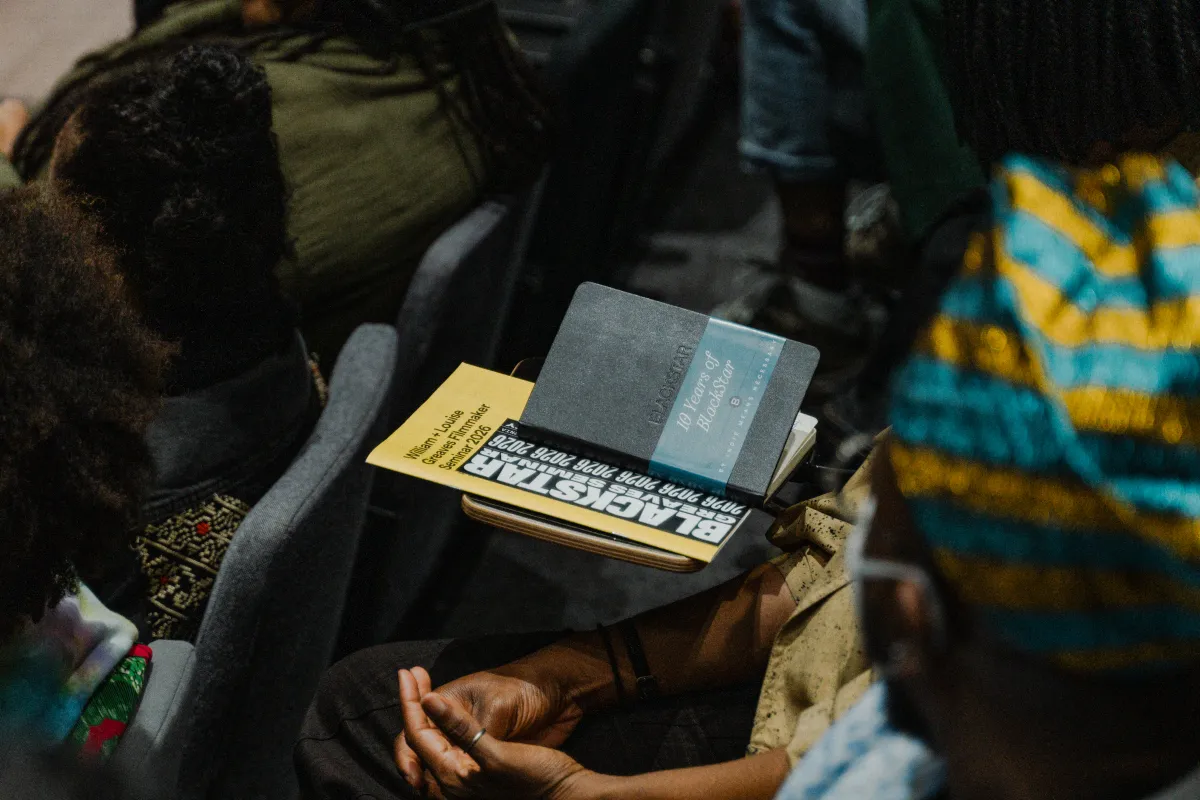
Spaced out over a dense, but well-paced three days, the Greaves Seminar is a gathering put on by BlackStar and hosted in partnership with the Institute for Diversity in the Arts (IDA) at Stanford University, “for Black, Brown, and Indigenous artists working in cinematic realms.”
I was ready to attend this year’s edition before I even heard what the lineup would be. I have trust in the seminar organizing team at BlackStar to put together a beautiful weekend of intergenerational connection and knowledge sharing. The filmmakers, artists, and speakers presenting at the seminar offered up an opportunity for attendees to reflect on the increasing permeability of filmmaking, the bounds of fiction/non-fiction continuing to blur, and forever developing ethical questions of storytelling that incorporate honest dialogue about the past, present, and future—all driving many of the discussions.
Keynote Address: “Create Dangerously: Remembering Black Bodies in Motion” With Michèle Stephenson
Michèle Stephenson, co-director of Going To Mars: The Nikki Giovanni Project, True North, and co-founder of Rada Studio, initiated the seminar with the directive for filmmakers to “create dangerously,” and a call to create “cinema that moves like freedom.” Her keynote glided from her previous cinematic works, with clips and images drawn from her archives, as she guided us through her process and the lessons it has imparted. She asked us, “What are we building as we’re running?” The perpetual flight of Black peoples globally towards resources, survival, prestige, stability, and brilliance at times clouds the horizon, obscuring our present and making us forget to think of “filmmaking practice as an archive for the future.”
“The current nonfiction field was never made for us,” she stated, all while imploring us to find ways to be radical in practice and especially in form in order to break the bounds of contemporary nonfiction filmmaking landscapes: to “create dangerously without reproducing extraction.” She reminded us that William Greaves made films that tested the conditions of filmmaking itself and that it is our responsibility as filmmakers, as Black filmmakers, to continue to test the bounds of our chosen art form beyond the demands for legibility and press into the unknown.
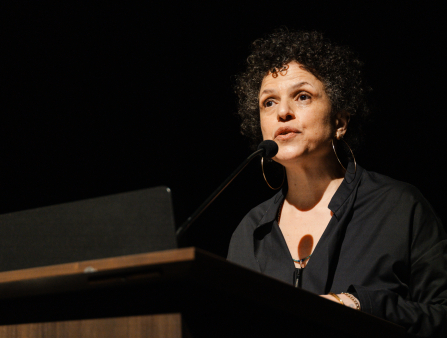
Michèle Stephenson during her keynote.
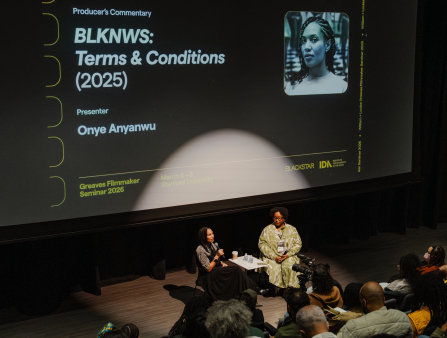
Onye Anyanwu (L) in conversation with Maori Karmael Holmes (R).
Producer’s Commentary: BLKNWS: Terms & Conditions With Onye Anyanwu
A chief joy of the seminar is to have this time, a reason to be together with friends from across the country, immersed in impassioned, interrogative discussion about filmmaking amidst the coast live oak and redwood trees on the aromatic and peaceful campus of Stanford University. That’s why, rather than attend the screening of BLKNWS: Terms & Conditions ahead of Onye Anyanwu’s talk (I’ve caught the film five times already), I opt to spend some time outside in the sun with fellow filmmaker friends to talk and eat. To be able to see each other in this way is truly a treat, with many either paying out of pocket to be present, and others having their day jobs and institutions pay for them to be able to be there.
Onye’s talk opened with a necessary and urgent reminder for us as storytellers: “the path of a griot is demanding.” She pulled back the curtains on the making of BLKNWS, from its inception at The Underground Museum in Los Angeles, pitched to Vice as a TV show with Ryan Coogler attached, through the fields of funding and production that led to to the film, from being pitched by Anikah McLaren, formerly at Participant, to make a feature back at 2020’s pre-Covid Sundance when they first showcased BLKNWS in its installation form, to its current feature film form that has circulated in theaters in the past year. It was a special treat to hear Onye speak about the project and her work, as well as the collaborative alchemy of the cinematic worlds she and her husband, Kahlil Joseph, create together.
She spun stories of difficulty and serendipity as she brought visions of Black life to reality. “Start where you are. You have more than you think you do.”
“Even when a deadline is looming, [think about] what you can do to help the soil, not the plant.” Onye, as Michèle before her, was asking us as filmmakers to consider the collective responsibility around storytelling—of making Black films and finding ways to compost the extractive modes of production and lay them down as fertilizer for the growth of new cinematic forms.
Work-in-Progress: The Age of All Women: The Becoming of Younousse Seye With Lendl Tellington
The seminar resumed on Saturday with a work-in-progress session, one of my favorite features of the Greaves Seminar. I love the excitement of seeing work take form, of witnessing new storytelling forms, and of early glimpses of magisterial histories being uncovered. I particularly enjoy the private and intimate joy of being part of an incubation space that prioritizes Black filmmakers and African methods and orientations in storytelling and world-making. Lendl showed us clips of his nearly finished feature documentary about his family, titled That’s Why He Made Momma, but we spent most of the session on his newer piece about the Senegalese artist Younousse Seye, titled The Age Of All Women: The Becoming of Younousse Seye.
Themes of collective accountability to memory, recognition, and the archive came alive again in this session. Lendl talked of the conflicts, the ethical contradictions inherent in (particularly American) filmmakers’ complicity in bringing western attention to continental African (and diasporic Black) brilliance, the heavy responsibility that comes with the act of cultural translation. We walked with him in a communal, intergenerational call-and-response of feedback as the room full of wisdom, energy, curiosity waded through the thornier brambles of telling a story by a Black American about African art and its “forgotten” artists.
The William and Louise Greaves Filmmaker Seminar is a powerful beacon in the Black film world, an opportunity for intergenerational encounters that have the power to help shape the trajectory of Black (especially African American) filmmaking.
Workshop: The Devil Finds Work: James Baldwin’s Cinema of the Mind With Beandrea July and Kendale Winbush
The second day of the seminar transitions into the multiple-choice phase, where attendees can pick one of three workshops to attend. While Rashid Zakat’s “Cinematic Aliveness: How to Edit Like a DJ” and Tenzin Phuntsog’s “The Image That Eludes the Conscious Mind” both sounded intriguing, I opted to attend Beandrea’s workshop.
The session focused on the writer’s relationship to film. We watched the airy film James Baldwin: From Another Place (1973), which finds the writer in Turkey, living his life and pontificating with ease about life at large and small. We got into a condensed cut of Lady Sings the Blues that Beandrea had assembled, and which Baldwin writes about in his book of film criticism, The Devil Finds Work. Beandrea led us through a study of Baldwin’s world and words, collectively thinking through Baldwin’s recognition of the primacy of the Black actor in Hollywood being able to pull Black realities into films that are white fantasies of Black life, “smuggled like contraband in a maudlin tale,” as he writes.
It’s enlightening to read Baldwin on speaking and crafting his languages of film, encouraging spectatorship as an active participatory act to create “cinema of my mind.” Beandrea led us in thinking of “film programming as an active way of creating empathy,” as she experiments with the form and worked with performer Kendale Winbush to enact a live rendition of Baldwin’s words for the workshop.
Short Film Program: 15 Years of BlackStar: Risible Shorts Curated by Nehad Khader
The day ended with a screening program from BlackStar Festival Director Nehad Khader, who looked back at 15 years of BlackStar with shorts from across the festival’s history. The films are fine and funny (full disclosure, I also work with Nehad and BlackStar as a programmer on their Feature Narrative Programming Committee for the festival), but the real meat of the night comes when Maori Karmael Holmes, founder of BlackStar, and Nehad sit down for a conversation about the structure and history of the festival and how it came to be what it is now.
As a more recent comer to BlackStar, I’ve been curious about how the festival has evolved over the years, and it was enlightening to learn of the changes and decisions that brought BlackStar to its current point. Maori spoke of the transition from focusing exclusively on Black American and diasporic work to the inclusion of non-Black filmmakers of color as a means to avoid replicating other Black festivals across the country and their programming. This shift is propelled by the Black Internationalist tradition, with the aim of leaning into Global South solidarity, lifting up the concept of the Global Majority, and affirming anti-imperial struggle. As the festival grew, they incorporated more non-Black POC programmers into their committees and selected more non-Black films for the programs.
This latter point was interesting to hear and nice to be discussed in such a semi-public forum. I’ve talked to and heard from many Black filmmakers who have been frustrated by this perceived drift in programming at BlackStar, folks upset that films by non-Black filmmakers were chosen over their films at a film festival that, in its namesake, history, and growing prestige, they feel could and should be for us by us. The conversation is ongoing and multilayered; the relative inclusiveness of BlackStar does help it stand out without necessarily threatening the priority of Black culture and art, but it is intriguing for BlackStar to open up a discussion about its past, present, and future as it moves into the 15th edition of the festival.
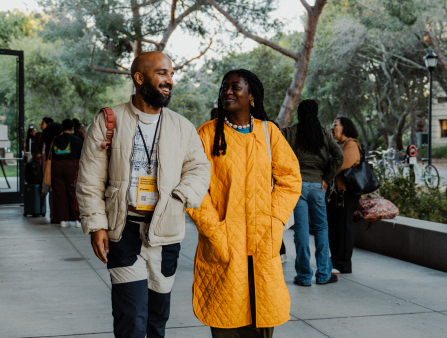
Matazi Weathers and Adesola Thomas in between sessions.
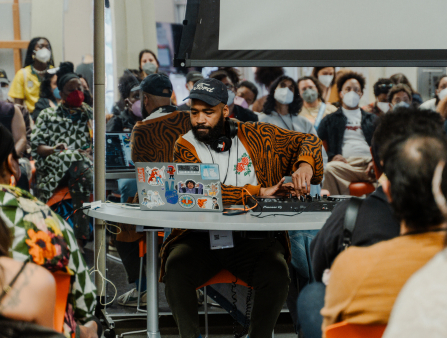
Rashid Zakat during his workshop.
Short Film Program: Filmmaking as Community Care with Maya S. Cade and Ben Caldwell
On Sunday morning, Maya and Ben led a screening and discussion of Ben’s work. Ben is a mentor of mine in Los Angeles, and I’m excited to see his film I & I for the first time. My first thought as I watched was that this is the prototype of Negro Collage (as my brilliant friend Brandon Drew Holmes likes to call it). In the film, we experienced personal accounts of Black history, familial stories, images of the world, the frights and delights therein.
Close-ups of skin, textures of body, the composition of love, leaving the tongue, given sound, given image. “We are love reaching for itself.” Ben walked us through his masterful, inventive film, sparking thoughtful, emotional responses from the crowd. Ben is a true inventor, an ingenious man of art who pounds like a drum and blows open civic possibilities for all those around him. “Do it for the world,” Ben said. He asked us to recognize that there is healthy film and unhealthy, junk film, and to be mindful of what we put into our bodies and spirits. “Film gets in your mind, and we’re shaping brains but pretending like we’re not.”
The William and Louise Greaves Filmmaker Seminar is a powerful beacon in the Black film world, an opportunity for intergenerational encounters that have the power to help shape the trajectory of Black (especially African American) filmmaking. As William Greaves did in his own films, the weekend offers more questions than answers about the art, craft, and industry of filmmaking. Other attendees and I left feeling empowered to be able to make our way, charged from a collective source of power, one that is generations deep in wisdom and experience, intentionally enlivened by fresh, forceful waves of energy and change. A power that can help us shift the form, the function, the affect, and the impact of the stories we tell and carefully construct the archive we aspire for future generations to receive.
Editor’s Note, April 13, 2026: This piece has been updated to reflect BlackStar’s mission in including non-Black filmmakers of color in their program.