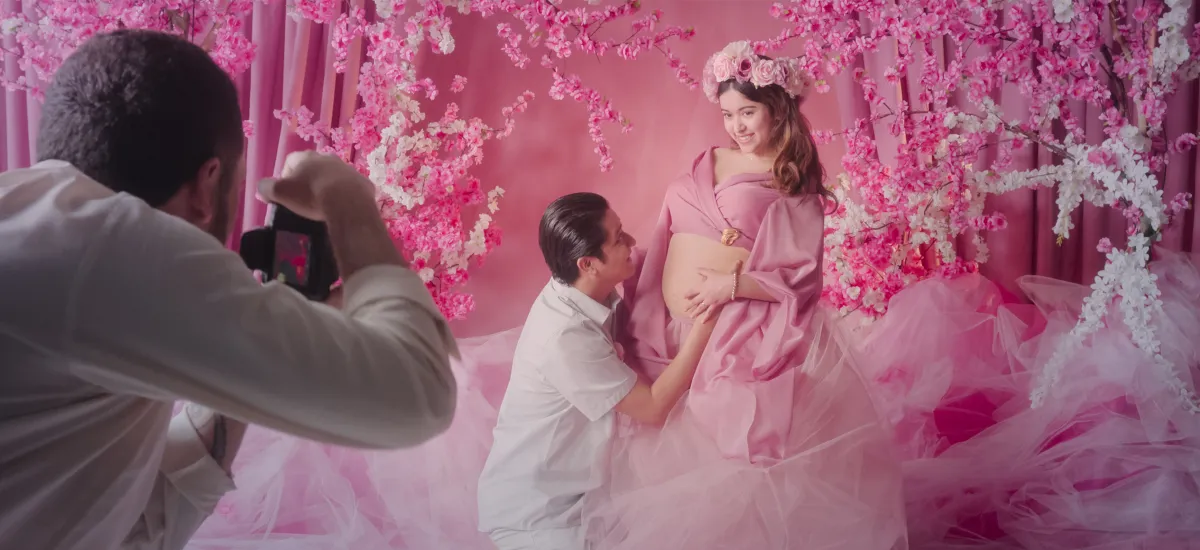


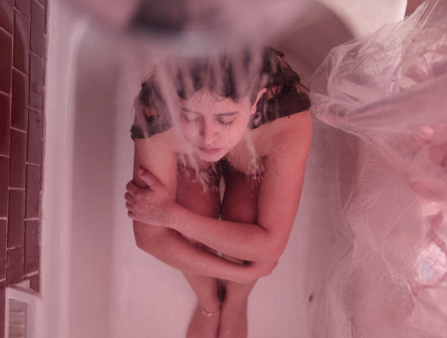
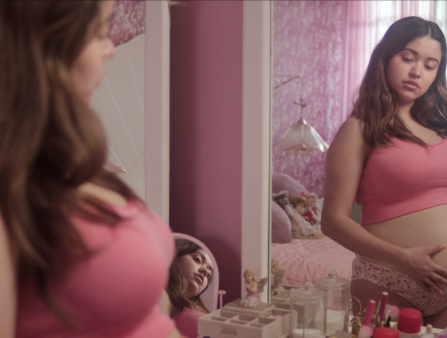
The cotton-candy aesthetic that runs through much of Maite Alberdi’s latest documentary, A Child of My Own, is intentionally cloying. As we follow the real-life story of Alejandra, who successfully faked her own pregnancy for months on end and then got arrested for leaving a hospital with another woman’s baby, Alberdi washes Ale’s tale in a pink-hued aesthetic that lends it an air of fanciful fantasy.
There is no commitment to gritty (or authentic) reality here, whatever that may mean. Instead, these reenactments feel like parodies of the unbelievable yarn Alejandra spun at the time of her arrest: she insisted Maya, the woman whose baby she’d left with, had agreed to give it up months prior.
The Chilean filmmaker knows this real-yet-implausible, true-crime-sounding Mexican story feels very much like a departure from her intimate observational docs, including Los niños (2016), The Mole Agent (2020), and The Eternal Memory (2023). Yet the documentary frame which encases it—the opening moments show Alberdi auditioning actresses for the role of Ale, while the latter part of the film features on-camera interviews with those involved in the case, including the judge who presided over it—is precisely what drew her to tell Alejandra’s story in the first place. “It’s so unbelievable,” she says, that the only way to tell it was within a genre that insists on its allegiance (however elastic) to “real life.” What emerges is both a rebuke against sensationalized media headlines that followed Alejandra’s case when it happened more than a decade ago, and a winking commentary on the expectations women like Alejandra are forced to conform to when it comes to being dutiful wives and mothers.
Ahead of its release on Netflix, Documentary caught up with Alberdi over Zoom to talk about moving away from her observational mode to tell Ale’s story, why she values character over story when choosing projects, and what writing film criticism taught her about making films. This interview has been edited for length and clarity.
DOCUMENTARY: As someone who’s been following your career for a long time, how you’re choosing your projects and your subjects is endlessly fascinating to me. I’m curious how this specific story landed in your orbit.
MAITE ALBERDI: I was hired to do research for a TV series inside a jail in Mexico, and I was having lunch when Alejandra started speaking to me. I asked her why she was there, and she didn’t tell me the first day. Then, after a week, she told me. I was completely blown away by the fact of why someone would need to fake a pregnancy for six months, but also how she did it—and that was my starting point with her: curiosity. At the beginning, everything was all these practical questions, like, “But do you have sex with your husband?”
And everything was weird, funny, and dramatic. The story has the tone that I love, because it is a story that easily could be a true crime about what happened. But for me, the question of the film from the beginning was about all those invisible pressures that we have around motherhood.
You cannot go with your form to the characters; you have to discover what the form is for that particular story.
—Maite Alberdi
D: I’m curious at what point this curiosity and that question translates into, Well, this should be a film—more specifically, a documentary, since the way you’ve structured it means it’s very much close to a fiction film for much of it.
MA: It was very clear from the beginning that it had to be a documentary because it’s impossible as a fiction: You cannot believe it. Everything feels so fake. You need to know that it was real to connect with it; that’s what I love about documentaries. Everything that happened to her is stranger than fiction. The most challenging thing about the process of development isn’t having the story, but really finding a way to build that character in the form. I can define myself as a documentary filmmaker who makes observational docs, but you cannot go with your form to the characters; you have to discover what the form is for that particular story.
D: Can you talk about the writing process and figuring out the doc’s structure?
MA: The form and the structure we decided on really represent my own process with [Alejandra]. Because for the first two years, I only heard her version. It was super difficult to get the trial and sentencing file, get to the judge, and have Maya, because she didn’t want to give the interview at first. So for many years, that was my version, and I completely believed in that version. And then when I started to hear the other voices, I crashed into reality. I was very disappointed. And I had to ask myself, How can I connect that with a character I love? The other characters helped me to do that. The judge helped me a lot when she stated that it was a social system that failed her; that she didn’t have the mental healthcare she needed when she had her third miscarriage.
I know that she committed a crime, and she made a mistake. I do not defend that, but I really empathize with her context and with her pain, and that journey is the one I want to represent in the script and in the form. So that’s why the first part is not a recreation for me. It’s a subjective representation of her testimony, in this pink Disney mood. It’s a fantasy she tells herself until she crashes into reality in jail, and the audience crashes into reality with the traditional documentary when we start to hear from those other voices.
D: I wanted to talk about what you owe her as a subject. The film—that fantasy part of it—is a bit of a gift to her, and I wanted to know if there was any hesitation in presenting her version of the story that way.
MA: It is a gift for her because it’s an opportunity to tell the story from another perspective—not the perspective the media has of her. She’s, of course, very grateful for that all the time. But what we really took care of was to make sure everything was from her perspective. It was fully her version, even if it has contradictions. Our limit was her testimony. Even though there were fake things in her testimony, especially the encounter with Maya.
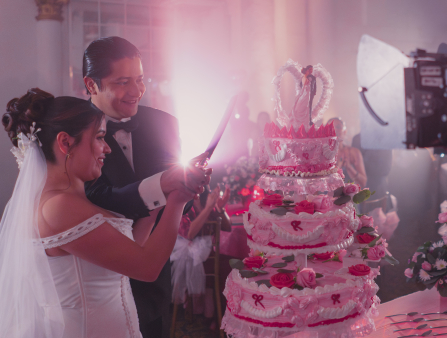
(L to R) Ana Celeste Montalvo as Alejandra, Armando Espitia as Arturo in A Child of My Own.
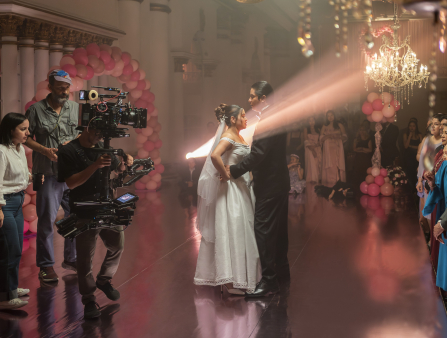
Maite Alberdi shooting A Child of My Own.
D: There are connections to be drawn with your recent fiction film, El lugar de la otra (In Her Place, 2024), since it carries a bit of the same DNA as A Child of My Own.
MA: A Child of My Own would never exist without In Her Place, because I would have been afraid to do that first part. I usually work with a crew of three people. I’m not used to having that big fiction crew. In Her Place was a kind of film school for me.
D: Thematically, though, these are also two films about women you’re trying to pull out of the legal and societal frameworks that lead to their own “true crime” stories.
MA: They’re about the same topic in the sense of what we expect women to be. In one, it’s about what it means to be judged as a woman, and in A Child of My Own, it’s a woman who is trying to be the best version of what society expects: being a mom, being married. They are very connected in how they have to be judged.
But also, both characters find freedom inside the jail. Alejandra really made the exercise to understand that it was a social desire, not her personal desire [to want to be a mom]. That is another way to understand the jail we never usually see.
D: I didn’t know that you had been so involved in writing film criticism early in your career. For instance, you worked on the publication of the anthology, Teorías del cine documental en Chile: 1957-1973 (Theories of Chilean Documentary Film: 1957-1973, 2007). How much of that work informs your practice today?
MA: It’s an important background for me. I didn’t write criticism for too long. I stopped when I started making films, but I did it for about three years. I wanted to write about cinema, not to make cinema, at the beginning. It was very important for my career in the sense that I always start from a very rational place. I don’t have the film with the story. I have the film with the form. There are so many questions you’re asking yourself in order to have an opinion of a film, and I think those are the same questions that I ask myself when I make a film. I don’t have a film until I have those answers.
D: It sounds like it’s quite intellectual.
MA: Yes, that is always my starting point.
D: Is there a moment when those intellectual conversations take a more visceral or emotional turn?
MA: I never have that intellectual conversation in the field. It’s in my mind—but in the field, it’s more about experience and being in the company with the subject. I could never make a film of someone I don’t want to be with. I’m going to be with them for so many years that I really need to want to share time with them.
D: I’m gonna quote you back to you because, in reading your criticism on political docs for La Fuga, I came across this quote that I want you to respond to: “Como espectadores, solemos esperar como personaje protagónico a alguien que encarne un magnetismo especial, ya sea por lo que le ha tocado vivir, por su manera de ser o porque nos identificamos con su naturalidad. Existen muchas posibilidades, que en el documental apuntan sobre todo a buscar personas reales con capacidad expresiva.” (“As viewers, we tend to expect a protagonist who embodies a special magnetism—whether due to their life experiences, their personality, or because we identify with their natural authenticity. There are many possibilities, though in documentary filmmaking the focus is primarily on finding real people with expressive presence.”)
It reads a bit like a thesis for what your filmmaking has become.
MA: Eso que puse me salió bien. Sobre todo hace tantos años. [What I wrote really came out well. Especially for it having been so many years ago.]
But that is what I expect from a subject when I’m casting. It’s people you really want to be with for an hour and a half in a film. And that is super difficult. It’s a kind of attraction. I’ve been talking a lot about this: In film school, they teach you about the journey of the hero and how the hero changes in the story, and they transform their own self. When you make documentaries, people never change. Nobody transforms. It’s terrible. In A Child of My Own, I shot that scene with Arturo one day before Ale leaves jail, and Ale is saying how she understood her desire to be a mom was social and maybe not her own, and when I asked him what he was expecting from their new life now that she was free, he said, “To have a child in vitro.” And all I thought was, After 16 years, you’re saying the exact same thing. People don’t change. You can’t expect that. The only thing that changes is the perception you have of that subject. That is something I learned, and it’s important because it’s not about the narrative; it’s about them.
D: That’s a fascinating way of thinking of documentary—that the journey is in the audience, not in the subject’s, necessarily.
MA: Completely. It’s an internal journey of the audience.