

Taylor Hosking still lives in the apartment where she grew up, in the same building where her grandmother raised Hosking’s mother and aunt, and where her grandmother still lives today. She knew her corner of Manhattan’s Upper West Side well, but when she met the neighborhood’s “mythical figure,” Chino La Familia, she realized how much she didn’t know—not only about Chino and his influential crew, La West Side Familia, but about her own relationship to a heavily gentrified community in New York City. Written, directed, and produced by Hosking in her feature debut, West Side Familia is both a tribute to a neighborhood that once was and an examination of the community that remains.
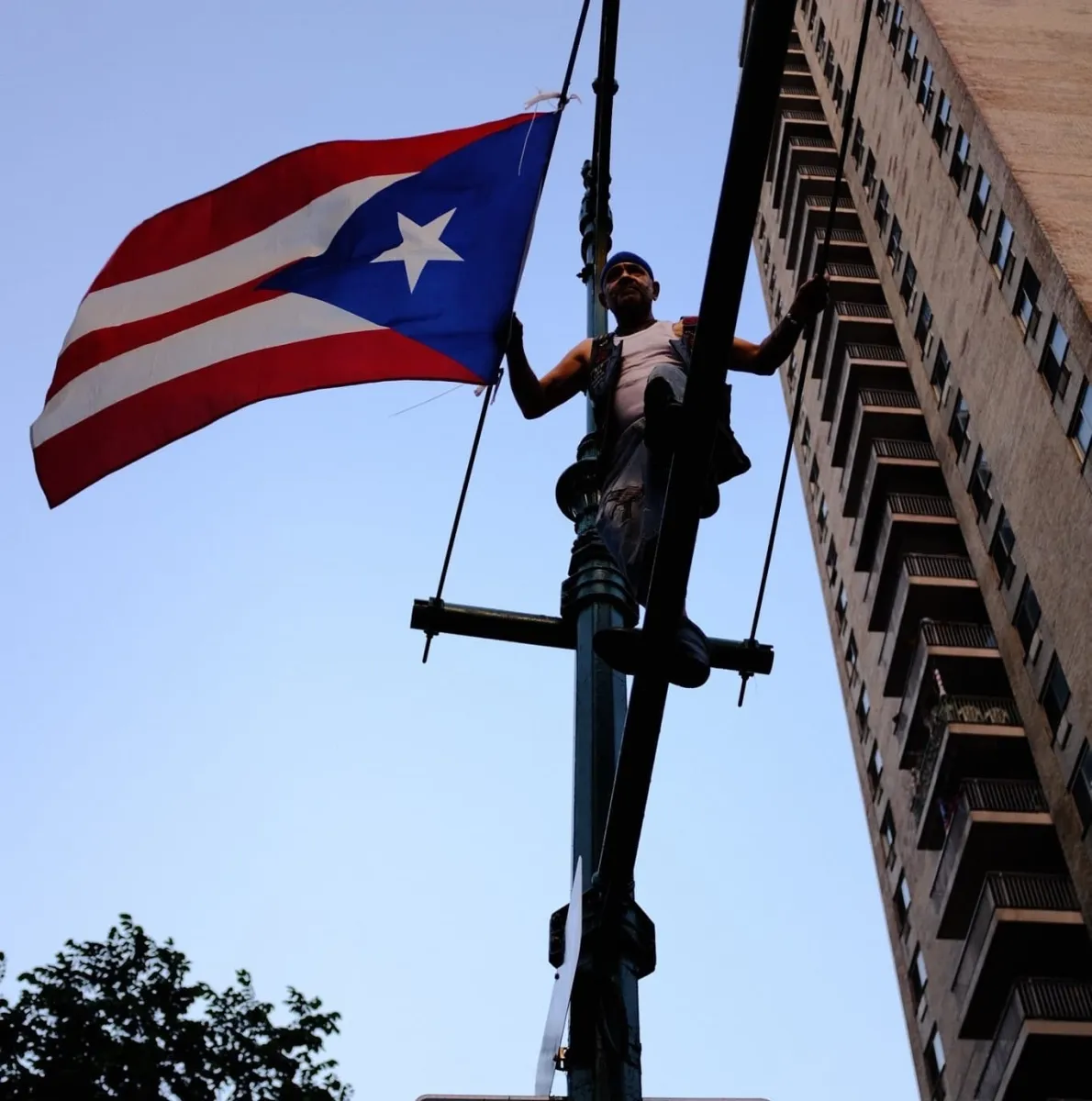
Shot over three years and combining oral history, archival research, and personal memoir, West Side Familia documents a predominantly Puerto Rican community that took root on Manhattan’s Upper West Side in the 1950s and whose cultural and political influence has largely been erased from the neighborhood’s official history. One of its central images, Chino and other West Siders scaling a traffic-light pole in front of Trader Joe’s to hang a Puerto Rican flag ahead of the annual Puerto Rican Day Parade, crystallizes the tension between erasure and visibility that runs throughout the film: the neighborhood has changed, but every June, the flag still goes up.
Hosking’s narration, at once succinct and poetic, does the intricate work of weaving Chino’s story together with her own, most poignantly through the West Side memories of her late mother and aunt. In an era when the individual can so easily eclipse the collective, West Side Familia asks how the spirit of communal life might be recovered, and offers its own making as one answer. Documentary caught up with Hosking via Zoom on the heels of its world premiere at the BlackStar Film Festival in Philadelphia, to talk about the challenges she faced in turning this community history into a feature-length doc (against calls to shape it into a short, instead), and alongside Chino, becoming an archival steward for the neighborhood in the process. This interview has been edited for length and clarity.
DOCUMENTARY: Tell me about the first time you met Chino and your impressions of him.
TAYLOR HOSKING: I had gotten my godfather to get me his number to interview him for a different take on this news write-up about Spielberg’s recreation of West Side Story. I was at Vice at the time, so I was like, How can I make this actually interesting? Let’s get a Puerto Rican leader of a quote-unquote “gang” in the neighborhood to comment on this.
So, just calling him up and talking to him about that. Of course, he doesn’t love West Side Story, right? But it just snowballed into me realizing that he had so many stories that I found interesting about the neighborhood.
D: Take me back to the moment when you realized, This needs to be a film, and I’m the one to direct it.
TH: I was pitching it around originally as a photo essay/article. I was chatting with a friend of mine who became the DP on that first day, Morgan Powell, who is now the producer. She just volunteered, “Why don’t we just go out there with a camera and get this thing rolling?” At the time, we had no idea if it might be a 10-minute video, but that first day, we did the main interview with him, where he’s standing on the balcony, and when he talked about how many movements he was a part of, I saw a whole movie unfurling around him as a vehicle to tell the whole neighborhood story.
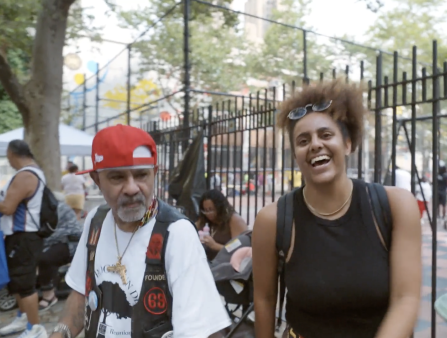
West Side Familia. Chino Familia dancing with director and narrator Taylor Hosking. Photo credit: Cristal Jefferson.
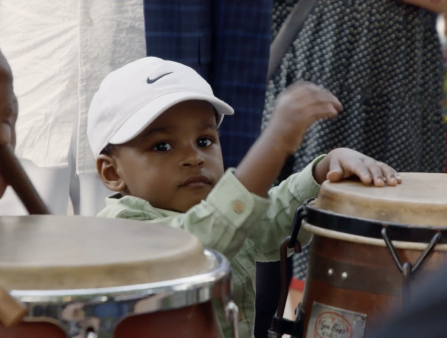
West Side Familia. A young boy playing conga with the Central Park rumba community. Photo credit: Cristal Jefferson.
D: It sounds like you came to it with an openness at first, and then you realized it could be a film?
TH: Definitely. It took on a life of its own, partly because we did start getting some grants as well, from the City of New York, the NYC Women’s Fund, and PBS’s Latino Public Broadcasting. Once we got Latino Public Broadcasting, that was when I was like, Okay, we could do a feature. Little did I know how much it really costs, but that was the thing that allowed us, from a logistical and financial perspective, to go for it after we saw the creative fullness of it.
I’m just kind of floored that, as a first-time filmmaker who was told by anyone I asked for advice on how to overcome these obstacles to just do a short, it actually worked out.
D: I’m not surprised to hear that people told you that, but after a while, you were like, No, actually, this needs to be a feature?
TH: There was actually a year in the middle there where we had a 40-minute rough cut, where we could either expand out or go down to 20 minutes. I just knew that at 20 minutes we probably wouldn’t be able to do anything more than the main story of this group, and a lot of the neighborhood story would get lost. A lot of the deeper reasons to tell the story wouldn’t likely be fleshed out in 20 minutes.
But we didn’t really have the money yet. So, for a while, I was just like, I don’t know why I feel spiritually pulled to keep going. I knew, creatively, that we had a feature. But when you don’t have the money in your hand, and you don’t necessarily even have the awareness of all the steps that it’ll take, and people are saying it’s going to be too many steps, too much work, it was very hard to decide to keep going as a feature. I knew that if we did the short, I probably wasn’t going to circle back for the feature.
D: The film feels like an act of preservation for a community that is increasingly shrinking. The spirit of the place isn’t gone, but a lot has changed over the years. When did you realize that preserving the community’s history was also part of what you needed to do?
TH: I’ve always been preoccupied with knowing that there were these interesting cultural stories about the neighborhood that seemed to be only being passed around amongst the adults around me. I became that person who was like, “Did you know that my neighborhood popularized breakdancing?” as just an element of my personality.
But I think as I started to see [Chino’s] story as a vehicle for that bigger one, and as I was interviewing more people and realizing it’s about La Familia as a group, I started asking: What’s really in it for me, in the deeper sense of a life’s mission, as I’m seeing the mountain of work and fundraising and all the favors and logistical hurdles that you have to pull off?
I think that search for a deeper meaning went to the neighborhood. And then it became about my love for my mom and the ways we are connected through our shared love of the neighborhood, and how she introduced me to that interest and told me about Chino for the first time when I was growing up, as this kind of mythical figure of the neighborhood.
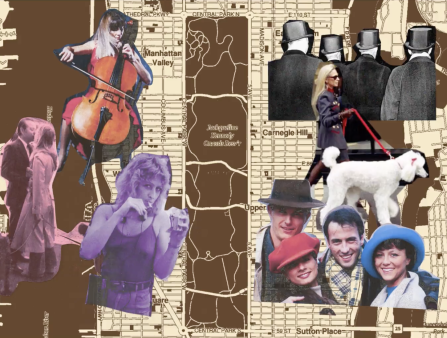
West Side Familia. Montage describing the stereotypical personalities and cultures associated with the Upper West Side and Upper East Side of Manhattan. Photo credit: Geoffrey Hiller and Getty Images.
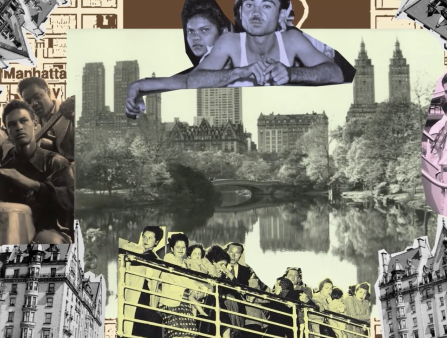
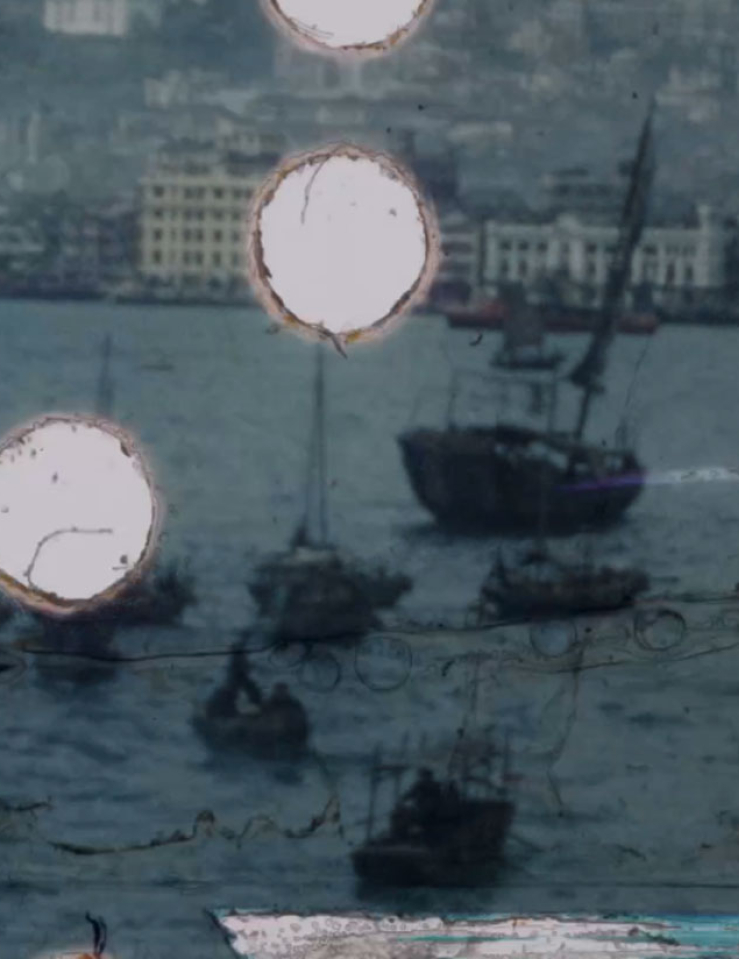
West Side Familia. Montage representing the communities that moved to the neighborhood after the creation of Central Park, a mixture of elites in castle-like buildings along the park, Jewish WWII refugees, and swaths of Puerto Ricans from the island throughout the 1950s and 60s. Photo credit: NYC Records and Getty Images.
D: I thought your narration was beautifully written and really worked to create the transitions and the seamlessness that you needed to weave the stories together. Did you always know that you would be narrating?
TH: I originally wasn’t narrating much in the first rough cut. But that was also a version of the film that was primarily about the guys and their story, and getting at the neighborhood story through that, but not nearly as robust or interwoven a story.
I realized, as we started to flesh it out more, Okay, well, I could get an academic to tell us about the history of urban renewal in this place, but actually, I don’t think anyone’s going to want to see them with all these other fun people around. So I was partly trying to avoid having—even though they are sitting and talking, they don’t feel like talking heads—anyone who wasn’t not only from the community, but of the community.
But it was certainly a hard decision to make because I didn’t want to take over the story. I didn’t want it to feel like a bait-and-switch. I still wanted [La Familia] to be the heart of the story. That was the most difficult thing to navigate. And then, as we organically became close and found so much meaning in our lives through our relationship with one another, between Chino and me, it became that kind of co-lead situation that felt right in the end because of the journey that we had gone on together.
D: Over those three years, what did you observe about Chino and the other guys in the doc?
TH: They are individually very confident people, and they love one another, but at the same time, they’re very marginalized within this world that we’re in right now. There were moments where I could feel how different things are right now versus what they’re speaking of in terms of their heyday with one another, and knowing that they would prefer for more of the people they grew up with to be around them more often. There is a somber undertone to being some of the last men standing, even if there’s beauty and glory in that. I just feel grateful that they allowed me in because it is a bit vulnerable to reflect on, because there is a lot of grief and sadness.
D: Do you have a sense of your documentarian ethos? Do you see documentary filmmaking as community service in this instance?
TH: It is, in a way, community service. Because a lot of people who are from here, even people who are part of this community, will feel extremely surprised, shocked that someone made a movie about this topic in general (My grandmother mentioned she learned things watching the doc, and she really grew up in that world.) I want them to feel very cared for and seen as people who deserve to have their legacy given back to them.
This is a community of culture keepers, so as an archive and time capsule, I hope that this movie finds longevity and a long-term home, whether that’s through selling DVDs that people have, or raising enough money that we can buy the in-perpetuity licenses to everything, or that some streamer puts it up for a significant amount of time. It’s something that I hope people want to share with their children and things like that.
Making a movie about an everyday person who’s maybe Forrest Gump-like—in the sense of finding themselves at all these turning points in neighborhood history, Puerto Rican history, American history, by virtue of just being a community-based person—is an inspiring avenue for getting more stories like that told. And for people not to assume that just because their people haven’t been written into history in a big way, that there isn’t something there.
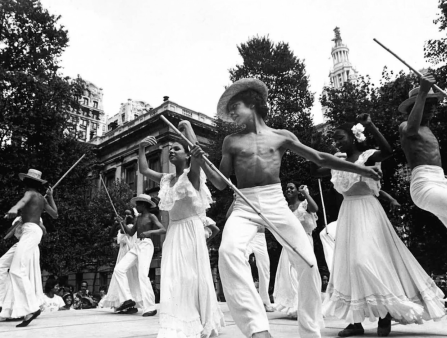
West Side Familia. Young children perform with the Ballet Hispanico in Central Park, a community staple that still exists today. Photo credit: Ballet Hispanico Archives.
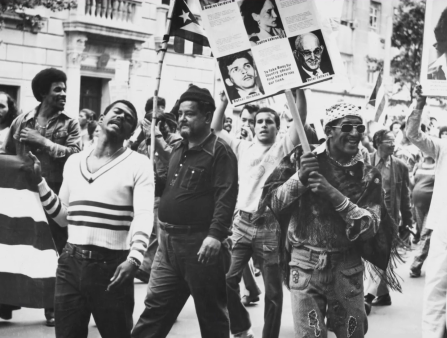
West Side Familia. Protestors support freeing Puerto Rican political prisoners during the Puerto Rican Day Parade in the 1970s. Photo credit: Getty Images.
D: Your storytelling experience as a podcast producer really shows in the doc. But do you see a connection between your podcast storytelling experience and moving into filmmaking?
TH: Definitely. I think having done a couple of narrative audio documentaries before this was definitely what gave me the confidence that I could, at least from a story-producing perspective. That really helped with a relatively accessible, somewhat conversational narration style that can also go in more poetic or more informational directions, too.
And then that moment where I just started crying in the middle of a narration recording session. There were some folks who were like, “Maybe we should retake this,” or, “If we’re going to keep it, let’s do it differently,” or something. But I was just like, “Let’s go with the organic version, and kind of build and change the relationship with the narrator throughout the film as the story becomes closer to home.”
D: Since you have taken the brave step of being personal in the documentary, what are your personal reflections on how it’s impacted you and your family?
TH: This is probably the biggest thing I’ve ever done to honor my mom since she passed. Sorry, I’m getting emotional now.
D: It’s okay.
TH: This is the biggest thing I’ve ever done to honor my mom since she passed. Funerals are not a very happy time, and her ceremony was during COVID as well, so it was smaller, and we didn’t really have the ability to do it up in a really fun way. I mean, it’s hard to have fun at a funeral, especially with an untimely passing, but in a way that felt more in alignment with her spirit. So this felt like the first thing that lived up to the bigness of my love for her.
D: Is the flag still up? Has anyone taken it down?
TH: It is still up. Ever since we started shooting, these have been the first years that the flag stayed up all year. Chino actually brought me one of the first flags that they took down after it had been up all year.
D: Wow. That’s such a good omen. Put that on your altar.
TH: Yeah. Got to get it maybe dry-cleaned first, and then framed.