

In Nathan Grossman’s Amazomania (2026), Swedish reporter Erling Söderström joins the 1996 expedition of the Brazilian ethnographer and civil activist Sydney Possuelo to the Javari Valley, home to the Korubo people, who lived largely uncontacted by the Brazilian state and global media. The Korubo, inhabiting a territory wedged alongside the border with Peru, were known to settlers as “clubbers” for the war clubs they used against rubber tappers and loggers as early as the 1920s.
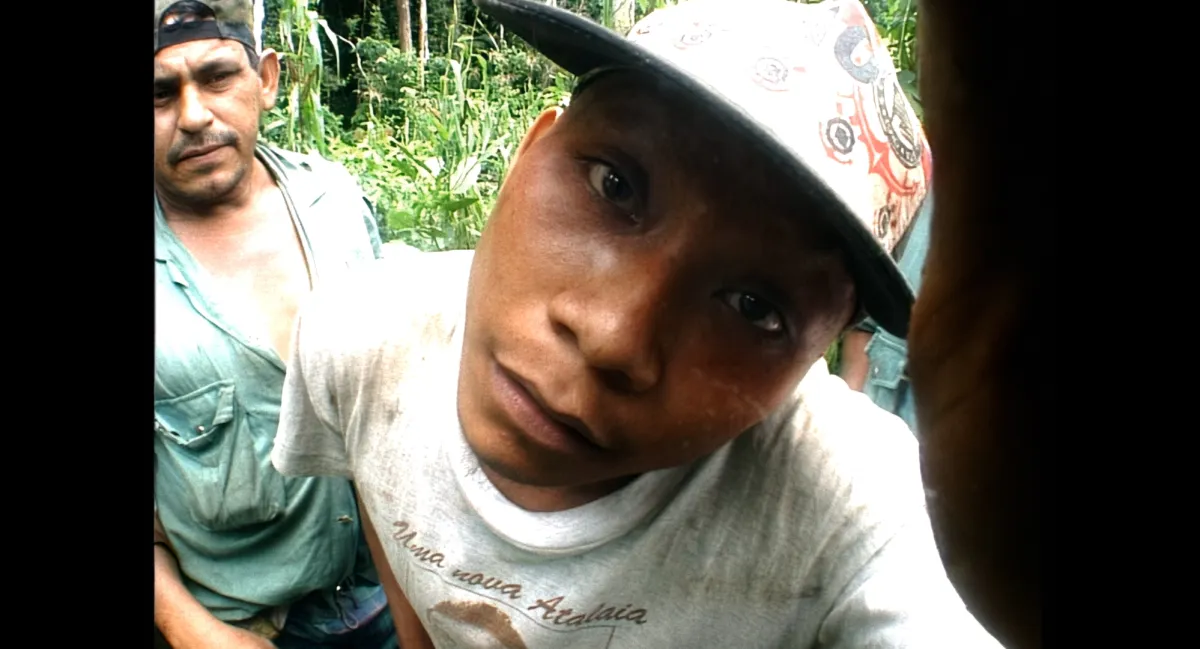
Söderström’s footage captures a riveting first encounter between a Korubo man and the camera itself. Moving close to the lens and staring directly into its nodal point, the young man hauntingly repeats, “Who are you?” He effectively turns the ethnographic gaze back onto the filmmaker as if wondering not only who is behind the camera but who is watching him through it.
This returned gaze in Grossman’s documentary points toward a broader reflexive turn in how contemporary ethnographic documentaries are grappling with the medium’s own histories of violence and representation. Ethnographic documentary—long mired in the colonial legacy since its inception—has recently undergone a notable shift toward collaborative and introspective modes of practice, a kind of reverse ethnography. By “reverse ethnography,” I refer to documentaries that redirect ethnographic scrutiny toward the filmmaker, foregrounding their positionality and interrogating representational frameworks through which Indigenous lives have historically been mediated.
Across recent features from Latin America, two distinct modes of ethnographic inquiry emerge. The first is collaborative, seeking to upend the structures of Western knowledge and cultural production built on power asymmetries, as exemplified by Alex Pritz’s The Territory (2022) and Grossman’s Amazomania (2026). The second is introspective, creating space for speculation about coexistence and the fragility of memory, as seen in Tatiana Fuentes Sadowski’s La memoria de las mariposas (The Memory of Butterflies, 2025), and Guillermo Quintero’s Relicto (2026). It’s important to acknowledge that these works are rooted in distinct geographies and situated histories within the continent. At the core of this inquiry is how contemporary ethnographic filmmakers contend with the enduring legacy of colonial extraction—an inescapable contradiction that often places them at risk of reproducing the very extractive practices of early salvage ethnography.
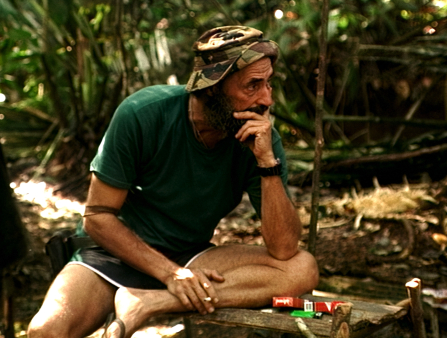
Amazomania. Courtesy of Autlook Films
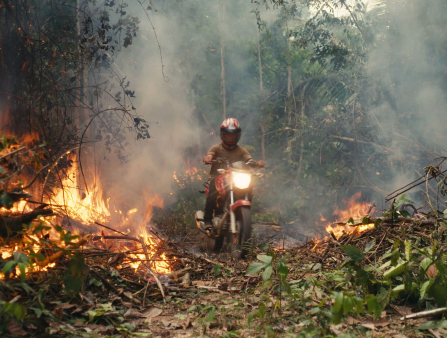
The Territory. Photo credit: Alex Pritz/Amazon Land Documentary. Courtesy of National Geographic
Visual Sovereignty and Self-Representation
From its inception, representations of Indigenous peoples have been part of the cinematic apparatus. The Edison Studios’ 1894 early kinetoscope shorts, Buffalo Dance and Sioux Ghost Dance, mark the first appearance of Native Americans on film. Both films feature men dancing in circles, wearing traditional ritualistic garb, warbonnets, and war paint.
Undoubtedly, the silent era films laid the foundation of the worst stereotypes of Indigenous people: the wretched savage or the noble friend of the white man, later to be canonized by Robert Flaherty in Nanook of the North (1922). Despite the film’s deserved—or undeserved—place in the cinematic canon, one thing is clear: the film portrays the Inuit through a paternalistic and racially stereotyped gaze. By recreating traditional practices, such as hunting, while excluding modern tools, Flaherty crafted an idealized image of the “noble savage,” depicting Inuit life as a pure struggle against nature.
Today, since the end of the 1960s, the continued efforts of Autochthonous communities around the world to regain their territorial sovereignty and political autonomy, referred to by historians as “Indigenous internationalism,” have expanded from physical actions to digital visual activism. In Film X Autochthonous Struggles Today, a 2024 essay anthology, the authors believe in the inseparability of political and visual sovereignty. “The gun/camera/computer are all aspects of the complete domination of Indigenous cultures,” they write. When the Korubo first saw Söderström’s large, heavy camera, they believed it to be a weapon. And not without reason. Yet increasingly, the camera is seen by Indigenous communities worldwide as a tool to document their struggles or preserve their cosmologies.
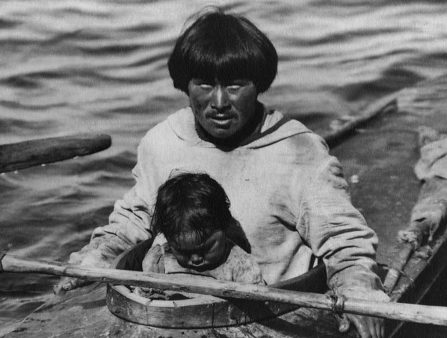
Nanook of the North. Courtesy of Janus Films
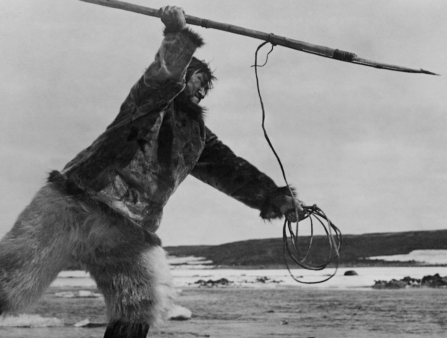
A notable example comes from the state of Chiapas in Mexico. After the Zapatista uprising of January 1994 was violently suppressed by the Mexican authorities, video became the communities’ means to continue their fight against state propaganda and wield control over their self-representation. In 1998, a group of Mexican, Autochthonous, and American filmmakers established The Chiapas Media Project (Proyecto de Medios en Chiapas), later renamed Promedios de Comunicación Comunitaria in 2002, which provided autonomous Zapatista communities with video-making workshops and paved the way for an alternative mediascape.
During the workshops, participants made short films and social commentaries documenting historic moments in the movement’s history by intercutting talking-head interviews with relevant video footage; for example, Tierra Sagrada (Sacred Land, 2000), which was screened at Sundance (it’s available on YouTube with Spanish subtitles). One of the Zapatistas memorably said during the workshop: “The camera is like my machete, I can use it to harvest food, but also to defend myself.” The shorts were screened in Mexico and the US, particularly at universities, raising funds to buy equipment for the Zapatistas, who refused any state support. Promedios, which operated for more than 15 years, has now assumed the archival function: preserving numerous films and building collective memory.
The term Fourth Cinema, proposed by Ngāti Apa filmmaker Barry Barclay in 2002, opens up a conversation for an entirely new framework of the forms, production, and circulation of Autochthonous cinema. The issue of sovereignty is crucial to Barclay, and can be fully realized through Indigenous film festivals as sites of Indigenous internationalism, the reclamation of cultural narratives, and the preservation of unique cosmologies. Digital filmmaking tools and institutional support have contributed to a dramatic rise in the production of Fourth Cinema: for example, the 13th Māoriland Film Festival alone screened 19 features in 2026. Mapping these milestones in the history of ethnographic cinema is crucial, as Nanook and its legacy laid the foundation for the power asymmetries against which contemporary ethnographic filmmakers now work through collaboration and self-reflexive practice.
When the Korubo first saw Söderström’s large, heavy camera, they believed it to be a weapon. And not without reason. Yet increasingly, the camera is seen by Indigenous communities worldwide as a tool to document their struggles or preserve their cosmologies.
Rethinking the Ethnographic Gaze
While Indigenous self-representation has expanded, it has neither rendered collaborative ethnographic practices obsolete nor automatically dissolved inequalities in funding and distribution. Collaborative ethnography nowadays offers a framework for redressing those inequalities. The Zapatistas’ Promedios de Comunicación can be seen as a great blueprint for the socially-engaged and politically-militant collaborations between Western and Indigenous filmmakers that emerge in films like The Territory and Amazomania.
Such a collaborative mode of documentary practice requires a process of ethical, conceptual, and legal decentering in which a filmmaker’s individual vision is reconfigured through a constant negotiation with the communities they work alongside. Faye Ginsburg refers to this practice as an “aesthetics of accountability.” Building upon Jean Rouch’s anthropologie partagée (“shared anthropology”), Ginsburg does not limit her scope to works by Indigenous filmmakers alone but instead interrogates the very dynamic between the maker and their subject.
The first half of Amazomania consists entirely of Söderström’s original footage, later used by him in his romanticized 2001 TV documentary, The Hidden Tribes of the Amazon. It never translated what the Korubo were saying. By opting instead for a lyrical voiceover narrated by Söderström himself, the Swedish ethnographer plays into a narrative of exoticization, rendering the community incomprehensible for viewers. When Grossman first came across Söderström’s footage, he felt that something was missing: “I just felt it’s strange not to, at least, ask the Korubo community what they think about this,” he tells Documentary.
By constructing nearly half of Amazomania’s runtime from Söderström’s original rushes, the filmmaker employs a fascinating narrative technique that introduces viewers to the logic of extractivism without resorting to didacticism. Both ethnographers, Söderström and Possuelo, emerge as Herzogian characters seeking “ecstatic truth” at the expense of Indigenous humans and ecologies, though Possuelo’s mission is arguably benevolent: to demarcate the Korubo’s territory and make peace with the tribe that had been attacked by local settler fishermen. In the second half of the film, set in 2023, Grossman turns the tables and accompanies an elderly Söderström back to the Javari Valley for a reunion of sorts, only for the Swedish reporter to discover that the Korubo were far from the infantilized versions he had painted them to be: they wanted restitution, and they wanted it now.
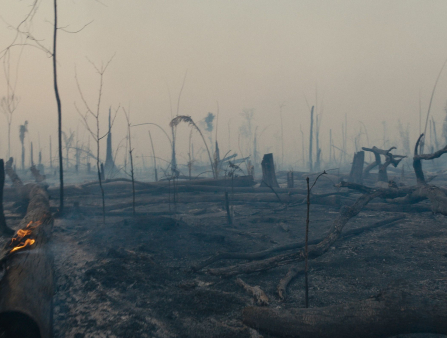
The Territory. Photo credit: Alex Pritz/Amazon Land Documentary. Courtesy of National Geographic
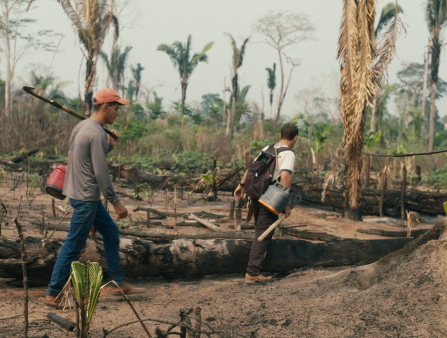
The crucial scene of confrontation happens on the boat where Söderström was staying, when the younger members of the Korubo community demand all the footage Söderström had shot back in 1996. Rendered through the immediacy of the handheld camera, the scene uncannily mirrors the first riveting encounter we witness earlier in the film, yet the tension has a completely different undertone. As Takvan, a young Korubo man, asserts the community’s claim for image ownership, the doc highlights much broader ethical and political forms of extraction.
Grossman’s restorative approach is not only confined to the film’s narrative but is woven into its making. Two members of the Korubo community—Comunidade Korubo and Takvan Vakwë Korubo—are credited as executive producers. The Korubo community collectively decided to highlight their contributions as they became more involved in the film. Speaking with Documentary, Grossman explained that ensuring the successful collaboration was working through the Korubo’s protocols developed after the first unsuccessful contact with FUNAI (National Indigenous People Foundation), as depicted in the film’s first half through Söderström’s rushes.
“It was always clear that they [the Korubo] should be on equal terms with us, so they share half of the proceeds,” Grossman adds. Aside from the financial rewards, the Korubo, particularly Takvan, who emerges as the main character in the second half of Amazomania, was involved in approving edits and working on translation. “We have created laws and [legal] structures that the film looks at, and the strength of those structures in terms of European legislation. The film is very much about how the ownership of everything is still and will always be with Erling [Söderström],” says Grossman.
What Amazomania and The Territory demonstrate is a shifting focus from representation to accountability. The question is less about ‘Who holds the camera?’ and more about ‘How can collaboration between Indigenous and non-Indigenous filmmakers be made more ethically and politically productive?’
The charged confrontation scene on the boat emerges as a kind of vigilante justice court, echoing the Uru-eu-wau-wau community’s arrests of illegal settlers in Alex Pritz’s The Territory. The film chronicles the fight of the Uru-eu-wau-wau community in the western Brazilian state of Rondônia against land dispossession. Alongside activist Neidinha Bandeira, the community confronts guerrilla deforestation, a tactic used by impoverished farmers and settlers to illegally clear the forests and establish claims to the land. Emboldened by Bolsonaro’s anti-Indigenous rhetoric, these incursions are incentivized by promises of financial gains from bigger haciendas.
Early in pre-production, Pritz organized film workshops emphasizing the aesthetics of accountability, which he referred to in many interviews as “flipping the camera” between the collaborators. But the tech-savviness of the community predates Pritz’s intervention. Drones—similar to the Zapatistas’ camcorders—have been repurposed by the Uru-eu-wau-wau into counter-surveillance, against illegal land occupation. The community’s involvement with the film extends to nearly every aspect of the filmmaking process. Potei and Tejubi Uru-eu-wau-wau serve as executive producers, while Tangãi Uru-eu-wau-wau shares cinematography credit, having filmed several key sequences, including the arrests of settler intruders. At the suggestion of Bitaté, a young Uru-eu-wau-wau leader, Pritz incorporated the perspectives of the story’s antagonists: a local farmer, Sérgio, and an illegal settler, Martins, portraying them as a localized expression of the larger logic of territorial appropriation upon which the Brazilian state has been built.
The partnership with National Geographic, which acquired The Territory for global audiences, was a conscious decision made by the community to amplify Uru-eu-wau-wau voices. In her detailed report on the film, Ela Bittencourt describes the financial commitment undertaken by the Western parties to redistribute equal shares of the proceeds to the Associação Jupaú (the Uru-eu-wau-wau Association) and Kaninde (Bandeira’s NGO).
What Amazomania and The Territory demonstrate is a shifting focus from representation to accountability. The question is less about “Who holds the camera?” and more about “How can collaboration between Indigenous and non-Indigenous filmmakers be made more ethically and politically productive?” This shift requires filmmakers on both sides to continually negotiate questions of authorship, accountability, and asymmetries of power.
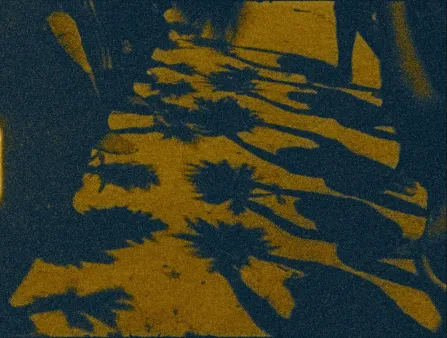
The Memory of Butterflies. Courtesy of IDFA
The Limits of Historical Recovery
Recent successful examples of collaborative ethnographic filmmaking have seen outsider filmmakers attempt to redress historical injustices and amplify Indigenous stories of resistance. Where collaborative ethnographic filmmaking seeks to renegotiate relations of power between filmmakers and Indigenous communities in the present, the dynamics become more complex when these stories are approached by filmmakers from the region itself, whose engagement with the questions of indigeneity is more entrenched, and framed as an attention to the past.
A different challenge emerges when the subjects of inquiry are encountered primarily through archival traces. Such archival encounters are central to Peruvian director Tatiana Fuentes Sadowski’s The Memory of Butterflies and Colombian documentarian Guillermo Quintero’s Relicto. In these works, filmmakers are confronted not only with the colonial histories embedded in ethnographic images and records, but also with the limits of historical recovery itself. This contradiction, however, creates a productive space for filmmakers to examine their own relationship to the colonial histories they strive to reconstruct.
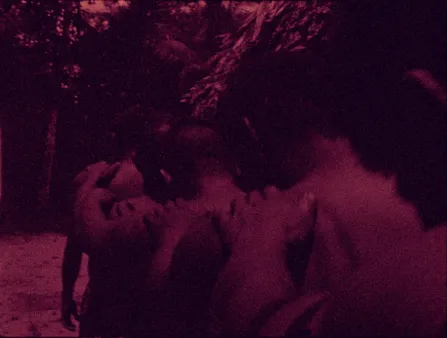
In The Memory of Butterflies, the discovery of an archival portrait of two young Indigenous men sends Sadowski on a journey across the Amazon. “Omarino and Aredomi are observing me. Their photo calls me, questions me,” the director explains in a poetic voiceover. The encounter with a photo also became a starting point for Quintero in Relicto. Quintero came across a portrait of a defiant-looking man—pursed lips, steady gaze—that carried with it an identifying caption in its back: “Sixto Muñoz, last of the Tinigua people.”
Both documentaries retrace the steps of early ethnographers by excavating the ghosts of the past. In doing so, an ethical ambivalence arises, bringing to the surface the innate contradiction embedded in this sort of historical inquiry: in the process of de-mythologizing, the Indigenous peoples remain impenetrable, a mystery. By filming the present-day community to which Omarino and Aredomi belonged on Super 8, echoing the aesthetic of the archival footage, Sadowski’s formal choice risks positioning the community as a relic of the past. Yet the complexity of the film lies in the director’s revelation that her son is directly descended, on his father’s side, from the rubber elite, and this yanks the film out of the realm of white innocence into the realm of settler culpability, breaking the dichotomy of “us” versus “them.”
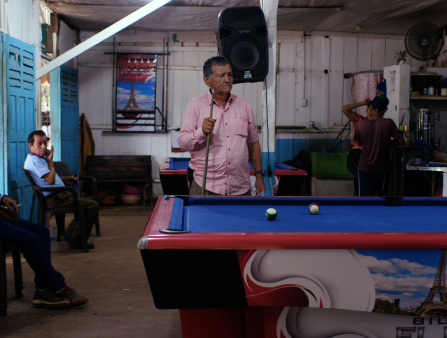
Relicto. Courtesy of Guillermo Quintero
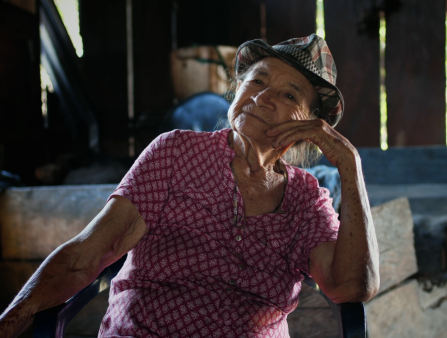
In Relicto, Quintero sets out to La Macarena, south of Bogotá, to find Sixto, a centenarian who disappeared in a canoe a few years earlier. The director reprises the role of past ethnographers, moving at a languid pace to record the testimonies of Sixto’s former neighbors and acquaintances, arranging them into a visual diary. The villagers keep referring to Sixto as “the Indian,” though not used as a slur, but more as a marker of otherness. “The people there use that term without a pejorative meaning, but it is there,” Quintero says when I ask him about the contested label. Old habits persist. As fascinating as their accounts are—with Sixto emerging as a trickster of sorts—they are ultimately unreliable if not warped. At the film’s end, when we finally meet Sixto, he never utters a word in Spanish, soliloquizing instead in his native tongue to a non-audience, his speech left unsubtitled, recalling the Korubo in Söderström’s footage in Amazomania.
Sixto retains his defiance and agency, one might argue, by “refusing” to speak Spanish. He neither confirms nor denies the rumors we have heard from the village folk. Though the scene is poignant, Quintero’s editorial decision turns Sixto’s opacity into a metaphor rather than allowing him to emerge as a historically situated subject. “I think that it is really hard to escape that contradiction,” the director tells me when I mention the question of accountability. “The main thing is that you must have the feeling of being honest with yourself and with the people that you are filming.”
Relicto thus becomes less a reconstruction of the enigmatic Sixto’s life than a portrait of the settlers themselves—“colonus colonos,” as Quintero puts it. In our conversation, he explained that many of the first settlers had fled violence in the Andean Cordillera and seized the opportunity to settle down in La Macarena. A second wave arrived at the end of the late 1970s to cultivate coca. Relicto actively constructs Sixto’s mysteriousness, avoiding blunt moralization. “I can’t help but also admire the strength of [the settlers’] work and their relationship with the land and the jungle.”
If collaborative ethnographic documentaries seek to redistribute authorship and make amends, films such as Amazomania and The Territory expose the cul-de-sac Indigenous communities experience in the absence of political power. The Memory of Butterflies and Relicto, by contrast, confront a different impasse: the impossibility of fully “representing” Indigenous lives. Driven by archival encounters, the latter films instead offer a space for introspection, if not for speculation, about shared existence and the fragility of memory.
Relicto. Courtesy of Guillermo Quintero
Convivial tool
When watching Amazomania for the first time, the initial encounter between the Korubo and FUNAI felt exhilarating: I found myself captivated by the community’s first interaction with the camera. In that moment, I was a pure voyeur, participating in the very act of exoticizing “the Other” that ethnographic cinema has long been criticized for. Yet the Korubo man’s question—“Who are you?”—jolted me out of this position. As Grossman suggests, “An audience both sees the adventure and then looks critically at [itself]. I think it’s a nice way to include the audience that way.”
Documentary cinema at large, and ethnographic documentary in particular, has historically constructed “the reality” of its subjects. From renaming Allakariallak to Nanook and to portraying individuals like Sixto as mysterious, filmmakers have certainly toyed with the risk of reproducing the extractivism of early ethnographic days. The turn towards the reverse ethnography, however, increasingly approaches the camera as a convivial tool. Through collaboration and reflexivity, the visual ethnography of today can scrutinize the contested histories of violence and (image) ownership and the legacy of the medium itself. These films represent gestures of solidarity and possibilities of restitution within ongoing struggles against unequal, Eurocentric regimes of representation.