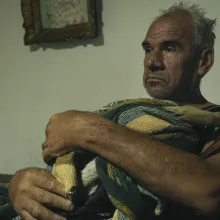

Angelo Madsen’s (North By Current) newest film, A Body to Live in, is an ode to body piercer, performance artist, and photographer Fakir Musafar (1930–2018). Madsen, who befriended Musafar in the last 14 years of his subject’s life, utters offscreen near the end of the film that he wishes he had begun this project when the founder of the “Modern Primitive” movement was still alive, to speak with Musafar directly about his westernization of Indigenous spirituality from a contemporary perspective. Both a critique and love letter to the divisive “Gender Flex” symbol, A Body to Live In is a sonic immersion of what it means to find community and be human. Ahead of its world premiere at True/False, Documentary chatted with Madsen over Zoom to discuss his friendship with Musafar, respect for Musafar’s legacy through a critical lens, and the difficulties of financing and marketing “niche” trans stories.
Online Feature
It’s tempting to pick nits about the relative merits of prizewinners and other films, and even more tempting to take a handful of the 346 new films as somehow indicative of the festival as a whole, but the truth is that a slate the size of IFFR’s can make proclamations about its strength difficult: two different attendees can carve distinct paths and have dissimilar takeaways. That’s one reason why a festival is more than just the films one watches.
Lisa Jackson is an Anishinaabe documentary maker working across multiple genres—film, XR, and installations—to share Indigenous stories and knowledge. Her most recent work, Wilfred Buck’s Star Stories, is a dome presentation bringing to life four star stories, gathered and told by renowned Cree astronomer, star knowledge expert, and author Wilfred Buck. It also features excerpts from her 2024 documentary Wilfred Buck, which explored the astronomer’s life, work, and philosophy. Documentary talked to Jackson about creating for different genres, reciprocity, and using technology in the context of sharing Indigenous knowledge. Star Stories, created in collaboration with the Macronautes, premieres at the 2025 Berlinale in the Forum Expanded section.
In The Dialogue Police , protests, Quran burnings, and political gatherings take center stage. This timely doc, helmed by veteran Susanna Edwards
In October 2023, as part of the series Making a Production, Documentary profiled the London-based production company Grain Media. As a small independent production company focused exclusively on documentary, they were managing to succeed, with difficulty, in a very challenging climate for documentary. At the end of 2024, the company’s Netflix documentaries The Lost Children and Buy Now: The Shopping Conspiracy achieved global prominence. At the same time, the company had to make its first redundancies, letting go of a handful of its long-serving staff. Documentary caught up with Grain’s founder and head Orlando von Einsiedel to discuss the ups and downs of the last year, and how they reflect what is going on in the global documentary industry.
The National Endowment for the Arts announced radical updates to its parameters for Fiscal Year 2026 funding via press release on Thursday, February 6
Frederick Wiseman is a pillar of American documentary, yet much of his work has historically been difficult to view in a high-quality format. For the first 40 years of his expansive career, Wiseman shot each of his deep-diving, sometimes epic-length explorations of various institutions on 16mm, not transitioning to digital until the late 2000s. Over the course of five years and in collaboration between Wiseman’s company Zipporah Films and the Library of Congress, the Harvard Film Archive, the late DuArt Film Lab, and Goldcrest Post, 33 of his features—from his debut Titicut Follies (1967) to State Legislature (2006)—received 4K restorations. Beyond being a vital work of preservation for one of our most important documentarians, the effort has precipitated one of the biggest repertory cinema events of the year in cities on multiple continents. Amidst these retrospectives, we sat down to speak with Wiseman over the phone about the restoration process, his literary influences, and how newer audiences have received his work.
It’s not called the Sundance “International” Film Festival, but it has become increasingly so, becoming one of the most vital global launchpads for nonfiction work. Despite the fact that there have yet to be any flashy global streamer deals (or even smaller sales) announced for any of this year’s documentaries, the industry’s wheels are churning. Highly praised films, such as Geeta Gandbhir’s riveting Directing Award winner The Perfect Neighbor and David Osit’s complex media exposé Predators are likely to find buyers soon, while at least one of the festival’s World titles was scooped up for international sales.
After presenting A Brief Excursion in 2017, Igor Bezinović returns to Rotterdam to showcase his latest documentary, titled Fiume o Morte!, in the Tiger competition. The Croatian director uses dramatic reconstructions and nonfiction interludes to explore the complex figure of Italian poet, playwright, and army officer Gabriele D’Annunzio (1863–1938). In his conversation with Documentary, Bezinović unpacks the making of his long-gestated project, its peculiar aesthetic choices, its ambitions, and its worryingly timely connections between past and present.
I interviewed Reid Davenport for the Doc Star of the Month column in 2022, the year the Stanford-trained TED fellow nabbed the Directing Award for U.S