


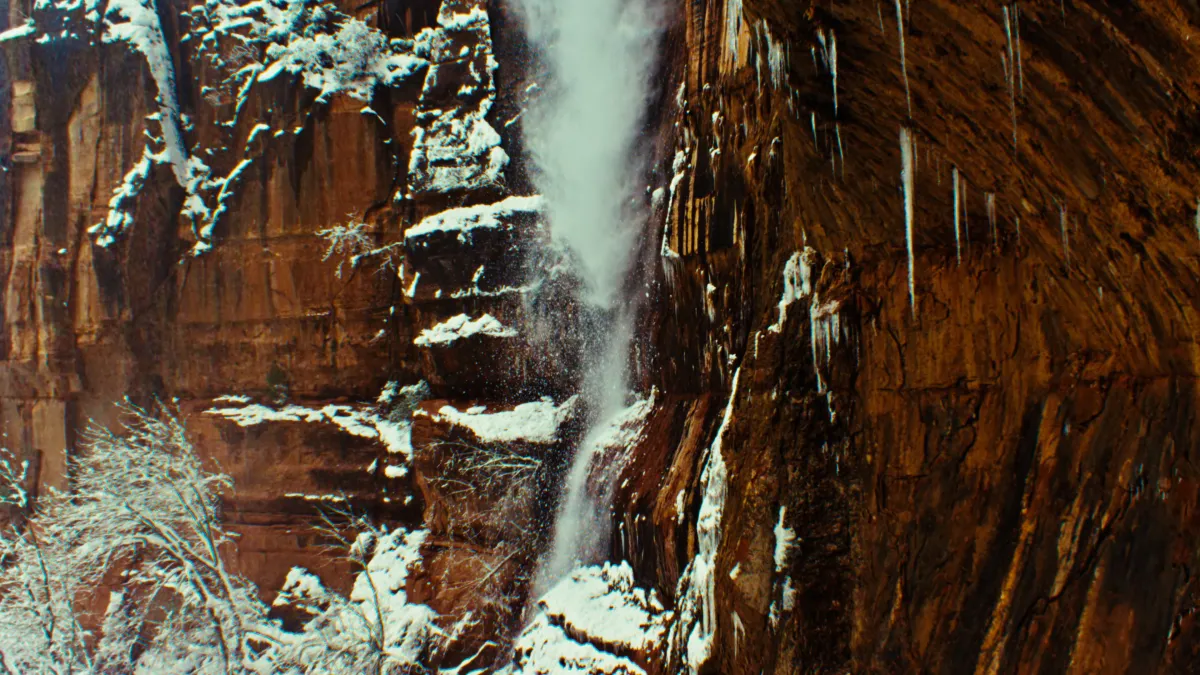
“Blizzard in Zion” episode from Ambient Film, season one. Image credit: Robby Piantanida. Courtesy of General Usage
This past spring, PBS premiered its new nonfiction program Ambient Film, billed as “a hypnotic experience, allowing the mind to roam on a visual and auditory voyage.” The ten half-hour episodes of the first season quietly observe subjects like snowfall in Zion National Park or lily pads floating on a pond in Mississippi. The emphasis on calm diversion situates the show within a growing trend of television and social media video.
Slowness has been an established mode of cinema for many decades, but the commercial demands of television meant it took longer for that medium to adopt such a form, thanks to the medium’s mass-market nature and heavy ties to advertising interests. Many early examples come from interstitials used around the world to fill unprogrammed time, such as the various “fishcams” which broadcast footage of aquariums. And of course, there’s the time-honored Yule Log, which also illustrated the way the television had supplanted the hearth as the center of family life in the postwar years.
The Origins of Slow Television
Unsurprisingly, the earliest proper slow programs to hit U.S. airwaves did so through public television. The Joy of Painting (1983–1994), in which Bob Ross soothingly talked audiences through painting vistas (including his much-memed “happy little trees”) demonstrated the appeal. The decades-old show is contiguous with the current wave of slow TV. When every episode of The Joy of Painting was released on YouTube, it was a sensation, with dozens of installments racking north of a million views (the most popular one has more than 50 million).
“Slow TV” coalesced as a consciously produced genre outside of the U.S. thanks to Norwegian broadcaster NRK, which started airing longform programs that drew high viewership in the late 2000s. The most well-known ones depicted an eight-hour train journey in full, a 12-hour ship voyage, and 12 hours of a sweater being knit. Channels like BBC4 followed suit. The austerity of the concept resonates with broader international perceptions of Scandinavian culture; at the same time that slow TV inspired imitators around the world, hygge became a buzzword. Minimalism is also strongly associated with Japanese design and art ethos, and that country has also been a major exporter of these kinds of shows, ranging from the many offerings within the “slice of life” genre of anime to the mega-popular Terrace House (2012–2020), which stood out as a reality show for purposefully eschewing many of the high-drama conventions of such programs.
All this anticipated the current craving for “cozy” television, which has broadened beyond nonfiction. Shows like Ted Lasso and Abbott Elementary are lauded specifically for their overriding pleasantness. There’s a significant overlap with the rise of hyper-positive “nicecore” cinema and shows. Audiences crave undemanding distraction from time to time, which is an understandable, likely universal need. There are even options to keep your pet occupied, with a site filled entirely with shows meant to be watched by dogs launched not long ago.
Proliferation on Social Platforms
Ambient Film arrives amid a glut in such works. But vectors like Instagram, YouTube, and TikTok long ago outpaced what traditional networks and streaming platforms can offer, in terms of both quantity and length. In the spirit of NRK’s slow TV offerings, you can watch people make train or on-foot journeys at length. There are countless channels devoted to painstakingly documenting the restorations of broken-down tools, toys, and other objects. You can watch someone construct miniature landscapes out of real greenery. Perhaps the ultimate ambient YouTube channel is Lofi Girl, host of the famous “lofi beats to study/relax to” stream. YouTube also beat streamers to the punch on videos for pets. I spent part of my time writing this article playing an eight-hour video of birds, squirrels, and chipmunks congregating around a pile of seeds and nuts for my cats’ enjoyment.
Here, slow nonfiction meets other trends of relaxing content, such as ASMR. Note the heavy emphasis many of these videos have not just on meticulous gestures but also on crisp and satisfying sounds—chirps, clinks, rustling, wind, taps, etc. My personal favorite maker within this sphere may be beekeeper Erika Thompson, who has one of the most soothing voices I’ve ever heard and produces mesmerizing videos about apian care.
Another cross-pollination between slow film and other social media genres can be seen in lifestyle vlogging, an increasingly prevalent part of influencer culture. The “tradwife” is a prominent archetype here. These women purvey older gender norms with highly idealized, elaborately produced videos of themselves cooking, cleaning, and caring for their children. And that’s just one of many lifestyles that various influencers embody in their posting. One of the most creative may be Li Ziqi, the most popular Chinese-language vlogger on YouTube, who embarks on unusual projects like dyeing a dress with grape skins.
We’ve likely entered a post-saturation era of entertainment, as most corporations have realized there’s no good reason for them to have their own bespoke streaming services. A handful of players—Netflix, Amazon, Disney, and the like—have emerged as clear dominants, and bundled subscriptions for various platforms look to reintroduce the era of basic cable that streaming “disrupted” not so long ago. Meanwhile, the transition to social platforms as a medium on its own has continued apace, also under the umbrellas of a few powerful centralized offerings: TikTok, Instagram, YouTube, etc. The cumulative effect is a curious simultaneous broadening (with more “content” available than ever) and narrowing (that “content” is available through comparatively fewer channels) of visual culture.
Selling Serenity
Within this environment, all art can become ambient. Industry insiders have attested that Netflix executives shape the site’s offerings with “second screen” viewing in mind—meaning they want their films and TV shows to require so little of a viewer’s attention that they can be passively understood while said viewer peruses their laptop or smartphone. Movies, shows, and personal videos alike have to compete to stand out from social feeds or selection screens, and then are played on a TV that’s just one of many active screens in a room, or in windows next to one’s internet browser and work apps, or as one tab on a phone. The war for attention is fierce, and it spurs an arms race of ever more bombastic editing styles and camerawork. YouTuber Jimmy Donaldson, better known as MrBeast, conquered YouTube with a mode of hyper-fast cutting precisely honed to pull in and hold younger viewers’ attention. The median sensibility of audiovisual language pitches itself ever louder.
Within such a paradigm, the appeal of calmer fare becomes obvious. People will seek a reprieve from anything too mentally taxing, especially since all this “content” exists in the background radiation of their lives alongside a deluge of news that’s often delivered in a similarly aggressive manner. The rise of cozy TV is of a piece with the greater trend toward “mindfulness” and other cultural expressions encouraging people to slow down and embrace the present moment.
Yet making something chill can entail a lot of effort. Terrace House was discontinued after the suicide of a participant stirred controversy and opened its production to outside scrutiny, revealing that much of its low-key realism was in fact constructed. Li Ziqi took a years-long hiatus from making videos because of a struggle with a brand management company for the ownership of her material. And the tradwife fad, as befits the name, is steeped in a culturally conservative antifeminist revanchism, and builds its illusion of simplicity with massive wealth (influencer Hannah Neeleman’s charming, rustic stove costs $30,000, but that’s no issue for someone married to a JetBlue heir). When pursuing these kinds of diversions, it’s important to keep in mind that almost nothing is really so simple. There are industrial processes undergirding and myriad attendant ideological slants to even the most innocuous entertainment.
Dan Schindel is a freelance critic and full-time copy editor living in Brooklyn. He has previously worked as the associate editor for documentary at Hyperallergic.