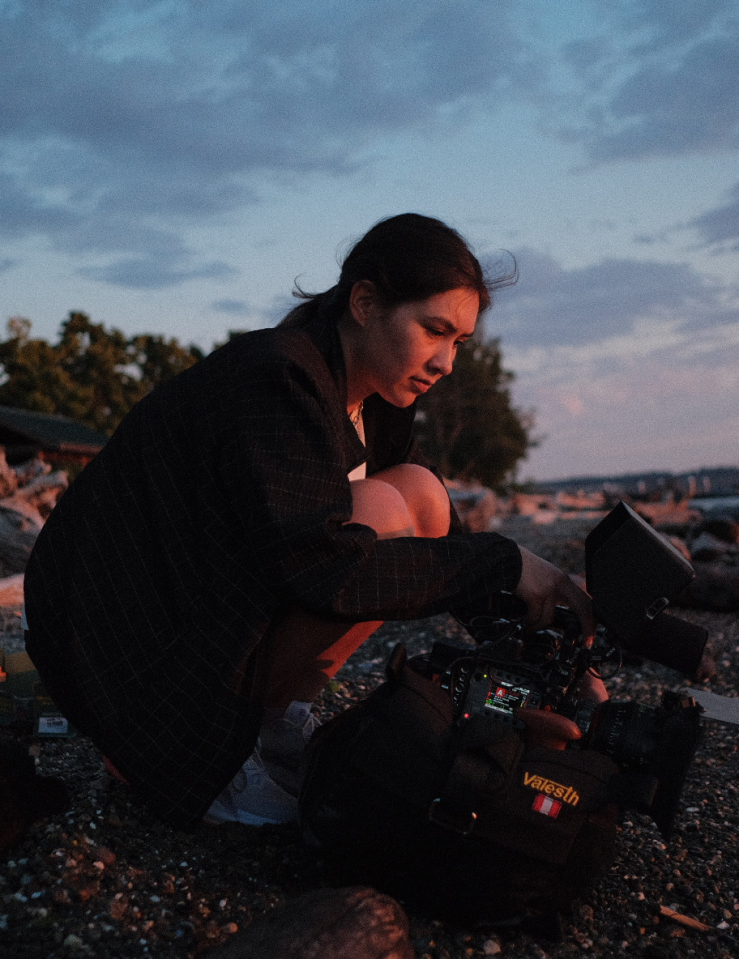

On the cover is Brittany Shyne. I first met her seven years ago as a promising emerging filmmaker, as part of a festival program. At that time, I was impressed by how she had already been filming Seeds for years. This type of deep place making remains unique, worth defending, and vital. In their conversation, Marya E. Gates draws upon the filmmaker’s artistic inspirations to illustrate the patient weaving of politics, history, care, and inheritance into the film’s fabric.
The Perfect Neighbor was produced under very different circumstances. In Mackenzie Lukenbill’s feature essay, they convincingly illustrate how director Geeta Gandbhir’s grief work as an editor, community involvement, and a FOIA request all collide in one of the year’s most popular and urgent documentaries. This unusual mix, in which true-crime spectacle, police evidence, issue-based activism, and one family’s sorrow converge, deserves our attention.
In the churn of film culture, restorations can give older films a boost in discursive contexts, like our own magazine. So when Jonathan Ali, a former colleague and GR ’22 programmer, reached out to let me know about the new circulation of a trio of 16mm activist docs from the Caribbean—Sweet Sugar Rage, Oema foe Sranan (Women of Suriname), and Bitter Cane—we asked him to survey their historical roots and their promises for today.
It’s been 80 years of the nuclear age. Returning contributor Sudipto Sanyal provides a spiky primer for us “nuclear amnesiacs” on a diverse selection of documentaries produced about, by, and around the ongoing threat of nuclear war. As Dominic’s note points out, the piece is also prescient. During editing, Peter Watkins passed away. Sudipto’s essay is now a necessary reading, featuring a lengthy discussion of Watkins’s greatest—and most underseen—film, Resan (The Journey).
This issue’s features are filled out with spotlights on the IDA Awards honorees. We asked producer and programmer Kiva Reardon to interview Julie Goldman, whose work at Motto Pictures spans local stories, international coproductions, urgent investigative documentaries, and longitudinal character studies. Their chat is filled with laughter and insight. And Jawni Han returns to Documentary’s pages with a profile of Impact Partners, the venerable Brooklyn-based investor advisory and equity fund. This article delves into great detail about how Impact Partners operates, from its pooled membership structure to its staff’s expertise in documentary production.
The festival dispatches are on DOK Leipzig and Ji.hlava, which for a few years now have overlapped during the same final week of October, in close proximity to IDFA, with large industry sections and socially conscious programming. Both are members of the Doc Alliance festival network, sharing the DAfilms streaming platform and other promotional activities. I found DOK Leipzig to be an earnestly dependable rock, whereas the Prague-based Botagoz Koilybayeva writes compellingly about Ji.hlava’s sociocultural influence.
Making a Production returns with Lucia Ahrensdorf’s profile of Sugar Studios, an all-in-one post house located down the street from IDA’s Wilshire offices. Through the eyes of founder Jijo Reed and its staff, we get a glimpse of the changes in indie docs in the commercial heart of Hollywood, and who gets to benefit. And an expanded “Screen Time” continues with capsule-length reviews on notable new releases.
Lastly, I’m thrilled that the Documentary team has grown. Each issue since Spring 2023 has been put together with Maria Hinds, Marlene Head, and Janki Patel. In October, we said goodbye to Zaferhan Yumru, who was my real co-conspirator in relaunching this magazine. But now, we welcome Manuel Betancourt, whose sharp eyes, discernment, and writerly generosity have already resulted in great contributions to this issue and everything we publish online.
Abby Sun
Editor, Documentary
This piece was first published in Documentary’s Winter 2026 issue.