

Gianfranco Rosi’s rigorous documentaries arise out of deep immersion. Only after spending an extensive amount of time at a certain locale, does the Etritria-born, Italian-American director pick up his camera to capture his surroundings and its inhabitants, mostly framing them in pensive static shots without voiceover narration. This unhurried and distinctive approach to nonfiction film has garnered Rosi a Golden Bear for Fire at Sea (2016), a depiction of how the arrival of African refugees in Lampedusa clashes with the local Italian population, and a Golden Lion for Sacro GRA (2013), a mosaic-like exploration of colorful characters inhabiting the areas adjacent to the eponymous motorway wrapped around Rome.
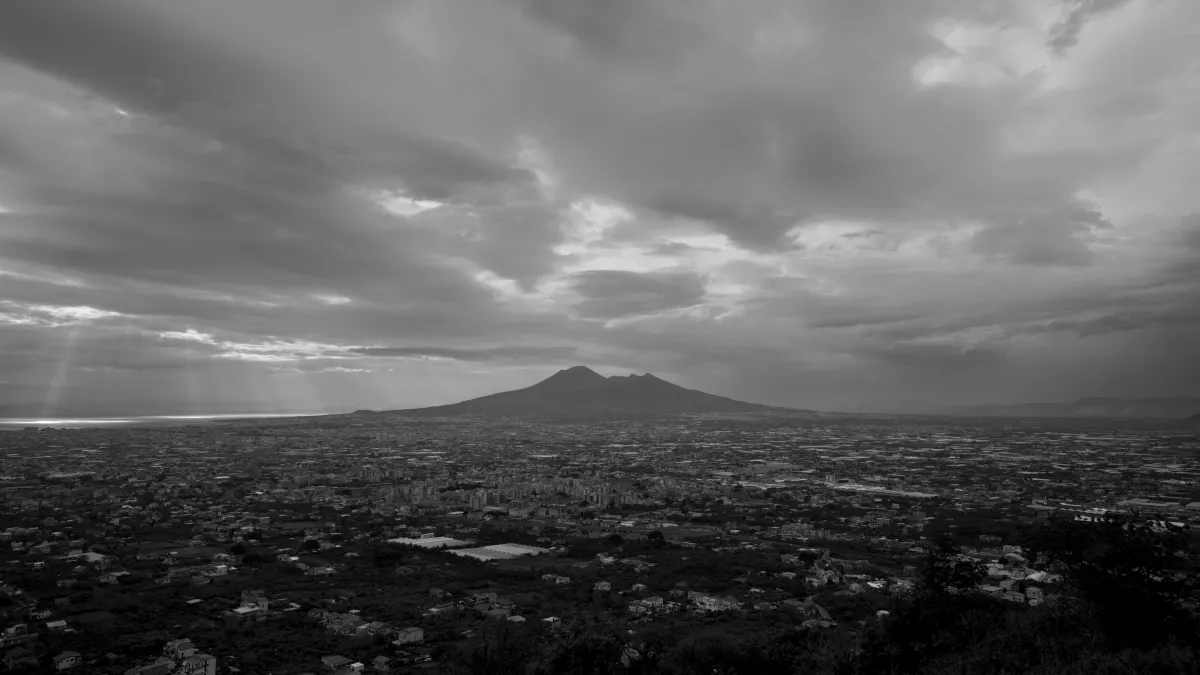
With Below the Clouds, the Special Jury Prize-winner at this year’s Venice, Rosi fashions himself an archaeologist of Naples, using his camera to excavate relics of the past while preserving present-day events through luminous black-and-white cinematography. Shot over the course of three years, Rosi depicts archaeologists, museum curators, firefighters, emergency line workers, and ordinary denizens, all buzzing around a city that never seems to sleep. Towering above them all is Vesuvius, the mythical volcano that, according to the famed Jean Cocteau quote with which Rosi opens the film, “makes all the clouds in the world.”
The omnipresent clouds over Naples allow Rosi to capture the city in strikingly grey hues. This color treatment conflates light and dark, past and present, sculpting a microcosm that seems to be lobbed out of time and space. In that sense, Naples is the ideal canvas for a director who, as self-described in the following interview, is obsessed with the “stratification of time”—making Below the Clouds the purest crystallization of Rosi’s cinematic project to date. Finding rhymes between the petrified lovers of Pompei and explosive current-day protests, between grave robbers and museum curators, and between historians and pupils of an elementary school, Rosi delicately depicts how history’s traces are always palpable in Naples. He even projects the Pompeii-set scenes of Roberto Rossellini’s Journey to Italy (1954) in a run-down cinema on the verge of decay, emphasizing cinema’s ability to mummify time and fossilize memories in perpetuity.
Albeit less explicitly manifested as in the war-torn Middle East of Notturno (2020), global conflict also sneaks into Under the Clouds, mainly in the guise of a colossal tanker ship transporting grain from Odessa’s port, a star reminder of the Russo-Ukrainian war. Coincidentally, the Syrian refugees who work on the ship can be seen as remnants of the Syrian civil war, becoming yet another symbol for Rosi to convey the scale of global displacement in recent history. “Time destroys everything, but it also preserves everything,” a historian notes, in Below the Clouds. Rosi, it seems, is fascinated by trying to capture both this destruction and preservation within the same frame. After the world premiere of Below the Clouds, we sat down with Rosi at a Lido hotel to discuss his views on nonfiction and his distinctive approach to capturing the timelessness of Naples. This interview has been edited.
DOCUMENTARY: You have made documentaries in India, Iraq, and Mexico, among other places. Occasionally, you find your way back to Italy, with films such as Sacro GRA, Fire at Sea, and now, Below the Clouds. What does it mean for you to make a documentary that is more or less on your home turf, as opposed to far-flung countries?
GIANFRANCO ROSI: The funny thing is that Italy has never been the place where I grew up. I was born in Eritrea, grew up in Turkey, and went to live in the United States when I was 21. So for me, making a film in Naples is akin to making it anywhere else. People say you should make films in the places where you belong. But where do I even belong? I only start to feel at home somewhere once I start making a film about that place. I have to immerse myself in the reality of my surroundings, without bringing my own thoughts into it. That’s why with every film, it seems like I’m working from scratch. I’m always figuring out how to find the right language of filmmaking. In that sense, every film that I do feels like my first.
D: You do have a cohesive oeuvre, though, with its own formal approaches to nonfiction. I’m wondering what your overarching philosophy of filmmaking is, something akin to Werner Herzog saying he’s looking for an “ecstatic truth” by filming what the naked eye usually can’t perceive.
GR: I once did a masterclass together with Herzog at Telluride, when I was there with El Sicario, Room 164 (2010). I told him that I miss the kind of voiceovers that carry his films. He is incredible at doing that. And indeed, it would be so nice to have someone explaining everything for you, as I have to synthesize all of it into one image. That’s a huge challenge for me. I can only use the language of cinema, working with the ideas of synthesis and subtraction, constantly transforming reality into something else. This is my obsession when I work in a new place, because I don't believe in observational documentaries at all. I don't even believe in cinema vérité.
What is vérité? Once you put a frame around something, there is no truthfulness, but rather a question. The moment you point a camera at something, the cinema of truth ceases to exist. The only truthfulness that exists for me in documentaries is the distance you place between your camera and your subject. That’s always my main battle—finding the right distance from which to tell the story.
D: Practically speaking, what does finding the right distance look like for you?
GR: When I was working on Notturno, I was filming a hunter on a boat, going through the marshlands of Iraq. I had my own tiny boat with my assistant, on which I spent about 15 or 20 minutes looking for the right position for the camera, but I just couldn’t find it. I couldn’t set up a tripod, so I had the handheld camera positioned on my backpack. The boat was jerky and moving, and I got frustrated because I couldn’t find the right frame. It was so maddening that, at one point, I was ready to take the camera and throw it into the water. Eventually, my assistant handed me two or three pieces of wood from the boat, which I stuck under my camera until I finally found my frame. It was just a difference of a few centimeters, but it made all the difference.
D: How can we apply this rigorous approach to Below the Clouds?
GR: I still take one lesson that I learned about my own filmmaking as a guide principle. After I won the Golden Lion for Sacro GRA, I met Bernardo Bertolucci on the train going back to Rome. The night before, he handed me the prize on stage, but it was still surreal. We began talking about my film and he said something that was very revealing to me. “What I love about your film,” he said, “is that in every frame, you also show what you don’t see. The off-screen becomes the center in your work.” Ever since that moment, I’ve always thought about how I film the off-screen, as a perfect frame is the one that also contains what you don’t show.
Naples, I discovered then, is an immense off-screen—it contains everything you don’t see. For me, this goes back to the idea of the stratification of time, the border zone between the present and the past. In Naples, that element was so strong; it’s like a huge time machine.
D: I assume you must have felt a poetic resonance between the petrified people of Naples and the way you consider the stratification of time when you make a film.
GR: That’s why one of the most important narrative choices was to film in black-and-white. My first film, Boatman (1993), shot around the Ganges River, was also done in black-and-white because I wanted to eliminate the folkloric colorfulness of India. In a similar fashion, I felt like I had to take all the colorfulness out of Naples. The black-and-white cinematography also became a way of turning the present into a contemporary archive, indicating that the present is already gone while I’m filming it. For that reason, I also knew I wanted to use archival footage, but I didn’t know how, yet.
When I discovered this run-down cinema in which I could project the archival footage of Rosselini’s Journey to Italy, amongst others, I realized that the film is essentially about memory, with the cinema functioning as an archaeological site that still holds memories.
D: Your later work increasingly deals with geopolitical crises and the aftermath of war. Fire at Sea shows African refugees arriving on Italian soil, while Notturno fully immerses itself in the landscapes of the war-torn Middle East. Here, you use the rumblings of Vesuvius as an ominous foreboding of global conflict. Can you say that this film is, in that sense, also an embodiment of the worries you have about the world?
GR: At a superficial glance, you might not think of this as a political film. Once you dig deeper, however, I think you’ll see my most political film to date. Again, through the use of the off-screen, it questions issues surrounding war, class, and the relationship with our past. Even the museum in the film becomes political, as it’s a metaphor for our class system and what gets shown and what gets hidden in our society. Meanwhile, war arrives in the form of a ship that brings our food supplies, with modern slaves working on board that make zero money, all so we can buy flour in the supermarket for our recipes. It’s about Ukraine dying under bombs, and about Syrian refugees finding a place in Europe. It somehow gradually grew together, because for the longest time, I didn’t know where the film was taking me. And still, after I finish a film, I’m never not quite sure about what I actually made.

Courtesy of Venice Biennale Cinema